
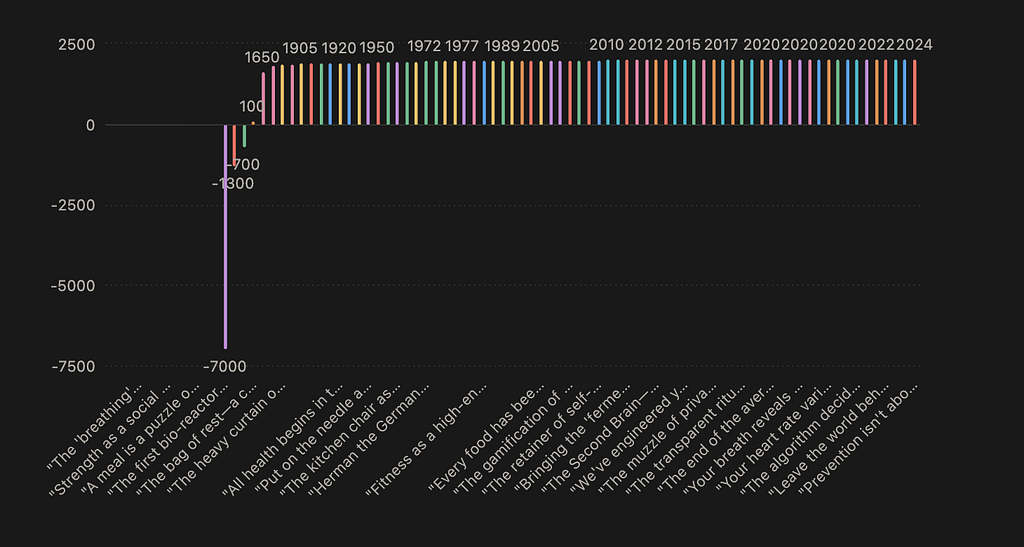
A 9,000-year vibe code analysis of 83 artifacts revealing the four cultural triggers that turn ancient traditions into billion-dollar “disruptions.
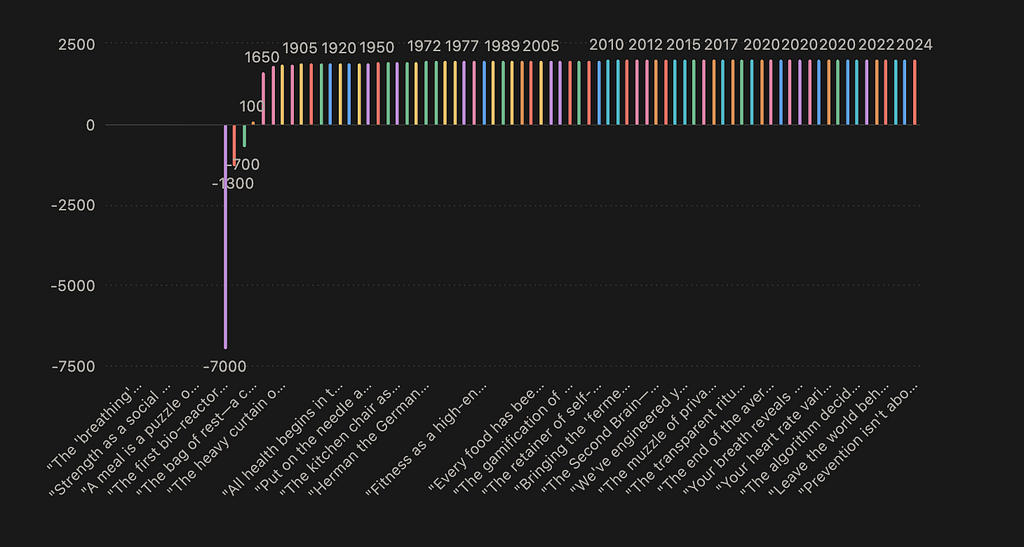
Collective amnesia
It took four weeks, five days, and seven hours to finish this research — and I’ve barely scratched the surface. As a Product Manager in healthcare, I was taught that “habit formation” was the holy grail. We ask: Can our product change people’s habits? But after analyzing 83 artifacts spanning from 7000 BC to 2024, I’ve realized habits are just the symptoms. The “Vibe” is the cause. We treat breakthroughs in fasting, sleep, and gut health as “disruptions.” They aren’t. They are translations of ancient practices rendered acceptable through contemporary measurement, automation, and a very specific kind of storytelling.
The methodology: vibe coding
Archaeologists read pottery shards to understand ancient civilizations — why this glaze, why this shape, why buried here? Vibe coding reads product design patterns to decode the invisible architecture of our moment.
I examined 83 artifacts across four domains (fasting, movement, sleep, gut health) spanning 9,000 years. Each artifact — from Neolithic globular fermentation jars (7000 BC) to Eight Sleep Pods (2019) — contains encoded information: What anxieties did it address? What authorities legitimized it? What previous solutions had failed? What I found wasn’t innovation. It was translation: the product is just the container for the story.
The pattern: four triggers, one cycle
Products don’t create trends; they arrive at the exact moment a convergence of triggers makes a practice culturally acceptable again. I identified four triggers that activate every preventive health resurgence:
- Crisis (Creates Urgency): A widespread problem makes the status quo unacceptable (e.g., 1970s obesity epidemic or 2020 pandemic isolation).
- Technology (Removes Barriers): New tools make a practice frictionless or measurable (e.g., smartphone apps or DNA sequencing cost collapse).
- Authority (Reframes Legitimacy): Scientific validation or aspirational figures reframe the practice (e.g., a Nobel Prize for autophagy).
- Disappointment (The Vacuum): The previous “innovation” (diet pills, gym memberships) fails.
Why timing matters more than quality
The Zeo Sleep Headband (2009) had better technology than the Oura Ring (2015) — clinical-grade EEG vs. optical sensors. It failed. Oura succeeded. Why? In 2009, only 1 trigger was present (Technology). By 2015, all 4 triggers aligned:
- Crisis: Burnout epidemic & “Sleep Recession.”
- Technology: Miniaturized sensors & smartphone ubiquity.
- Authority: Matthew Walker’s bestseller Why We Sleep.
- Disappointment: Ambien dependency & sleeping pill side effects.
The pattern: The Oura ring did not create the trend. It arrived when the culture was ready to tell itself a new story about an old practice.
Case study 1: fasting (the permission structure)

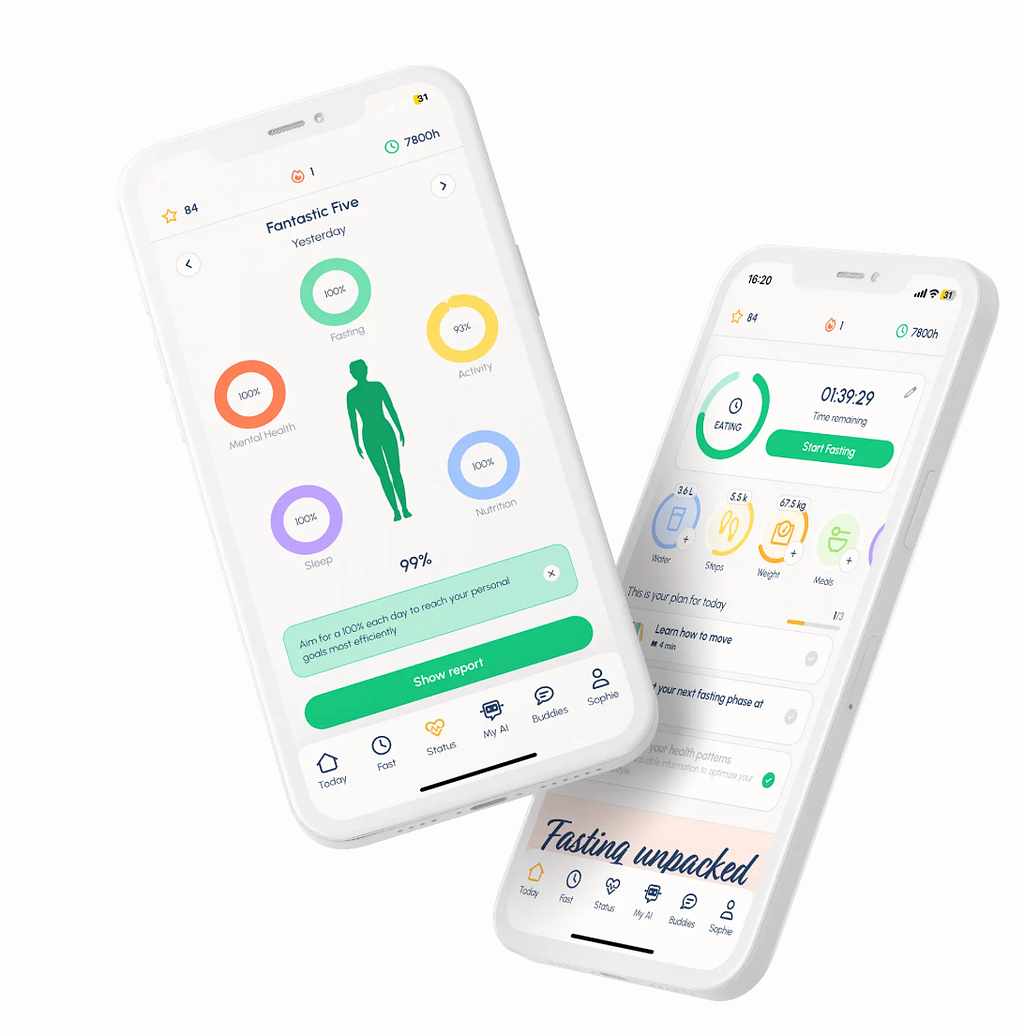
Ancient Reality: For millennia, humans practiced restricted eating through religious and cultural traditions: Buddhist monks (563 BC) eating before noon, Ramadan Iftar street traditions, and Christian Lent. These were discipline, devotion, and community practice — requiring no measurement beyond the setting sun or church bells.
The Medical Framing Era (1920–2016): Fasting moved into the clinic. The 1920s Austrian “Mayr Kur” and 1990s epilepsy protocols used fasting as a medical intervention. It was “unconventional” and something sick people did under supervision.
The 2016 Convergence: In 2016, the pattern activated when:
- Crisis: US obesity rates hit 39.8%; productivity culture demanded “biohacking.”
- Authority: Yoshinori Ohsumi won the Nobel Prize for autophagy.
- Technology: The Zero App (2016) made tracking windows a game; Lumen (2019) made metabolism a metric.
What actually changed?
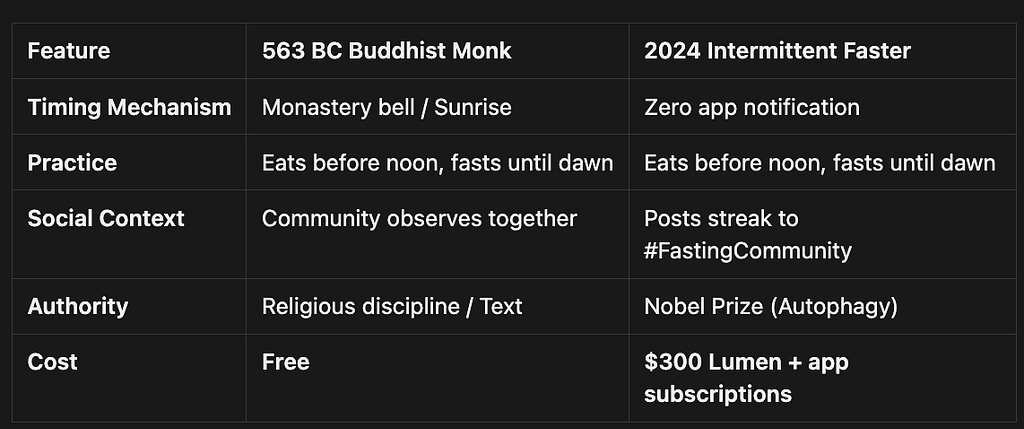
The Translation: The biology of a 2024 “Intermittent Faster” is identical to a 563 BC monk. What’s new is the Permission Structure. We replaced spiritual language (purification) with scientific language (autophagy). We replaced the sunset with an app notification from Zero or Lumen.
The fasting permission structure


The Current Turn: We are now at peak extraction. Measurement has created Orthofasting — anxiety about breaking windows perfectly. This is resulting in the rise of GLP-1 drugs (Ozempic). It is the logical endpoint: bottling the biological result (appetite suppression) while removing the practice (discipline) entirely.
The Translation Formula:
Ancient Practice + Modern Permission (Science/Tech) = Scalable Product.
Case study 2: movement (the social scaffolding)
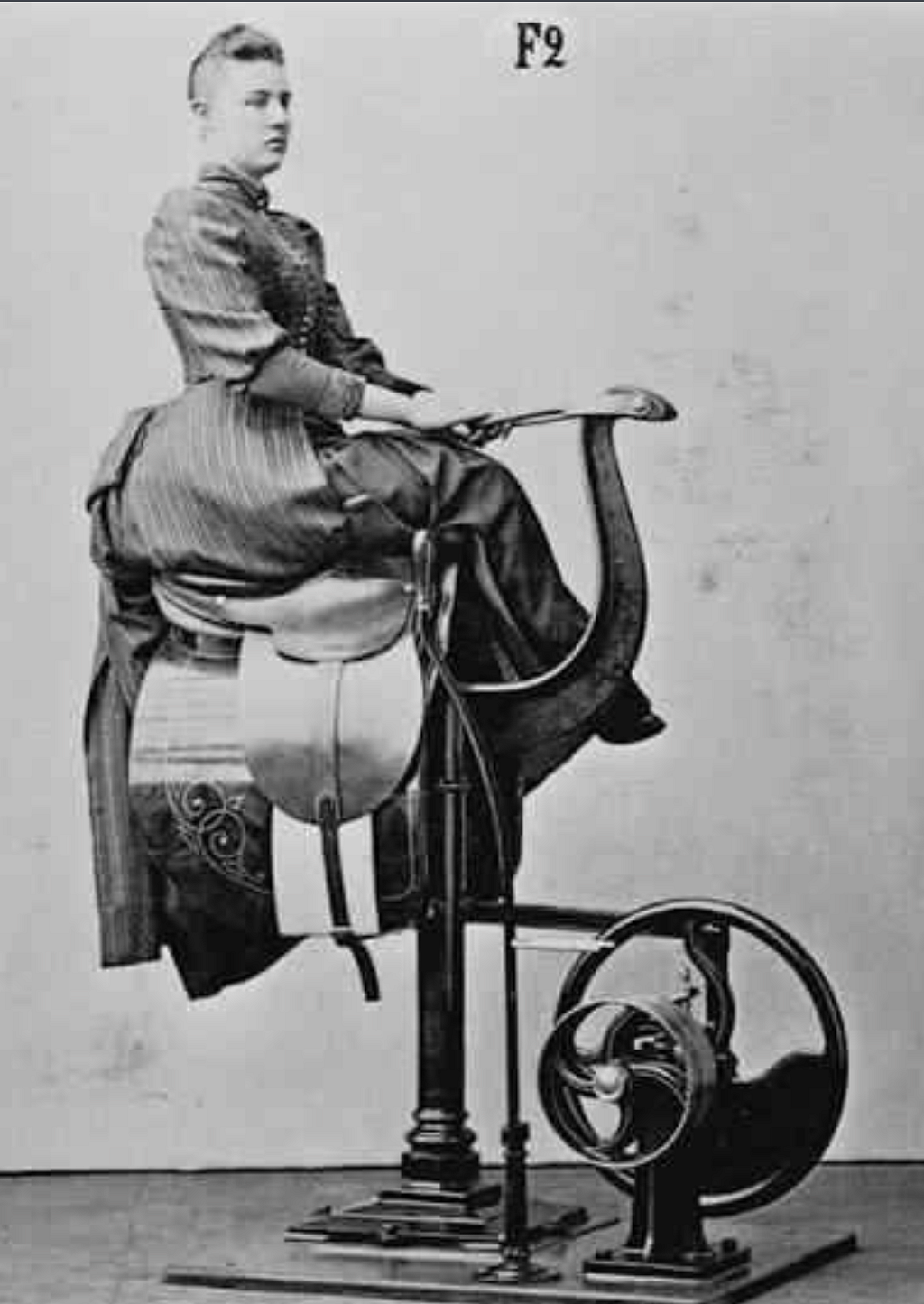
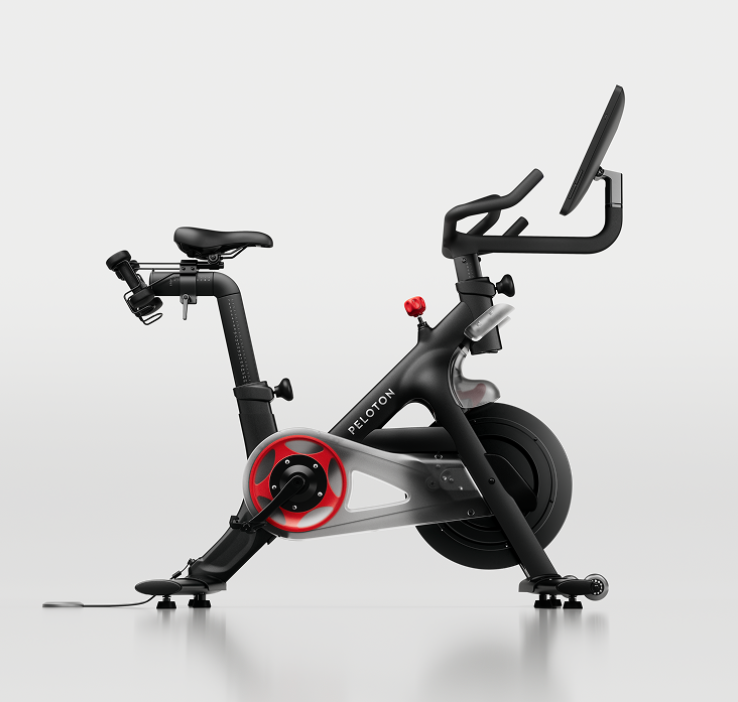
Ancient Reality: For most of human history, “exercise” didn’t exist. Greek Halteres (776 BC) were for Olympic training, but the average person moved to survive. Greek Halteres (776 BC) were for Olympic training, but the average person moved because they had to hunt, farm, or dance in the village square (Mahdale).
The Mechanization Era (1890s–1970s): Industrialization removed movement. The Zander Horse-Simulation Machine (1920s) and the Vibrating Belt (1960s) promised “passive gymnastics” where the machine would move for you. It failed because it ignored effort.
The 2012 Convergence: Peloton (2012) didn’t innovate the stationary bike; it innovated the Social Scaffolding. It rebuilt the village square in your living room.
- Crisis: “Gymtimidation” and the death of the 27-minute commute.
- Technology: Broadband enabled live streaming and leaderboards.
- Authority: Boutique fitness (SoulCycle) made “sweaty community” a status symbol.
The movement social scaffolding
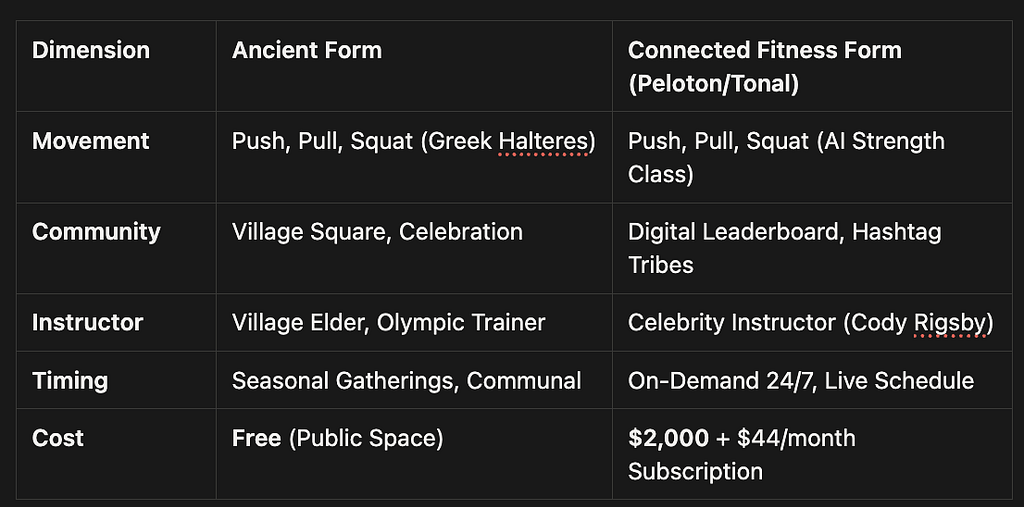
The Translation: We spent 50 years isolating movement from life (gyms), then 20 years trying to make isolated movement feel like life through gamification. Peloton succeeded because it rebuilt the village square in your living room, but at a premium price.
Study 3: sleep (the automation paradox


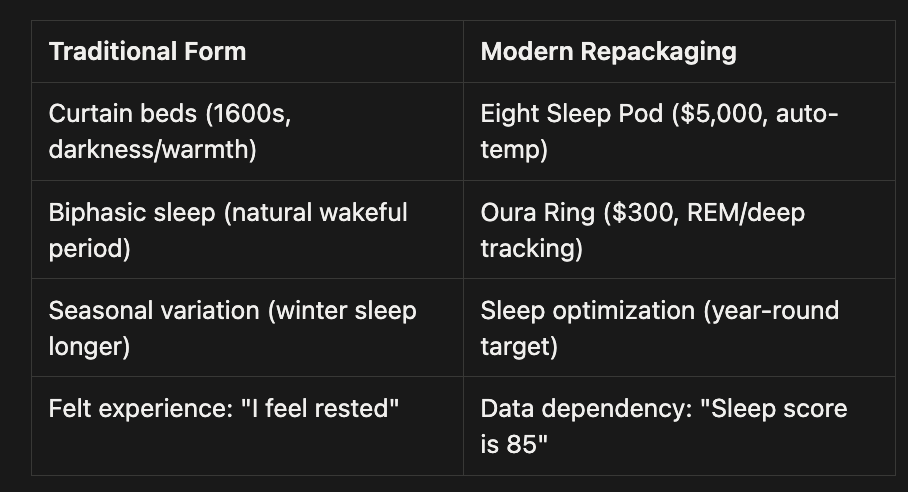
Ancient Reality: Pre-industrial sleep was biphasic (two segments per night). Humans practiced Biphasic Sleep (two segments per night) and used Curtain Beds (1600s) to create environmental control. You knew you slept well if you felt rested.
The Failed Pioneer: The Zeo Sleep Headband (2009) had the tech (EEG tracking) but failed because sleep wasn’t yet a “performance metric.”
The 2015 Convergence: Six years later, the Oura Ring and Eight Sleep turned rest into a “Readiness Score.”
- Crisis: A global burnout epidemic and “Sleep Recession.”
- Authority: Matthew Walker’s Why We Sleep (2017) made sleep a productivity tool.
- Technology: Miniaturized sensors turned rest into a “Readiness Score.”
The more we automate sleep, the less we actually sleep. Orthosomnia — clinical anxiety about sleep scores— now plagues users. Checking your Oura Ring data before bed provides the blue light and anxiety that destroys the sleep the ring was meant to track. We are the only species that needs a push notification to know we had a good night’s rest!
The sleep automation paradox
Case study 4: gut health (grandmother vs. the lab)
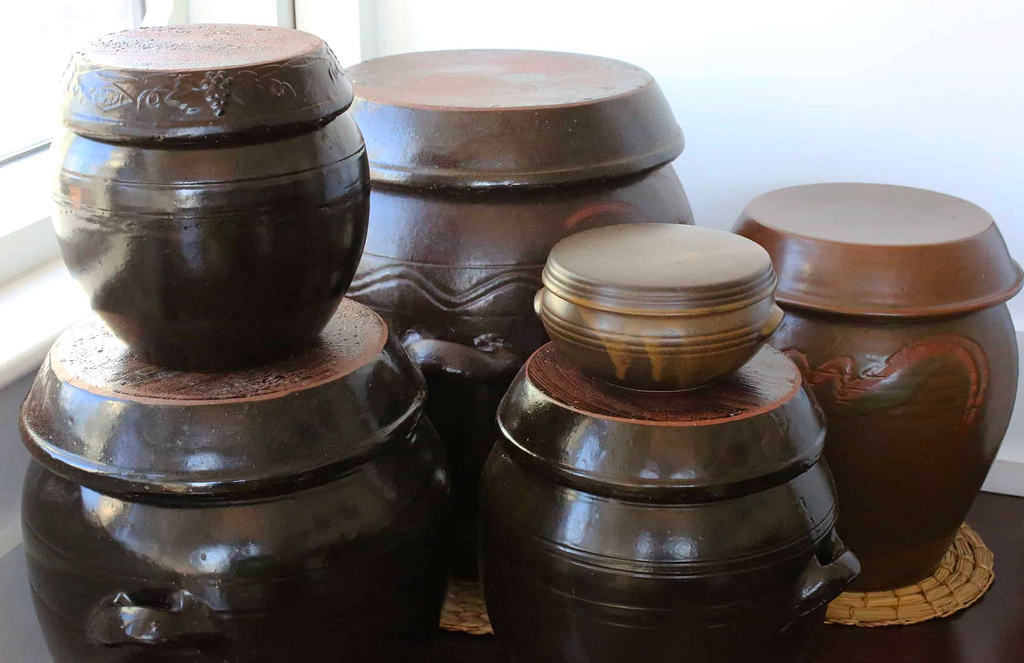

Ancient Reality: Fermentation is humanity’s oldest biotech. Korean Onggi (500 BC) were survival technologies. You fermented food because you had to eat in the winter. Knowledge was generational.
The 2010s Convergence: The “Probiotic Boom” turned “gross” fermented foods into a $5 billion market.
- Crisis: A mental health crisis reframed as a “gut-brain axis” issue.
- Technology: DNA sequencing costs collapsed, enabling consumer kits like Viome (2016).
- Disappointment: Traditional medicine struggled with IBS and autoimmune issues.
The Translation: We moved from “this is how we eat” to DNA sequencing kits like Viome (2016). After the uBiome fraud scandal (2019), the cycle is turning back to “Authentic” home fermentation. We are realizing that humans figured out fermentation 9,000 years ago without needing a 40-page algorithmic report.
The gut health translation

The time compression: why the cycle is speeding up
Notice the acceleration in these cycles. For thousands of years, these practices remained embedded in culture. Now, technology and capital move them through the “hype cycle” at breakneck speed:
- Fermentation: 9,000 years (Traditional) → 15 years (Quantified) → 3 years (Fatigue).
- Fasting: Millennia (Religious) → 4 years (App Adoption) → 2 years (Pharmaceutical Replacement).
The meta-lesson: what the industry gets wrong
- Measurement ≠ Innovation: Measurement often creates “score anxiety” rather than health.
- Automation ≠ Improvement: Automation removes the “essential challenge” of developing body awareness. When the algorithm decides everything, you lose the skill of deciding for yourself.
- Products ≠ Trends: Building a great product is useless if the cultural pattern isn’t ready. The product is just the container for the story the culture is finally ready to hear.
The cycle accelerates
Notice the time compression. Fermentation took 9,000 years to move from survival to science. Fasting took only four years to move from “hacker” app to a pharmaceutical injection (GLP-1s). We are approaching a pattern saturation point where cycles turn so fast that “new” products launch into immediate consumer skepticism.
The future: 2026–2035 predictions
Where is the “Vibe” moving next? Based on the pattern recognition from the last 83 artifacts, here is what I predict for the next decade of preventive health:
1. The current wave crashes (2026–2028)
We are approaching “Optimization Fatigue.” The resale market will soon flood with $2,000 bikes and $300 rings. Subscription resistance will peak — consumers will reject paying “rent” on their own health data. We will see the collapse of several “personalized nutrition” startups as users realize 40-page algorithmic reports rarely lead to actionable change.
2. The pharmaceutical end-game (2025–2032)
GLP-1 drugs (Ozempic) represent the Final Extraction. We have extracted the biological mechanism so thoroughly that we no longer need the practice of discipline. Expect this to follow in other domains:
- Sleep: Orexin antagonists replacing the need for “sleep hygiene.”
- Exercise: Myostatin inhibitors or “exercise mimetics” — pills that mimic the metabolic benefits of a workout without the sweat.
- The Backlash: By 2030, a counter-movement will emerge that views this pharmaceutical path as “synthetic living,” leading to a massive resurgence in the “Authentic” phase.
3. The resurgence of dismissed practices (2027–2035)
Whatever we currently consider “outdated” or “inefficient” is a candidate for rediscovery. Watch for:
- Biphasic Sleep: A return to the pre-industrial “midnight awakening” as a time for meditation or creativity.
- Communal Labor: Movement that serves a purpose. As gym culture fades, we will see “functional fitness” return to actual functions: community gardening, building, and manual repair.
- Seasonal Living: The ultimate status symbol will be eating only what is locally available and sleeping according to natural light cycles, rejecting the “optimized 72 degrees year-round” environment.
4. Pattern recognition becomes the product
As consumers become savvier (largely due to the “de-influencing” trend), they will stop buying “innovations.” Successful products in 2030 will explicitly market themselves as translations. They will say: “This is a 9,000-year-old jar, we just made it fit in your modern fridge.” Authenticity will replace “Biohacking” as the dominant marketing language.
Conclusion: The product as container for the story
The practices that keep humans healthy are ancient: Eat less sometimes. Move with your tribe. Rest with the sun. Consume beneficial bacteria.
As Product Managers, we aren’t discoverers; we are translators. We build containers for stories that convince each generation to do what has always worked. But the most valuable “innovation” for the next decade won’t be a better sensor. It will be the courage to recognize that some things don’t need innovation at all. They need:
- Time (lost to optimization culture)
- Community (lost to individualization)
- Trust (lost to data dependency)
The product was never the solution. The practice was.
The pattern is visible. The question is: Will we see it in time for the next cycle?
Reference Notes
Research Methodology
This analysis examined 83 artifacts across four domains:
- Time span: 7000 BC (Neolithic jars) → 2024 AD (Eight Sleep Pod)
- Geographic scope: Middle East, East Asia, Europe, Americas
- Artifact types: Physical objects (Onggi vessels), products (Peloton), practices (Ramadan), clinical interventions (Mayr Kur)
Vibe Coding Process:
- Artifact documentation: Cataloged launch year, cultural moment, design language, marketing claims
- Pattern recognition: Identified recurring triggers (Crisis, Technology, Authority, Disappointment)
- Trigger mapping: Analyzed which conditions were present when dormant practices resurged
Sources: Academic journals (PubMed, JSTOR), product archives (Product Hunt, Crunchbase), historical records (museum collections, ethnographic studies), contemporary media (TechCrunch, NYT health coverage).
Limitations: This is pattern analysis, not causal proof. Correlation ≠ causation. Future cycles may break this pattern.
Product Timeline: When Triggers Aligned

Scientific & Clinical Sources
Key Scientific Studies:
- 2016 Nobel Prize in Physiology or Medicine (Autophagy): Yoshinori Ohsumi’s research legitimized intermittent fasting in Western consciousness
- Gilman, N. V. (2017). Analysis for science librarians of the 2016 Nobel Prize in Physiology or Medicine: The life and work of Yoshinori Ohsumi. Science & Technology Libraries, 36(1), 1–19.
- Kirkin, V. (2020). History of the selective autophagy research: How did it begin and where does it stand today? Journal of Molecular Biology, 432(1), 3–27.
- McCarthy, M. (2016). Japanese cellular biologist wins Nobel prize for study of autophagy. BMJ, 355, i5374.
- 2007 Human Microbiome Project: NIH’s $170M investment mapping gut bacteria catalyzed the probiotic boom
- Human Microbiome Project Consortium. (2012). Structure, function and diversity of the healthy human microbiome. Nature, 486(7402), 207–214.
- Biphasic Sleep Research: Historical documentation of pre-industrial two-phase sleep patterns (1500s-1800s)
- Ekirch, A. R. (2005). At Day’s Close: Night in Times Past. W. W. Norton & Company.
- Boyce, N. (2023). Have we lost sleep? A reconsideration of segmented sleep in early modern England. Medical History, 67(2), 91–108.
- Gut-Brain Axis Research: Studies linking microbiome to depression, anxiety, and mental health (2013-present)
- Circadian Rhythm & Time-Restricted Eating:
- Panda, S. (2018). The Circadian Code: Lose Weight, Supercharge Your Energy, and Transform Your Health from Morning to Midnight. Rodale Books.
Clinical Recognition:
- Orthosomnia (2017): Clinical anxiety about sleep scores
- Jahrami, H., Trabelsi, K., Vitiello, M. V., & BaHammam, A. S. (2023). The tale of orthosomnia: I am so good at sleeping that I can do it with my eyes closed and my fitness tracker on me. Nature and Science of Sleep, 15, 13–15.
- CDC Sleep Data: 35% of adults sleep <7 hours; sleep recession of 44 minutes vs. 1942
- IHRSA Gym Statistics: 70% of gym memberships go unused
Books & Cultural Manifestos:
- Walker, M. (2017). Why We Sleep: Unlocking the Power of Sleep and Dreams. Scribner. [Bestseller that mainstreamed sleep optimization]
- Burroughs, S. (1976). The Master Cleanser. Burroughs Books. [Original lemonade diet detox manual]
- Metchnikoff, E. (1907). The Prolongation of Life: Optimistic Studies. G. P. Putnam’s Sons. [First probiotic manifesto by Nobel Prize winner]
- Petrini, C. (1989). Slow Food Manifesto. [Philosophy against industrialized food culture]
- Pasteur, L. (1857). Mémoire sur la fermentation appelée lactique. [The “Scientific Extraction” point for gut health]
Product Sources
Fasting & Nutrition:
- Zero App (2016): First mainstream intermittent fasting tracker, 10M+ downloads
- Lumen (2019): $300 breath-based metabolic analyzer measuring ketone levels
- ProLon Fasting Mimicking Diet (2016): $249 five-day meal kit
- Fastic (2019): AI-powered fasting coach with personalized eating windows
- MyFitnessPal (2005): Crowd-sourced food database and calorie tracking
Gut Health & Fermentation:
- uBiome (2012–2019): First direct-to-consumer microbiome test, $105M funding, shut down for insurance fraud following FBI raid
- Viome (2016): $199–399 RNA sequencing for “personalized” nutrition
- Pendulum (2019): $165/month engineered probiotics targeting glucose control
- GT’s Kombucha (1995, mainstream 2010s): From health food stores to $1.8B market
- Activia (1987, major campaign 2006): Dannon’s “Bifidus Regularis” branded probiotic yogurt
Exercise & Movement:
- Peloton (2012): $2,000 bike + $44/month subscription, connected fitness pioneer. Stock peaked at $162 (2021), crashed to $8 (2024), 95% decline
- Mirror (2018): $1,500 reflective workout screen. Acquired by Lululemon for $500M (2020), shut down (2023)
- Tonal (2018): $4,000 AI-powered electromagnetic resistance training system
- Wii Fit (2007): Nintendo’s gamified balance board fitness platform, 22.7M units sold
- Jane Fonda VHS Workout Tapes (1982): 17M tapes sold, pioneer of home aerobics
Sleep & Recovery:
- Oura Ring (2015): $300 + $5.99/month subscription, sleep staging and HRV tracking, 1M+ users, $2.55B valuation (2021)
- Eight Sleep Pod (2019): $2,500–5,000 AI-controlled temperature regulation mattress with dual-zone control
- Zeo Sleep Manager (2009–2013): Failed EEG headband pioneer with clinical-grade sleep stage tracking, shut down despite superior technology
- Hatch Restore (2020): $130 smart alarm clock with sunrise simulation and soundscapes
- Marpac Sleep-Mate (1962): Original white noise machine using actual rotating fan mechanism
Cultural & Historical Context
Ancient & Traditional Fasting Practices:
- Buddhist One Meal a Day (563 BC): Theravada monks eating before noon, fasting until sunrise
- Ramadan Iftar Street Traditions (7th century CE): Communal breaking of fast at sunset in Oran/Algeria and the Levant, signaled by cannon fire
- Christian Lent (4th century CE): 40-day modified fasting period with seasonal dishes
- Abiy Tsome (Ethiopian Orthodox): 55-day Great Lent with no food or drink until 3pm
- Okinawan Hara Hachi Bu: Traditional practice of eating until 80% full, embedded in cultural longevity
- Ukrainian Kutia (12th century): Twelve-dish Christmas Eve supper following daylong fast
- Lebanese Lenten Dishes: Bamieh bi-Zeit (okra in olive oil), Mujadara (lentils and rice)
Fermentation & Gut Health Traditions:
- Neolithic Globular Fermentation Jars (7000 BC, China): Earliest archaeological evidence of intentional fermentation vessels with wide-mouth oxygen access
- Korean Onggi Vessels (500 BC): Porous breathing ceramic specifically designed for kimchi fermentation and temperature regulation
- Lebanese Tannour Sourdough: Multi-generational starter cultures, some maintained continuously for 100+ years
- Caucasus Kefir Grains: Traditionally given as wedding gifts in the Caucasus region, cultural taboo against selling
- Soviet Milk Kitchens (1950s, Ukraine): State-mandated public health distribution of kefir to children and pregnant women
Movement & Exercise Traditions:
- Greek Halteres (776 BC): Stone jumping weights used in ancient Olympic long jump training (2–10 kg each)
- Lebanese Mhadaleh: 100kg village lifting stone; young men had to lift it to prove marriage readiness
- Lebanese Mahdale: Synchronized group stomping dance performed at celebrations, functional leg strength training
- Zander Medico-Mechanical Institute (1890s Stockholm): 70+ passive exercise machines promising “gymnastics without effort”
- Zander Horse-Simulation Machine (1920s): Mechanical device that moved pelvis while user remained seated
- Vibrating Belt Machines (1960s): Popularized by Jack LaLanne, promised “effortless” weight loss through external vibration
Sleep Traditions & Technologies:
- Biphasic Sleep (1500s-1800s Europe): Two distinct sleep periods separated by 1–2 hour wakeful period for prayer, reflection, or intimate conversation
- Ukrainian Kolyka Cradle: Hand-carved wooden cradle traditionally made by “happy man with many children,” stored in attics for multiple generations
- Egyptian Weres Headrest (1300 BC): Curved wooden or ceramic neck rest elevating head to ward off spirits and insects
- Curtain Beds (1850s): Heavy fabric enclosures creating room-within-room for privacy, warmth, and darkness control in shared sleeping spaces
- Laudanum (19th century): Opium-based tincture widely used as sleep aid before regulation
Additional Context
On Cultural Cycles & Fashion Theory:
The 20–30 year generational gap that creates “collective amnesia” where practices become rediscovered as “innovations”
On Measurement & Optimization Fatigue:
- Lupton, D. (2016). The Quantified Self. Polity Press. [Critical examination of how measurement changes relationship with our bodies]
- Petersen, A. H. (2020). Can’t Even: How Millennials Became the Burnout Generation. Houghton Mifflin Harcourt. [Context for Crisis triggers in sleep and movement apps]
On Returning to Traditional Practices:
- Berry, W. (2017). The World-Ending Fire: The Essential Wendell Berry. Counterpoint. [Essays on returning to manual and integrated living]
- Katz, S. E. (2012). The Art of Fermentation: An In-Depth Exploration of Essential Concepts and Processes from Around the World. Chelsea Green Publishing. [Definitive modern guide for DIY fermentation movement]
For Further Reading
[Full Artifact Database] — All 83 artifacts with complete vibe code analysis
[Comprehensive Case Studies] — Detailed chronological mapping and trigger analysis
[Vibe Code Methodology] — Deep dive into the pattern recognition process
Questions or spotted a pattern I missed? Drop a comment below. I’d love to hear what cycles you’re seeing in your own product work.
The preventive healthcare product cycle: how ancient practices become “innovations” every 20 years was originally published in UX Collective on Medium, where people are continuing the conversation by highlighting and responding to this story.