

Why Is AI Consulting On The Rise?
According to recent market research, the global AI consulting market is projected to grow at a 28.8% CAGR from 2024 to 2029, reflecting the rapid acceleration of enterprise AI adoption and the expanding role of consulting partners in digital transformation initiatives. AI consulting is now one of the fastest-growing service categories in the enterprise technology landscape, driven by pressure to operationalize generative AI, improve data maturity, and modernize legacy systems.
Many companies invest in AI consulting services with high expectations, but results vary widely depending on scope, readiness, and execution quality. In practice, the challenge is not access to AI expertise, but clarity on which services actually drive measurable business outcomes. AI consulting companies are increasingly positioning themselves as long-term transformation partners rather than project-based vendors. However, this shift has also made procurement more complex for enterprise buyers evaluating impact versus cost.
Understanding when to hire AI consultants has become a critical decision point for leadership teams. Early engagement without strategic focus can lead to fragmented pilots, while delayed adoption can result in missed competitive advantage. Within this landscape, AI strategy consulting plays a central role in defining priorities, identifying high-value use cases, and ensuring alignment between business objectives and technical execution.
Stick around as we break down the AI consulting services companies truly need and highlight what to avoid in order to prevent wasted investment and misaligned transformation efforts.
TL;DR
- AI consulting should focus on strategy, scalability, and business impact.
- Not all services deliver measurable value.
- Companies must prioritize outcome-driven consulting over technical experimentation.
- Choosing the right consulting partner significantly impacts ROI.
Want to stand out as an AI consulting partner?
eLearning Industry helps AI consulting firms, learning providers, and HR tech vendors showcase their services and build authority.
In This Guide, You Will Find…
What AI Consulting Actually Means Today
AI consulting has shifted from a narrow technology service into a core driver of enterprise transformation. As organizations move from experimentation into large-scale adoption, the focus is no longer on isolated models or pilots, but on how AI reshapes decision-making, operations, and long-term competitiveness. At its core, AI consulting includes a structured set of capabilities that connect strategy with execution and ensure measurable business outcomes:
Defining where AI creates real business value, prioritizing investment areas, and aligning initiatives with enterprise goals. This includes assessing organizational readiness, identifying constraints, and ensuring leadership alignment before any technical work begins.
Mapping AI opportunities across business functions such as operations, customer service, finance, and supply chain. The goal is to identify high-impact use cases that are feasible, scalable, and tied to clear performance metrics rather than experimental ideas with limited ROI potential.
Establishing how people, data, governance, and technology interact to support AI adoption. This often involves redesigning workflows, defining ownership structures, and building cross-functional collaboration models that allow AI to function across departments.
Translating plans into working systems through integration with existing infrastructure, process redesign, and deployment planning. This stage often determines success or failure, which is why AI implementation consulting is frequently used to bridge the gap between AI strategy and production environments.
Expanding AI solutions beyond initial pilots into enterprise-wide systems. This includes monitoring model performance, managing data drift, refining outputs, and continuously improving system alignment with evolving business needs.
When Companies Actually Need AI Consulting
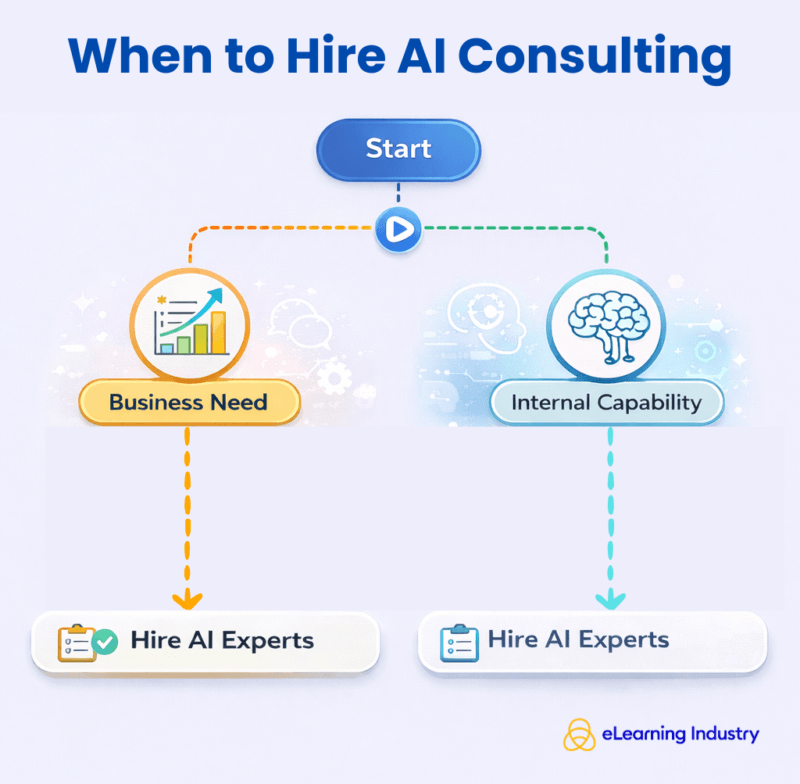
Companies reach a point where internal teams can no longer drive AI initiatives forward with the clarity, speed, or structure required for enterprise-scale outcomes. At this stage, external support becomes less about experimentation and more about making correct decisions on scope, sequencing, and business impact while reducing the risk of fragmented investments across departments.
Companies typically benefit from structured support such as an AI consulting services list when dealing with complex transformation decisions that require clarity on feasibility, prioritization, and measurable outcomes across business and technology functions.
-
Entering AI Adoption For The First Time
Organizations at the beginning of their AI journey often lack benchmarks, internal frameworks, and technical direction. AI consulting helps define foundational direction, identify realistic use cases, assess readiness, and ensure early investments are aligned with long-term scalability rather than isolated experiments.
-
Scaling AI Across The Organization
Once early pilots show value, many companies struggle to expand beyond isolated use cases. External support helps standardize workflows, unify data systems, establish governance structures, and ensure consistent deployment across teams without creating duplication or operational silos.
-
Lacking Internal Expertise
Many enterprises do not have in-house specialists covering data engineering, model deployment, governance, and change management at the same time. In these cases, AI advisory services provide structured expertise that fills capability gaps, supports execution oversight, and strengthens delivery confidence across complex initiatives.
-
Aligning AI With Business Goals
Misalignment between leadership priorities and technical execution is one of the most common causes of underperforming initiatives. A clear AI business strategy ensures that every initiative is tied to revenue impact, efficiency improvements, or cost optimization rather than disconnected innovation efforts.
-
Moving From Experimentation To Operational Deployment
Many organizations successfully run pilots but fail to operationalize them at scale. AI consulting helps bridge this gap by defining deployment standards, integrating systems into existing workflows, and ensuring models perform reliably in real business environments.
-
Managing Risk, Compliance, And Governance Requirements
As AI adoption increases, so do concerns around data privacy, regulatory compliance, and model transparency. Structured AI consulting services help organizations establish governance frameworks, reduce operational risk, and ensure responsible deployment across all use cases.
AI Consulting Services That Actually Deliver Value
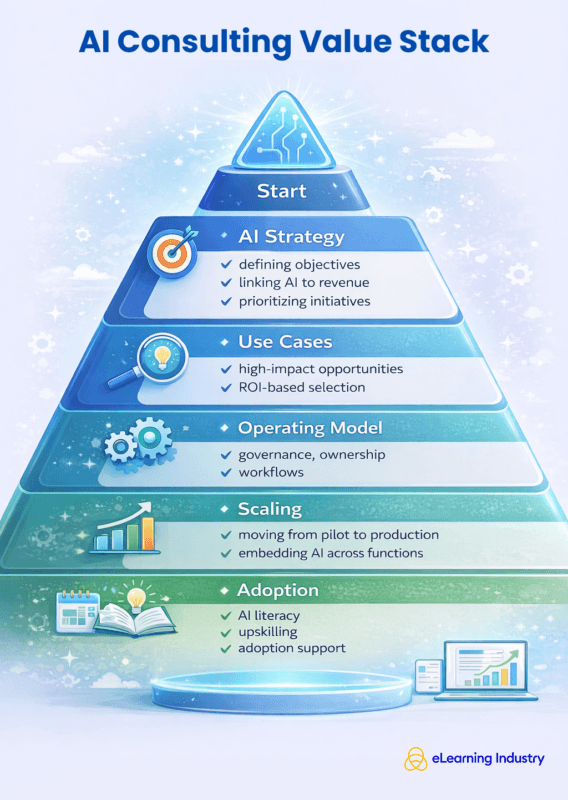
1. AI Strategy And Business Alignment
- Defining objectives across business units, transformation priorities, and operational targets with measurable outcomes.
- Linking AI initiatives directly to revenue growth, cost optimization, and efficiency improvements across functions.
- Prioritizing initiatives based on feasibility, data readiness, and expected business impact rather than technical novelty.
- Aligning investments with a clear corporate AI strategy to ensure consistency across departments and avoid fragmented execution paths.
2. Use Case Identification And Prioritization
- Identifying high-impact opportunities across operations, customer experience, finance, and supply chain environments.
- Evaluating feasibility based on data availability, system maturity, and integration complexity across enterprise platforms.
- Prioritizing use cases using ROI potential, implementation effort, and scalability considerations for long-term value creation.
- Filtering out low-value experimentation that does not align with enterprise goals or cannot be operationalized effectively.
3. AI Operating Model Design
- Defining governance structures for decision-making, model oversight, and cross-functional coordination.
- Establishing clear ownership across business units, technical teams, and data stakeholders.
- Redesigning workflows to ensure AI outputs are embedded into day-to-day operational processes.
- Creating accountability frameworks that support consistent execution and long-term system reliability.
4. Scaling And Integration
- Moving AI initiatives from pilot environments into fully operational production systems.
- Embedding AI capabilities across departments, business units, and global operational structures.
- Integrating models with legacy infrastructure, cloud platforms, and enterprise software ecosystems.
- Ensuring performance stability, monitoring systems, and continuous improvement during large-scale rollout.
5. Workforce Enablement And Training
- Building AI literacy across leadership teams, operational staff, and technical specialists.
- Developing structured upskilling programs tailored to role-specific responsibilities and use cases.
- Supporting organizational change management to improve adoption rates and reduce resistance to new systems.
- Strengthening internal AI skills to reduce reliance on external providers and improve long-term capability building.
6. Data Foundation And Infrastructure Readiness
- Assessing data quality, governance maturity, and accessibility across fragmented enterprise systems.
- Building scalable data pipelines that support real-time and batch AI workloads.
- Improving interoperability between siloed databases and legacy infrastructure environments.
- Preparing infrastructure for scalable enterprise AI consulting implementations across multiple business units.
7. Governance, Risk, And Compliance Frameworks
- Establishing policies for responsible AI usage, monitoring, and lifecycle management across systems.
- Ensuring compliance with evolving data privacy regulations and industry-specific requirements.
- Monitoring model drift, bias risks, and explainability standards across deployed solutions.
- Aligning governance frameworks with enterprise risk management practices supported by leading AI consulting firms.
8. Performance Measurement And Continuous Optimization
- Defining KPIs that measure business impact rather than just technical model performance.
- Implementing feedback loops to continuously refine models based on real-world outcomes.
- Tracking adoption rates, process efficiency gains, and cost reductions across departments.
- Ensuring ongoing optimization aligns AI systems with evolving AI advisory services expectations across enterprise environments.
Services That Often Fail To Deliver ROI
This approach focuses on tools, platforms, or vendor ecosystems instead of solving business problems. The result is often a stack of disconnected technologies that look advanced but do not translate into measurable outcomes. In many cases, it shifts attention away from value creation and reduces AI consulting effectiveness by prioritizing technology selection over business impact and execution clarity.
-
Experimental Projects Without Scaling Plans
Many organizations invest in pilots that demonstrate potential but never include a clear roadmap to production. Without scaling architecture, governance planning, or operational integration, these initiatives remain isolated experiments. They consume time and budget without delivering enterprise value, leading to stalled programs that never evolve into business-critical systems.
-
Overly Technical, Business-Detached Solutions
Some consulting efforts focus heavily on model accuracy or technical sophistication while ignoring operational relevance. When outputs are not tied to revenue, cost reduction, or efficiency metrics, adoption becomes difficult. This disconnect between technical teams and business leaders often results in solutions that are impressive in theory but underused in practice.
-
One-Off Engagements Without Long-Term Strategy
Short-term projects that end at delivery create significant gaps in continuity. Without monitoring, optimization, or lifecycle ownership, AI systems degrade over time. This lack of sustained engagement limits long-term value creation and weakens the effectiveness of AI strategy consulting initiatives across the organization.
-
Misaligned Stakeholder Priorities
When leadership, IT, and operational teams operate with different expectations, execution becomes fragmented. There is often no shared definition of success or accountability structure. This misalignment reduces coordination and weakens the impact of AI investments, leading to duplicated efforts and inconsistent outcomes across departments.
-
Poor Data Readiness Assumptions
Many projects assume data is ready for use without proper validation or governance checks. In reality, fragmented systems and inconsistent data quality create major barriers to deployment. These issues often surface late in the process, causing delays, increased costs, and reduced model reliability.
-
Lack Of Measurable Success Metrics
Without clearly defined KPIs tied to business outcomes, it becomes difficult to evaluate whether an initiative is successful. Projects are often judged on delivery milestones rather than real impact. This weakens accountability and makes it harder to justify continued investment or scale successful solutions.
How To Evaluate An AI Consulting Partner
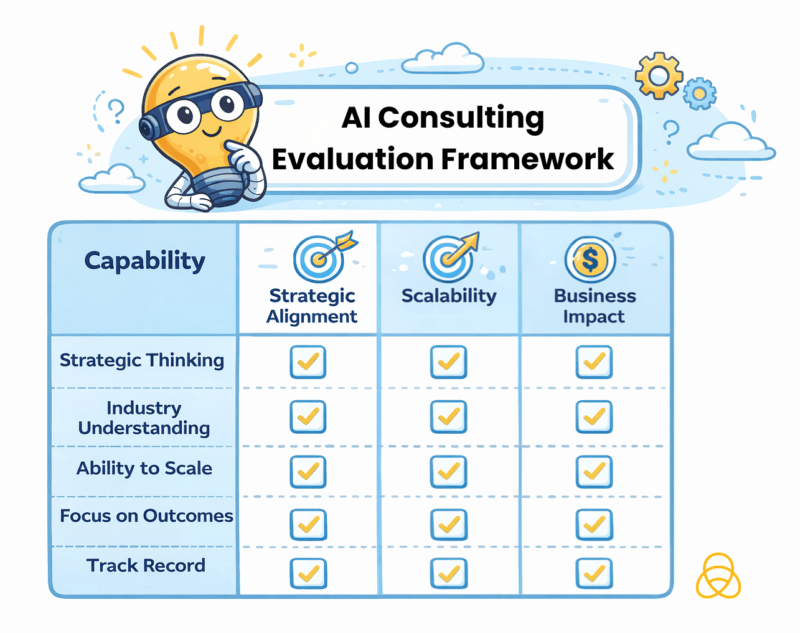
1. Strategic Thinking
A strong partner should demonstrate the ability to connect AI initiatives directly to business priorities rather than focusing on isolated technical deliverables. This includes clarity on how decisions are made, how initiatives are prioritized, and how value is measured across different stages of adoption. Strategic thinking also ensures that projects remain aligned with long-term transformation goals instead of short-term experimentation. This is often a key signal of maturity in AI consulting services.
2. Industry Understanding
Effective consulting partners understand the operational realities of the industries they serve. This includes knowledge of regulatory constraints, competitive dynamics, and typical data environments. Without this context, even technically strong solutions can fail during implementation. Industry awareness ensures recommendations are practical, relevant, and easier to integrate into existing business structures.
3. Ability To Scale
Many initiatives succeed at pilot level but fail when expanded. A reliable partner must show clear capability in scaling solutions across departments, regions, and systems. This includes architecture design, infrastructure planning, and governance models that support long-term growth. Scalability is one of the most important indicators of execution readiness.
4. Focus On Outcomes
A credible consulting partner prioritizes measurable business impact over technical complexity. Every recommendation should be tied to outcomes such as cost reduction, revenue growth, or efficiency improvements. This outcome orientation is also central to understanding when to hire AI consultants, especially in high-investment transformation programs where accountability matters.
5. Track Record And Proven Delivery
Past performance is one of the strongest indicators of future success. Evaluating case studies, industry references, and measurable results helps validate capability. A consistent track record of delivering value across multiple environments signals reliability and execution discipline.
6. Alignment With Enterprise Vision
A strong partner should operate within the context of a broader enterprise AI strategy, ensuring that individual projects contribute to a unified transformation roadmap. Without this alignment, organizations risk fragmented initiatives that fail to scale or deliver sustained impact.
The Shift From Consulting To Strategic Partnership
-
Companies Moving From Vendor Relationships To Strategic Partnerships
Organizations are no longer looking for short-term delivery providers. They expect ongoing involvement in decision-making, execution support, and long-term value creation across the entire AI lifecycle.
-
Long-Term Collaboration Replacing Project-Based Engagement
Modern engagements extend beyond initial implementation. Partners are expected to stay involved through scaling, optimization, and continuous improvement rather than exiting after deployment.
-
Continuous Optimization As A Core Requirement
AI systems require ongoing tuning, monitoring, and refinement. This has shifted expectations toward partners who can support iterative performance improvements over time.
-
Integration Into Core Business Strategy And Operations
AI is increasingly embedded into enterprise workflows, requiring partners who understand business context and operational complexity rather than isolated technical delivery.
-
Shared Accountability For Outcomes And Performance
Engagements are becoming outcome-driven, where success is measured by business impact rather than delivery milestones or technical completion.
-
Greater Emphasis On Cross-Functional Alignment
Partners are expected to work across leadership, IT, and operational teams to ensure consistent execution and reduce fragmentation across initiatives.
-
Expansion Of Scope Beyond Traditional Advisory Work
The role of AI consulting firms is evolving into continuous strategic involvement, supporting everything from planning to deployment and optimization.
-
Rise Of Embedded Delivery Models In Enterprise Environments
Through AI transformation consulting, external experts are increasingly embedded within internal teams to accelerate execution and improve decision quality.
-
Increasing Demand From Companies That Use AI At Scale
As more companies that use AI move into production-level deployment, the need for long-term strategic partners continues to grow.
What This Means For AI Consulting Firms
The shift in enterprise demand is reshaping how AI consulting is positioned and delivered. Clients are no longer evaluating providers based on technical capability alone. They are assessing whether engagement leads to measurable business outcomes, clear accountability, and sustained value creation. In this environment, AI consulting providers that fail to connect their work to business impact risk being deprioritized in procurement decisions, even if their technical expertise is strong.
At the same time, buyers are placing greater emphasis on transparency and communication. Complex solutions that are difficult to interpret or justify are losing relevance compared to approaches that clearly explain impact, trade-offs, and expected ROI. This is where AI advisory services are becoming more influential, as organizations seek guidance that is both strategic and actionable rather than purely technical or implementation focused.
The competitive landscape is also being shaped by broader workforce and capability shifts. As AI skills gap trends continue to widen across industries, consulting firms are expected to do more than deliver solutions. They must help organizations build internal understanding, improve decision-making maturity, and support long-term capability development. Firms that position themselves around outcomes, clarity, and authority rather than tool-based delivery are better aligned with how enterprise buyers now evaluate strategic partners and allocate investment.
The Role Of Visibility In Winning AI Consulting Clients
In today’s market, most enterprise buyers do not engage with providers immediately. They research extensively before making contact, comparing credibility, positioning, and perceived expertise across multiple touchpoints. For AI consulting companies, this means that visibility is no longer a secondary marketing outcome. It is often the first filter that determines whether a firm is even considered for evaluation. If a company is not present in the right discovery environments, it is effectively excluded before the sales process begins.
Trust is also formed long before any direct conversation takes place. Decision-makers rely on content authority, third-party validation, and consistent presence across trusted platforms to assess legitimacy. This early-stage perception plays a critical role in shaping shortlist decisions. Visibility, therefore, directly influences whether a firm is perceived as a serious contender or overlooked in favor of more established names in the market.
This is where structured industry platforms become essential. Being featured in a curated PPC directory helps AI consulting providers increase discovery among high-intent buyers actively comparing solutions. Platforms like eLearning Industry strengthen authority signals, improve visibility across relevant search journeys, and reduce friction in early-stage evaluation. In practice, this level of exposure shortens sales cycles because buyers arrive with higher trust, clearer understanding, and stronger intent before the first conversation even begins.
Key Takeaway
AI consulting continues to expand as enterprises accelerate digital transformation and move AI from experimentation to execution. However, success is increasingly defined by structure, not adoption alone. Organizations that lack clarity on priorities, sequencing, and measurable outcomes often struggle to turn investment into impact. A critical factor in this shift is the need for an AI strategy roadmap that connects business objectives with scalable implementation. Without it, initiatives tend to remain fragmented, leading to inconsistent results across departments and limited long-term value creation.
At the operational level, success also depends on how effectively organizations redesign AI workflows to support integration across systems and teams. When workflows are properly structured, AI becomes embedded into daily operations rather than functioning as a standalone capability. This improves consistency, efficiency, and the ability to scale across the enterprise.
As demand for AI consulting grows, companies are increasingly selective about who they trust to guide their strategy and transformation. eLearning Industry helps AI consulting companies, learning providers, and HR tech vendors showcase their services, build authority, and connect with decision-makers actively seeking AI expertise.
AI consulting focuses on helping organizations align AI initiatives with business goals, ensuring scalability, integration, and measurable impact rather than just technical implementation.
Demand is rising because companies need guidance to move from experimentation to real-world deployment and to avoid costly missteps in AI investments.
Companies should seek AI consulting when they lack internal expertise, need to identify high-impact use cases, or want to scale AI across operations effectively.
High-value services include AI strategy development, use case prioritization, operating model design, integration planning, and workforce training.
Low-value efforts include tool-focused consulting, isolated experiments without scaling plans, overly technical solutions disconnected from business needs, and one-off engagements.