

Everyone Uses AI, But How Many Companies Have A Strategy?
According to a McKinsey global survey, more than half of enterprises have increased investment in AI over the past year, yet only a fraction report measurable enterprise-wide impact. The difference comes down to structure. An AI strategy framework is what separates scattered pilots from scalable transformation. Most organizations still treat AI as a set of isolated use cases rather than a coordinated system, and this is where execution slows down. An effective AI strategy model brings clarity to priorities, governance, and value creation across teams.
Once the foundation is defined, organizations need a practical direction for execution. This is where an AI strategy roadmap becomes essential. It connects business priorities with operational initiatives and ensures teams are not working in isolation. Without it, even strong ideas tend to lose momentum during implementation. Leaders often underestimate how quickly alignment breaks when data, governance, and ownership are not clearly defined. A roadmap provides sequencing, helping organizations decide what to build first, what to scale next, and where to pause before expanding further.
Turning strategy into execution requires discipline and consistency. The steps to implement AI strategy should focus on aligning leadership, defining ownership, and establishing measurable outcomes across business units. Many organizations fail at this stage because they jump straight into deployment without preparing the operating model. A structured approach ensures that experimentation leads to repeatable impact rather than disconnected results. This article breaks down how to move from planning to execution in a way that supports long-term scalability and business value creation.
TL;DR
- AI success requires a structured framework, not isolated initiatives.
- A strong AI strategy aligns technology with business outcomes.
- The most effective frameworks include strategy, governance, use cases, and scaling.
- Companies that follow a structured model scale AI faster and achieve higher ROI.
Are you ready to position your AI strategy as a market advantage?
eLearning Industry helps learning and HR tech companies showcase their AI strategy, share insights, and connect with decision-makers.
In This Guide, You Will Find…
Why Companies Need An AI Strategy Framework
Companies are putting more budget, time, and attention into AI than ever before. It shows up in marketing, operations, customer service, and product development. Still, the results are uneven. Many companies who use AI today are not seeing the kind of impact they expected. In most cases, the issue is not access to tools or talent. It is the way efforts are organized and applied across the business.
The main challenge is alignment. Different teams often run their own AI initiatives without a shared direction. One team focuses on automation, another on analytics, and another on customer experience, but they rarely connect the dots. This creates duplication, confusion, and slow progress. An AI strategy framework helps solve this by giving structure to how AI is planned and used across the organization. It creates a clear link between business goals and day-to-day execution, so efforts do not stay isolated.
An AI adoption model for companies gives teams a simple way to move from ideas to real outcomes. It helps define who owns what, how success is measured, and how progress is tracked. Instead of chasing random use cases, companies can focus on building a steady path forward. When this structure is in place, AI becomes easier to manage and scale. It also helps teams stay focused on outcomes instead of getting stuck in experimentation without direction.
What Defines A High-Performing AI Strategy Framework
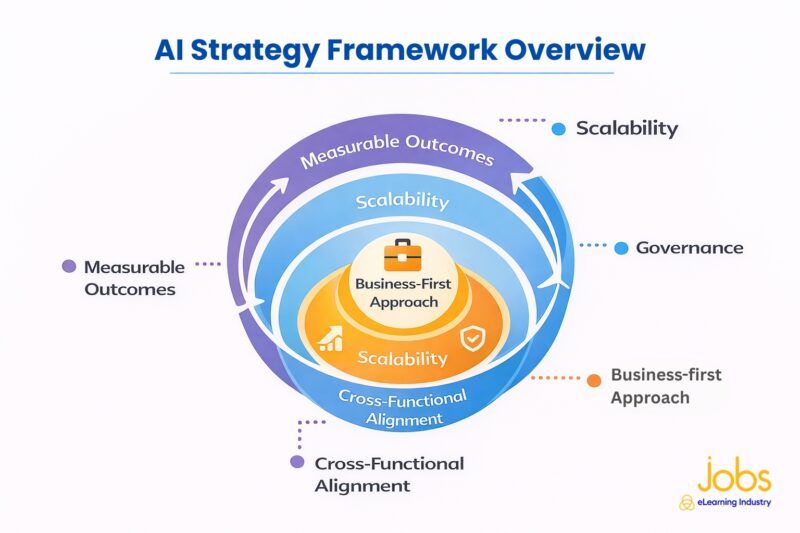
A high-performing AI strategy is not about how many tools a company adopts, but how well everything is structured and aligned. Many organizations increase AI investments but still struggle to turn them into consistent business value. The difference usually comes down to strategy and execution. When looking at how to build your AI strategy, a few core principles define whether an approach will actually work in practice.
Every initiative should start with a real business problem. Instead of focusing on technology first, teams should focus on outcomes like improving efficiency, reducing costs, or improving customer experience. This keeps AI grounded in value rather than experimentation for its own sake.
A strong system should work beyond a single use case. If something works in one department, it should be able to expand across other teams without requiring a complete rebuild. Scalability also means planning for growth early, not after success is already achieved.
Clear ownership is essential. Teams need to know who is responsible for data, models, and decision-making. Without governance, efforts become inconsistent, and trust in outputs starts to drop. Strong governance also helps manage risk as AI use expands.
-
Cross-Functional Alignment
AI cannot live in isolation. Business teams, technical teams, and leadership all need to work together. When alignment is missing, projects move in different directions and lose momentum. Shared priorities help keep execution consistent across the organization.
Success should always be defined in clear terms. Whether it is revenue growth, cost savings, or operational speed, every initiative should connect back to a metric. Without measurable outcomes, it becomes difficult to know what is actually working and what needs to change.
A Proven 5-Layer Model
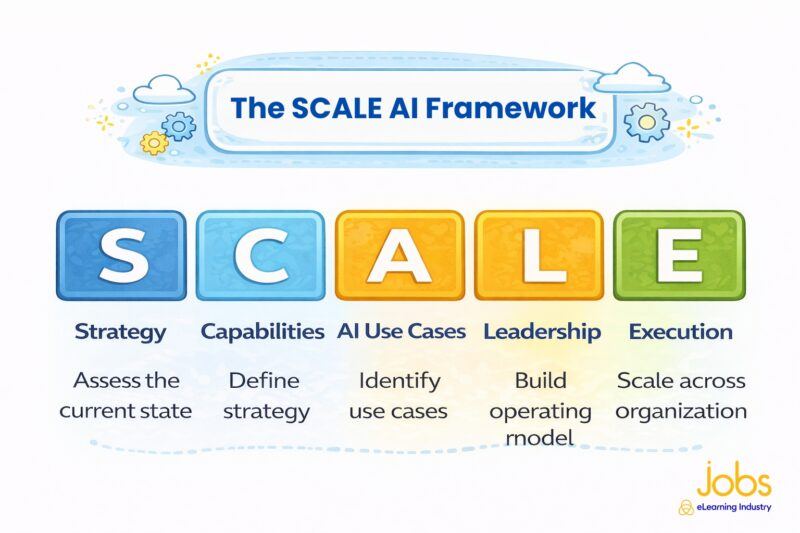
S — Strategy & Business Alignment
- Define clear business objectives.
- Link AI directly to revenue, cost, or growth outcomes.
- Prioritize initiatives based on business impact.
This is the starting point of the entire AI strategy framework. Without clear direction, your AI strategy becomes scattered and reactive. You first need to decide what you actually want AI to improve. It could be revenue growth, lower operational cost, or better customer experience. The key is clarity. Once objectives are defined, AI efforts must connect directly to them. This avoids random experimentation that does not lead anywhere. Also, Prioritization plays a big role here. Not every idea should move forward, only the ones that support core business goals.
C — Capabilities & Data Infrastructure
- Assess data quality and accessibility.
- Align technology stack with business needs.
- Ensure tools and systems work together.
This layer is about readiness. Many initiatives fail because the foundation is weak. Data needs to be clean, structured, and easy to access across teams. If information is scattered or inconsistent, AI outputs will not be reliable. The technology stack also matters, but more is not always better. The focus should be on systems that integrate well instead of creating complexity. When tools and platforms work together smoothly, it becomes easier to scale future initiatives without constant restructuring. This is a core part of an AI transformation framework because it determines whether AI can move beyond pilots.
A — AI Use Cases & Prioritization
- Identify high-impact business opportunities
- Evaluate ROI and execution feasibility
- Focus resources on scalable initiatives
This stage turns ideas into focus. Most organizations generate more AI ideas than they can realistically execute. The goal here is to filter and prioritize. Each use case should be checked for its business value and how realistic it is to implement. High-impact and achievable ideas should move forward first. This helps avoid spreading resources too thin and ensures teams are working on initiatives that can actually deliver measurable results.
L — Leadership, Governance & Operating Model
- Define ownership for AI initiatives
- Establish governance and compliance rules
- Align cross-functional teams and processes
This layer sets the rules of execution. Without ownership, projects lose direction quickly. Every initiative needs someone responsible for outcomes. Governance ensures that data use, model deployment, and decision-making follow consistent standards. This reduces risk and improves trust in the system. Cross-functional alignment is also critical because AI touches multiple parts of the business. When teams work together under a shared structure, execution becomes more stable and predictable.
E — Execution & Scaling
- Move from pilot to production in stages
- Continuously improve performance and outputs
- Drive adoption across teams and functions
This is where strategy turns into real impact. Projects start small through pilots, where results are tested in controlled environments. Once validated, they move into full production and are used across the organization. Continuous improvement is important because systems need to evolve based on real usage. Scaling also depends on adoption. If only one team uses AI, value stays limited. When multiple teams adopt it, impact grows across the business and creates long-term momentum. This is where a true AI scaling strategy becomes visible, turning isolated wins into enterprise-wide execution, including areas like AI adoption in L&D where learning systems can expand impact across teams.
How To Apply The AI Strategy Framework In Practice
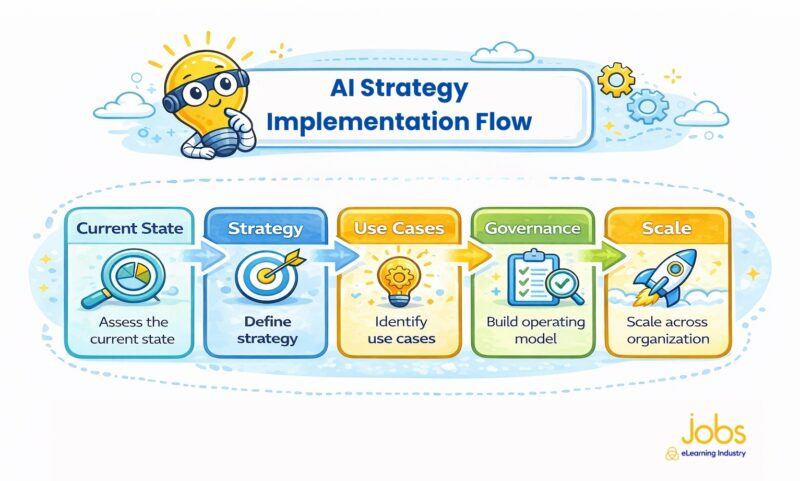
Start by understanding where the organization stands today. This includes reviewing data maturity, existing tools, team capabilities, and how AI is currently being used across departments. Many companies discover that they already have AI in place, but it is scattered and inconsistent. This step is not about fixing everything at once. It is about getting a clear picture of your strengths, gaps, and duplication. Without this baseline, any attempt to move forward becomes guesswork. It also helps leadership see whether the organization is ready to support more advanced initiatives or if foundational work is still needed.
Once the current state is clear, the next step is setting direction. This is where business goals are translated into an actionable AI plan. A strong enterprise AI strategy framework ensures that AI is tied directly to measurable outcomes like revenue growth, cost efficiency, or improved customer experience. At this stage, you set priorities so teams know what matters most. Instead of chasing multiple ideas at once, you shift your focus to creating business impact.
After you define your strategy, move your focus to execution. This step involves identifying practical use cases that can deliver value quickly. Evaluate each use case based on business impact, feasibility, and scalability. Not every idea is worth pursuing, so prioritization is essential. This is where your organization moves from planning to action. A strong corporate AI strategy ensures that use cases are not isolated experiments but connected to broader business goals.
This step defines how AI will actually work inside the organization. It includes ownership, governance, workflows, and collaboration between teams. It’s important to foster an environment with clear accountability so that initiatives do not lose direction. This is also where your should set decision-making structures, ensuring consistency across projects. At the end of the day, a well-defined model should reduce confusion and help teams execute faster with fewer blockers.
-
Scale Across Organization
This is where AI moves from isolated projects to enterprise-wide impact. So, expand successful pilots across teams, departments, and regions. Refine systems based on real usage, and try to continuously improve your performance. This is one of the most critical steps to implement AI strategy because it determines whether AI creates long-term value or remains limited to small experiments.
Common Mistakes Companies Make When Building Their Strategy
One of the most common mistakes is starting with technology instead of business needs. Companies often rush to adopt platforms, models, or vendors without first defining what problem they are trying to solve. This creates complexity without clarity. An effective AI framework should always start with outcomes, not tools. When the focus is too technical, teams end up optimizing systems that do not actually move business performance forward. This leads to wasted investment and low adoption across the organization.
Many organizations treat AI as a separate initiative instead of linking it to core objectives. When AI is not tied to revenue, cost, or customer outcomes, it becomes difficult to measure success. A strong enterprise AI strategy ensures that every initiative is connected to a real business priority. Without this connection, teams lose direction and projects become disconnected experiments that fail to scale or deliver meaningful value.
Without clear ownership and rules, AI efforts quickly become inconsistent. Different teams may follow different standards for data, models, and deployment. This creates risk and reduces trust in outputs. Governance is not about slowing things down. It is about creating structure so decisions can scale safely. A strong AI framework for business growth depends on clear accountability and consistent processes across all initiatives.
Many companies successfully launch small AI pilots but fail to move beyond them. These projects often show promise but remain stuck in one department. Without integration into broader systems, their impact stays limited. The real value of AI comes when pilots are connected and expanded across the organization.
A major gap is the absence of a clear path from experimentation to enterprise use. Without a scaling plan, even successful initiatives lose momentum. Companies need a structured approach to expand AI across teams, processes, and markets instead of leaving it at the pilot stage.
How AI Strategy Frameworks Drive Business Outcomes
An AI strategy framework helps companies streamline operations by removing repetitive manual work and improving workflow automation. Teams spend less time on low-value tasks and more time on strategic activities. This directly reduces operational costs and improves output across departments. When processes become more efficient, organizations also reduce delays and improve overall productivity without adding extra headcount.
Companies make better decisions when they can access real-time insights. An AI adoption framework enables teams to process large volumes of data quickly and turn it into clear, actionable insights. Leaders no longer rely on delayed reports or guesswork. Instead, they act on updated information, which improves speed and accuracy across business functions.
-
Better Customer Experience
AI helps organizations understand customer behavior and preferences at a deeper level. This leads to more personalized interactions across channels. Companies respond faster to customer needs and reduce friction in support journeys. As a result, satisfaction and retention improve over time.
AI allows companies to identify new opportunities they previously overlooked. This includes product improvements, new service offerings, and more targeted upselling. Businesses use insights to expand into adjacent markets and unlock additional revenue sources.
-
Stronger Alignment With AI Skills Gap Trends
Organizations that follow structured frameworks adapt faster to changing talent needs. As AI skills gap trends continue to grow, companies invest more in upskilling and better role alignment. This ensures teams can support evolving AI systems without slowing down execution.
-
Higher ROI From AI Investments
A clear structure ensures companies focus on initiatives that generate measurable returns. Instead of scattered experiments, teams prioritize high-impact use cases that directly support business growth and financial performance.
The Role Of Leadership In AI Strategy Success
-
Set Clear Direction From The Top
Leadership defines how AI fits into the overall business strategy. Executives decide what problems AI should solve and what outcomes matter most. Without this direction, teams work on disconnected initiatives that do not support long-term goals. Strong leadership ensures that AI stays tied to business value instead of becoming a set of isolated experiments.
-
Drive Alignment Across Teams
Leaders connect business, technical, and operational teams so they work toward the same priorities. They remove silos and encourage collaboration across departments. An AI adoption framework helps structure this alignment by defining roles, responsibilities, and shared goals. This reduces confusion and speeds up execution because everyone understands how their work contributes to the bigger picture.
-
Establish Governance And Accountability
Leadership sets rules for how teams build, test, and deploy AI systems. An AI governance framework ensures consistency in data usage, model development, and decision-making. This creates trust in AI outputs and reduces risk across the organization. Clear accountability also prevents duplicated efforts and unclear ownership.
-
Invest In Capability Building
Leaders recognize that success depends on people as much as technology. They invest in developing AI skills across teams so employees can work effectively with new systems. This includes training, upskilling, and role redesign. When teams grow their capabilities, they adopt AI faster and use it more effectively in daily operations.
-
Ensure Long-Term Execution Focus
Leadership keeps attention on outcomes instead of short-term wins. They track progress, adjust priorities, and push for continuous improvement. This helps organizations move beyond experimentation and build sustainable AI-driven growth over time.
From Framework To Competitive Advantage
Companies that treat AI as a structured system outperform those that treat it as isolated experiments. A clear approach turns AI from a technical initiative into a business advantage. When organizations apply an AI strategy framework consistently, they improve speed, execution quality, and long-term positioning in their market.
-
Faster Execution Across Teams
Companies move quicker when they follow a structured approach. Teams understand priorities, reduce confusion, and avoid duplicate work. An AI adoption model for companies helps align business and technical teams so they act in sync instead of working in silos.
Organizations improve decisions when they rely on structured data flows and clear ownership. Leaders act with more confidence because they base decisions on consistent inputs instead of fragmented reports. This leads to fewer delays and better outcomes across functions.
-
Improved Operational Consistency
Structured companies standardize how they build and deploy solutions. This creates repeatable processes that teams can scale. It also reduces errors and improves reliability in execution.
-
Better Use Of AI Workflows
AI workflows help teams connect data, tools, and processes in a unified system. This reduces friction and allows organizations to move from experimentation to repeatable execution. When workflows run smoothly, teams spend less time fixing issues and more time improving outcomes.
-
Stronger Market Positioning
Companies that scale AI effectively gain a competitive edge. They respond faster to market changes, deliver better customer experiences, and introduce new capabilities earlier than competitors. This strengthens their position and builds long-term advantage.
Key Takeaway
AI changes how companies operate, but only structure turns it into real results. Without a clear system, teams stay stuck in pilots and disconnected work. When companies follow an AI strategy framework, they align business goals, technology, and execution in one direction. But, execution matters as much as planning. Strong steps to implement an AI strategy help organizations move from ideas to action with clarity. Teams set priorities, assign ownership, and track outcomes instead of working in silos. This keeps progress steady and focused.
Remember that long-term success depends on direction, not tools. A strong AI business strategy connects AI work to outcomes like growth, efficiency, and customer value. It helps leaders keep focus when priorities shift or new opportunities appear. Additionally, many organizations use AI consulting to guide early decisions and avoid common mistakes. External expertise helps teams structure efforts faster and build confidence in execution.
Companies that clearly communicate their approach, capabilities, and vision stand out in competitive markets. Thought leadership and visibility play a critical role in shaping how buyers, partners, and investors perceive your organization. eLearning Industry helps learning and HR tech companies showcase their AI strategy, share insights, and connect with decision-makers actively exploring AI-driven solutions.
If you want to stay updated regarding all the latest industry news and trends, subscribe to our newsletter and never miss a beat.
An AI strategy framework ensures AI initiatives are structured, aligned with business goals, and scalable, rather than fragmented or experimental efforts.
A strong framework aligns AI with business outcomes, includes governance, prioritizes high-impact use cases, and supports organization-wide scaling.
A typical model includes five layers: business objectives, use case identification, capability building, governance and operating model, and scaling across the organization.
Common mistakes include lack of alignment with business goals, focusing too much on tools, ignoring governance, and failing to plan for scaling.
It improves outcomes by ensuring AI investments are targeted, measurable, integrated into workflows, and capable of delivering sustained ROI.
Leadership sets direction, ensures alignment across teams, allocates resources, and drives cultural and organizational readiness for AI adoption.