
AI didn’t create the gap. It made it impossible to ignore.
Last quarter, I sat through a product planning session — five leads around a table, a roadmap on the screen, a budget conversation that had already been decided. The question on the agenda was: how do we integrate AI into our product?
It’s the question every product team is asking right now. And it’s the wrong one.
Not because integration is bad. Because the question assumes the product’s purpose is still valid — that what the product exists to do is correct, and AI is the upgrade that does it better. Add intelligence here. Automate that workflow. Insert a copilot. Ship the announcement.
Nobody in the room stopped to ask the harder question: what is this product for, now that an intelligence can live inside it?
These are not the same question. The first optimizes what exists. The second interrogates whether what exists should continue in its current form. The first is a product decision. The second is an intellectual one.
That gap — between the question everyone is asking and the one almost nobody stops to ask first — is what this article is about.

The question everyone is asking wrong
Every roadmap session I’ve observed in the last eighteen months runs a version of the same playbook: identify where AI fits, prototype a feature, test adoption, ship. The framework is sound. The assumption underneath it isn’t.
The assumption is that the product’s purpose — the reason it exists, the job it was built to do — is still the right one. AI is just the new capability being added to that existing purpose.
But what if the purpose itself has changed?
Jakob Nielsen identified this shift in 2023 when he called AI “the first new UI paradigm in 60 years.” His argument was precise: we’ve moved from command-based interaction — where the user tells the computer how to do something — to intent-based outcome specification, where the user tells the computer what they want. That reversal doesn’t just change the interface. It changes what a product needs to be.
Ethan Mollick pushed the argument further in Co-Intelligence: AI isn’t a tool you add to a workflow. It’s a collaborator that changes the nature of the work itself. When the work changes, the product built to organize that work has to change with it — or become a legacy artifact that people use out of habit rather than need.
Clayton Christensen’s Jobs to Be Done framework makes the consequence concrete: customers don’t buy products. They hire them to make progress in specific circumstances. When those circumstances change — when an intelligence can resolve intent directly — the job the product was hired to do may no longer exist.
Three independent thinkers. Three different disciplines. The same conclusion: adding AI to an unexamined purpose is building on a foundation you haven’t checked.
The evidence hiding in plain sight

In August 2024, Satya Nadella sent an internal memo to Microsoft. He looked directly at the founding vision of the company he leads and wrote:
“When Bill founded Microsoft, he envisioned not just a software company, but a software factory, unconstrained by any single product or category. That idea has guided us for decades. Today, it’s no longer enough.”
The CEO of Microsoft — the company that makes Word, Excel, and PowerPoint — looked at the model that built one of the most valuable companies in history and said it’s no longer enough. Not “needs updating.” Not “requires new features.” Enough. Structurally insufficient for what comes next.
And here is the tension that memo doesn’t resolve: Copilot, as it exists today, is built on top of that same legacy. The intelligence has been added. The purpose hasn’t been re-examined. Word still simulates a typewriter. Excel still simulates an accounting ledger. PowerPoint still simulates a slide projector. Extraordinary simulations — refined over decades, loved by hundreds of millions. But simulations of tools designed for a world before AI. And by Nadella’s own public acknowledgment, he isn’t satisfied with where Copilot has landed.
That’s not a failure of ambition. It’s an honest illustration of how brutally difficult it is to move from recognizing a purpose gap to actually closing it. I wrote earlier this year about the architectural shift — how the environment we’ve designed for over forty years is being structurally replaced. But what I’ve come to realize since is that the architecture question is actually the second question. The first one is about purpose. And it’s the one almost nobody is asking.
Now look at Google.
Google’s core product was never the answer — it was access to the answer. In 2025, AI Overviews appeared in 60% of U.S. queries, zero-click searches jumped to 69%, and organic click-through rates fell 61%. The product that gave you a map to the answer is now being forced to become the answer itself. That’s not a feature update. That’s an existential redefinition.
Meanwhile, Anthropic made a different bet entirely. Rather than building a product that competes with Word, Gmail, or Notion, they built the intelligence layer those products connect to. The intelligence itself is the interface. Everything else orbits around it. It’s the same structural logic as Airbnb not owning houses or Uber not owning cars — the business isn’t the asset, it’s the connection between the user and what they need.
Three companies. Three responses to the same shift. One declared the old model obsolete but shipped AI into it anyway. One is watching its core product definition dissolve in real time. One started from purpose and built outward. The pattern isn’t subtle.
The market put a price on the gap
In February 2026, the financial press coined a term for what happened to software stocks: the “SaaSpocalypse.”
In roughly 48 hours, approximately $285 billion disappeared from SaaS company valuations. Atlassian dropped 35% after enterprise seat count declined for the first time in the company’s history. Salesforce fell 28%.
Bloomberg’s summary is worth sitting with: “Wall Street looked at the speed of agentic AI progress and concluded that hundreds of SaaS companies built on per-seat pricing were structurally overvalued.”
Structurally overvalued. Not facing headwinds. Structurally — meaning the foundation itself.
Forrester declared that “SaaS as we know it is dead.” TechCrunch named what the market was actually pricing: “Being ‘in the cloud’ is no longer enough. You must be the intelligence.” Bain & Company framed the choice plainly: “Disruption is mandatory. Obsolescence is optional.”
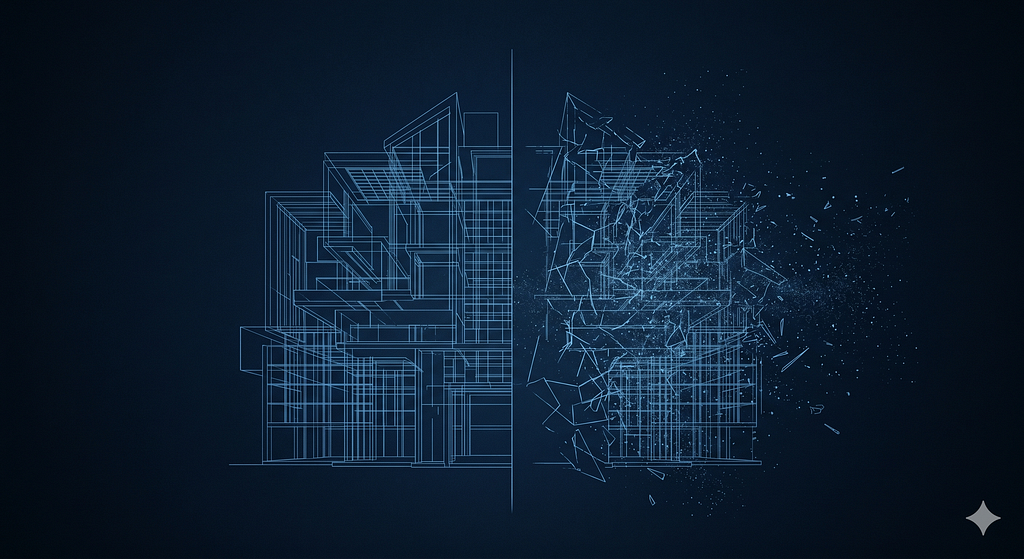
Per-seat pricing didn’t collapse because AI got capable. It collapsed because the purpose those seats were built around — humans performing workflows through a UI — was no longer the only model available. The purpose gap was always there. AI made it financially visible.
$285 billion in 48 hours. That is what unexamined purpose costs when the market finally looks.
I should be honest about where this gets difficult
The argument I’m making sounds clean. In practice, it’s brutal.
Most products have millions of users who depend on them exactly as they are. Most teams are operating inside organizations with years of technical debt, committed roadmaps, and real constraints on how much they can question from scratch. “Re-examine your purpose” is easy to write. It costs something real to execute.
There’s also a legitimate counter-argument worth taking seriously: not every product needs a purpose revolution. Some software exists to do a specific, bounded, well-defined job — and AI makes it do that job better. That’s a valid integration. Forrester’s own analysis confirms this: vertical, domain-specific SaaS products — the ones that know exactly what they’re for — are projected to grow from $133.5 billion to $194 billion by 2029. Purpose specificity is a defense. It’s the unexamined purpose that’s the vulnerability.
But here’s the distinction that matters: there’s a difference between knowing your purpose and having inherited it. Most product teams today are in the second condition. They didn’t choose the purpose — they inherited it from whoever shipped the first version years ago, under different constraints, with different capabilities. The question “what is this for?” was never asked explicitly. It was assumed.
And the gap cuts both ways. Humane’s AI Pin had the right vision and no inherited baggage — yet it failed for the same reason. The founders never asked what their product was for in relation to the ecosystem users already inhabited. They built a new building instead of rewiring an existing one. The purpose gap isn’t only about legacy products. It’s about any product built without an honest answer to the first question.
That assumption — or that omission — is the vulnerability.
Three questions before the next roadmap

I want to be precise about what I’m not saying. I’m not saying tear everything down. I’m not saying every company needs to become an AI-native startup.
What I’m saying is simpler: before your team opens the roadmap and starts planning AI features, someone in the room needs to answer three questions honestly. Not theoretically. Honestly.
The first question is about the job.
What job is this product being hired to do — and is that job still the right one, now that an intelligence can do part of it?
Christensen’s framework applies directly here. If the job your product was hired to do can now be resolved by expressing intent to an AI — without opening your application, navigating your menu, executing your workflow — then you don’t have a feature gap. You have a purpose gap.
The second question is about the task versus the outcome.
Is this product designed around a task — or around the outcome behind the task?
Word was designed around the task of creating documents. The outcome people needed was to communicate ideas, move decisions forward, make work visible. When intelligence can engage with intent directly, the task layer becomes optional. Products built entirely around tasks, without a clear connection to the underlying outcome, are the ones the market just repriced.
The third question is the most uncomfortable.
If you built this product today, from scratch, knowing what AI can do — would it look anything like what you have?
If the honest answer is “no” — and for many teams, it is — you have a purpose gap. Not necessarily a crisis. A gap: a measurable distance between the product built for one set of assumptions and the product you would build for the ones that now exist.
That distance is exactly what the market just priced.

The question is already being answered — with or without you
In 2026, the purpose of your product is being redefined — by users who have learned to express intent to AI systems and now expect the same everywhere, by competitors building from purpose outward, and by a market that just demonstrated, with $285 billion in 48 hours, that the gap between declared transformation and actual purpose change has a price.
The pattern is not new. Netflix didn’t improve video rental — it rethought what “accessing entertainment” meant. Spotify didn’t improve music purchase — it rethought music access entirely. The difference was never between companies that adopted new technology and those that didn’t. It was between companies that asked “how do we improve what we do?” and those that asked “what should we be doing now?”
The choice in front of you isn’t whether to engage with AI. That was decided for you. The choice is whether to engage with the harder question underneath it — before the market engages on your behalf.
I’ve spent the last two years studying this question — how product purpose transforms when intelligence becomes the architecture, not the feature. And the longer I work with teams trying to apply those ideas, the clearer the pattern becomes: the ones that struggle most aren’t the ones that lack technical capability. They’re the ones that never asked what their product was for in the first place. The architecture question has answers. The purpose question comes first.
That question was always important. It’s just that before AI, you could get away with not asking it.
You can’t anymore.
Adrian Levy is a UX architect and information architecture researcher. His previous work for UX Collective includes “You’re still designing for an architecture that no longer exists” and “When the Agents Go Marching In.” He is the author of “The Intelligence Architect: Designing for Autonomy in the Post-Interface Era”, which maps the seven structural transformations in how humans organize access to information — from the printing press to the age of intelligence.
You skipped the first question. Now you’re adding AI. was originally published in UX Collective on Medium, where people are continuing the conversation by highlighting and responding to this story.