
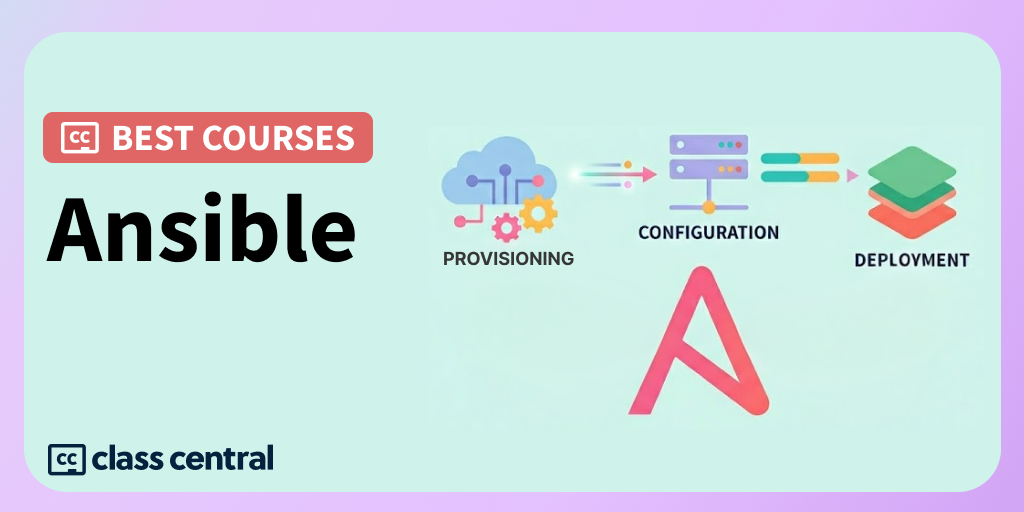

If you manage Linux servers for long enough, you eventually build a messy checklist: install these packages, create this user, copy that config file, restart this service, open this port, and remember to do it again on the next machine.
In fact, I’ve run into this problem myself managing a home server and a public-facing VPS.

That’s the kind of work Ansible is good at. It takes the server tasks you keep repeating — users, packages, configs, firewall rules, updates, app deployment, service restarts — and turns them into playbooks you can reuse.
In this Best Courses Guide (BCG), I’ve picked the best free and paid Ansible courses based on what you’re trying to do, like:
- Beginner-friendly picks for your first inventory and playbook,
- Practical resources for Linux admins,
- Red Hat-focused training for Ansible Automation Platform and the RHCE/EX294 path,
- and network automation courses for engineers using Ansible outside normal server administration.
Shortcuts
Why Learn Ansible?
Ansible is worth learning because it gives you a better way to handle server work that keeps coming back. Instead of SSHing into a machine, fixing something by hand, and hoping you remember the steps later, you write the setup once as a playbook and run it again when another server needs the same treatment.
That matters once you are managing more than a throwaway machine. A VPS, a homelab, a staging server, and a client server may not look like infrastructure at first, but they still need consistent setup, updates, configuration, and recovery when something breaks.
The beginner’s mistake is thinking Ansible is just YAML. The useful part is learning how Ansible thinks about machines: which hosts you are targeting, what state they should be in, what should change, what should stay untouched, and what needs to happen only when a file or service actually changes. That is why the better resources in this guide go beyond first playbooks and spend time on inventory, variables, handlers, templates, roles, secrets, and debugging.
Why Trust My Picks?
Class Central, a Tripadvisor for online education, has helped 100 million learners find their next course. We’ve been combing through online education for more than a decade to aggregate a catalog of 250,000 online courses. We’re online learners ourselves: combined, the Class Central team has completed over 400 online courses, including online degrees.
- A clear learner fit: beginner Linux admin, hands-on lab learner, Red Hat/AAP learner, book reader, or network engineer.
- Actual Ansible practice: inventories, playbooks, variables, handlers, templates, roles, collections, Vault, debugging, and real server-style tasks.
- Honest freshness: older resources can still teach the basics, but I flag where readers should check current docs for modern Ansible behavior.
Now without further ado, let’s get on to my picks!
Best Ansible Courses
| Course Name | Duration |
| Best Free Ansible Course for Linux Admins (Learn Linux TV) | 5 hours |
| Best Official Ansible Reference (Red Hat) | N/A |
| Best Short Fundamental Ansible Course (Red Hat) | 6–7 hours |
| Best Advanced Ansible Book (Packt) | 540 Pages |
| Best Ansible Reference Book (O’Reilly) | 472 Pages |
| Best Free Ansible Automation Platform Overview (Red Hat) | ≈2 hours |
| Best Hands-On Beginner Course with Free Labs (KodeKloud) | ≈2.5 hours |
| Best Project-Based Ansible Book (Jeff Geerling) | 487 Pages |
| Best Ansible Course for Network Automation (Pluralsight) | 15 hours |
| Bonus Resources | Varies |





Best Free Ansible Course for Linux Admins (Learn Linux TV)
| Take if: |
|
- Duration: 5 hours
- Cost: Free

Learn Linux TV’s Getting Started with Ansible starts from the question beginners actually have: where does Ansible live, how does it reach the servers, and what do the playbooks look like in a real setup?
Here, Jay center the series around a workstation, a few Linux servers, SSH access, and a Git repo, which is very much useful if you already have some existing workflow you want to automate right now!
You’ll work through:
- Setting up the control machine: run Ansible from a workstation instead of installing it on every server.
- Connecting over SSH: prepare the access Ansible needs before it can manage your machines.
- Keeping playbooks in Git: store your automation somewhere safer than one laptop.
- Running tasks across multiple servers: start with simple commands, then move into playbooks that configure hosts repeatedly.
- Handling real server differences: target groups of machines, use host variables, and avoid treating every server the same.
- Growing the setup gradually: move into roles, handlers, templates, and Vault as the playbooks become more serious.
Note that the series is a bit old, so make sure to check current Ansible docs for install commands and module names.
Best Official Ansible Reference (Red Hat)
| Take if: |
|
- Duration: N/A
- Cost: Free

Courses are good for learning the workflow, but once you start asking sharper questions like “What options does this module accept?”, “Why did this variable win?”, or “What changed in this version?”, then the Ansible docs are where you go.
Because (good) Ansible courses and tutorials aren’t that common, some of the resources in this guide are aged . A course can show the idea, but the docs help you check the exact behavior before you put something into your own playbook.
So, you should use the docs to:
- Install Ansible the current way: check setup instructions instead of relying on an old blog post or course video.
- Check module options: confirm parameters, examples, return values, and required fields before copying a task.
- Find the right collection: look up current module names and fully qualified collection names.
- Understand confusing playbook behavior: check keywords, variable precedence, special variables, and return values when output does not match what you expected.
- Update older playbooks safely: use porting notes when an old role or example breaks after an Ansible upgrade.
Best Short Fundamental Ansible Course (Red Hat)
| Take if: |
|
- Rating: 4.7 / 5.0 (91)
- Duration: 6–7 hours
- Cost: Free to trial / Paid

If you’re curious about automation and configuration management, Red Hat’s Fundamentals of Ansible will give you a random of what Ansible is for — inventory, playbook, variables, roles — and ends with a Coursera or edX certificate on top.
What makes this different from the other Red Hat courses in this guide is that it includes graded quizzes and assignments that’ll test what you’ve been taught.
By the end, you’ll come away able to:
- Read a basic Ansible setup: recognize the control node, managed hosts, inventory, modules, and playbooks.
- Create a small inventory: define which machines Ansible should manage before running tasks against them.
- Write a first playbook: use YAML to run simple tasks across your managed hosts.
- Avoid hard-coding everything: use variables and facts when machines need different values.
- Recognize reusable structure: understand why roles, collections, handlers, and conditionals matter once playbooks start growing.
Best Advanced Ansible Book (Packt)
| Take if: |
|
- Pages: 540
- Cost: Paid

When an Ansible run fails halfway through, the beginner examples stop helping pretty quickly.
Packt’s Mastering Ansible, 4th Edition is for that next stage: you know what a playbook is, but you want a better handle on execution, collections, secrets, debugging, and failure recovery. It’s a denser follow-up to Jeff Geerling’s Ansible for DevOps (the resource after this), especially if your main problem is not “how do I start?” but “how do I make this behave when the setup gets messy?”
You’ll work through:
- Tracing a playbook run: understand how Ansible connects, gathers facts, runs tasks, and reports changes.
- Working with collections: make sense of collection-based module names and reusable Ansible content.
- Handling secrets: use encrypted data instead of leaving sensitive values in plain variable files.
- Recovering from failures: use blocks, rescue steps, and cleanup logic when a task breaks halfway through.
- Debugging bad runs: inspect playbook behavior with Ansible’s debugger and console instead of guessing.
- Going beyond one server: see how Ansible fits into cloud and container workflows.
Best Ansible Reference Book (O’Reilly)
| Take if: |
|
- Pages: 472
- Cost: Paid

Ansible is easy to learn in fragments: one tutorial for inventory, another for roles, another for Vault, and somehow your own setup still feels patched together.
O’Reilly’s Ansible: Up and Running, 3rd Edition is useful because it puts those pieces into a clearer working order. Compared with Jeff Geerling’s Ansible for DevOps, this feels less like a guided project book and more like the reference you return to when you need to understand how a part of Ansible is supposed to work.
You’ll work through:
- Writing cleaner playbooks: describe server state without turning every task into shell commands.
- Managing different targets: apply Ansible across Linux, Windows, and network devices.
- Organizing inventory: separate hosts, groups, and variables before the setup becomes hard to follow.
- Using modules properly: rely on Ansible’s declarative modules instead of brittle command shortcuts.
- Reusing content: understand where roles, collections, plugins, and custom modules fit.
- Reading real examples: use the companion GitHub repo to inspect chapter code and adapt patterns.
Best Free Ansible Automation Platform Overview (Red Hat)
| Take if: |
|
- Duration: ≈2 hours
- Cost: Free

Red Hat’s free Ansible Basics: Automation Technical Overview is for IT leaders, administrators, engineers, and architects who want a quick look at Ansible Automation Platform 2.5.
It shows how Red Hat uses Ansible for configuration management, provisioning, application deployment, and orchestration across cloud, virtual, and physical infrastructure, helping you prepare for the Red Hat Certified Advanced System Administrator in Ansible Exam (EX294).
You’ll learn:
- How Ansible handles common IT work: use automation to configure systems, provision infrastructure, deploy applications, and coordinate tasks across environments.
- How automation is built: modules perform actions, tasks call those modules, and playbooks organize the work.
- How playbooks become easier to reuse: variables, templates, roles, and collections help avoid rewriting automation for every environment.
- How teams control automation: Automation Controller, RBAC, and workflows show who can run jobs, what they can access, and how work is approved or chained together.
- How automation can respond to events: Event-Driven Ansible gives a first look at triggering actions from alerts, changes, or system signals.
The next recommended RedHat course you should take after this is Red Hat Enterprise Linux Automation with Ansible.
Best Hands-On Beginner Course with Free Labs (KodeKloud)
| Take if: |
| You prefer Udemy and want a beginner course with short lessons, coding exercises, and lots of learner ratings. |
- Rating: 4.6/5.0 (463) (TrustPilot)
- Duration: ≈2.5 hours
- Cost: Paid course, free labs

Ansible makes more sense once you actually run it. Reading a playbook is one thing; seeing it target hosts, complete tasks, fail, and print output is where the pieces start connecting.
That’s why KodeKloud’s Ansible Basics course is a strong beginner pick. It gives you short lessons plus free browser labs (yes, free!), so you can try inventories and playbooks before touching your own servers.
I can’t stress the importance of actually doing hands-on work with Ansible, so even if you’re not planning on taking KodeKloud’s course, you should at least use the labs for practice.
You’ll find out:
- Running your first Ansible tasks: create an inventory, target managed hosts, and see how Ansible runs work across machines.
- Turning admin steps into playbooks: take repeated setup work and write it as YAML you can rerun.
- Automating small server jobs: install packages, manage users, set permissions, and deploy software.
- Handling different machines cleanly: use facts, variables, conditionals, loops, and handlers when hosts need different treatment.
- Organizing work once playbooks grow: move repeated tasks into roles, templates, and collections.
Once the basics feel comfortable, Ansible Advanced is the next KodeKloud course to look at.
If you prefer another platform, the same beginner course is also available through Coursera, Udemy, and PacktPub, with a companion repo for the course files.
Best Project-Based Ansible Book (Jeff Geerling)
| Take if: |
|
- Pages: 478
- Cost: Paid book; free manuscript available

Once you can write a basic playbook, the next step is seeing how Ansible holds a real server setup together.
And that’s what Jeff Geerling’s Ansible for DevOps will demonstrate: it moves from small playbook examples into provisioning, configuration, deployment, and multi-server projects.
The book has been around for a while, so some examples may show their age. But no worries! The manuscript and companion repo are updated and freely available, and Geerling has shared plans for updating the book.
You’ll work toward:
- Rebuilding a server from repeatable steps: packages, users, services, configuration files, and application dependencies.
- Making playbooks less fragile: use variables, templates, and roles so the project is easier to adjust later.
- Managing more realistic setups: work with multiple machines instead of pretending every example fits on one host.
- Connecting Ansible to deployment work: see how it supports app files, web servers, databases, and service changes.
P.S: If you’re wondering where you might have heard his name from, he runs a YouTube channel where he talks about Linux, Raspberry Pi, and homelab.
Best Ansible Course for Network Automation (Pluralsight)
| Take if: |
|
- Duration: 15 hours
- Cost: Paid subscription / trial

Pluralsight’s Automating Networks with Ansible is for network engineers who want Ansible to fit real operations work: pushing config changes, handling vendor differences, checking device state, and connecting automation to tickets or source-of-truth data.
You’ll work on:
- Repeatable network changes: turn common configuration tasks into playbooks that are easier to review, rerun, and share.
- Multi-vendor environments: compare ways to automate networks when devices do not all behave the same way.
- Reusable network automation: organize playbooks with roles and collections so your work does not become scattered YAML.
- Source-of-truth workflows: use network data to decide which devices Ansible targets and what context it needs.
- Operations handoff: connect configuration, troubleshooting, and notifications to service-management workflows.
It also helps that this is a Pluralsight path rather than a single video course. You get a guided sequence, Skill IQ to check your level, and access to Pluralsight’s wider practice environment while you work through the material. Cool!
Bonus Resources
Here are some miscellaneous resources that I found useful while researching this BCG:
- Ansible Workshops: Official workshop material for deeper practice with Red Hat Ansible Automation Platform. Good after you know basic playbooks.
- Ansible Collections Index: Keep this open when you stop writing toy playbooks and need the right collection/module for the job.
Did this guide help? We’ve got 200+ more for you. Check our Best Courses Guides to find your next course!

The post 9 Best Ansible Courses for 2026: Repeatable Server Automation appeared first on The Report by Class Central.