Most Indonesian apps start with the formal language used in news, schools, and official writing. This is bahasa baku. Everyday conversation sounds different: tidak becomes nggak, prefixes often disappear, and the same root can grow into several words. Ajar, belajar, mengajar, pelajaran, and pengajar all mean different things.
Indonesian is still friendly to beginners. It uses the Latin alphabet, has no tones or grammatical gender, and verbs do not conjugate for person. A structured course can get you started quickly, but colloquial listening, extensive reading, conversation, and lookup often need separate tools.
So in this Best Courses Guide, I look at what each Indonesian app is actually useful for, and not just which ones are popular.
Best Indonesian Learning Apps — Overview
| App |
Structured Study |
Grammar |
Vocabulary |
Listening |
Speaking |
Reading |
Writing |
Best for |
| General Purpose & Structured |
| The Indonesian Way |
 |
|
|
|
|
|
|
Complete structured self-study |
| Babbel |
|
|
|
|
|
|
|
Guided beginner study through A2 |
| Mango Languages |
|
|
|
|
|
|
|
Conversation and library access |
| IndonesianPod101 |
|
|
|
|
|
|
|
Explained audio/video lessons |
| BIPA Daring |
|
|
|
|
|
|
|
Official materials and provider hub |
| Vocabulary & Review |
| Memrise |
|
|
|
|
|
|
|
Native-speaker phrase video |
| Glossika |
|
|
|
|
|
|
|
High-volume sentence drilling |
| uTalk |
|
|
|
|
|
|
|
Cheap travel phrases |
| Clozemaster |
|
|
|
|
|
|
|
Intermediate vocabulary in context |
| Reading & Listening |
| LingQ |
|
|
|
|
|
|
|
Supported input and imports |
| Speaking & Live Instruction |
| Pimsleur |
|
|
|
|
|
|
|
Compact oral course |
| Preply |
|
|
|
|
|
|
|
Broadest tutor marketplace |
| italki |
|
|
|
|
|
|
|
Alternative tutor marketplace |
| Tandem |
|
|
|
|
|
|
|
Direct language exchange |
| Dictionaries & Lookup |
| KBBI Daring |
|
|
|
|
|
|
|
Official monolingual lookup |
| SEAlang |
|
|
|
|
|
|
|
Bilingual and corpus-supported lookup |
I’ve grouped them by the job they do for you:
Note: Prices are listed in USD. App pricing may differ due to promotions or regional pricing, so do check the official pricing page before subscribing.
General Purpose and Structured Indonesian Learning
 The Indonesian Way
Cost: Beginner package: $10 one-month trial or $90 for two years.
If you’re going to stick to one course for the first year, I’d make it this one. The beginner package gives you a long sequence of lessons with native audio, interactive exercises, flashcards, and regular progress tests. Nothing about your next study session is left for you to design.
Where it pulls ahead of the consumer apps is what comes after the beginner course. Advanced packages move into reading, literature, media, contemporary Indonesia, and the distance between formal and colloquial listening, which is the stretch where self-taught learners usually stop.
The beginner course takes you from zero to B1. It does not include feedback on your speaking or writing, so you should add a tutor or conversation partner when you want corrections (there’s free and paid apps for that further down!).
Babbel
Cost: Paid plans; exact price varies by region and term.
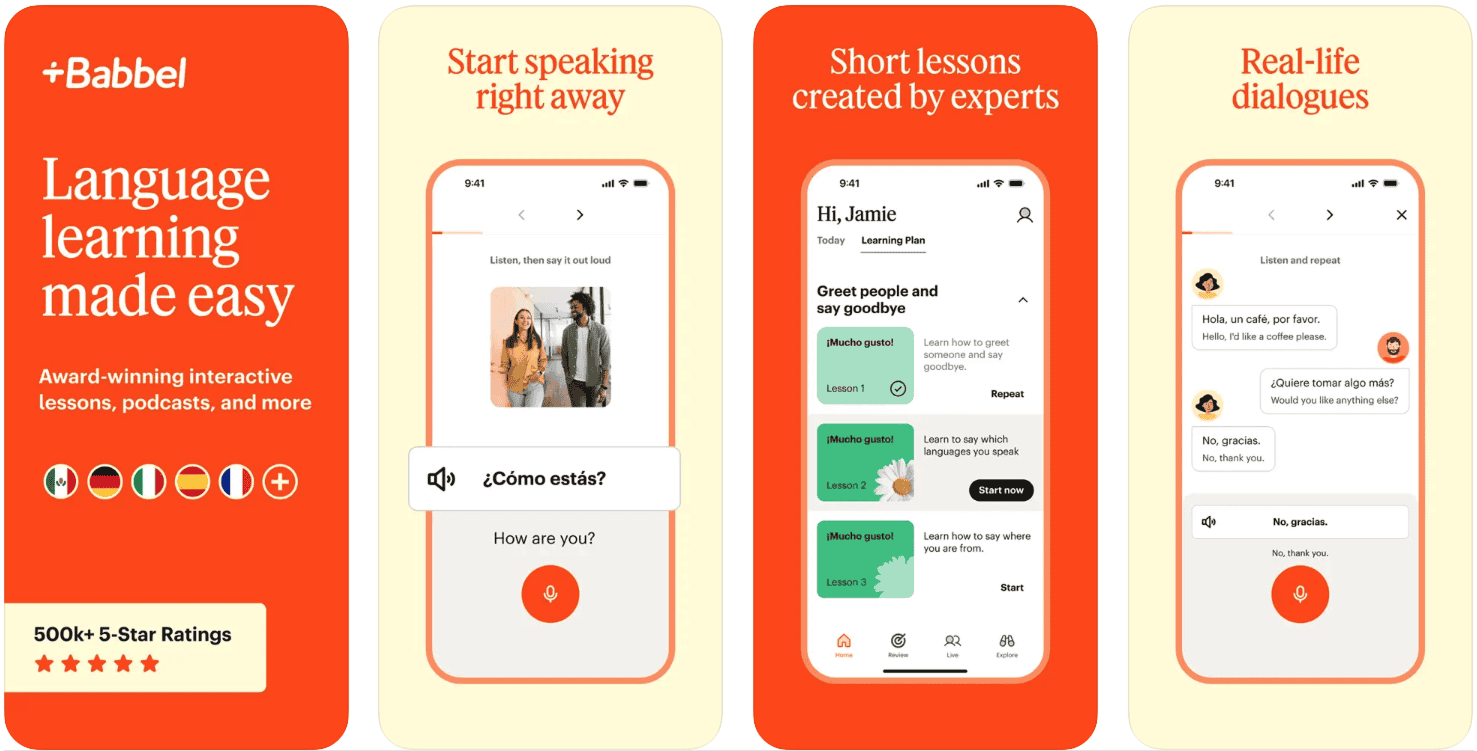
Babbel’s Indonesian course covers beginner material through A2. Lessons run 10–15 minutes and build around real-life conversations, native-speaker audio, speaking aloud, and personalized review that brings vocabulary back over time.
This is the mainstream app pick for a beginner who wants a clear daily routine. By the end, you’ll have worked through practical dialogues and enough structured review to move into longer reading, listening, and conversation with a solid base.
Mango Languages
Cost: $13.99/month for individual access; free through many libraries and institutions.
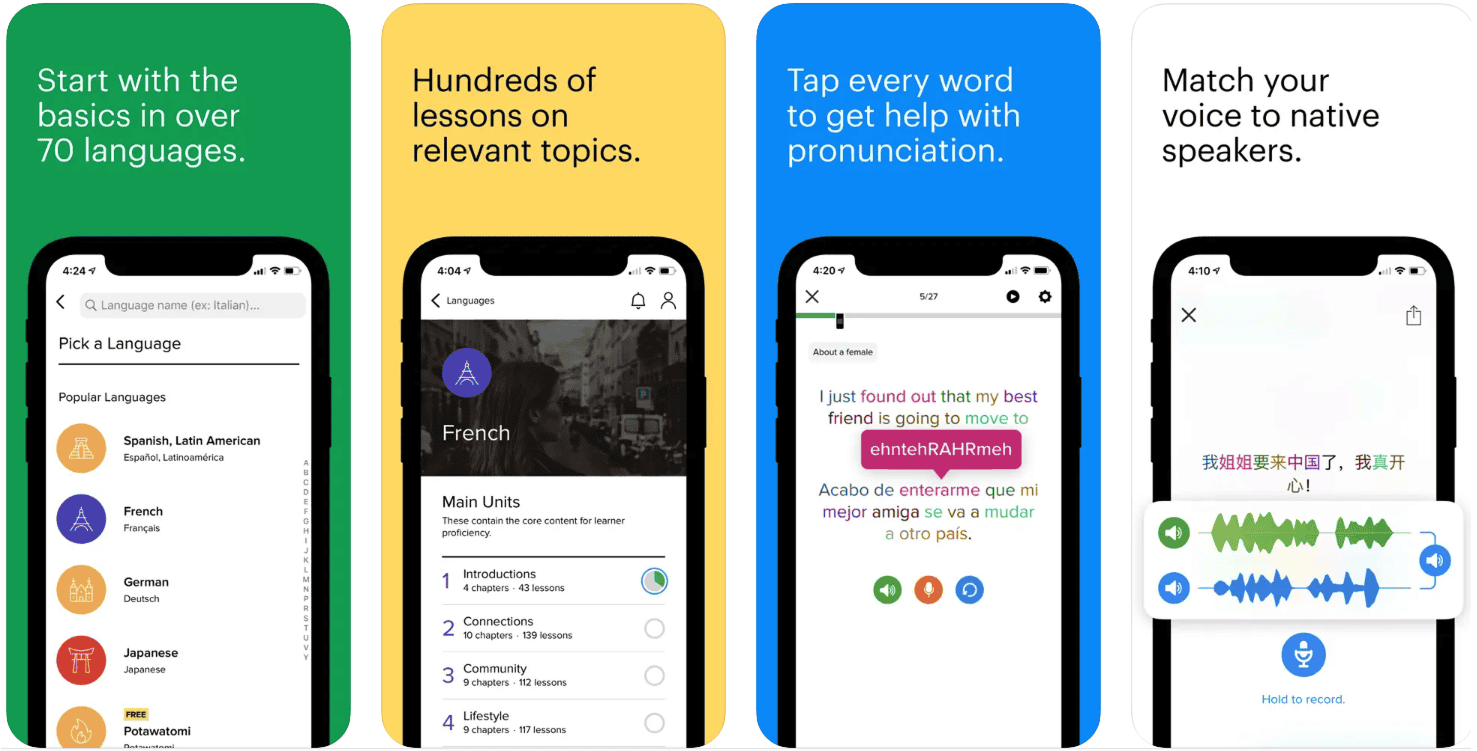
Mango builds each lesson around a conversation and then pulls it apart line by line, dropping in grammar and culture notes at the points where an English speaker would otherwise guess wrong.
Its recording tool sets your voice against a native speaker’s. Indonesian pronunciation is regular enough that beginners assume they’ve got it, and habits picked up in week two are still there in year two.
Mango is strongest as speaking and listening practice for beginners already following a structured course.
IndonesianPod101
Cost: Free tier; Basic $4/month and Premium Plus $23/month when purchased as 24-month subscriptions.
IndonesianPod101 has a large library of explained audio and video lessons. Each one starts with a dialogue and adds a transcript, line-by-line audio, cultural notes, and assessments, with pathways from absolute beginner to advanced.
The library spans levels and topics rather than one linear curriculum, making it a good fit if you prefer choosing lessons as you go.
BIPA Daring
Cost: Free.
The Indonesian government runs its own portal for teaching the language to foreigners. It includes four-skill learning materials, placement tests, interactive resources, and a directory of institutions running BIPA programs in Indonesia and abroad.
That connection between self-study and formal programs makes BIPA Daring useful whether you want to study independently or find an institution. It is a portal rather than one course, and much of it is in Indonesian.
Indonesian Apps for Vocabulary and Review
Memrise
Cost: Free tier with paid Pro plans.
Video is Memrise’s clearest advantage for Indonesian: short clips of ordinary speakers saying the phrase you just learned, at their own pace and in their own accent.
Those clips help bridge the gap between recognizing a word in a clean recording and catching it in ordinary speech. Personalized review brings saved vocabulary back over time, while AI chat gives the phrases somewhere to go beyond flashcards.
Memrise works best as a daily vocabulary-and-listening layer beside a structured course, especially once textbook audio begins to feel too neat.
Glossika
Cost: 7-day free trial; $19.99/month for one language or $16.58/month billed annually.
Glossika drills sentences rather than words. You hear native audio, repeat it, type it, and the scheduler returns each sentence at spaced intervals until saying it costs you no thought.
Glossika explains very little, so start once basic sentence structure already makes sense and you want faster recall. A placement test picks your starting point, and the Indonesian course runs from A1 to C1.
It is the most expensive tool in this section and makes the most sense if you are willing to practise every day.
uTalk
Cost: $4.99/month or $29.99/year.
For a trip, uTalk gives you more than 2,500 words and phrases across 60-plus topics, two native voices, pronunciation comparison, and full offline use once you have downloaded a topic.
It focuses on quick phrase recall rather than sentence building. Use it to prepare for common travel situations before you land.
Clozemaster
Cost: Free play with paid Pro extras.
Clozemaster pulls one word out of a sentence and asks you to put it back, moving through Indonesian vocabulary in rough frequency order. Multiple choice while you’re finding your feet, typed answers once guessing gets too easy.
It is built for people past the beginner stage, and the sentences assume you can already handle affixes and word order by yourself.
Indonesian Apps for Reading and Listening
LingQ
Cost: Premium $14.99/month, $119.99/year, or $215.76 for two years.
LingQ earns its place at the point where lessons stop being the bottleneck and finding readable Indonesian starts to be. Text and audio run together, one tap on an unknown word gives you a translation, and every word you save is tracked wherever you meet it next.
The Indonesian side includes Mini Stories, short repetitive narratives that make a workable first reading habit, plus podcasts and older dialogue courses. Imports are what keep it useful years later: news, blog posts, subtitles, whatever you’d have read anyway.
Indonesian Apps for Speaking and Live Instruction
Pimsleur
Cost: $105 complete-course purchase in August 2026.
Pimsleur teaches through the ear and the mouth alone. Each half-hour lesson pushes you to say Indonesian aloud slightly before you feel ready, then brings the same material back at widening gaps. The course contains 30 lessons in standard Indonesian as spoken in Jakarta.
By the end, you’ll be able to hold a simple spoken exchange. For a first month that’s a fair bargain, provided you know you’ve bought a speaking course rather than a complete one.
Preply
Cost: Tutor-set prices from $3 to $40.
Preply has a much larger pool of Indonesian teachers than italki, giving you more choice across time zones, prices, and specialisms.
Profiles include ratings, reviews, completed lesson counts, and specialisms. Lessons run on a monthly subscription for a set number of hours, which fits a weekly schedule better than occasional bookings.
italki
Cost: Tutor-set prices from roughly $10–30+ per hour.
italki’s Indonesian roster is much smaller and organised differently: professional teachers with credentials on one side, community tutors offering conversation practice on the other, and lessons bought one at a time instead of in a monthly block.
This works well with an irregular schedule and lets you try several teachers before settling on one. The split between professional teachers and community tutors also makes it easy to choose between formal instruction and conversation without changing platforms.
Tandem
Cost: Free core language exchange with optional paid features.
Tandem pairs you with someone who speaks Indonesian and wants to learn your language, and you trade time. Its large Indonesian-speaking community gives you room to find someone you enjoy talking to.
Unlike a tutoring marketplace, the relationship is reciprocal: part of the exchange is for your Indonesian and part for your partner’s target language. That gives the conversation more room to settle into ordinary interests and repeated contact.
Indonesian Dictionaries and Lookup Tools
KBBI Daring
Cost: Free.
Sooner or later you should be looking up Indonesian words in Indonesian, and KBBI is the dictionary for it. It’s the official reference published by the education ministry, with standard spellings, forms, and usage labels.
KBBI is most useful once you can read a definition without translating every word, as it’s quite comprehensive in showing a word’s distinctions and usages.
SEAlang
Cost: Free.
But if you aren’t at that level of understanding Indonesian through Indonesian, then stick with SEAlang. Its bilingual dictionary, corpus, and bitext search show how words appear in real sentences, including which affixes commonly attach to a verb. Quite useful!
The post The Best Apps to Learn Indonesian in 2026 appeared first on The Report by Class Central.