
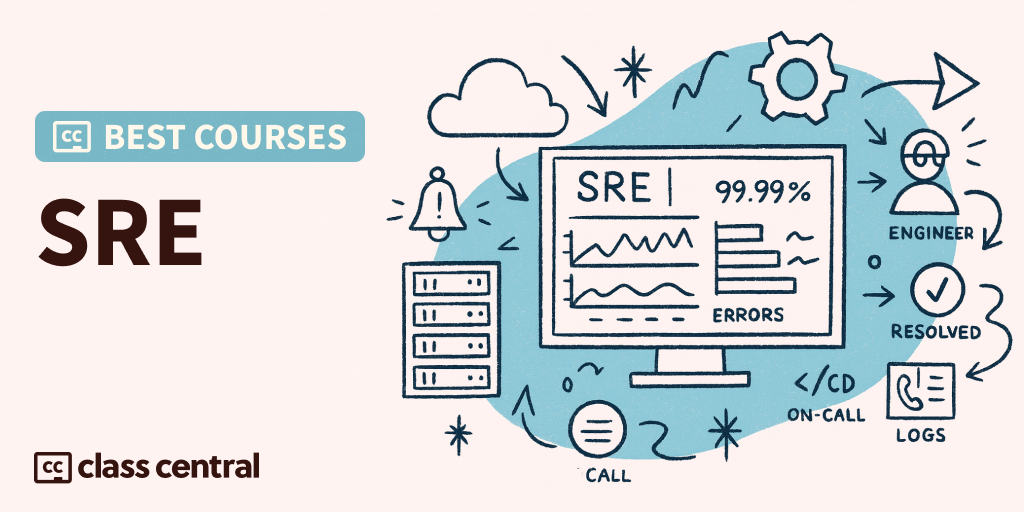

When Fastly’s configuration error took down Amazon, Reddit, Spotify, and half the internet for an hour in 2021, Site Reliability Engineers (SREs) were the ones who fixed it. These professionals ensure systems stay running when millions of users need them. SRE salaries average 166K USD in the US, with FAANG companies paying even more.
But what exactly is Site Reliability Engineering? Google’s Benjamin Treynor Sloss, who founded the first SRE team in 2003, described it as “what happens when you ask a software engineer to design an operations function.” SREs write software to solve operational problems. They focus on automation, system design, and system resilience while keeping a close eye on availability, latency, monitoring, and capacity planning.
In essence, being an SRE means applying DevOps best practices with the goal of building reliable systems
The role requires deep technical skills across multiple domains: operating systems, networking, containerization, CI/CD pipelines, and infrastructure as code. In essence, being an SRE means applying DevOps best practices with the goal of building reliable systems. However, the exact definition of SRE can vary slightly between companies, each adapting the role to their specific needs.
Here’s the reality: An online course alone won’t make you an SRE. This field demands hands-on experience with production systems. You need practical experience working with real infrastructure and actual scale. However, the right course can accelerate your learning. You’ll understand core principles, learn industry-standard tools, and practice techniques that would otherwise take years to discover on your own.
The courses below range from Google’s official SRE training to hands-on labs that simulate production environments. Each one offers a different approach to learning this complex field.
Bonus Resource: Check out the DevOps/SRE Roadmap before starting. While not a course itself, this visual guide shows you exactly which skills to learn and in what order.
Which SRE Course Is Right for You?





Why You Should Trust Us
Class Central, a Tripadvisor for online education, has helped 100 million learners find their next course. We’ve been combing through online education for more than a decade to aggregate a catalog of 250,000 online courses and 250,000 reviews written by our users. And we’re online learners ourselves: combined, the Class Central team has completed over 400 online courses, including online degrees.
Best Foundation Resource: Linkedin School of SRE
- Level: Beginner to Intermediate
- Duration: Self-paced reading
- Cost: Free
- Certification: No

This course is a starting point for anyone wanting to build their career as a Site Reliability Engineer. Created by LinkedIn’s engineering team, it’s structured as a comprehensive handbook rather than a traditional course. The layout lets you jump between topics quickly, whether you’re learning new concepts or refreshing existing knowledge. This makes it excellent as both a learning resource and a reference guide to keep handy while working on SRE tasks. As an engineer myself, I find this documentation-style approach resonates best with how I prefer to learn.
Pros:
- Completely free to read online
- Well-structured content from LinkedIn’s actual SRE team
- Works as both a learning path and quick reference
Cons:
- No hands-on labs or exercises (it’s a handbook, not an interactive course like those on Coursera or Udemy)
- Requires self-discipline without structured assignments
Who is it for? Engineers transitioning to SRE who prefer documentation-style learning, or current SREs needing a solid reference guide.
Best SRE Theory: Google SRE Books
- Level: Beginner to Advanced
- Duration: Self-paced reading
- Cost: Free
- Certification: No

Nothing beats a good book for deep learning, and Google provides not one but three O’Reilly books that you can read online for free. These books give you an inside look at how Google’s team deploys SRE operations. The third book, Site Reliability Engineering, should be your primary focus. It outlines the core principles, practices, and management approaches while packing in conclusions and real-world examples that show what SRE work actually involves. Since Google invented the SRE role, these books offer the most authoritative perspective on the field.
Pros:
- Free to read online (all three books)
- Straight from Google, who created the SRE discipline
Cons:
- Could use more diverse example cases beyond Google’s context
- Theory-heavy without hands-on practice components
Who is it for? Anyone who wants to understand SRE philosophy from its source, especially those who learn best through comprehensive reading rather than video courses.
Best Vendor-Neutral Primer: Linux Foundation LFS162
- Level: Beginner
- Duration: 10 hours
- Cost: Free
- Certification: Yes (course completion certificate)

This one comes from the Linux Foundation, the nonprofit behind Kubernetes, the Linux kernel, and a long list of other open-source infrastructure projects, so it’s not tied to a single cloud vendor the way the IBM and Google picks are. Structured as eight chapters, it moves from DevOps fundamentals through cloud, containers, infrastructure as code, and CI/CD, before landing on observability and SRE itself. It’s built for people starting from zero, whether that’s engineers making the jump into DevOps/SRE or managers trying to figure out where to begin.
Pros:
- Completely free, with an actual completion certificate
- Vendor-neutral, from a widely respected body in open-source infrastructure
- Broad, structured path from DevOps basics through to SRE specifically
Cons:
- Very new listing with no learner reviews yet
- Introductory only, no hands-on labs or graded projects
- Overlaps with the free resources above, so treat it as an alternative starting point rather than an add-on to both
Who is it for? Beginners who want a vendor-neutral starting point instead of committing to Google’s or IBM’s ecosystem right away.
Best IBM Cloud Ecosystem SRE Training
- Level: Beginner to Intermediate
- Duration: Self-paced (varies)
- Cost: Free
- Certification: Yes (IBM Cloud SRE Professional. Certification exam offered at additional cost)

This course focuses on SRE practices within the IBM cloud ecosystem while preparing you for the IBM Cloud SRE Professional Certification. IBM emphasizes three core pillars: reliability, resilience, and user experience. The course follows a traditional linear structure where you complete each module before advancing to the next. You’ll need patience to work through the sequential format, but it provides a clear path toward the certification exam. While the website’s roadmap is well-organized, it can load slowly in browsers.
Pros:
- Free to attend the entire course
- Leads to an industry certification
- Structured learning path with clear progression
Cons:
- IBM might retire this course soon
- Vendor lock-in (focuses heavily on IBM cloud tools)
Who is it for? SRE aspirants who want a free certification path, or those working in IBM cloud environments. The principles taught apply to any SRE role despite the IBM-specific context.
Best Structured Online Course: Google Cloud SRE
- Level: Beginner to Intermediate
- Duration: 3 hours
- Cost: Free
- Certification: Yes (completion badge)

(Note: this pick previously linked to a Coursera version of this course from Google Cloud Training, which has since been discontinued. It’s been swapped for the same curriculum’s current, official home.)
This course now lives directly on Google’s own Google Skills platform (formerly Cloud Skills Boost), free of charge. It’s the same core curriculum Google originally built for Coursera: how to devise service level indicators (SLIs) and service level objectives (SLOs), and how to manage reliability with an error budget, worked through a running example of a fictional mobile game. The format is self-paced reading and short quizzes organized into modules, rather than the graded assignments the old Coursera version used, and it wraps up with a completion badge instead of a shareable certificate.
Pros:
- Completely free (the Coursera version required a subscription or one-time purchase)
- Straight from Google, the company that originated both SRE and this specific curriculum
- Organized into clear modules with quizzes, so you can track progress as you go
Cons:
- No graded assignments or practice exercises, just reading and quizzes
- Very few learner reviews so far, since it’s a newer listing on this platform
- A completion badge, not a shareable certificate, if you need something for a resume or LinkedIn
Who is it for? Learners who want Google’s official SRE course on SLOs and error budgets at no cost, and don’t need a polished shareable certificate out of it.
Best Quick Overview: Udemy SRE Fundamentals
- Level: Beginner (with IT background)
- Duration: 4 hours on-demand video
- Cost: Paid
- Certification: Yes (Udemy certificate)

This course offers roughly 4 hours of on-demand video content designed for IT professionals looking to understand SRE concepts. While marketed as having no prerequisites, you really need an IT background to get value from it. The course focuses on helping you understand why and how to adopt SRE practices in your existing work rather than teaching hands-on skills. The course doesn’t offer labs to learn by doing, so when you try to apply your newly acquired SRE skills, you’ll have to complement your learning with materials from other sources.
Pros:
- Quick overview of SRE concepts
- Good for understanding the “why” behind SRE practices
- Short time commitment
Cons:
- No hands-on labs or practical exercises
- Requires supplementary materials for actual implementation
Who is it for? IT professionals who want a quick introduction to SRE concepts before diving deeper, or managers who need to understand SRE without necessarily implementing it themselves.
Best Hands-On Primer: Udacity SRE Fluency
- Level: Beginner to Intermediate
- Duration: 6 hours
- Cost: Paid (Udacity subscription)
- Certification: Yes

This is Udacity’s short-form entry into SRE, a fraction of the size of the Nanodegree below but still genuinely hands-on. It opens with zero trust security concepts, then has you build real SLO/SLI queries in Prometheus and a dashboard in Grafana, before covering capacity management and on-call/incident response practices. It’s the practical middle ground between the theory-only free picks above and the Nanodegree’s four-month commitment.
Pros:
- Real hands-on work with Prometheus and Grafana, not just video
- Much shorter and cheaper than the Nanodegree, with none of its ten prerequisites
- Perfect 5-star rating so far, though from a small sample of reviews
Cons:
- Small review base, so that rating comes with a grain of salt
- Covers far less ground than the Nanodegree (no deployment automation, no full-scale projects)
- Requires an active Udacity subscription
Who is it for? Learners who want actual hands-on practice with SRE tooling without the cost or prerequisites of the full Nanodegree.
Most Comprehensive Program: Udacity SRE Nanodegree
- Level: Intermediate to Advanced
- Duration: 4 months (10 hours/week)
- Cost: Paid (expensive)
- Certification: Yes (Nanodegree)

This comprehensive program includes four hands-on projects and claims to teach over 50 SRE skills. However, it comes with significant prerequisites: ten in total, including at least three AWS certifications. The course has a downloadable syllabus outlining the extensive curriculum. Despite the ambitious scope, it hasn’t received great reviews from Reddit users, with many recommending free self-learning routes instead.
Pros:
- Covers 50+ SRE skills according to the syllabus
- Four hands-on projects for portfolio building
- Structured learning path with mentor support
Cons:
- Very expensive compared to alternatives
- Heavy prerequisites (10 requirements including AWS certifications)
- Mixed reviews from the community
Who is it for? Experienced IT professionals with AWS background and budget for premium training, or those whose employers will cover the cost. Not recommended if you’re paying out of pocket given the available free alternatives.
The post 8 Best Site Reliability Engineering Courses to Take in 2026 appeared first on The Report by Class Central.