
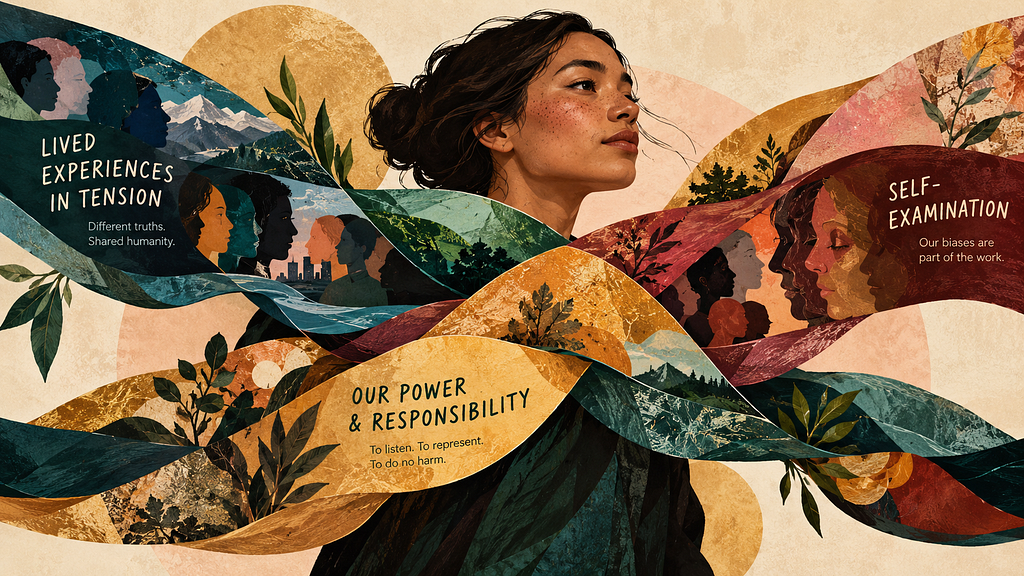
How to navigate opposing voices and lived tensions.
By Julia Beard, Naman Mandhan, & Stacie Sheldon

Asking the Hardest Question First
“What gives us the right to make the interventions and choices we are contemplating on behalf of others?” asks Erika Hall, cofounder of Mule Design. For UX professionals, it’s a question worth sitting with. We’re driven by empathy and a desire to solve problems, yet it’s not common practice for us to question our own authority. How often do we stop to ask the question Erika poses — especially when so much of our job involves putting solutions out into the world? In our effort to do good, we risk unintentionally causing harm. Do we recognize how much power and privilege come with that responsibility?
In Part One of In/Tension Modeling as a UX research and strategy tool, we explored the reality that when you solve one problem, other problems are naturally created. We also discussed how, while analyzing data, you will often find perspectives that are in conflict with one another, and how it is vital to amplify all perspectives, not just the loud ones.
In this Part Two, we go a step deeper into how In/Tension Modeling can be applied to anticipate, prevent, and respond to potential harms while creating solutions. Throughout the design process, it offers a way to continually check the work against Erika’s question: “What gives us the right?” — ensuring that the drive to solve problems is balanced with care for those most affected by the outcomes.
Throughout this article, we share examples of how In/Tension Modeling helped us navigate conflicting perspectives and advocate for the lived experiences of those most affected by the outcomes of a solution. While reading these examples you’ll find moments where we often questioned our own authority on highly polarizing topics. Instead of taking sides, we sought to make space for all the voices and used practical tools to find paths forward that minimize harm. These stories demonstrate that staying with the tension, rather than rushing to resolve it, can lead to more inclusive and resilient outcomes.
How In/Tension Modeling Works: A Quick Map
The stories in this article move through three recurring steps. You’ll see each of them in action as you read.
Step 1: Surface moments of tension
While interacting with research findings, we may encounter opinions or experiences that contradict one another. A common question that arises is how to navigate these conflicting needs and goals, which can feel paralyzing. One effective approach is to juxtapose these perspectives. Doing so allows us to see the full spectrum of needs and goals, leading to better understanding and more informed decision-making. Learn more about this step in Part One of In/Tension Modeling as a UX Research and Strategy Tool.

Step 2: Identify opportunities and cultivate solutions
Where there is tension, there is opportunity. Moments of conflict often reveal pain points, but by reframing those pain points as opportunities, we shift from what is not working to what could work better. This mindset helps us approach problem solving with curiosity instead of frustration, and it keeps conversations constructive.
Once opportunities have been identified, brainstorm ways to address them. Each opportunity becomes a prompt for generating solution ideas that balance the needs and values represented in the voices from research.

Step 3: Assess solution feasibility
Once solutions have been brainstormed, take time to consider how each one might affect all parties involved. A helpful way to do this is by exploring the relationships between conflicting points of view and using the Range of Tolerance tool to see where each voice falls. This helps identify whether a proposed solution might unintentionally exclude or disadvantage someone.
Involving a diverse group at this stage can surface different perspectives and reduce bias. It is also important to remember that solving one problem can sometimes create another. Revisit the preferences and tolerance ranges of each voice to ensure the solution remains balanced and practical.

Repeat step three for all solutions.
Central to Step 3 is a tool designed to make that assessment visible across every voice in the room: the Range of Tolerance.
The Range of Tolerance

The strength of the Range of Tolerance lies in its honesty. Full agreement is rare. Rather than seeking solutions everyone loves, it helps identify solutions that people can genuinely accept while intentionally mitigating harm or exclusion. When a voice falls outside the range of tolerance, it signals that a proposed solution may lead to disengagement, resistance, or loss of participation.
When testing the viability of solutions, the project team looked for options where all voices fall within either the preference zone or the range of tolerance.
- Preference zone: The proposed solution is ideal for that group.
- Range of tolerance zone: While the proposed solution may not be their preferred option, they can live with it and it is unlikely to cause harm.
- Outside both zones: Anything outside the range of tolerance means they are not willing to consent to that solution.
It is difficult to find solutions that place every voice in the preference zone, especially when perspectives are in conflict. But aiming for solutions that keep all voices within the range of tolerance is a practical and powerful goal. It allows us to design with all perspectives in mind, rather than feeling forced to choose one over another; or worse, abandoning the effort to design a solution at all.
Responsible design does not pick sides and does not ignore harms. It works through the tension.
When Every Voice Tells a Different Story: A Case from the Field
Tension isn’t always a bad thing; it can actually bring important truths to the surface. The role of a researcher is not to be a peacekeeper–it is to sit with conflicting insights and find a way forward through them. One project brought this challenge into sharp focus: we were asked to work on one of the most polarizing government programs out there, child support. By design, the program can feel like it creates a winner and a loser. If you are paying support, you may feel you are paying too much or that the money is not being spent as intended. If you are receiving support, you may feel you are not getting nearly enough to meet your family’s needs. Those opposing experiences, both valid, make the program emotionally charged for everyone involved.
Even people who have never participated in the Child Support Program often carry assumptions shaped by what they have heard from friends, family, or the media. Phrases such as “deadbeat parent” or “they get so much in child support, they probably don’t even spend it on the kids” seep into everyday conversations and influence how we see the system, often in ways that are oversimplified or unfair.
Choosing not to act would still leave children bearing the consequences.
For this qualitative research project, our goal was to help child support employees build empathy with families by sharing the stories of people who had lived experience with the program. We also recognized that while navigating child support could be incredibly difficult for participants, the work could be emotionally complex and demanding for staff. Heavy workloads and highly sensitive situations could influence how families experienced the system. We were asked to create a storytelling exhibit to help reconnect staff with the human side of their work. To tell these stories authentically, we first needed to listen.
The foundation of this research was one-on-one interviews with families connected to the program. We spoke with people who pay child support, who receive it, and who do both. We sought a diversity of voices which included moms, dads, family members with guardianship, individuals who had left the program, and participants whose involvement ranged from just one year to over thirty.
As we conducted interviews, we repeatedly heard perspectives that were in direct tension with one another. In one conversation, a parent who pays child support shared that their monthly payments were so high they were being pushed into debt and struggling to maintain a stable home. In the very next interview, a parent who receives child support described that same payment structure as leaving them without enough money to cover basic needs like food, rent, and childcare. Each parent’s experience was real and valid, shaped by their own circumstances, and each revealed how the system could place families in competing positions. Somewhere in the middle of that tension was a child, depending on both.

As a researcher when someone shares a deeply personal experience, especially one that impacts their entire family, you feel a responsibility to honor that. It is not just about listening; it is about carrying their voice forward in a meaningful way. In this case, that responsibility felt heavy. Every possible solution carried a risk. Solving for one group could unintentionally hurt another. And that harm was real. It could mean one group going into overwhelming debt or the other group not having the support needed to care for their family. Choosing not to act would still leave children bearing the consequences.
This led us to consider a framework authored by Designit entitled Do No Harm. The framework challenges practitioners to think about the consequences not only of their actions, but also of their inaction. It encourages us to keep moving forward, even if we make mistakes, as long as we do not become passive.
“If the design discipline is to evolve into a safer and more conscientious version of itself, we need to develop approaches from within to be able to effectively forecast, prevent, and respond to harm. A disciplinary culture shift is in order, and the Do No Harm framework provides a way towards achieving it.” — Dr. Pardis Shafafi, Global Responsible Business Lead of Designit
After careful reflection, we recognized that doing nothing (not directly addressing the tensions) carried greater consequences than taking action . We chose to adopt the Do No Harm framework with In/Tension Modeling and committed to amplifying the lived experiences we uncovered. That choice gave us a clear path forward; not the easy path, not the fast path, but the honest, difficult, and necessary one. Through In/Tension Modeling, we didn’t just identify points of tension; we stayed with them, worked through them, and sought to fully understand every perspective.
The result was a storytelling exhibit built for program staff, organized around the voices of payers, receivers, and people who had experienced both. It wasn’t designed to declare a winner. It was designed to make the full range of lived experiences impossible to ignore, inviting staff to sit with the people behind the cases rather than the cases alone. The exhibit included reflection questions, guiding principles for engagement, and a call to action for teams ready to do something with what they heard. We built it to last beyond the project. The voices we had been trusted to carry forward were at its heart.
That process, staying with the tension long enough to honor every voice, is what In/Tension Modeling made possible. And it wasn’t the last time we’d need it.
When Empathy Is Not Enough
Even with a strong foundation in empathy and a commitment to honoring every voice, there are moments when progress stalls. Tensions can become so entrenched — politically, emotionally, or institutionally, that traditional methods of facilitation and consensus-building fall short.
In another project with a statewide Child Support Program, we encountered exactly this kind of deeply entrenched disagreement over whether families receiving state assistance should be required to participate in the Program. Despite clear direction and shared intentions, the people involved struggled to move forward. The deeper we went, the more it became evident that no amount of storytelling or surface-level agreement could bridge the divide. We applied In/Tension Modeling not only as a research tool, but as a strategic intervention to help people see one another’s perspectives more clearly, and to begin moving past their entrenched positions.
The disagreement surfaced when we were helping to shape a future vision for how services would be delivered. In the first phase, we conducted research to understand how staff across the program perceived the current system, while also gathering experiences from the families being served. This work revealed a deeply divided landscape. Two dominant narratives had taken hold, and neither side seemed willing or able to move toward common ground.
On one side, some of these stakeholders expressed a desire to change the experience for families receiving state assistance. They described how participation in the program is mandatory for those on assistance, since the state seeks reimbursement through child support collections. Many believe that families often do not understand this requirement when they apply for assistance, or that they lack a real choice because the financial support is essential. Some participants questioned whether this approach truly benefits families, arguing that it can cause harm by reducing autonomy and dignity without generating significant financial return for the state.
At the same time, other stakeholders expressed a different perspective: the program should not change because individuals who use and benefit from the services of the state have an obligation to help repay those costs. For this perspective, required participation was not viewed as punitive but as necessary for fairness, accountability, and in some cases protection. They noted that mandatory engagement with state systems can, in certain situations such as cases of family violence, create opportunities for safety, support, or intervention that might not otherwise occur.
We wondered how to get past this argument. The more it was discussed the more entrenched it felt. We decided a starting point should be to model the two sides of the debate:

As a third party this was our best effort to represent the two sides and we were as intentional as possible to write each voice without bias, knowing that we could not write each side exactly how a person might want to see it represented.
One learning we took from this experience was that, next time, we might invite working groups to participate in creating the models themselves. In our case, we did not have enough time to do so (and it remains to be seen if it would have been beneficial or created a sticking point) but the models as written did produce an immediate response. One person said, “I don’t see my idea on here. There is a loophole where we can avoid forcing them into this program if we wish.” We had never heard that idea before and it became a voice in the middle as well as the beginning of a possible solution for today while the deeper issue is still debated.

Facing Our Own Biases in the Process
While modeling opposing voices in the child support project helped move the conversation forward, it also revealed something we hadn’t anticipated, our own blind spots. As researchers and facilitators, we’re trained to center empathy and maintain neutrality, but the charged nature of this work pushed us into uncomfortable territory.
When tensions mirrored our own deeply held beliefs, it became painfully clear how hard it is to give fair representation to perspectives we personally disagree with. This wasn’t just about the issues at hand, it was a mirror for our own assumptions, and a test of our integrity in the process.
We found that when working as organizational and strategic researchers on issues like child support, the emotions run deep, both within the Child Support Program itself and within us as humans doing the work. Perspectives on poverty, personal autonomy, individual agency, and the role of government collided in ways that brought many tensions to the surface, and we often felt those tensions as sharply as the people we were listening to.
At one point, facing a major impasse, we turned to modeling the most common positions emerging from our sessions. Writing one side came naturally — it reflected our own views. But the opposing voice? We struggled. Early drafts framed it as misguided, even harmful. That moment revealed just how easily bias can seep in, even with the best intentions.
And yet, that struggle was the work.
And yet, that struggle was the work. Wrestling with perspectives we disagreed with forced us to slow down, to listen more carefully, and to understand not just what people believed, but why. It demanded more than empathy — it demanded rigor. We’ve come to believe that this kind of effort should be part of the process itself. Having working groups model both their own and opposing voices, then reflect on that experience, could be transformative. For us, it deepened our respect for every position at the table and gave us a better foundation for moving forward together.
Lessons Learned
#1 Even when every effort is made to listen and honor each voice, some conflicts are rooted so deeply in belief systems, institutional structures, or moral divides that empathy alone cannot bridge them.
#2 Creating neutral models of each perspective helped shift the group from argument to reflection. It gave participants a way to see their own positions more clearly and to recognize the logic in others’ views.
#3 Writing from perspectives that differed from our own revealed our blind spots. The exercise forced us to confront how easily personal beliefs can shape research outputs, even unconsciously.
#4 The discomfort of disagreement and resistance is not a barrier to progress but a source of information about what truly matters to people. Learning to stay with that discomfort, rather than smoothing it over, can produce deeper understanding and more resilient solutions.
Two Truths: Power & Privilege.
Two things are true but rarely discussed in UX: our roles carry both power and privilege. That power is not always visible, but it is embedded in our roles and the decisions we make every day. Designing for others means making choices that can either support or constrain their lives. That responsibility requires care, humility, and an awareness of our influence because everything we create has the potential to shape someone’s life for better or worse.
“All powers have two sides, the power to create and the power to destroy. We must recognize them both, but invest our gifts on the side of creation.” — Robin Wall Kimmerer, Braiding Sweetgrass
Robin Wall Kimmerer is a botanist and member of the Citizen Potawatomi Nation whose writing explores reciprocity between humans and the natural world. Her words travel well beyond their original context, and that, too, is worth noticing.
On a project with an automotive company, we conducted qualitative research to understand drivers’ behaviors, needs, and perceptions of electric vehicles. We spoke with EV, hybrid, and gas-powered drivers and uncovered a wide range of deeply held, often conflicting attitudes: some saw driving an EV as something they could personally do to contribute to a better environmental future, while others depended on gas-powered vehicles to do their jobs and support their families.
To capture these tensions, we plotted perspectives on an “In/Tension” scale. Three distinct voices emerged:

It was tempting to connect most with the first voice because it aligned with our own values and lived experiences. But designing only for those who think like us risks reinforcing privilege and overlooking important voices. In/Tension modeling reminds us to ask whether we are designing for people who live like us or for the full range of experiences. It also helps track and map how much each voice can tolerate a given solution, which not only supports more inclusive and sustainable design decisions but also reduces the risk of people abandoning a product or reverting to unhelpful behaviors when a solution pushes beyond what they can accept.
The car example, and the earlier example around child support, show why it is often not the behavior itself that should be judged or dismissed. Our job is to dig deeper to understand why people act the way they do. Why is someone behind on child support payments? Why is someone opposed to EVs? Jumping straight into solutions without that understanding can lead to harm.
A person’s behavior is often shaped by three things: what they are able to do, the circumstances that give them or limit their chances to do it, and the personal drive they feel to act. These elements of capability, opportunity, and motivation work together to influence behaviors. Assuming any of them can cause us to miss the real issue or design a solution that makes things worse. Yet when we understand them, we can remove barriers and, in some cases, help shift an unhelpful behavior into a constructive one.

Following each voice in the EV research revealed these deeper factors. For many EV drivers, the switch aligned with personal values and came with few sacrifices. They drove infrequently, had access to free chargers, and found the change easy. For some gas-powered drivers, however, driving was their livelihood. Charging times meant lost income, and towing for work drained battery life. For them, an EV would threaten their ability to provide for their families.
Understanding these motivations brought empathy into the process. It showed that even when lived experiences differ, the values behind them — responsibility, care for others, doing what is right — can be deeply aligned. It also challenged us to ask a harder question: Are we truly bettering society if our solutions only work for those who already share our worldview? If our work deepens divides rather than bridging them, we may be reinforcing the very systems we hope to improve.
Lessons Learned
#1 Solutions that reflect only our own values and lived experiences risk reinforcing privilege and deepening divides.
#2 Whether someone is behind on child support payments or rejects EVs, the behavior alone is not enough to understand the problem. Deep research into people’s circumstances and constraints offers a clearer view of the “why,” fostering empathy and reducing the risk of harmful assumptions.
#3 Capability, opportunity, and motivation drive behavior. These three factors work together to influence choices. Assuming them can lead to harmful or ineffective solutions, while understanding them can help remove barriers and encourage constructive change.
#4 Mapping how much different perspectives can tolerate a solution allows for more inclusive and sustainable design.
#5 Design should connect people across differences rather than reinforcing existing inequalities. The goal is to bridge, not widen, divides.
When It’s Easier to Choose, and Better Not To
While we as UX professionals play a critical role in confronting power, privilege, and opposing viewpoints in our work, it’s equally important to recognize that we operate within a broader ecosystem — one shaped by human relationships, business objectives, technologies, and cultural norms. For us to effectively practice In/Tension Modeling and ask “What gives us the right?” before “How might we?” we need a culture that supports and protects our ability to create that space.
A recent project offers a compelling example, while translating research insights into new product features for a customer onboarding experience on an e-procurement platform. During synthesis, it was discovered that customers had diverging preferences for how they wanted to add users to their accounts. Some customers knew exactly who they wanted to add and preferred assigning roles and permissions to specific individuals (a user-first approach). Others had a clear idea of the roles and permissions needed but not who would fill them (a role-first approach).
This insight revealed an opportunity to innovate — to meet the needs of those who wanted to assign roles to specific users immediately, and those who needed the flexibility to define roles that could be assigned later. In other words, it was a chance to design for the middle space where tensions and nuance lived.
However, when the author presented these findings to the team, they were asked to “pick a side and recommend it.” Rather than exploring a solution that embraced the tension and expanded the range of tolerance, internal biases and power dynamics took over. The process of translating research into product features shifted — from solving real customer problems across the In/Tension spectrum to prioritizing features that satisfied the preferences of the most powerful stakeholders.
This example shows how cultural forces within teams such as a bias toward quick decisions, deference to power, or discomfort with ambiguity, can collapse the very tension that leads to better, more inclusive outcomes. Practicing In/Tension Modeling isn’t just about having the right methods; it’s about fostering a culture that makes space for complexity, dialogue, and dissent. That kind of culture won’t always be in place, but naming what’s missing is a step toward building it. Even when we can’t fully hold the tension, choosing to surface it is still meaningful. A hope would be that every conversation that resists oversimplification helps shift the culture, bit by bit, toward one that can hold more.
A Practice, Not a Position
So, what gives us the right?
Erika Hall’s question doesn’t have a clean answer, and we’ve stopped expecting one. What we’ve found instead is that the question itself is the practice. Every time we return to it, before a solution, after a finding, in the middle of a disagreement, it keeps us accountable to the people whose lives our work touches. The right, when it exists at all, isn’t ours to keep. We hold it on their behalf, and the work is to be worthy of that.
The work is rarely as simple as deciding who is right and who is wrong. Holding tension does not mean finding the perfect middle ground or choosing which side wins. It means staying curious long enough to understand what different perspectives reveal, particularly when they challenge our own assumptions.
Across every project in this article, child support families navigating an impossible system, drivers weighing livelihood against climate, customers whose needs got flattened into a stakeholder preference, what we found was the same: the most important insights lived exactly where the tension was hardest to hold. Not on either side of it. In it.
We don’t think that changes. We think that’s the work. And we think the practitioners who are willing to stay there, rather than reach for the cleaner answer, are the ones who will build something worth building.
What gives you the right? That question belongs to you now.
In/tension modeling: what gives us the right? was originally published in UX Collective on Medium, where people are continuing the conversation by highlighting and responding to this story.