
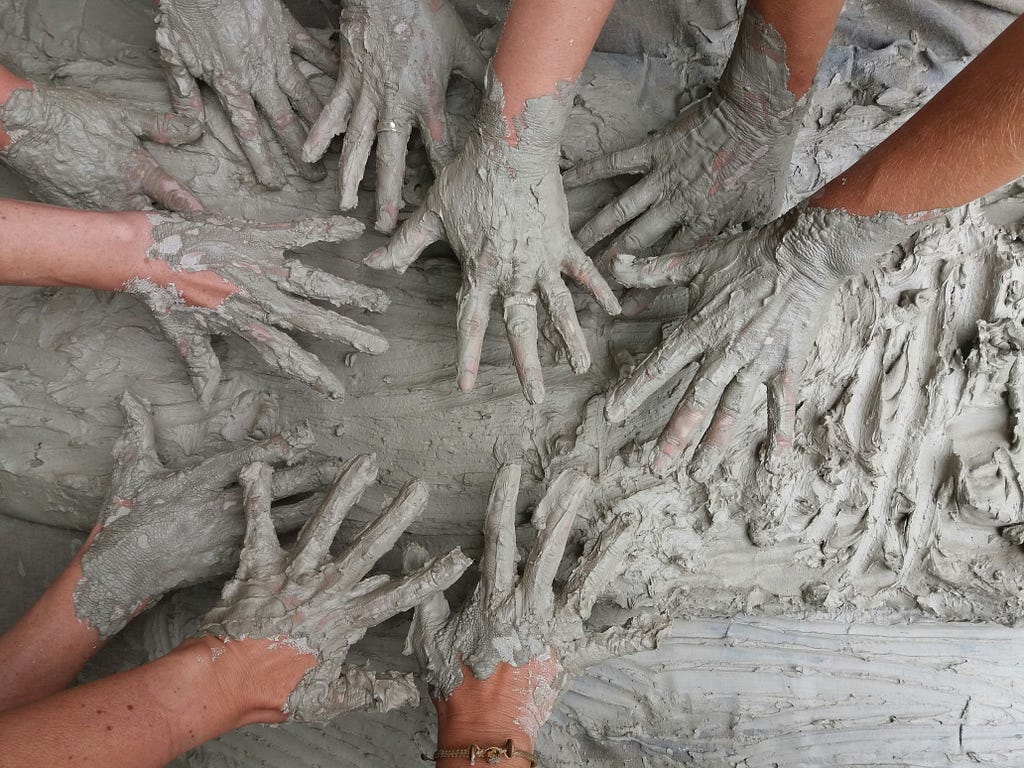
Five pairs of hands
A conversation with Christian Crumlish, on typesetters, AI, the jobs merging around us, and the work you would keep doing anyway.

In the early nineties, a couple of years out of college, Christian Crumlish went to work at Sybex, a publisher of computer books that Wiley later bought. A manuscript at Sybex went through a surprising number of hands before anyone could hold it as a book. The author typed it at home. An editor in the office read the pages, marked them up by hand and mailed them back, and the author typed a corrected version and mailed that in. Then the pages went to a person whose job title was literally “word processor,” and whose work was to type the whole manuscript into a Wang, a machine that did word processing and nothing else.
From there the text went to the typesetters, who set the columns on a phototypesetting machine that printed them out in long strips. Somebody cut the strips apart, ran them through a waxing machine and pressed them onto boards the size of a page, adding the pictures where they belonged and checking the alignment by eye. If a page came out wrong, you cut and pasted it again by hand. Then the proofreaders read the galleys and sent their marks back up the line.
Christian told me all this from memory, over a video call, more than thirty years later. At one point he warned me he might have the order wrong, then kept going, adding people to the chain as he remembered them. Not counting the author, there were five jobs in it.

Since then he has been an information architect, a writer, a product leader at AOL and head of product at 7 Cups, and he wrote Product Management for UX People. These days he is building Piper Morgan, an AI assistant for product managers, with a team made up entirely of AI agents. I’d asked him for an hour on how designers should think about their careers now. Partway through, he took me back to Sybex and the years when PCs arrived on everyone’s desk.
The desk
PCs arrived while he was there, and the chain started to get shorter. Writers began sending WordPerfect files instead of paper. Editors edited on screen, with whatever WordPerfect called tracked changes back then. There was still no email, so people mailed each other disks. And the person whose title was word processor wasn’t needed anymore. “That job was gone,” Christian said, and moved on to the typesetters.
Sybex offered to retrain the typesetters in desktop publishing, and some of them didn’t want it. They felt the new way “wasn’t as good,” and they saw themselves as typesetters, “not a person who works on a PC.” For a few of them that was the end of their career. Others went looking for one of the shops that still set type the old way. The ones who took the training became desktop publishers, and their new job covered the work of the word processor, the typesetter and the layout artist, because one person could now lay out a whole page on a screen in QuarkXPress. The proofreaders kept their jobs, “last time I checked,” he added.
I understand the typesetters who said no. They had spent years getting good at setting type, and to them the PC version looked worse. I’d like to think I would have taken the training. But I’ve watched my own work move away from design over the last few years, and I can see why someone would hold on.
He told me the story because he thinks the same thing is now happening to us, with AI. A lot of companies, he said, will look at the designers, researchers, product managers and engineers on a team and decide they need fewer people, each covering more. He doesn’t know yet what comes after. He called this “that in between phase,” the stretch before the new job titles settle.
A stop along the way
Afterwards I looked up what happened to the desktop publishers. The job still exists in US labor statistics. The Bureau of Labor Statistics counted about 4,600 desktop publishers in 2025, with a median wage of $55,290 a year, and it expects the number to drop another 14 percent by 2035. The reason it gives is that desktop-publishing tasks are “increasingly performed by other types of workers,” such as graphic designers, web designers and editors.
Where the lines came from
Someone joining the field today could easily believe there’s a right way to build software, with engineers, designers and product managers in fixed proportions, following a fixed process. Christian thinks it’s “a lot more made up than that.” The roles took their current shape because that was “a manageable way to get stuff done with today’s tools,” and he has seen the lines move before. Twenty years ago there were a lot more business analysts and a lot fewer product managers, doing much of the same work, split up differently.
To anyone outside UX, the differences between a researcher, a prototyper, a UI designer, a visual designer and a product designer are “all microscopic.” The pressure on those lines started with plain economics, with companies that didn’t want to pay for so many kinds of specialists, and AI has sped it up a lot. Product managers now ship code with an interface on it, designers build working versions of what they design without being much of a coder, and an engineer might decide, “I don’t need a designer anymore. Claude can make my interface.” Everyone keeps the core skill they’re comfortable with and wanders into areas that used to need another expert, and in the areas where you’re not the expert, what the machine makes tends to look good enough. Specialties are valuable to us, he said, because we “get to stay in just the thing we like to do the most.” He doesn’t think the rest of the company values them the same way.
This autumn I got my own version of this. A colleague at the bank where I lead a design chapter lost his job. He looked after our digital vendors, meaning the contracts and invoices, the security checks and the data protection reviews that touch every digital product we ship. When he left, his meetings came to me. My title and my pay didn’t change. Earlier this year, in The promotion that didn’t take, I wrote about scope sliding down to people while their titles stay put, something I had watched happen on my team. Now it had happened to me. The first vendor meeting I went to in his place was awkward for both sides. The person across the table was clearly wondering what a design lead was doing there. I was wondering the same thing, plus what I was supposed to say. It felt like being thrown into the sea and told to swim.
Christian thinks designers find this harder than most, because we tend to build our identity around being designers. He did the voice for me. “I’m not one of those suits. I’m not one of those drones, bean counters, all thinking about money all the time. I’m creative. I invent stuff.” So when a company decides it needs fewer designers, or wants you to be a designer who also does something else, “it can threaten your identity.” At a dinner earlier this year someone asked me what I do, and I paused before saying “designer,” long enough to notice it, and later I wrote about that pause.
What he never stopped being
Christian was never the pixel person, and he says so openly. He grew up when graphic design meant magazine ads and billboards, and he didn’t go to design school. On the spectrum from artist to designer he puts himself closer to the artist. He likes to draw what he likes, he’s bad at working on spec, and he’s no perfectionist about craft. He has a lot of respect for designers who care about the exact radius of a button’s curve and whether the light source on a shine makes sense everywhere it appears. It just isn’t what he’s good at, or what he could spend all day on. What drew him into the field was the planning and organizing, the orchestration, the strategy. “What’s the big picture? What’s the diagram? What’s the meaning of it all?”
Over the years he worked as an information architect, a content strategist and “just a writer,” and eventually he moved into product. He describes that move as a pull and a push. The pull was the strategic side of product work, the questions about how to make money, how to get customers and whether an idea is even sustainable. The push was a power imbalance. Product managers set the roadmap, and sometimes they just handed designers assignments, a wireframe here, “I need some screens” there. “In a sort of, like, greedy career oriented way,” he figured that if those people were in charge, maybe he should become one of them. He had seen it done at Yahoo, where the design VP and director on the search team one day became its product VP and director. “They just said, well, we’re product now,” he said, and his reaction at the time was “Oh, you can do that?”
His own move happened at AOL. His boss there, Matte Scheinker, who was also a friend, noticed where Christian’s energy was going before Christian did. “I can see that you are really, really thriving when you’re doing product stuff,” Christian remembers him saying. Matte made room for him to build product skills, and before he left AOL, Christian had gone from a consumer experience director title to director of product.
I never stopped being an information architect, even though my title became many other things.
He said that early in our call, in the middle of explaining what drew him to product. Even now, running his own product, he is often the one thinking about how the whole thing is structured, “because somebody has to, and no one’s job anymore is to do that.”
The one who can have coffee
Piper Morgan started in May 2025 with a question Christian typed into a chatbot. He describes himself back then as a product manager “maybe a little tired of doing the same knowledge management tasks over and over,” and he wanted to know how to build himself “a sort of ‘junior associate product management intern’” to take some of that work off his plate. He has written about what happened next ever since, in a series called Building Piper Morgan. It reads like a lab notebook, and he’s funny about his own mistakes.
By the time he published the first post, he had put more than 300 hours into the project. It began as a work experiment. His employer at the time paid for his first Claude Pro account and encouraged him to try things, and the idea was to help the whole team level up on process. The project moved faster than the team could, so after the first few weeks he kept going outside his main job, early in the morning, after work, on weekends, and checking in over lunch. He says he has “not written a single line of code (I’ve read a lot of it!).”
Piper Morgan is now built by eleven AI agents, each with a job title. There’s a chief of staff, a chief architect, a chief experience officer, a principal product manager, a lead developer and a communications director, among others. He added them one at a time, whenever a new kind of work kept coming up. Christian is the only human on the team. He still decides what gets built, and as he has told the agents, he’s “still the only one who can have coffee” with the people who matter to the project.
A lot of what he learned managing people turns out to carry over to managing machines. Early on, when something broke, he would get frustrated and type in capital letters, and the agent would “rush and try to, like, perform improvement” to make him less unhappy, “but not necessarily, like, carefully do the right thing.” He doesn’t think there’s a person in there, but the models learned from how people write and behave, and when you shout at them they act like people being shouted at. They cut corners and hide what went wrong. So now he runs blameless retros with his bots. His writing agent also has a standing rule to leave a bracketed placeholder when a draft needs an anecdote, because it used to make them up. “I’d be writing a blog post and they’d say something like, when I was working at Hulu,” he said. “Well, I never worked at Hulu.” He writes up the failures too, like the time an agent wiped the sprint assignments on all 1,175 items on his project board, with no way to undo it.
Managerial skills, he said, are “getting pushed down closer and closer to the junior level.” A designer used to be able to go through a whole career without learning to delegate. Now it’s as if every new employee gets a college intern on day one, one who knows nothing about the business, and has to learn how to brief it and check its work.
The people next to you
I asked him what a designer should actually do about all this. He talked about the people you already work with, what he called “the adjacent disciplines, the partner disciplines.” For a long time you could treat those roles as black boxes. He compared it to different courts sending ambassadors to each other. The product manager asks for something, the designer delivers it, and the engineer comes back with questions about the mock. He thinks that arrangement is ending. Some days designers will be doing a piece of the other jobs themselves, so they need to get nosier about how that work is done and stop saying “oh, sorry, I’m not in that union, I can’t do that work.” He’d like them to dabble in the other thing and learn it.
Sorry, I’m not in that union. I can’t do that work.
It works the other way too. His example was a salesperson who vibe-codes a UI, shows it to a customer, and now the customer wants that thing. Most designers would wince, and he admitted he wouldn’t want it to happen either. But salespeople have the tools now, so his answer is to show them where the design system is and meet with them once a week, so that their urge to shape the interface is “informed by a real designer.”
When he crossed into product, his bottom line became keeping the business alive and the customers coming, while the designers kept fighting for the best possible experience. Product and design “should be closely aligned, so you can really work together,” he said, though never 100 percent, because “they have different agendas.” Handled well, that tension “teases out the nuances” and produces something better than either side’s first idea, “not some clumsy compromise, but actually, like, an alloy.”
He wants designers to keep their taste and their opinions about AI, as long as those opinions are well informed. His example was synthetic users. A designer could agree they’re useful for some experiments when they’re built from large sets of real user data, and still say, “I do not want to stop talking to real people and just talk to synthetic users. I believe that will not work for these reasons. I researched it.” That’s “a much more well grounded position,” he said, than “I don’t like change. I don’t like AI.”
If you stay too narrow, other people who can “cover one and a half things” will outcompete you. He compared it to musical chairs. When the music stops and the rules change, “you want to be doing a useful thing.”
New clay
Near the end I asked how he sees the industry three to five years from now. “Oh, God,” he said, and took a while to answer. He talked about software that makes other software, and about designing for a world where people send their own agents to your product and you no longer control the screen they see.
Earlier in the call he had compared AI to a new kind of clay. Imagine you’ve worked with clay your whole life, and a strange new material shows up, soft and rubbery, that behaves differently in the kiln. You’d have to spend time with it. You’d make some pretty ugly pottery that collapsed. After a while you’d find things it can do that clay never could, and places where you’d never use it because it’s too squishy, and you’d develop a feel for the material and a taste for it.
“If anybody got into UX or tech for stability,” he said, “I don’t think it’s a guarantee of that.” For a while it looked like a career you could learn in college and then settle into, “like being a really good electrician,” but he thinks that was “kind of an illusion,” and the work was always demanding underneath.
We just got to a part of the mountain that’s steeper, and you got to get your climbing gear out.
Since the call I’ve been asking myself which part of my work I would keep doing if my title disappeared tomorrow, along with the tools that come with it, and nobody paid me for it, just because I can’t stop thinking about it. For me it’s building things. When I moved into management I stopped designing day to day, so I started side projects to keep the craft alive, and they’ve become the place where I try ideas the bank isn’t ready for yet. If you ask yourself the same question, I’d like to hear your answer.
Christian Crumlish leads Design in Product, writes the Building Piper Morgan series, and is the author of Product Management for UX People.
This conversation is part of a series with designers who left the craft or reshaped it into something new. The earlier ones were with Whitney Hess and Jamie Rothwell.
One of the side projects I mentioned is a free self-assessment for designers. It’s scenario based, takes about ten minutes, and the result is a profile of where you stand. You can find it at designlevel.io/assessment.
And if you think I am wrong about any of this, tell me. The strongest corrections to my thinking have come from readers.
Five pairs of hands: what the typesetters can teach designers about AI was originally published in UX Collective on Medium, where people are continuing the conversation by highlighting and responding to this story.