
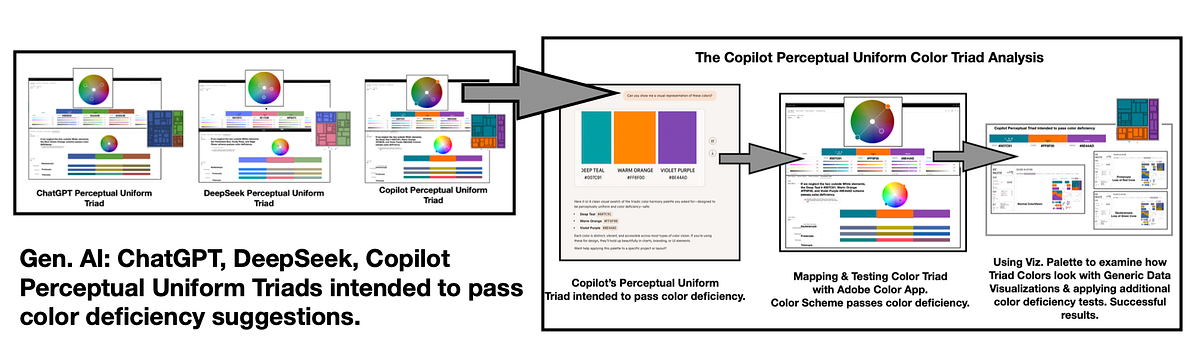
My next step in exploring the capabilities of Gen. AIs to produce perceptional uniform color triads that pass color deficiency was to examine results from Microsoft’s Copilot. I previously explored Claude, ChatGPT, and DeepSeek efforts. A color space is perceptually uniform if a change of length in any direction X of the color space is perceived by a human as the same change. Non-uniform perceptual color spaces like RGB and RYB can have stark contrasts when transitioning from one hue to another hue.
In data visualization, these contrasts can be mistaken as changes in the data rather than as transitions in the color palette. As a result, many data visualization practitioners prefer to work in the perceptual uniform CIE LAB or Hue Chroma Luminance (HCL) color spaces. Unfortunately, these color spaces have irregularly shaped geometries resulting in challenges to calculate color combinations that also pass color deficiency. Gen AI systems, like Microsoft Copilot, can help to quickly locate these perceptual uniform color schemes for data visualization.
Let’s begin our journey by first defining the concepts of triad color harmony, perceptual uniformity, and color deficiency. From there, a Copilot perceptual uniform triad color suggestion can be examined and contrasted with…