
I’ve been designing for a long time. I’ve burned out, and I’ve watched other designers burn out. The job market is brutal, AI is changing everything, and companies still don’t value design the way they should. All true. But there’s a thread underneath all of it that isn’t called out enough, and it’s one we created ourselves.
Data doesn’t lie
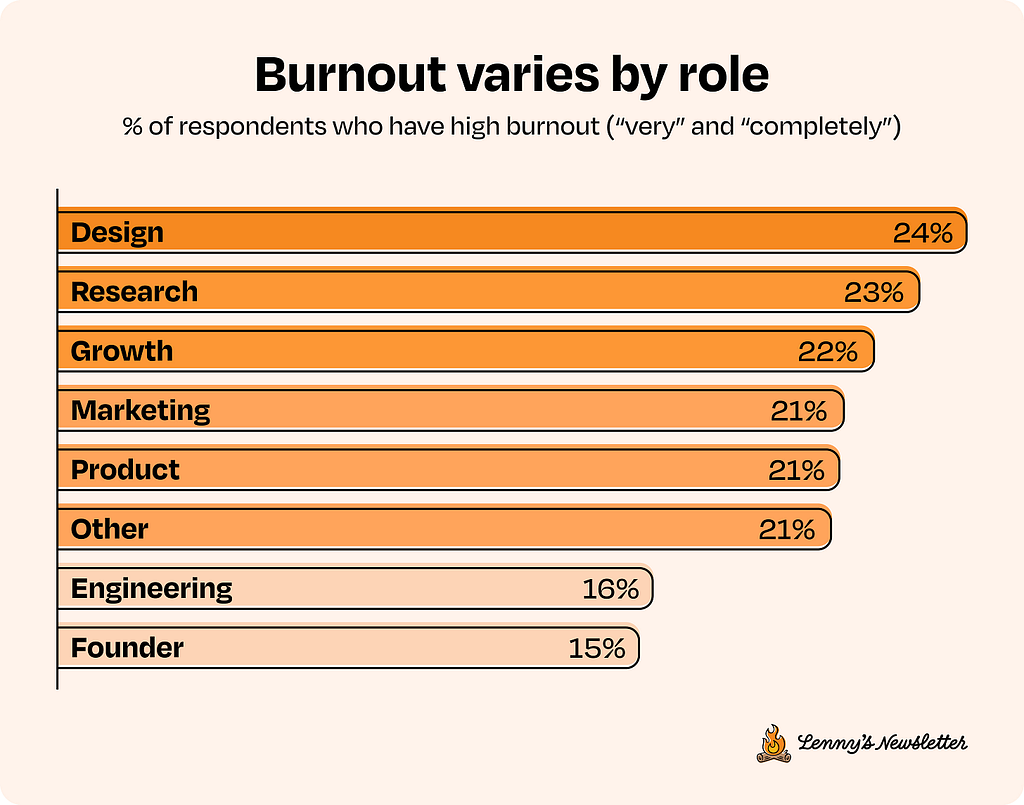
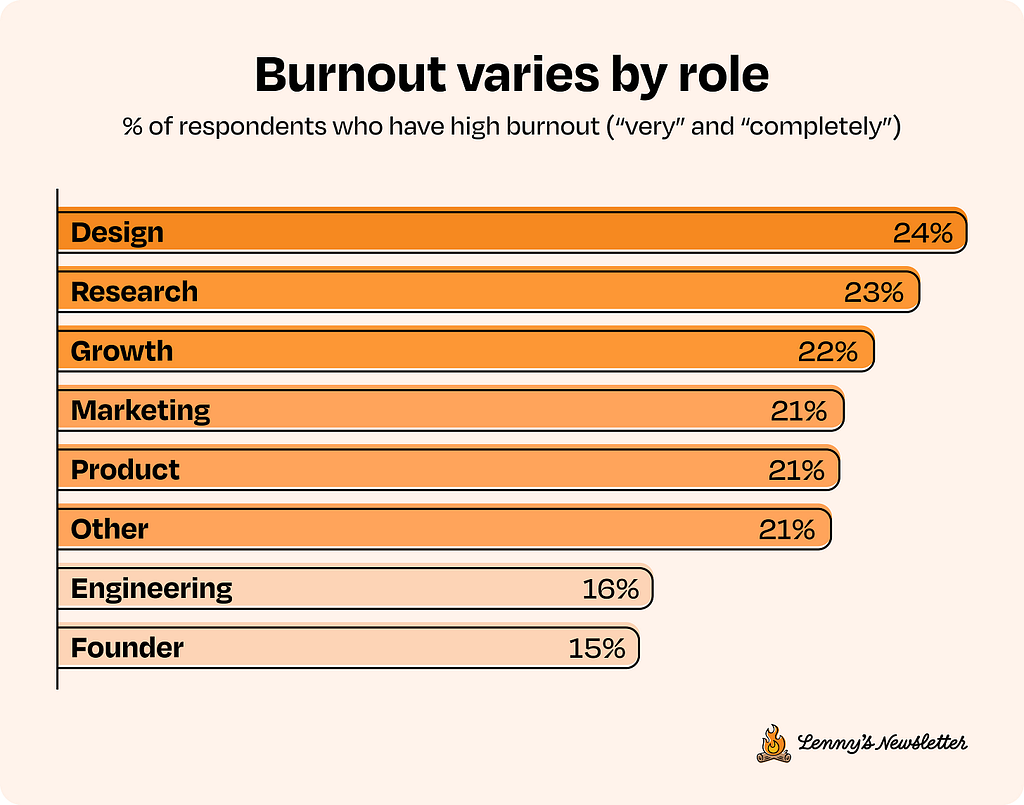
In May 2025, Lenny Rachitsky published survey results from over 8,200 tech workers. Design and research roles had the highest burnout rates in the entire sample: 24% and 23%, respectively. Higher than Engineering. Higher than Product.
What’s driving it? A lot of fingers point outward: AI, layoffs, shrinking teams, companies that don’t value design. However, there’s a quieter contributor that points back at us, and it lives inside the very frameworks we built for ourselves.
The frameworks we built
The most referenced design career ladders in the industry were written by design managers and VPs, published openly, and copied across the field. Figma’s career levels were built internally by the design management team. Intercom’s design team published theirs under a Creative Commons license so anyone could adapt them. DoorDash’s Head of Design wrote a public how-to on the process. These frameworks spread through sites like Progression.fyi, where design leaders share their work with other design leaders.
The community that built these tools for itself keeps reaching for the same structure: Craft, Strategy, Impact, and Collaboration, with collaboration carrying meaningful, and often equal, weight. Figma’s ladder lists Collaboration as one of four core pillars. DoorDash’s framework includes “contribution to culture” as a measured axis. Intercom’s design ladder has a full “Behaviors” section. These aren’t outliers. They’re the templates the rest of the industry is building from.
Here’s where it gets interesting
In Intercom’s PM career ladder, collaboration is almost entirely operational: Collaborates effectively, reacts well to feedback, and removes barriers that slow people down. Even the emotional language that shows up, like “warm and empathetic,” is tied to being consistent and predictable. The frame is: Does this person make the machine run smoothly?
Their design ladder asks something a little different. Designers are expected to “use storytelling,” to “excite, align and influence,” to “craft compelling narratives” that “inspire others.” The PM ladder asks whether you can synthesize inputs into a clear story. The design ladder asks whether you can move people emotionally. One is a coordination skill. The other is a relational performance, and it’s much harder to evaluate without bias.
The pattern holds everywhere you look. PM and engineering ladders use behavioral language: "Rarely needs guidance when collaborating." "Decisive and assertive." "Doesn't procrastinate." These are still somewhat subjective, but they describe actions. Design ladders describe dispositions. And dispositional language gives managers cover to make evaluations that are really about relationships, politics, or personality, without having to say so.
When the criteria are dispositional and perception-based, bias doesn’t just creep in; it’s structurally invited. Designers are disproportionately women, and are among the most on the receiving end of that. Academic research on subjective performance evaluation consistently finds that it reduces motivation, increases turnover, and allows favoritism. The problem isn’t that subjective criteria exist. It’s that they’re applied unevenly. When engineering ladders are mostly behavioral, and design ladders are mostly dispositional, designers absorb far more of the risk.
Why we built it this way, and what it costs
Design managers have become the emotional shock absorbers of their organizations, translating between business metrics and user empathy, defending timelines to stakeholders while pushing their teams to move faster, absorbing stress from above and below with nowhere to put it. That’s the job they survived. When those managers built career ladders, they encoded the skills they used to survive. The result is a profession that has taught itself, through the frameworks it openly shares, that emotional labor is craft.
The wording is open-ended enough that a manager can point to almost any criteria and say, “not meeting expectations.” You can’t disprove “not maintaining an open mindset” or “not showing enough citizenship.” There’s no evidence standard. It’s perception masquerading as evaluation, and because these frameworks were written with good intentions and published by respected companies, they carry institutional authority that makes it very hard to push back on.
Stuart Frisby puts it plainly: In calibration sessions, design managers “are outnumbered by people who work in ways which are fundamentally different, and fundamentally incomparable.” Engineers look for output. PMs look for stakeholder management. Designers, by default, are evaluated through those frames by people who never had to endure what the design manager endured and who don’t fully understand what they’re measuring.
Being evaluated on how your teammates feel about working with you is a completely different kind of weight. You can’t optimize for it. You can’t always see it coming. You can do everything right and still fail the metric because it depends on how other people feel, and how they feel is shaped by dynamics no individual can fully control. A late-stage scope change, an engineer who skips design review, a product decision that overrides user research, none of that shows up on anyone else’s review. But the friction it creates can show up on yours, filed under “collaboration” or “stakeholder relationships.”
What this is doing to the field
PM and engineering roles are generally considered higher stress due to being closer to the business, being on call, being on the hook for outcomes, etc. But I’m watching experienced designers move into those roles anyway. Lenny’s State of the Product Job Market found that PM demand is 1.27x higher than designer demand and growing.
Designers are moving toward roles with clearer accountability and actual authority. You know when you've failed. You know what you're being measured against. You'd rather be responsible for a number you can track than a vibe you can't control. They got tired of having their careers feel precarious over things they couldn’t control. When you’ve spent years being evaluated on whether people liked working with you, a role where you’re measured on outcomes you can actually point to starts to feel like relief, even if it’s harder in other ways. It’s not that those roles have less pressure. It’s that the pressure makes sense.
What the field loses when that keeps happening is the people with the most design judgment, the most capacity to push back on bad product decisions, the most experience doing the actual work. Junior and mid-level designers inherit an industry where the evaluation standard was set by the people who couldn’t stay. They’re still being sold the idea that being likable and collaborative is what makes a great designer, without anyone asking whether their PM is being held to the same standard.
What needs to change
The fix isn’t removing collaboration from design ladders. Cross-functional communication is real. Documentation matters. The ability to present and defend decisions under pressure is a genuine skill.
The real fix is removing the criteria that put a designer’s career at risk based on things outside their control. How your stakeholders feel about you is not something you can fully own. Whether your team gave you positive feedback is not something you can fully own. Those things are influenced by org dysfunction, by a PM who wrote bad requirements, by an engineer who loops you in to QA too late, by a manager who already made up their mind.
If relational quality genuinely matters, it needs to live in PM and engineering evaluation frameworks too, with real weight, not a single competency line. Did the PM write requirements clear enough to execute against? Did engineers flag design concerns before implementation rather than after? Did anyone on the cross-functional team create the conditions for collaboration, or did they just expect the designer to smooth it over?
The frameworks we built to professionalize this field are creating a standard that just ends up exhausting the people we’re trying to support. The people who wrote them didn’t have bad intentions, but wrote from survival. Surviving in an undervalued function requires a kind of emotional labor that probably shouldn’t define what it means to be a great designer. Who designs at their best when they are burnt out?
The job market is hard enough. We don’t need to make it harder by measuring designers against a bar that no one else in the room is being asked to clear.
Designers: We are perpetuating our own burnout problem was originally published in UX Collective on Medium, where people are continuing the conversation by highlighting and responding to this story.