
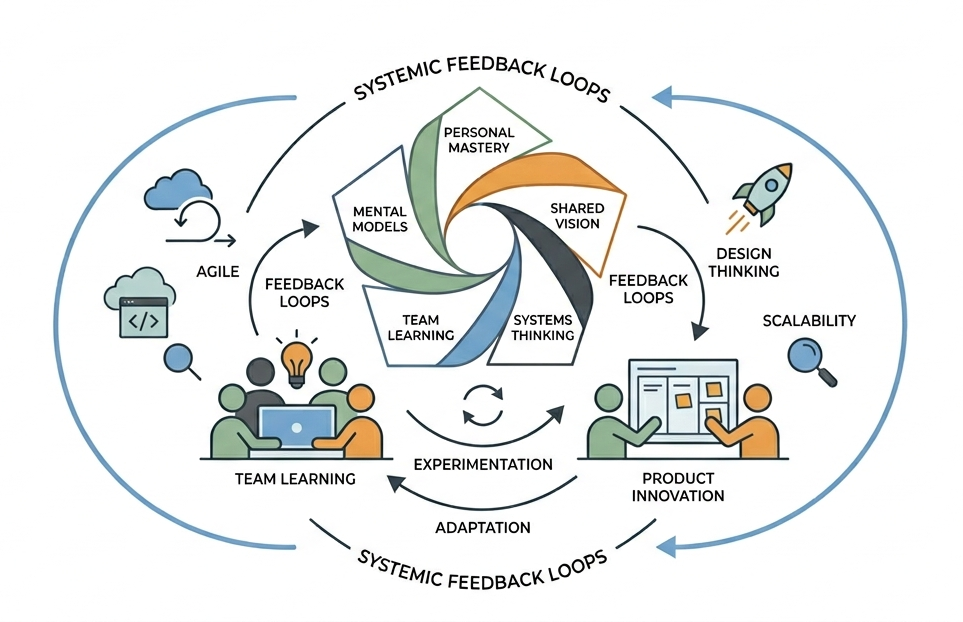
A systemic analysis of Peter Senge’s learning organisation within the modern product and design ecosystem
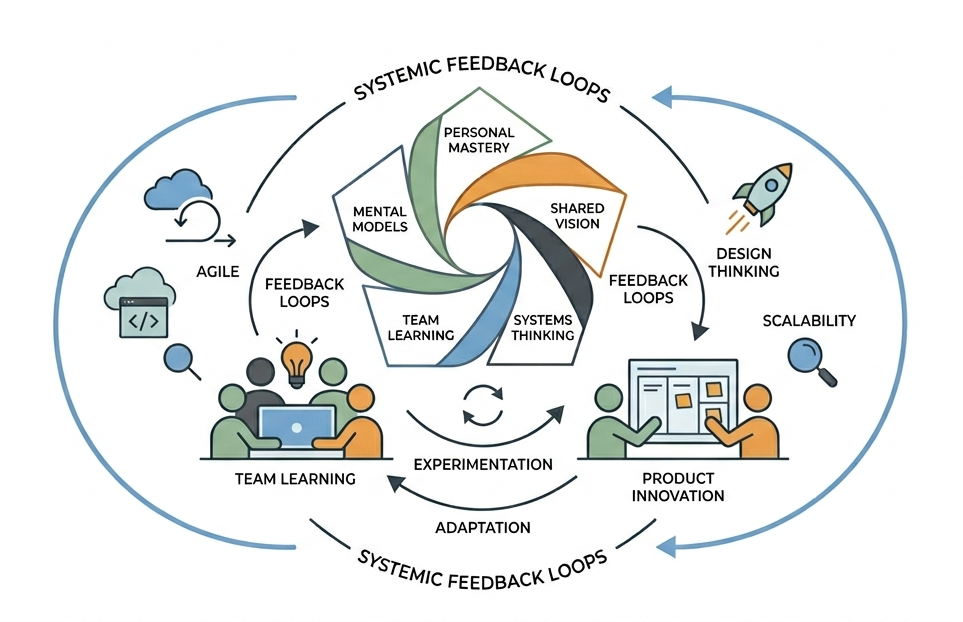
Over the past few weeks I was reading the conceptual framework of the “Learning Organization,” as articulated by Peter Senge of the MIT Sloan School of Management, which represents a paradigm shift from the mechanical, industrial-era hierarchies toward a biological, systemic view of corporate governance.
In his foundational 1990 work, The Fifth Discipline, Senge argues that,
In an increasingly volatile and complex global market, the only sustainable source of competitive advantage is an organisation’s collective capacity to learn faster than its rivals.
This philosophy posits that high-performance teams are not merely collections of skilled individuals but integrated units that continuously enhance their ability to create the future they desire.
In my current role, one of the key challenges is ensuring that cross-functional operations run smoothly.
In today’s modern professional landscape — particularly for Product Managers, DesignOps leads, and UX Designers — these principles serve as essential architectural blueprints. They help navigate the complex feedback loops between user behavior, technical constraints, and organizational dynamics.
The foundation of the Fifth Discipline
Let’s see this challenge from the core of Senge’s theory,
Rests upon the belief that organisations are living systems characterised by interdependencies rather than isolated functions.
The shift toward a learning organisation requires a fundamental “metanoia” — a shift of mind — where members move from seeing themselves as passive responders to external events to seeing themselves as active participants in shaping their systemic reality. This generative learning differs from traditional adaptive learning, which focuses on mere survival; generative learning is about the expansion of creative capacity.
Senge identifies five core disciplines that serve as the “component technologies” of the learning organization. These disciplines are not separate initiatives but an integrated body of theory and practice. Systems thinking serves as the fifth discipline, acting as the cornerstone that integrates the other four: personal mastery, mental models, shared vision, and team learning.
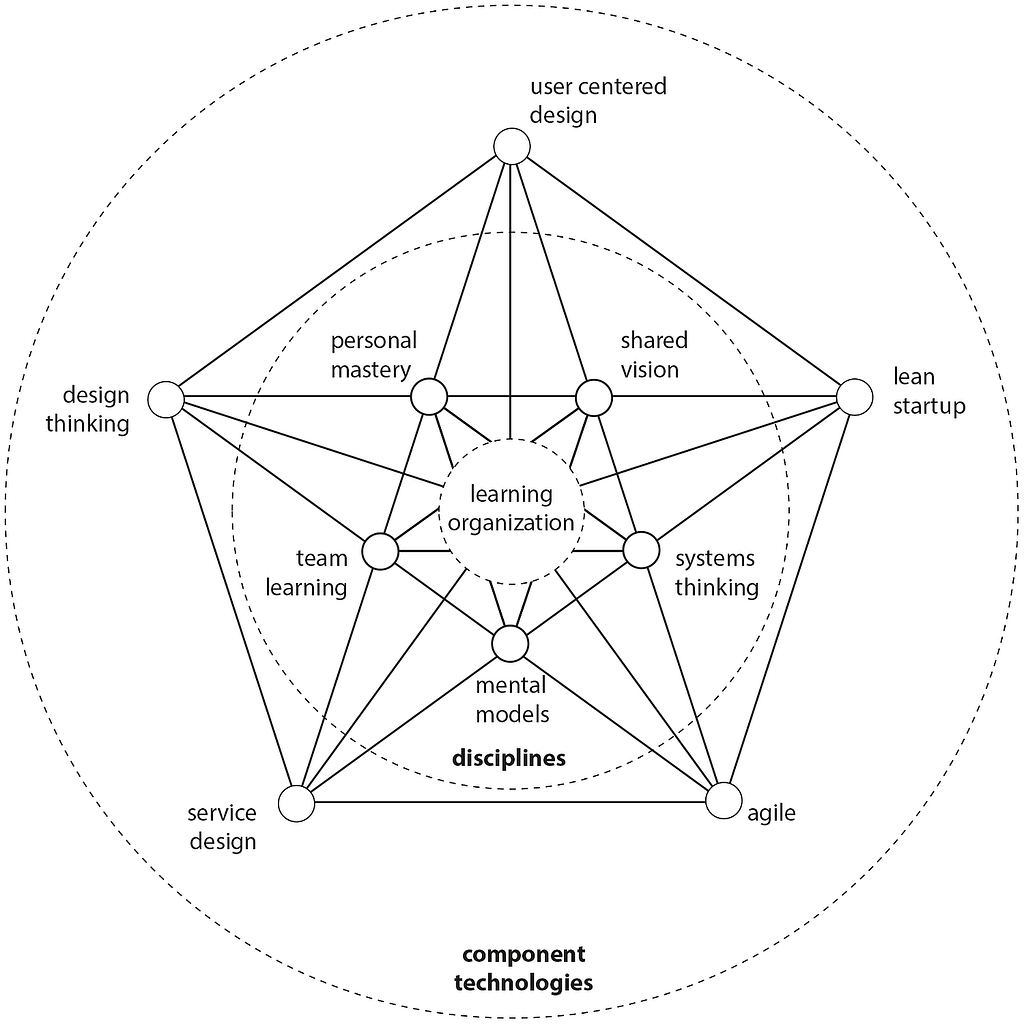
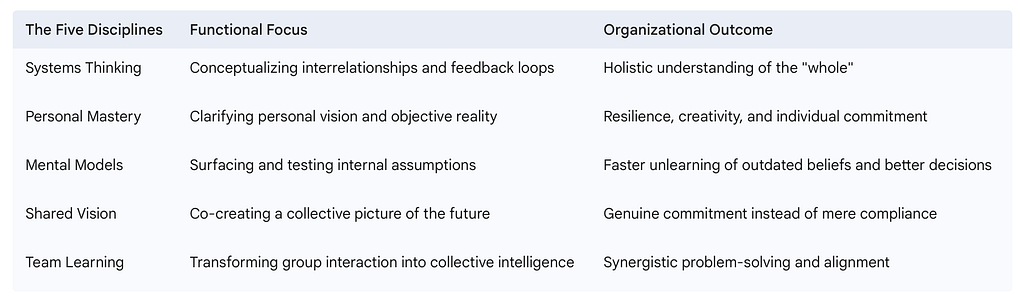
Systems thinking: The integrating cornerstone
Systems thinking involves,
The ability to recognise patterns of change rather than snapshots, and to see the circular nature of cause and effect rather than linear sequences.
In the realm of product development, a linear perspective might conclude that a drop in user retention is caused by a specific UI change (Event A leads to Event B). A systemic perspective, however, would look for the reinforcing and balancing feedback loops that govern the entire user journey, identifying how technical debt, market timing, and customer support responsiveness interact to influence retention over time.
The mechanics of Feedback and Delay
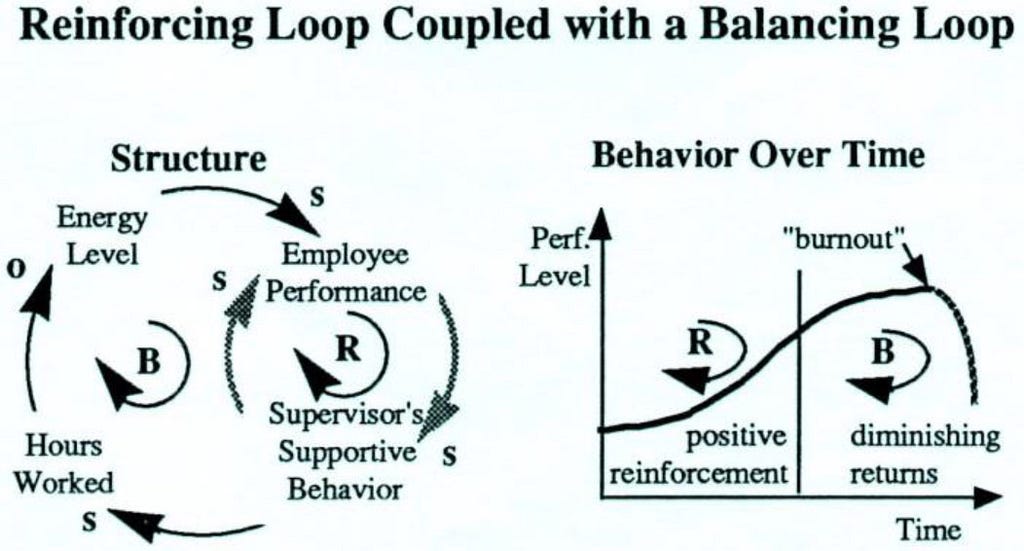
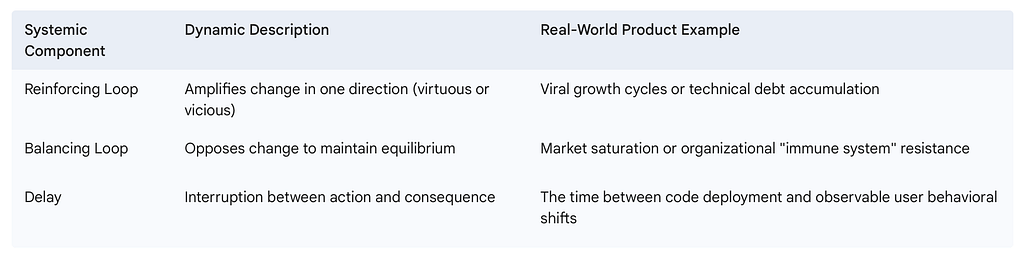
Central to systems thinking are the concepts of reinforcing feedback, balancing feedback, and delays.
- Reinforcing loops are engines of growth or decline (e.g., more users leading to more content, which attracts even more users).
- Balancing loops are self-correcting mechanisms that maintain stability but can also create resistance to change (e.g., a team working harder to meet a deadline but eventually hitting a plateau of exhaustion and error).
- Delay is the gap between an action and its visible result, which often leads to over-correction and systemic instability.
Eleven laws of systems thinking
Senge outlines eleven laws that govern systemic behaviour, which serve as warnings for managers accustomed to linear problem-solving.
- Today’s problems come from yesterday’s “solutions”: Interventions that solve a symptom without addressing the root cause often create new problems elsewhere in the system.
- The harder you push, the harder the system pushes back: Compensatory feedback occurs when well-intentioned interventions trigger responses that offset the benefits of the intervention.
- Behaviour grows better before it grows worse: Low-leverage interventions often yield short-term gains that mask long-term deterioration.
- The easy way out usually leads back in: Reliance on familiar solutions rather than systemic redesign often results in the problem’s return.
- The cure can be worse than the disease: Symptomatic fixes can lead to addiction or dependence on the intervention (e.g., constant firefighting).
- Faster is slower: Pushing for rapid growth often leads to systemic collapse or the “cooling off” of the system’s natural limits.
- Cause and effect are not closely related in time and space: The source of a problem is rarely found in the immediate vicinity of its symptoms.
- Small changes can produce big results (leverage points): High-leverage areas are often the least obvious but offer the most significant impact.
- You can have your cake and eat it too, but not at the same time: Systems thinking allows for the resolution of seemingly impossible trade-offs by looking at them over a longer time horizon.
- Dividing an elephant in half does not produce two small elephants: Living systems cannot be understood by looking at their parts in isolation.
- There is no blame: Systems thinking teaches that the enemy is the structure of the system, not the individuals within it.
Implementation in product management: Navigating complexity
Now let’s think as a Product Managers (PMs), Product Managers function as the architects of their product’s ecosystem. Applying Senge’s theory allows PMs to move from being “feature factories” to being strategic designers of value-delivery systems.
Stakeholder management through bounded rationality
A systems-thinking PM views stakeholder management as an exercise in system design rather than interpersonal negotiation. Using Donella Meadows’ principle of bounded rationality, PMs understand that stakeholders make rational decisions based on the specific information and incentives they receive.
When a stakeholder demands a low-value feature, the systemic response is not to argue, but to fix the information flows and align the incentives that led to that demand.
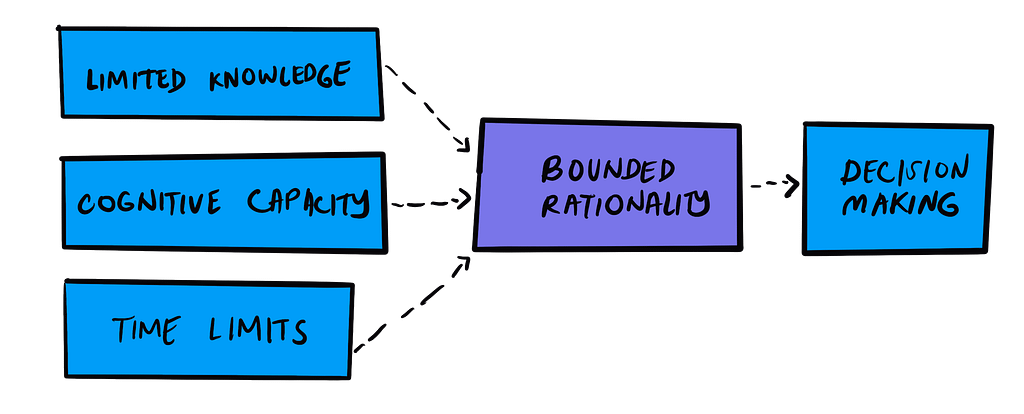
By visualising the system map for all stakeholders, the PM fosters a shared understanding of why certain trade-offs are necessary for the whole system’s health.
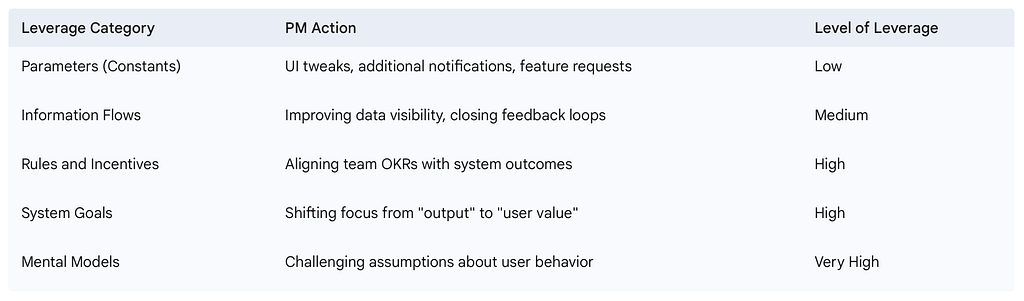
Designing structural interventions in roadmaps
Roadmaps in a learning organisation are not static lists of outputs but sets of systemic interventions.
PMs identify high-leverage points — such as reducing information gaps, correcting misaligned incentives, or closing feedback loops — to change the underlying behaviour of the product.
For example, instead of merely adding a notification feature (a low-leverage parameter change), a systemic PM might redesign the “value loop” by accelerating the time-to-reward for a new user, thereby reinforcing the habit of product usage.
Systems thinking in UX design: The user ecosystem
I believe designers are the last gatekeepers of the digital world, UX Designers utilise systems thinking to move beyond the interface and understand the broader user ecosystem.
A digital product is merely one component in a complex environment of social, cultural, and technological factors.
Mapping complex user relationships
By mapping user ecosystems, UX researchers visualise the relationships between users, stakeholders, products, and services. This holistic analysis enables designers to anticipate side effects and unintended consequences of design changes.
For instance, a change meant to simplify a checkout flow for a customer might inadvertently create a bottleneck for the back-end fulfilment team.
Systems-thinking designers look for these interconnections to optimise the entire system rather than just a single touchpoint.
Iterative and adaptive Design Systems
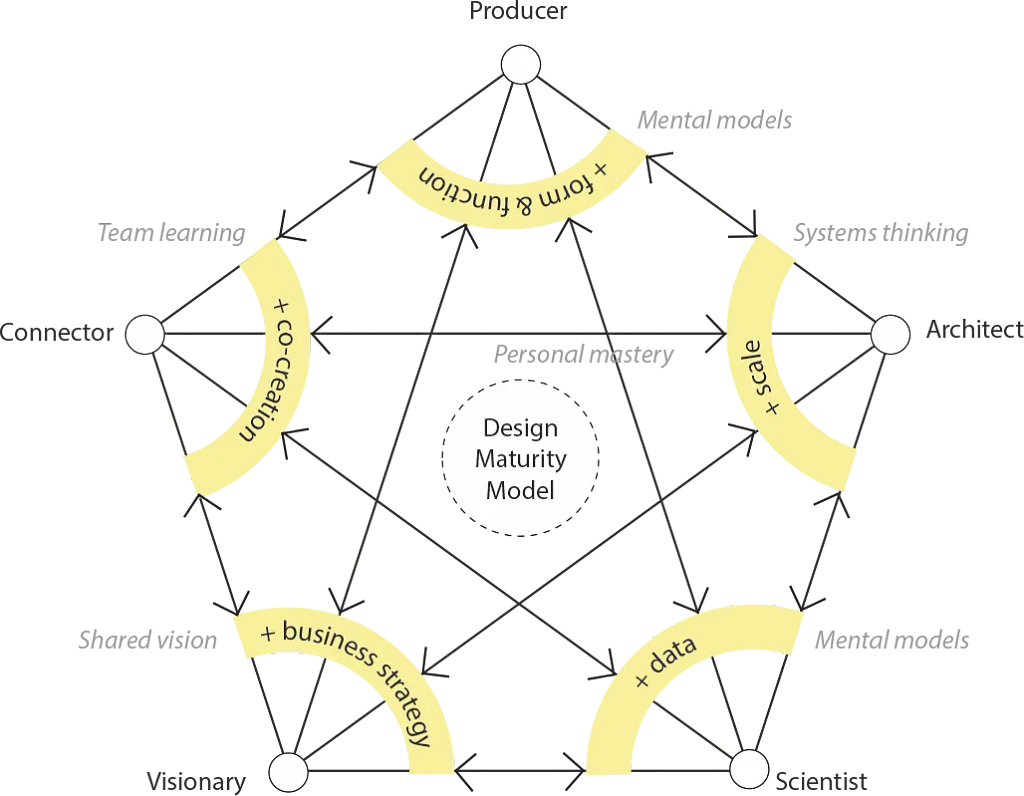
In a learning organization, design is an iterative and adaptive process. Designers must embrace ambiguity and treat design artifacts — such as personas or design systems — as living documents that evolve as the team’s understanding of the system deepens. The design system itself acts as a “shared mental model,” codifying the principles and patterns that govern the product experience. DesignOps facilitates this by ensuring that the design system is continuously updated based on feedback from both the design and engineering teams, thereby preventing “siloed” thinking.
DesignOps: Scaling the learning organisation
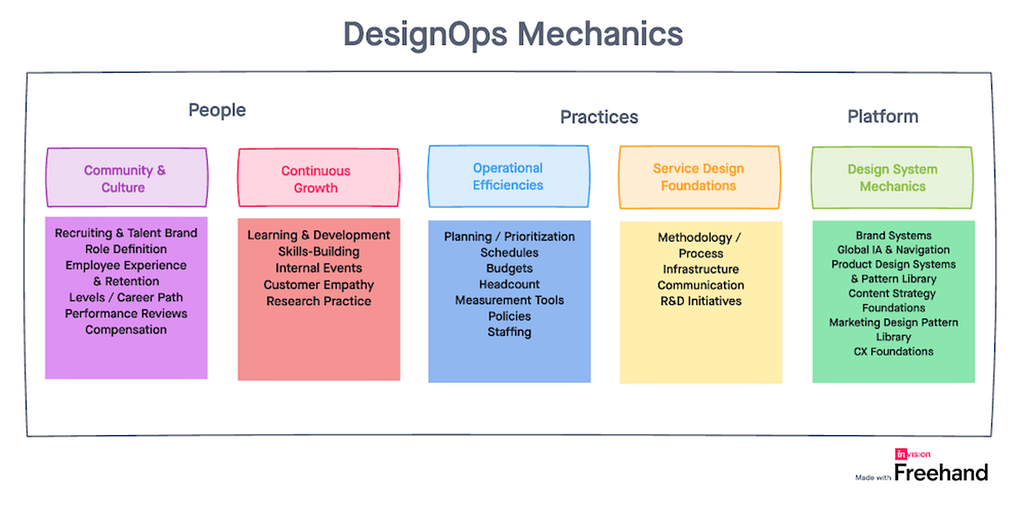
DesignOps serves as the operational engine that enables a design team to function as a learning organization. By focusing on the “how” of design, DesignOps professionals implement the five disciplines at scale.
Personal mastery and coaching
DesignOps fosters personal mastery by providing structured coaching and professional development pathways. Unlike traditional training, which focuses on specific skills, this coaching helps designers clarify their personal vision and manage the creative tension between that vision and current reality. Consultants and coaches work one-on-one with design leads to help them identify goals and stay accountable to their personal growth, which in turn enhances the collective capability of the design team.
Mental models and change management
Mental models are the implicit assumptions that shape how a design team views its role and its relationship to the business.
DesignOps uses change management strategies to surface and challenge these models.
External consultants can bring “fresh perspectives” that expose outdated or limiting beliefs, such as the assumption that “design is only about aesthetics”. By creating a safe environment for dialogue, DesignOps enables teams to refine their shared mental models and align them with the organization’s evolving goals.
Overcoming learning disabilities in the corporate environment
Senge identifies seven learning disabilities that act as structural barriers to organisational learning. These are often exacerbated in high-pressure tech environments.
Seven learning disabilities in tech contexts
- “I am my position”: Designers or PMs who focus only on their specific job descriptions fail to see their influence on the overall product outcome, leading to a lack of accountability for systemic failures.
- “The enemy is out there”: Teams often point to other departments (e.g., “Marketing didn’t provide good specs”) as the cause of problems, rather than examining how their own internal structures contributed to the issue.
- The illusion of taking charge: Managers who react to crises with top-down “new rules” or “quick fixes” are often merely reacting to symptoms, which Senge characterises as the danger of reactive action rather than true proactivity.
- The fixation on events: A preoccupation with short-term metrics (e.g., daily active users) or “one-day events” prevents a team from seeing the small, continuous shifts that indicate long-term systemic trends.
- The parable of the boiled frog: Organisations often fail to notice gradual environmental changes — such as a slow decline in technical quality or shifting user expectations — until it is too late to react.
- The delusion of learning from experience: Because the most important consequences of our actions are often delayed in time, we cannot truly learn the long-term impact of our decisions by looking at short-term results.
- The myth of the management team: The reliance on a heroic management team to solve all problems inhibits decentralised learning and ignores the fact that no single manager can know every process in a complex system.
System archetypes: Patterns of organisational behaviour
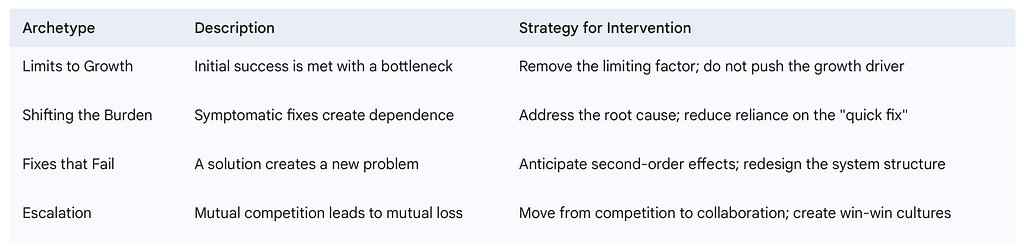
System archetypes are recurring structures that provide a language for discussing systemic behaviour. By recognising these archetypes, product and design leaders can move from reacting to events to designing the system structure.
Nine common system archetypes
- Delay: The time lag between an action and its result often causes over-shooting or frustration.
- Limits to growth: A period of rapid expansion is followed by a slowing of growth as the system hits a limiting factor. The solution is to identify and remove the “limiting factor” rather than pushing harder on the growth engine.
- Shifting the burden: A symptomatic solution is used to provide relief, but it only addresses the symptoms, not the root cause. This leads to the problem returning and a dependence on the symptomatic fix.
- Deteriorating goals: In times of crisis, a team lowers its standards or sets aside its vision to achieve a short-term goal, which eliminates the direction needed for long-term success.
- Escalation loop: Two actors influence each other in a lose-lose situation, such as a “feature war” between competitors that results in a bloated, unusable product for both.
- Success to the successful: Resources are disproportionately allocated to already successful projects, causing less successful but potentially high-value initiatives to starve.
- Politics to receive resources: Departments manipulate data or “game” the system to receive a larger share of a limited resource pool, rather than acting in the interest of the whole.
- Solutions which do not solve: Short-term positive results lead to long-term losses, such as cutting QA testing to speed up a release, which leads to catastrophic post-launch bugs.
- Growth and underinvestment: A failure to invest in capacity or skills during a boom leads to an inability to handle future growth, resulting in a loss of market share.
Team learning and the role of dialogue
Team learning is the process of developing the potential for many minds to be more intelligent than one mind. Senge argues that teams, not individuals, are the fundamental unit of learning in a modern organisation.
Dialogue vs. Discussion
A critical practice in team learning is the distinction between dialogue and discussion. In a dialogue, team members “suspend” their assumptions and enter into a “genuine thinking together”. This is contrasted with a discussion, which is a competitive process aimed at “winning” or reaching a decision through advocacy.
For dialogue to occur, three conditions must be met:
- Members must suspend their judgments and assumptions.
- Members must regard each other as colleagues, not rivals.
- A facilitator must “hold the space” for the dialogue to proceed.
Three levels of explanation
To facilitate team learning, Senge suggests analyzing problems at three levels:
- Event level: A reactive explanation based on what happened (e.g., “The server went down”).
- Behaviour level: A responsive explanation based on patterns over time (e.g., “Server load increases every Friday afternoon”).
- Structural level: A generative explanation based on the underlying system design (e.g., “The load balancing algorithm is not designed for spikes in mobile traffic”).
True learning occurs at the structural level, where the system itself can be redesigned to produce different behaviors and events.
Strategies for Monday morning
Implementing the five disciplines is not about a single workshop but about integrating “learning health” into the daily operating rhythms of the organization.
Practical rituals and tools
- The Ladder of Inference: A tool for mental models that helps individuals recognise how they jump from observable data to biased conclusions.
- After-Action Reviews (AARs): A team learning ritual focused on four questions: What was supposed to happen? What actually happened? Why was there a difference? What can we learn for next time?.
- Causal loop diagrams: A visual method for systems thinking that maps the interrelationships between variables to identify leverage points.
- Visioning workshops: Sessions where a shared vision is co-created by all members of the organisation, moving beyond the “founder’s aspiration” to a collectively owned future.
- Left-hand column exercise: A mental model practice where individuals write what they were actually thinking versus what they said during a difficult conversation to surface hidden assumptions.
Measuring learning health
Organizations can measure their progress toward becoming a learning organization through specific KPIs.
- AAR completion rates: The frequency and quality of reflection sessions following major projects.
- Double-loop learning changes: The number of times a team identifies and corrects the underlying system structure rather than just the symptom.
- Psychological safety pulse: Regular surveys to assess whether team members feel safe to take risks and be vulnerable.
- Time-to-decision: A reduction in the time it takes for a team to reach alignment and take action in complex situations.
Pros and cons of the Fifth Discipline model
While the Learning Organisation model provides a powerful framework for adaptation, its implementation requires a significant cultural shift and carries certain risks.
Pros
- Sustainable innovation: By fostering a culture of continuous learning, organisations can maintain their innovative edge even as market conditions change.
- Higher employee engagement: The focus on personal mastery and shared vision aligns individual purpose with organizational goals, leading to higher levels of commitment and job satisfaction.
- Increased resilience: Systems thinking enables organizations to anticipate and adapt to disruptions before they become crises.
- Collaborative efficiency: Breaking down silos and improving team learning accelerates information flow and reduces handoff errors.
Cons and implementation barriers
- Resource and time intensive: Building a learning organization is a “slow” process that can conflict with short-term financial pressures. Senge notes that “faster is slower,” and organisations often struggle with the “planned pause” required for reflection.
- Resistance to change: Moving away from traditional hierarchies can be unsettling for employees and managers accustomed to command-and-control structures.
- Overhead of dialogue: Engaging in genuine dialogue takes more time than simple top-down discussion, which can lead to frustration in fast-paced environments.
- Difficulty in measurement: Unlike financial metrics, “learning health” is often difficult to quantify, making it hard for leaders to justify the long-term investment to stakeholders.
- The complexity gap: The high level of conceptual skill required for systems thinking can create a gap where some team members feel overwhelmed by the complexity of the maps and archetypes.
Future outlook: The agentic learning organisation
The rise of “Agentic AI” and sophisticated automation represents the next frontier for Senge’s theory. Future learning organisations will likely feature “agent ecosystems” where specialised AI agents collaborate with human experts to manage interconnected processes.
These systems will provide “democratised process insight,” allowing every member of the organisation to see the “whole” in real-time, effectively automating the data-collection phase of systems thinking and allowing humans to focus on the higher-level disciplines of shared vision and dialogue.
Designing the future
Peter Senge’s The Fifth Discipline remains a seminal guide for organisations seeking to navigate the escalating complexity of the modern world. By integrating systems thinking as the cornerstone, organisations can transform their cultures into environments where learning is decentralised, continuous, and generative.
For Product Managers, DesignOps professionals, and UX Designers, these disciplines are not merely management theories but practical tools for building products and systems that are resilient, user-centric, and future-proof. The ultimate success of a learning organization lies in its ability to reconcile the tension between the current reality and its collective vision, turning the “struggle between work and family time” or “siloed technical debt” into a synergistic drive for innovation.
Designing adaptive teams was originally published in UX Collective on Medium, where people are continuing the conversation by highlighting and responding to this story.