
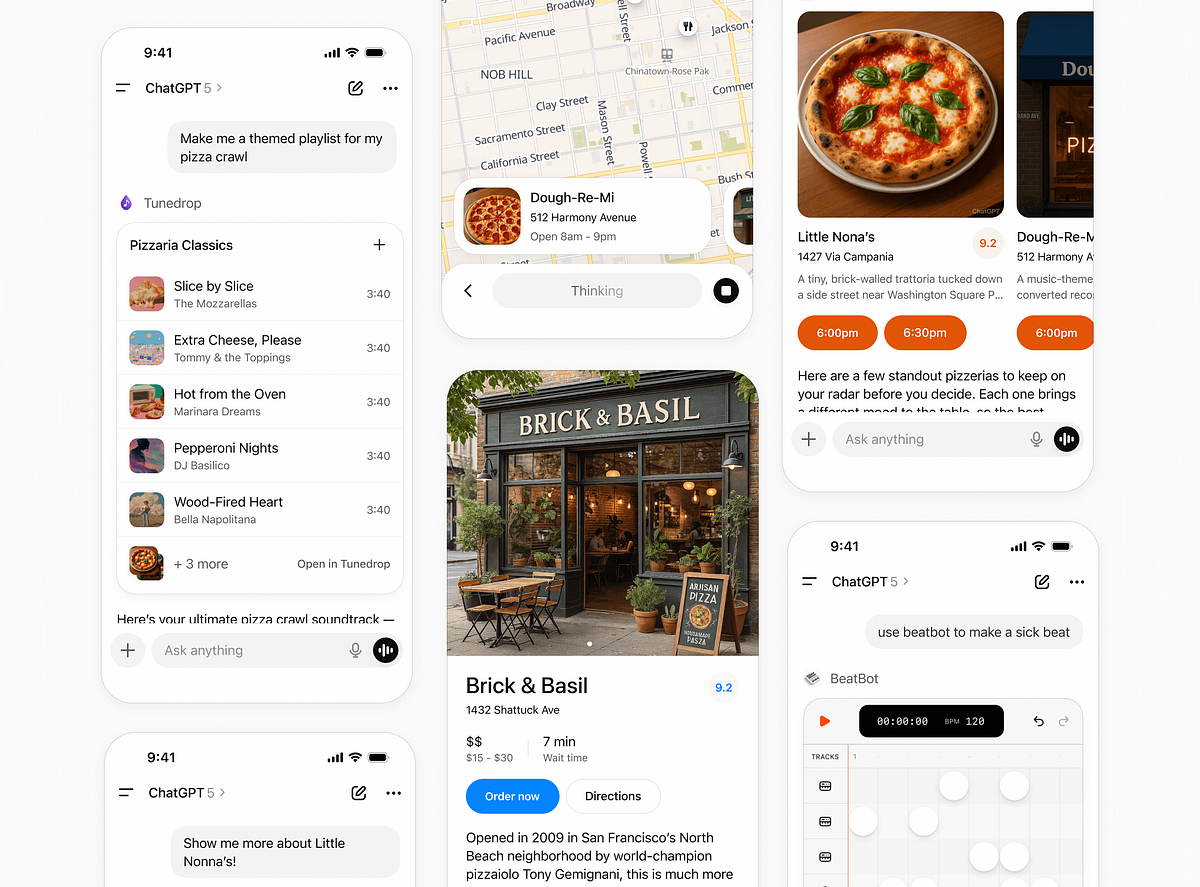
Designing experiences that belong in a conversation
After understanding the broader impact of the Apps SDK, designers can start thinking about how to shape these experiences in practice.
Designing for the SDK means clearly defining who the users are, what their goals look like in context, and which parts of their workflow feel most natural to complete through conversation. The task must be specific enough for ChatGPT to assist, yet simple enough to avoid overwhelming the interaction.
OpenAI offers several guiding questions to help designers identify good use cases, each of which can also be viewed through the lens of Hick’s Law, showing how the SDK minimizes the number of decisions users need to make. Ask yourself:
- How do your user task fit naturally into a conversation? (for example, booking, ordering, scheduling, quick lookups)
- Is it time-bound or action-oriented? (short or medium duration tasks with a clear start and end)
- Is the information valuable in the moment? (users can act on it right away or get a concise preview before diving deeper)
- Can it be summarized visually and simply? (one card, a few key details, a clear CTA)
- Does it extend ChatGPT in a way that feels additive or differentiated?
Designers should also avoid designing interfaces that:
- Display long-form or static content better suited for a website or app.
- Require complex multi-step workflows that exceed the inline or fullscreen display modes.
- Use the space for ads, upsells, or irrelevant messaging.
- Surface sensitive or private information directly in a card where others might see it.
- Duplicate ChatGPT’s system functions (for example, recreating the input composer).
From most of these principles, we can notice that OpenAI encourages designers to avoid tasks that involve too many steps, or think about what information is valuable to show on the interface.
Take Figma SDK for example. The workflows like converting a short piece of text into a user flow represents a much stronger use case. It is easier for users to describe with natural language, and this information can immediate be summarized into visual feedback that users can act on right away.

In contrast, designing a complex design system with ChatGPT may not be a good user case. Because it require both users and computers to access complicate information on multiple design pages, and users have to constantly make fragmented decisions and repeatedly step in to guide the AI, which interrupts the flow of interaction and increases the overall time to complete a task.
For designers, building for the Apps SDK starts with defining a clear, focused task. ChatGPT favors apps that serve a single, well-scoped purpose, something users can complete in one short interaction. Try to describe your user’s key goal in plain language, outline its input and output, and make sure it fits naturally into a conversation.