
What are we willing to pay to get paid? Embracing non-commercial creativity.

I used to dream of having a job where I could be creative. I wanted to be paid to do the thing I loved. I had read about starving artists and struggling creatives, and I was happy and proud when I found a job in the creative field right out of college. After graduating, I became a graphic designer in the marketing field and from there, I worked my way up the corporate ladder.
For many years, I loved my job and the world of design. I got to create for others. It felt like an act of service. I prided myself on the sentiment that design was more than making something pretty. It was strategic, and it served business outcomes. It could also be used to solve complex problems and to help people and the world around us.
In my corporate job, I created campaigns, videos, websites, brands, and more. There was a lot of variety but it was also just a lot.I was paid well, but somewhere along the way, my creative inspiration started to fade. There was always more to do and never enough time to do it.
The dream I had to “get paid for my creativity” was starting to feel less like a dream and more like a nightmare. I was making at the speed of the industry — always pushing myself to a little more, try a little harder, making something new. The demands felt insatiable.
The time I had to actually “be” creative was always shrinking, and instead of imagining better futures or serving my creative vision, I was asked to prove my worth through numbers and fit my creativity into small spreadsheet cells.
The world of business was in fact paying me, but I often felt like I was paying with my creative fire. I went from creating with purpose to creating algorithms, sharing not because I had something to say, but because the system demanded content. More for the sake of more. More for the sake of clicks.
What are we willing to pay to get paid? Embracing non-commercial creativity.
Lately, I’ve been asking myself: as creatives, what are we willing to sacrifice to monetize our craft? Right now, it feels like we’re trading the joy of making just to “make it.” We’re more concerned with making reels than expressing what’s real, optimizing for engagement rather than genuine expression.
What would it look like to return to or remember what the joy of creativity actually looks like? In my search for meaning in my making, I started looking for non-commercial initiatives. Those projects or ideas that are there just to serve our happiness and joy vs. being guided by outcomes and measurements. What I came across was joyful examples from a rave at a middle school, a giant pencil sharpening event, an office drawer filled with confetti, and millions of stick reviews. Let me tell you about them.
1. A middle-school rave in Leicester.

Every Friday at Braunstone Community School in Leicester, something special happens: the halls turn into a full-on rave. Music blasts, students dance, and the entire school comes alive — all thanks to head teacher “Mr T,” who started the tradition to boost happiness, attendance, and energy.
The idea is simple: joy helps learning. When kids are excited to show up, they’re more engaged in class. And it works. Friday attendance is higher, test scores are strong, and students look forward to the weekly ritual. One child said, “The second we hear the music, we rush out to dance.”
Mr T’s weekly school raves have gone viral, and while some question the approach, he’s unapologetic: “We dance our way to the top.”
It’s a powerful reminder that connection, energy, and play are not distractions from learning but rather at the heart of it.
2. A giant pencil sharpening event
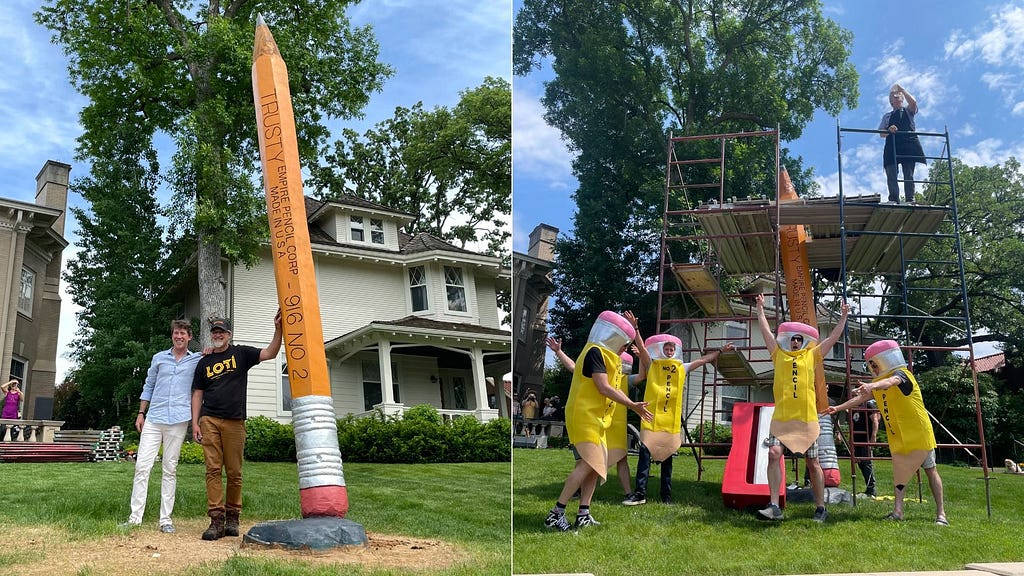
Every year in a Minneapolis neighborhood, something wonderfully unusual happens: residents gather to sharpen a giant wooden pencil from John and Amy Higgins’s front lawn.
The pencil was created from a 180-year-old oak tree that fell during a storm. John recalls how hard it was to see the majestic tree go, describing its severed trunk as “almost sinister” — like a broken skeleton in the night. Instead of letting the tree’s legacy fade, John and Amy teamed up with wood sculptor Curtis Ingvoldstad to turn the massive trunk into a replica of a classic Trusty brand №2 pencil. Amy explains why a pencil was the perfect choice: “Everybody uses a pencil. You see it in school, in work, in drawings. It’s accessible to everyone and can mean something different to each person.”
What started as a playful moment has grown into a beloved annual ritual where people come together to celebrate creativity, connection, and the joy of doing something completely unnecessary and completely wonderful. It’s not about the pencil; it’s about presence, weirdness, and the magic of making time for joy.
John said in an article with CBC Canada: “It’s fun. It’s joyful. There’s no agenda. It’s not a commercial event. There’s not a ticket or anything,” Higgins said. “But through word of mouth, I think, people come and they really have fun.”
3. A drawer full of Confetti (and joy)

One of my favorite creative people is Tina Roth-Eisenberg. She is the author of the design blog SwissMiss, and the founder of Creative Mornings and Tattly, among other things. She’s really creative. And through her social media channel, she shares a lot of the weirdness they use to make each team member at Tattly feel accepted. One example is the confetti drawer. Yes. A drawer full of confetti.
Why? Roth-Eisenberg explains how “Joy is at the core of Tattly. When you purchase tattoos on tattly.com, you can add confetti to your package during the check-out process. Funny enough, it’s our most purchased product.”
4. Stick reviews from around the world.

My personal favorite space for non-commercial joy and certainty is Stick Nation. It is a global internet community that grew from the Instagram account @officialstickreviews, where friends Boone Hogg and Logan Jugler began humorously reviewing ordinary sticks they found outdoors. What started as a joke has grown into a worldwide movement, with people from over 100 countries sharing photos and videos of sticks. It is not about selling or finding the best sticks. It is about sharing what is found naturally in nature. Submissions are raw and unedited, with people young and old sharing their finds from around the globe. Many ask what the point is. Among those were comedian Bill Mahr that mocked the initiative by saying “I don’t know what is more depressing.. That there is an Instagram page dedicated to reviewing sticks, or that it has 3.2 million followers who makes comments like ‘nice stick, bro.’” Mahr among others question that point of it all, but that is exactly the point of it all. Sharing a moment with others because you found it cool… Showing cool things in nature… being playful about life itself and finding joy in something simple and everyday.
Where do we go from here?
I can’t read about these examples without smiling. They show how pure creativity outside of commerce brings joy and hope to people. They are examples about how beyond tangible outcomes, there is a space of joy and excitement that can make 10-year-olds look forward to Friday class, communities dance and sing while celebrating a giant pencil, and people can lean into the messiness that confetti brings to any room while looking for their great next stick.
When I read these examples among others, I remember the power of creativity as a source of joy and connection. I’m reminded that the question isn’t whether we can survive the machine, but how we keep our light burning while it tries to dim us. Creatives have the power to bring joy to life if we have the courage to not let go of tangible outcomes and embrace the weird ideas that live inside of us.
What are your favorite weird and non-useful things on the internet and beyond? What have you made just because you wanted to make it?
Other joyful things
- The World’s Most Interesting Characters 🌎
- This girl has portfolio where you can pet a cat
- Paola Mendoza, on how art creates culture and illuminates us in dark times.
- what the early internet can teach us
- Whimsicle websites on the internet
- Draw and fish and raise it with others
- A fish doorbell
- Tune into forest around the world
Making vs. the machine was originally published in UX Collective on Medium, where people are continuing the conversation by highlighting and responding to this story.