

What we can learn from Linear about trusting judgement without ignoring evidence

Data feels objective, defensible, and safe. In many product teams, it has quietly become the most powerful decision-maker in the room — not because it consistently leads to better outcomes, but because it removes personal accountability. When a decision can be justified with numbers, no one has to truly own it.
“Although you may think that people instinctively want to make the best possible decision, there is a stronger force that animates business decision-making: the desire not to get blamed or fired.”
— Rory Sutherland
‘Data-driven design’ is often framed as maturity. In practice, it can become a way to defer judgement, smooth over disagreement, and default to the option that will attract the least resistance. The result isn’t better products — it’s safer ones. Incremental improvements which optimise what already exists, while bolder ideas are quietly filtered out because they can’t yet be proven.
The uncomfortable truth is that data doesn’t make decisions, people do. Data can inform, challenge, and validate — but it can’t decide what should exist, only describe what has happened before. When teams hide behind metrics, they’re not being rigorous; they’re avoiding the risk that comes with choosing a direction and standing behind it.
“It’s important to remember that big data all comes from the same place — the past.”
— Rory Sutherland
How Linear balances judgement and evidence
In an interview reflecting on Linear’s design philosophy, co-founder and designer Karri Saarinen speaks directly about the limits of “hiding behind data” and the harder work of judgement. He describes how teams often lean on quantitative signals because they’re afraid of making the wrong choice — and how data becomes a comforting shield. But that safety is an illusion. Data doesn’t make choices for you; it only reports what has already happened.
Too much deference to metrics doesn’t just slow teams down — it actively pushes them toward incrementalism. When evidence is treated as a prerequisite for action rather than an input into judgement, bold ideas struggle to survive long enough to be tested.
What’s striking in Saarinen’s thinking is his insistence that product teams should feel empowered to decide based on a deep understanding of the problem, and rich context gained from direct engagement with users and the product — not just dashboards or scoreboard metrics.
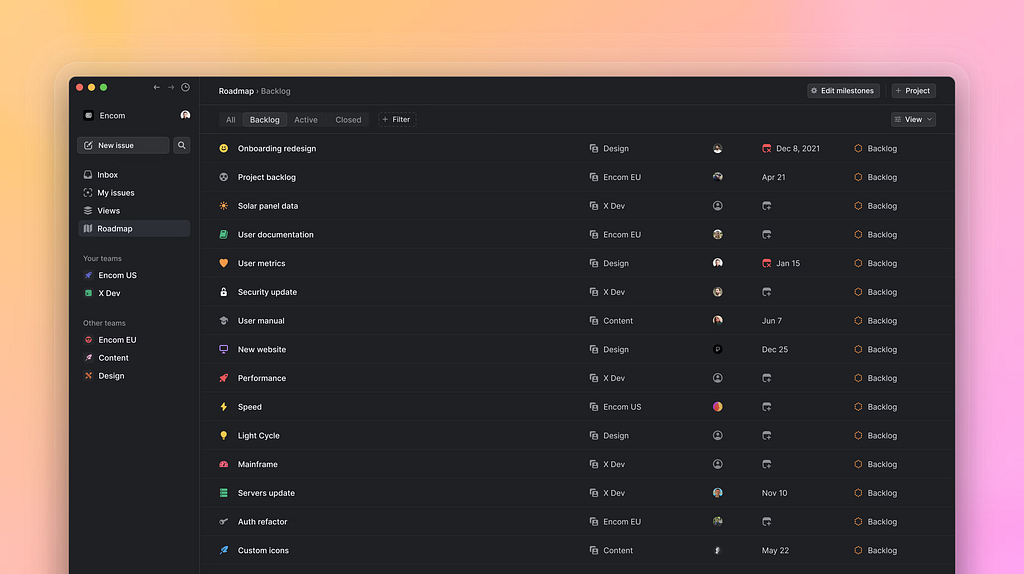
At Linear, design isn’t something you outsource to analytics — it’s a product philosophy. They pursue quality not as a growth tactic or a differentiator, but because they believe good software should be well made. Craft isn’t justified by metrics; it’s a responsibility the team chooses to take seriously.
Rather than waiting for perfect metrics before acting, Linear routinely builds features and ships them to internal users or small opt-in groups early — even when the experience is rough. This accelerates learning, sharpens judgement, and creates real feedback long before broad exposure. Engineers and designers are encouraged to own problems end-to-end, including small inefficiencies that may not yet register in analytics, but materially affect the lived experience of users.
Data is a tool, not a crutch
Saarinen points out that teams often invoke data when they’re afraid to own a decision. At Linear, they don’t rely on exhaustive ranking exercises or metric-driven roadmaps to determine direction. Instead, decisions emerge from a blend of:
- Direct customer conversations and qualitative feedback
- Founders’ and team intuition, shaped by deep product familiarity
- Contextual signals from real usage
Data is still present, but it becomes one signal in a broader conversation, not the authority that ends it.
“Data isn’t bad — it’s just not the decision-maker.”
— Karri Saarinen
Build with confidence, fail fast, and fix things
Linear treats mistakes as an expected part of building good products. This flips the narrative from fear to responsibility. Designers and product leads aren’t protected by metrics; they’re accountable for choices — and expected to correct them quickly when they’re wrong.
“Sometimes we make the wrong choice, and then we just fix it — but at least we made the choice, and the data didn’t make the choice for us.”
— Karri Saarinen
Safe decisions are rarely transformative
Safe decisions are rarely transformative — and transformative decisions are rarely safe. Direction at Linear is chosen through judgement informed by deep engagement with users, even when the metrics haven’t caught up yet.
By combining context, craft, judgement, and fast feedback loops, teams can avoid both extremes: blind intuition on one side, and the paralysis of waiting for perfect data on the other.
What we can learn from Linear
Ship early and often
Don’t wait for perfect analytics before releasing. Internal launches and small cohorts create faster, richer learning than prolonged analysis ever will.
Build shared product understanding
Distribute customer stories, recordings, and qualitative insights. When context is shared, judgement becomes defensible without needing a dashboard to prove every choice.
Treat data as input, not authority
Use metrics to inform and challenge intuition, not replace it. Data should contribute to decisions — not make them by default.
Give designers space to pursue craft
Quality isn’t always measurable upfront, but it’s immediately felt. When teams prioritise craft, they make better decisions because they’re deeply attuned to user experience.
Close the accountability loop
Make decisions based on expertise and judgement — then measure the outcome. Celebrate learning, not just success. That’s how intuition becomes a skill, not a superstition.
References and resources
Inside Linear: Building with taste, craft, and focus
The main inspiration for this article was an interview with Karri Saarinen on design judgement, data, and decision-making — particularly from around 49m, where he critiques hiding behind data and emphasises ownership of decisions.
- If you're not using UX data, it's not UX design
- The onboarding Linear built without any AB Testing
- A/B testing done wrong
The safest decision is rarely the right one was originally published in UX Collective on Medium, where people are continuing the conversation by highlighting and responding to this story.