
Co-Invention: Redesigning Discovery
I had spent six weeks conducting discovery and design on an AI-powered toolkit to accelerate product discovery when I came across Ajay Agrawal’s YouTube interview, „The AI Economist: The Skill You Need to Stay Employed in the Age of AI“ (Full interview is 1 hour and 5 minutes). I was researching AI capabilities for the toolkit when his insight stopped me in my tracks. In my experience, software teams often skipped proper discovery, claiming they didn’t have time. I saw AI as the solution to a productivity problem: automate tasks, integrate workflows, and make discovery faster so software teams would have fewer excuses not to do it properly.
In their book Power and Prediction, Agrawal, Gans, and Goldfarb (2022) describe what happened when factories first adopted electricity. Manufacturers replaced steam engines with electric motors, but retained the same layout — one large motor, complex belts and pulleys, and machines clustered around a central power source. Productivity barely improved. The breakthrough came when they redesigned around electricity’s potential: machines could go anywhere, organized by workflow rather than power source.
This is what they call co-invention: the new technology is only part of the solution. The real value lies in inventing complementary systems, processes, and organizational structures that leverage the technology’s strengths.
Today we’re making the same mistake with AI — bolting it onto existing workflows, increasing speed without improving outcomes. An effective AI-human partnership requires co-inventing new systems that leverage the strengths of each. The processes that guide discovery need fundamental redesign, not around speed, but around judgment.
Speed without judgment means building the wrong things faster.
Prediction vs Judgment
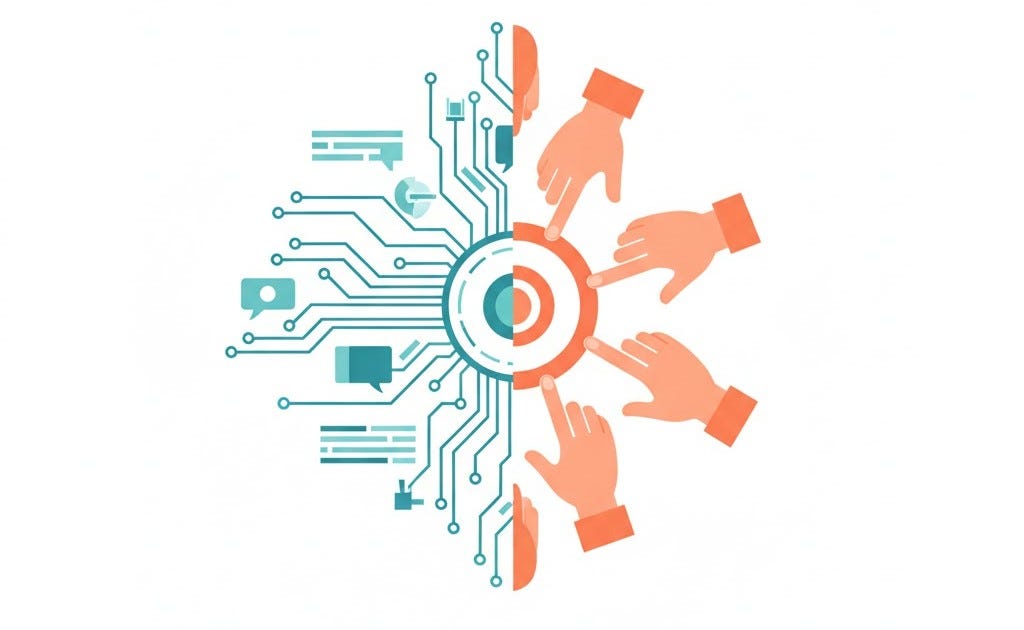
Agrawal’s deeper insight reframed my thinking. In the human-AI partnership, AI makes predictions radically faster — filling in missing information, recognizing patterns, generating options, and forecasting outcomes. What remains scarce is judgment: the ability to interpret meaning, weigh trade-offs, and decide what’s worth pursuing.
Watch economist Ajay Agrawal explain this distinction(1 minute)
Decision-making is the interplay of prediction and judgment. AI handles what is likely to happen. Humans decide what should be done about it.
“AI handles what is likely to happen. Humans decide what should be done about it.”

In discovery, this plays out constantly. AI can analyze customer-interview transcripts and identify patterns across dozens of conversations — that’s prediction. But we must decide whether those patterns represent real problems worth solving or simply interesting noise — that’s judgment.
AI can forecast which features might increase engagement — that’s prediction. Only humans can decide how well they align with customers’ needs and the product’s vision, purpose and principles — that’s judgment.
Brandon Harwood (2025) describes this distinction in his framework for AI-powered product design, noting that specific tasks must remain human-centric due to the need for judgment, intuition, and emotional intelligence. What AI accelerates is synthesis; what humans provide is meaning-making.
Judgment develops by making decisions under uncertainty and owning the consequences. When you pursue an opportunity based on limited evidence, ship it, and learn it was the wrong bet, that failure can grow your judgment. When you kill a beloved idea because evidence doesn’t support it and that decision proves correct, that success strengthens your judgment. Learning comes from the whole cycle: decide → act → observe → reflect.
Discovery judgment is the practice of developing judgment about what deserves to exist. It’s not a single activity but a set of practices: identifying opportunities, talking to customers about their needs, mapping assumptions about what would make a solution valuable, testing those assumptions with minimal investment, and deciding when evidence is strong enough to commit resources.
Sinek’s (2009) Golden Circle, explored in Start with Why and his TED Talk “How Great Leaders Inspire Action”, provides a valuable lens for understanding why judgment remains a human trait. The Golden Circle shows that inspiring action starts with why — purpose and belief — then moves to how, and finally what you produce. This order is often reversed, starting with what or how to build.
AI can handle the how and even suggest the what. Only humans can determine the why, which makes it worthwhile to build. Judgment is the capacity to reason about purpose, meaning, and value — capabilities that belong uniquely to us.