
Disclaimer: although I am going to use industry examples from products I am building at Miro to illustrate key ideas in this piece, I am sharing my own POV, and I am not speaking on behalf of Miro.
For decades, a single question has dominated startup boardrooms and venture capitalist pitch meetings: “What’s your DAU/WAU/MAU?” The trinity of Daily, Weekly, and Monthly Active Users has been the number 1 undisputed set of metrics. It has been widely considered the ultimate proxy for engagement and a key indicator of early signs of product-market fit for software companies.
That’s because DAU/WAU/MAU are used to calculate key metrics such as user retention (e.g. the classics 30-day retention and 12-month retention metrics) as well as stickyness (e.g. the DAU/MAU Ratio that measures the proportion of monthly users of a product who engage with it daily) and many more important metrics to measure how well a software product or service is performing.
But this model, built on the premise of a human directly interacting with a graphical user interface, is becoming a dangerously misleading measure of a product’s true value. This doesn’t mean the human user is disappearing. It means their role is evolving — from a direct operator to a high-level delegator.
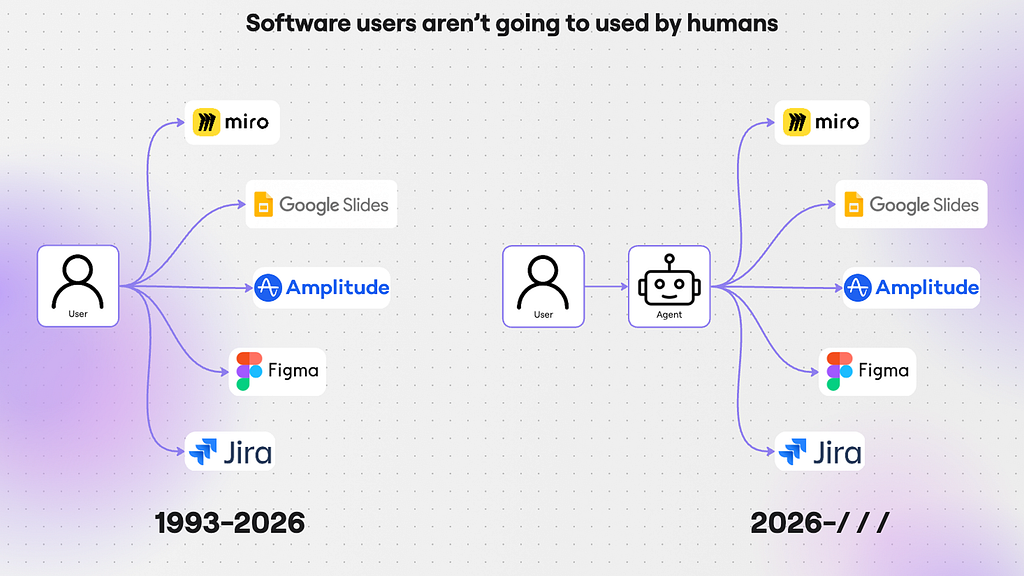
In the new paradigm of work, humans will interact with their AI agents, and those agents will, in turn, interact with our software on our behalf. The heartbeat of a healthy SaaS company is no longer a human login; it’s a programmatic action.
The reign of the Monthly Active Users metric is over. It’s time to design products for AI agents, and measure Monthly Active Agents (MAA).
What are Agents anyway?
Everyone is talking about agents, and for good reasons. The theoretical hype of previous years has finally materialized into a tangible market shift in 2025. Last year, venture capital poured billions into AI, with companies at all layers of the stack commanding massive valuations. Despite sobering findings on the value of AI in the first half of 2025, the technology has quickly caught up and improved dramatically.
The tipping point arrived in early 2026 with a series of hardware-native and “computer-use” releases that moved AI from a chat box to a virtual colleague. In January 2026, Anthropic launched Claude Cowork, a desktop agent capable of performing multi-step tasks natively across local files and third-party applications. This was quickly followed by the release of Claude Opus 4.6 in February, which set a new industry record on the GDPval-AA benchmark and the ARC-AGI benchmark — evaluation benchmarks specifically designed to measure the performance and “intelligence” of AI models. Google released Gemini 3.1 Pro shortly after in late February 2026 — achieving a record high score on the ARC-AGI-2 benchmark, and more than doubling the reasoning performance of the Gemini 3 series from just a year prior. These gains in “core intelligence” mean agents no longer just follow instructions; they can now solve entirely new logic patterns and manage autonomous workflows with minimal human oversight.
However, this “agentic summer” has come with a heavy price for legacy tech. In early February 2026, the introduction of these autonomous workflows triggered what analysts called the “SaaS-pocalypse” — a massive, sudden sell-off in software stocks. Investors, fearing that autonomous agents would replace “per-seat” licensing models, wiped out nearly $300 billion in market value in a matter of days.
The “Black Tuesday for Software” (February 3, 2026) remains the largest single-day valuation reset for the SaaS sector in history. Giants like Salesforce and Adobe saw historic one-day drops as the market began to revalue software not as a tool for humans, but as a utility for AI agents.
The conversation in boardrooms and on tech stages has pivoted decisively from “what is generative AI?” to “what is our agentic strategy?” So what are AI agents anyway? Everyone seems to have their own definitions with slight differences.
In the context discussed below, AI agents — or simply agents—are described as pieces of software that are programmed in natural language through a prompt executed by a Large Language Model (LLM) to autonomously or semi-autonomously process data and/or execute actions in a given software applications.
Think of AI agents as digital interns you can instruct with natural language. You give them a high-level goal — like “find VC-backed startups building propulsion systems for nano and micro-satellites, compile a report comparing their technology’s strengths and weaknesses, then post a link to Slack when you’re done” — and the agent uses all the tools is has available (e.g., web search, CRM data, Slack API, etc.) to figure out the steps and get the job done. It’s this ability to act on our behalf that is fundamentally changing how we interact with technology. It’s the fact that pieces of software are now able to understand how to carry on a different task, plan the work, identify a set of tools to carry a given sub-task, and execute it all end-to-end.
It’s also important to recognize a critical distinction: AI agents fall into two primary categories.
Internal Agents: The Product Enhancers
Internal agents are those built by the software company itself to operate within their product. For example, Salesforce Einstein Service Agent, Intercom Fin, or Microsoft Copilot in Microsoft 365. These first-party agents are designed to enrich the native product experience and are often a key part of a premium feature set or add-on.
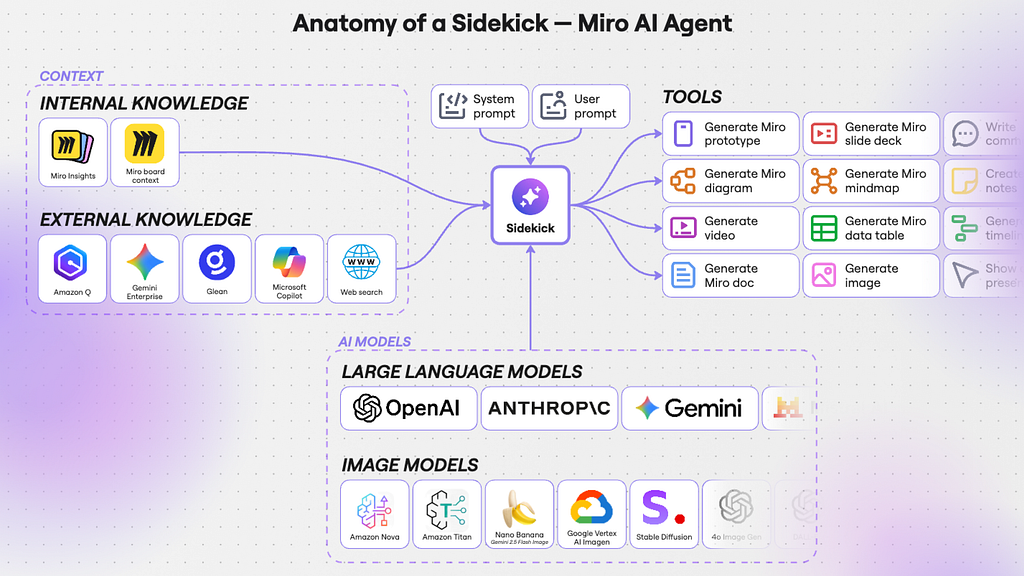
As an example, the figure above showcases the high-level architecture of a Sidekick: Miro’s AI agent designed to run natively in the Miro platform (which was released on October 14 at Canvas25).
A Sidekick agent is able to tap into data (knowledge) that it uses as context to assist users with their jobs-to-be-done. The knowledge it uses can be internal to the Miro environment (i.e. content and visual context on a Miro board, information retrieved through Miro Insights) or external (i.e. search information on the web, or retrieve business knowledge if the user has an active integration with something like Gemini Enterprise or Amazon Q). Sidekicks can execute actions through a set of tools that it has access to (e.g. generate a mobile app prototype, create sticky notes, write a doc, generate a flow chart technical diagram, etc.). Users can use pre-made Sidekicks or create their own custom virtual assistants through prompting.
External Agents: The Ecosystem Creator
External agents are built by third parties — your customers, other startups, or independent developers — who use your public API and Model Context Protocol (MCP) server to interact with your software from the outside. In other worlds, these agents are never designed nor built by the software companies as a way to elevate their core product experience. These are instead built by a wider users’ community to automate their workflow and extend the surface areas for leveraging a given software in their tool set.
In the illustration below, a developer using Cursor can tap into Miro’s MCP server to use Miro boards as rich context to accelerate development and translate the outcomes of ideation sessions and workshops into production code faster.
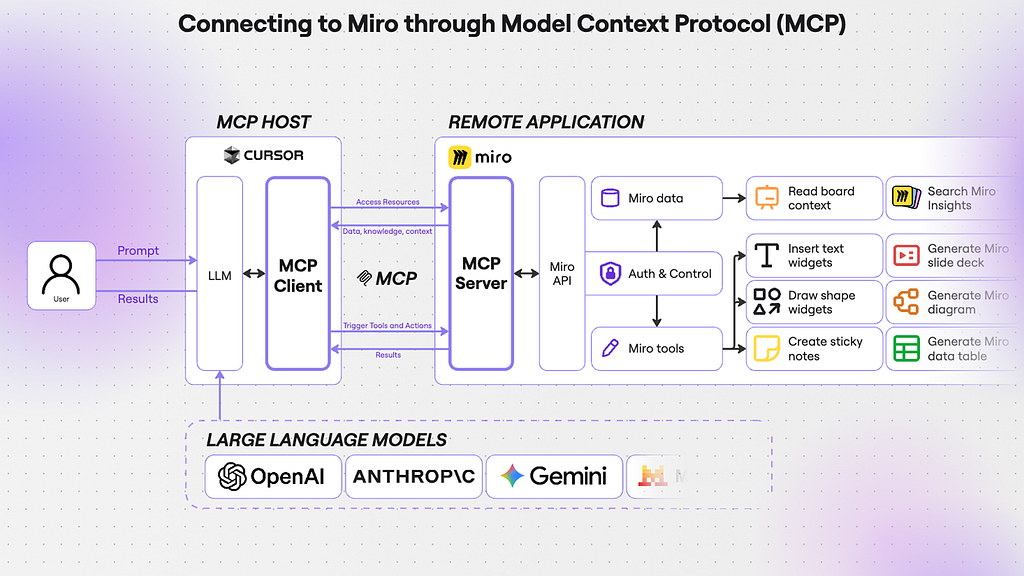
While the positive growth rate of internal agents is a positive signal that a given product is extending its value to customers, the growth of external agents is the ultimate validation of your platform’s value. An active external agent represents a deep, institutional commitment. It means a customer has invested their own engineering resources to build custom logic on top of your service. It proves that your platform is viewed as a fundamental piece of infrastructure that is so valuable that the market is building its own tools and businesses around it.
Usage growth of internal agents shows you’re building a better product; usage growth of external agents shows you’re building an ecosystem. The latter is the true indicator of a defensible long-term position.
The Real User Journey is Changing: From Operator to Delegator
The arrival of agents doesn’t mean that they replace humans, but rather augment them. Human users will continue to be the drivers and initiators of work, but their primary point of interaction will shift away from the myriad of SaaS graphical user interfaces they use today and consolidate into a single interface: their AI agent.
Think about the following workflow:
- A developer just implemented a fix for a bug, and needs to update the progress status of the bug ticket.
- They stop what they’re doing, open a new tab, and log into their project management software.
- They navigate through the UI to find the right project and ticket.
- They make the update, leave a comment, and close the tab.
This entire process generates a “Daily Active User” event.
Now consider the new, agent-powered workflow:
- An engineer tells their AI assistant (via voice or text): “Hey, fix this bug please, and update the ticket so the GTM team can communicate to customers.”
- The AI agent write a fix for the bug through Claude Code, Codex, or Mistral Code, the developer review and approves, then the agent automatically pushes the PR, then authenticates through the MCP server of the project management software, to autonomously executes a set of actions to move the bug ticket to “Done”, confirms completion, and then post an update to the GTM team on Slack.
The human user never logged in. The DAU is zero for that interaction. Yet, the same — or even more — value was created. The user is still active, but their activity is now proxied through an agent.
We are moving from a world where the human is the central router of information — manually context-switching between Miro, Google Slides, Amplitude, Figma, and Jira — to one where the human sits behind an autonomous AI-powered intermediary. In the new “Agentic Era,” the human provides the high-level goal, while the Agent becomes the primary “consumer” of the software’s interface.
“Oh no, I love the beautiful UI and dead simple UX of Jira and Workday!” — said no one ever.
This is a great news, isn’t it?
This transformation will be most profound for SaaS products that act as a system of record (SoR). For tools like Jira, Salesforce, HubSpot, Workday, or GitHub, the ultimate value isn’t the time users spend clicking around in the interface; it’s the accuracy, timeliness, and completeness of the data within the system. When an AI agent can update Salesforce with meeting notes, create a new branch in GitHub, or pull a report from HubSpot programmatically, the system of record becomes more valuable and more integrated than ever before, all while human logins decline.
The New Gold Standard: Tracking Programmatic Value 🤖
The users of SaaS software aren’t going to be humans anymore. As such, measuring human interactions as a key performance indicator is no longer the most reliable measure of value — we need a new set of metrics that reflect this new reality.
- Daily Active Agents (DAA): The number of unique, authenticated AI agents making meaningful API/MCP calls to your platform each day (both internal + external agents).
- Weekly Active Agents (WAA): The number of unique agents interacting with your platform in a given week.
- Monthly Active Agents (MAA): The number of unique agents active on a monthly basis.
Each “Active Agent” is a force multiplier, representing a human user or an entire team whose productivity is being scaled programmatically.
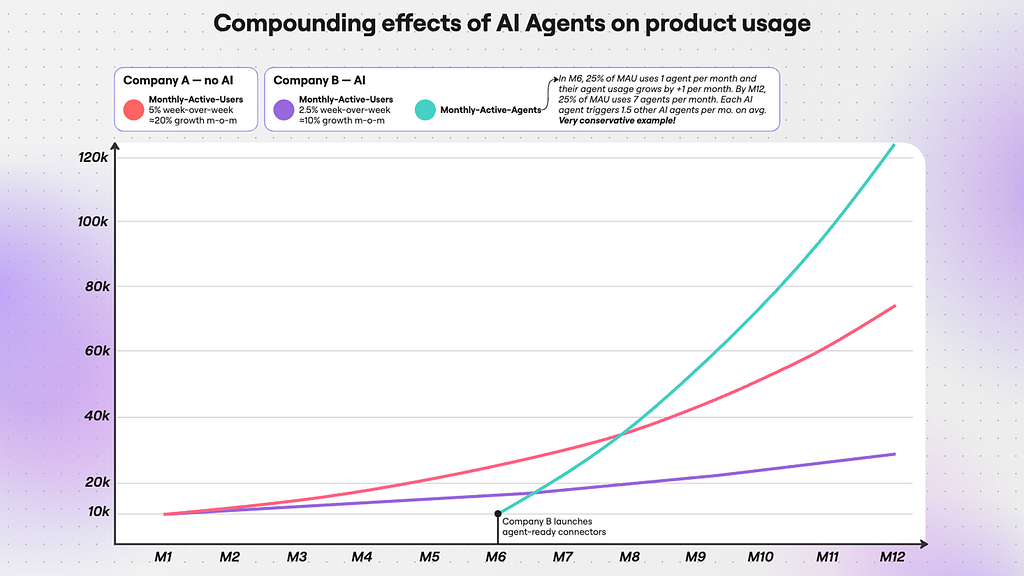
In the figure above, I showcase a very conservative scenario to illustrate the compounding effects of AI agents to compare product usage of 2 hypothetical companies.
On one hand, we have Company A. Company A is growing very fast (MAU growing 5% week-over-week or about 20% month-over-month) and doesn’t launch any agent-ready connectors or solution.
On the other hand, we have Company B. Company B is growing a lot slower than Company A (MAU growing 2.5% week-over-week or about 10% month-over-month). However, Company B launches agent-ready connectors in its product on Month 6. The rules of the algorithm behind the data are as follows:
- Only 25% of total MAU adopt the agent solution from Month 6 to Month 12.
- In Month 6, 25% of MAU uses 1 agent per month and their agent usage grows by +1 per month. By Month 12, 25% of MAU uses 7 agents per month.
- Each AI agent triggers 1.5 other AI agents per month on average.
Even with this conservative adoption scenario, you can see that Company B’s MAA takes over Company A’s MAU in just 2 months on Month 8. At Month 12, Company B’s MAA is about 2x Company A’s MAU.
This a conservative illustrative example and it’s crucial to understand that the scale of these new metrics operates on a completely different plane. While one human represents a single user, that same human could delegate tasks to hundreds or even thousands of autonomous AI agents simultaneously. This creates a massive divergence in growth trajectories. A mature SaaS product might see its human-centric Monthly Active Users grow by a respectable 1% month-over-month. However, as its customers begin deploying agents, its Monthly Active Agents could explode, growing at an exponential rate of 25% month-over-month. This is the difference between measuring linear adoption and measuring exponential, programmatic integration.
Tracking MAA gives you a direct line of sight into how your product is creating value at scale and how deeply it is embedded into your customers’ core, automated workflows.
What does this mean for Product-Market Fit? 🎯
For years, founders have proven Product-Market Fit with two key methods. The first is the DAU/MAU ratio, a quick pulse check on overall user stickiness. The second, and arguably the more powerful indicator, is cohort retention. The ultimate proof of PMF was seeing the retention curve for a new user cohort — say, everyone who signed up in January — flatten out over 30, 60, and 90 days. A flattening curve was the gold-standard signal that you had built something people truly needed.
But in a world where AI agents are the primary interactors, both of these human-centric metrics become unreliable. A human user might delegate all their tasks to an agent and stop logging in, causing their cohort to look like it’s churned when, in reality, their engagement with the product has actually deepened.
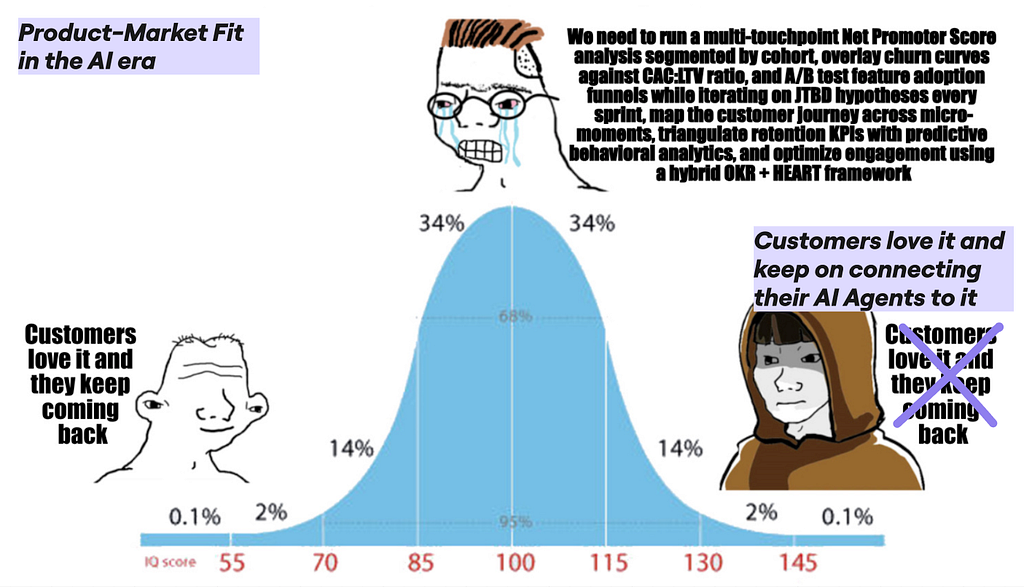
This calls for a direct evolution of our best metrics. Product-Market Fit is no longer about user cohorts; it’s about agent cohort retention.
The new key question becomes: “Of the new agents that were activated on our platform in January, what percentage are still active 30, 60, and 90 days later?”
This is a profoundly more powerful metric. A human user might churn because they change jobs, their team reorganizes, or they simply forget to log in. An agent, however, only “churns” when a company makes a deliberate, high-effort decision to rip out an integration and re-architect a core automated process. The friction to churn is greater.
Therefore, seeing a flattening agent retention curve is the new, unequivocal signal of deep, structural Product-Market Fit. It proves your platform has been successfully embedded not just into a person’s workflow, but into a company’s foundational, automated infrastructure.
Therefore, a high AI agent retention is a far stronger and more resilient signal of true, durable Product-Market Fit than human logins ever were.
What does this mean for monetization? 💰
The agent-driven future will cause the seat-based pricing model to completely fall on its head. This is one of the root cause behind the “SaaS-pocalypse” in early February 2026.
For decades, SaaS revenue has been a simple multiplication: number of users times price per seat. But if a single human can deploy 100 AI agents to do the work of 100 interns, what is a “seat”?
For incumbents, this presents a classic Innovator’s Dilemma. Think about a company like Adobe. Their success is built on serving and charging for their core audience: creatives and designers paying a monthly seat price.
Imagine that a given enterprise customer build a suite of designer agents that can connect to Adobe’s products to auto-generate design proposals at scale, assist human designers to expedite design reviews, etc. (or a startup build a AI agent solution to do this)
This given enterprise customer is paying for 200 designer seats and is now able to achieve the same outcome with only 50 designer seats using 1000 agents. It’s easy to see how the seat-based pricing model completely collapses as AI agents are increasingly deeply integrated within SaaS products.
This dilemma is precisely why the old model is unsustainable. This paradigm shift forces a move toward consumption-based pricing or a totally different model. The future of SaaS monetization is not about charging for access, but about charging for the value created. New models will become the norm:
- Per-Agent: Charging per unique active agent connected to the platform per month as a direct replacement to the seat-based model.
- Usage-Based: Pricing per API call, per task completed, or per gigabyte of data processed.
- Value-Metric: Tying the price to a clear business outcome (e.g., number of leads processed for a CRM, number of incidents resolved for a support tool, number of workflow executed).
This transition is not just a financial necessity; it’s a healthier model that aligns a vendor’s success more directly with the success of its customers.
If you swap Adobe for Figma in the example above, the disruption is even more dramatic: it’s not just the pricing model that’s crumbling, it’s the disruption of the workflow itself. Designers, developers, and PMs, are increasingly moving to AI and vibe coding tools to do prototyping and designs directly in code — making the traditional design-to-handoff process (and Figma) increasingly redundant. Figma’s response has been one of cautious protectionism; their initial MCP server was artificially limited to “read-only” in a clear attempt to prevent the cannibalization of their core user base. Even with the release of the Claude Code-Figma integration, the ability for agents to actually create within Figma remains gated behind a strict paywall and with limits. To the market, these limitations feel like a desperate moat — and investors remain deeply concerned about the long-term risk of letting the “agentic fox” into the human-seat hen house.
What This Means for Startups and VCs 📈
It’s a fundamental shift in strategy. Your user (and your buyer) is still a human, but your primary interface is now their agent.
This requires a foundational change in how we build products. As Andrej Karpathy recently put it, companies that fail to adapt are putting themselves at significant risk. He argues that for true human-AI collaboration to flourish, products must be built for programmatic access first.
https://medium.com/media/418c8723a200130628017963259697e6/href
“Products with extensive/rich UIs lots of sliders, switches, menus, with no scripting support, and built on opaque, custom, binary formats are Not Gonna Make It in the era of heavy human+AI collaboration.
If an LLM can’t read the underlying representations and manipulate them and all of the related settings via scripting, then it also can’t co-pilot your product with existing professionals and it doesn’t allow vibe coding for the 100X more aspiring prosumers.”
– Andrej Karpathy
His warning is clear. If your platform is a black box that can only be manipulated through a human clicking buttons, you are building a legacy product. If you’re doing this deliberately to safe-guard your seat-based business model, you’ll get disrupted anyway, and probably faster than you realize.
For Startups & SaaS Companies: The call to action is to prioritize the “Agent Experience” (AX):
- Your API is your new UI: It must be robust, well-documented, and expressive. This is what enables an AI to become a “co-pilot” for your human users. And who knows: just like “User Experience” (UX) gave rise to a number of specialized jobs (i.e. User Experience Designer, User Experience Researcher), perhaps the need for optimized “Agent Experience” (AX) will also give rise to a similar set of new jobs
- Embrace text-based, scriptable formats: The easier it is for an LLM to read, understand, and manipulate the core objects of your product, the more valuable your product becomes. Furthermore, because LLMs have been trained on internet data, they are exceptional at understanding information serialized as an HTML DOM. If you can represent your software interface as a DOM, you’re already halfway there.
- Don’t wait for AI to master your UI: Karpathy warns, “…products that attempt to exclusively wait for this future without trying to meet the technology halfway where it is today are not going to have a good time.” You must build for the programmatic reality of today. At Miro, we’re introducing the concept of Miro Turing Test internally. The test is passed when agents can use the totality of Miro to the point where human users wouldn’t be able to tell they are collaborating with an AI agent on the canvas (theoretically not practically).
- Build a Model Context Protocol (MCP) server: A great API is paramount, and the next step is an MCP server. Just as USB-C provides a standardized way to connect electronic devices, and REST APIs provides a standardized way to connect websites and web apps on the web, MCP provides a standardized way to connect AI applications to systems. Building an MCP server means designing your programmatic interface specifically for LLM consumption. While a traditional API serves data, an MCP serves context and expose tools. It provides clear, machine-readable function definitions, prompts, examples, and constraints that an LLM can understand natively, dramatically reducing the effort for an agent to reliably learn and use your tool.
For Venture Capitalists: Your due diligence must evolve to look past the vanity metric of human logins and shallow activity:
- The crucial question becomes: “Show me your agent engagement. How scriptable is your platform? How many customers are connecting to your platform through MCP?”
- Monthly Active Agents (MAA) is not a replacement for human value; it is a multiplier. A high MAA is the ultimate validation of product-market fit in the AI era.
The future of software isn’t a world without users. It’s a world where users are super-powered by AI agents who do the tedious work for them. The companies that thrive will be those that embrace this shift and build for the delegator, not just the operator.
So, are you still measuring how many people use your product, or are you measuring how deeply your platform is integrated into the AI ecosystem?
Your users aren’t human anymore; start building for agents today was originally published in UX Collective on Medium, where people are continuing the conversation by highlighting and responding to this story.