Geologists learn their subject by measuring, sampling, and walking actual ground, turning observation into understanding. The best online courses put you through that same process yourself.
The courses worth your time do exactly that. In Planet Earth…and You!, you extract an earthquake’s epicenter from real seismogram data and clock how fast your own tectonic plate moves in Google Earth, a direct look at plate tectonics in action. Practising science: Reading the Rocks sends you outside to sketch and interpret an actual rock exposure, and the Open University certifies it for free.
I’m Australian, and my home is often written off as geologically dull: no active volcanoes, few earthquakes, no glaciers, no towering peaks. But standing at Uluru, the monolith that rises out of the flat center of the country, showed me otherwise, and learning geology gave me the tools to read the millions of years of process written into that rock.
From over 1,300 geology courses on Class Central, I picked 10 for this Best Courses Guide, spanning topics from mineralogy to engineering geology. Two are free geology courses with certificates, so you walk away with proof.
Which Geology Course Is Right for You?
You can’t learn geology by watching alone
The courses worth your time hand you real data, real rock, or a reason to go outside and look. Planet Earth…and You! is where to start: it’s beginner level with a free preview, and its weekly labs put you on actual seismogram and Google Earth data from week one instead of saving practice for the end.
How We Chose These Courses
I looked for courses that get you handling actual data or samples, not just passive watching. Here’s what I checked for.
- A lab or exercise that uses real data: locating an earthquake epicenter from seismograms, practicing mineral and rock identification with a digital sample kit, sketching an outcrop, not just naming rock types from photos
- Field trip materials, problem sets, or lecture notes you can work through.
The ranking leans on learner reviews on Class Central, ratings on the hosting platforms, and what learners say on Reddit, drawing on a team that has tracked online courses since 2011 and completed 400+ of them. I’ve taken courses in this guide myself, including finishing both Open University picks in a couple of days, and sampled videos of the ones I hadn’t already done. Minerals and the crystalline state earned its spot with the Digital Geology Kit, a tool packed with images and properties of minerals, rocks and fossils. Start with Planet Earth…and You!, and let its first lab, locating an earthquake from actual seismic data, be your introduction to the subject.




Best Comprehensive Geology Course (University of Illinois)
Planet Earth…and You! is a professionally produced course brimming with geological information, covering earthquakes, plate tectonics, volcanoes, rocks and minerals, and energy resources. It has some of the most interesting assignments I’ve ever seen in an online course. You can look at features on Google Earth, discover the epicenter of an earthquake from seismology data, and find out how fast the tectonic plate you are on is moving.
“Great learning experience. High quality material and presentation.” Mike S., Class Central learner.
If you’re hoping to transfer credit toward a degree, Geology 101: Physical Geology is designed with that in mind, though acceptance depends on your school.
| Provider | Coursera |
| Institution | University of Illinois at Urbana-Champaign |
| Instructors | Stephen Marshak, Eileen Herrstrom |
| Duration | 42 hours |
| Level | Beginner |
| Rating | 4.9/5.0 (540 ratings on Coursera) |
| Cost | Paid |
| Certificate | Paid |
Best Free Comprehensive Geology Course (Earth and Space Sciences X)

If you’re a geology beginner, Introduction to Geology will teach you about plate tectonics, minerals, rocks, volcanoes, earthquakes, soil, the ocean floor, mountains, and more. The course spans 23 videos and 18 hours.
“This is the most articulate and comprehensive introduction to geology that I have seen anywhere.” @arbimoradian, YouTube learner.
There’s no certificate and no quizzes to test what you’ve learned, so if you want a credential to show for your effort, Practising science: Reading the rocks and ecology offers a free one.
| Provider | YouTube |
| Channel | Earth and Space Sciences X |
| Duration | 18 hours |
| Level | Beginner |
| Rating | 4.4/5.0 (5 ratings on Class Central) |
| Cost | Free |
| Quizzes/Assessment Items | No |
| Certificate | No |
Best Geology Course for Self-Directed Study (MIT)

Introduction to Geology is MIT’s undergraduate course 12.001, taught by Taylor Perron and Oliver Jagoutz and published through OpenCourseWare. It covers mineral and rock identification, the origin of continents, geologic mapping, plate tectonics, erosion by rivers and glaciers, the history of life, mountain building, volcanoes, earthquakes, and the evolution of Earth’s atmosphere.
What’s published includes lecture notes and slides, labs and exercises, readings, problem sets, and field trip guides, along with an Instructor Insights section where Perron and Jagoutz discuss co-teaching the course, planning the field trip component, communicating geology’s societal relevance, and handling conceptually difficult material. The published materials don’t include lecture video, so this suits someone comfortable building understanding from written notes and working through labs independently rather than following recorded lectures. The materials are from Fall 2013, and there is no certificate.
Anyone wanting video lectures and structured assessment instead should look at Planet Earth…and You!, the guide’s pick for a comprehensive, instructor-led introduction.
| Provider | MIT OpenCourseWare |
| Institution | Massachusetts Institute of Technology |
| Instructors | Taylor Perron, Oliver Jagoutz |
| Level | Undergraduate |
| Materials | Lecture notes, slides, labs, problem sets, readings, field trip guides |
| Term | Fall 2013 |
| Cost | Free |
| Certificate | No |
Best Short Geology Course (Udemy)
If you just want a quick introduction to geology, consider DJ Lake’s Geology: Earth Science for Everyone. It’s packed with clear explanations of complex scientific concepts in under 3 hours of video, starting with Earth’s early history. The course focuses on big-picture ideas rather than rock and mineral identification, covering topics such as the formation of mountains, the existence of oceans, crystals, the age of the Earth, and the impact of geology on landscapes and natural events.
“…I couldn’t be more satisfied with what I learned…” Robert Amell, Class Central learner.
If you’d like to go further with rock and mineral identification, Minerals and the crystalline state covers identifying minerals by crystal shape, color, lustre, cleavage, density and hardness, though it’s a step up in level that assumes some chemistry background.
| Provider | Udemy |
| Instructor | DJ Lake |
| Duration | 2 hours 40 minutes |
| Level | Beginner |
| Rating | 4.3/5.0 (2.2K ratings on Udemy) |
| Enrollments | 27K |
| Cost | Free |
| Quizzes/Assessment Items | No |
| Certificate | No |
Best Geology Course for College Credit (Study.com)

Geology 101: Physical Geology is designed to help study time convert into transcript credit. ACE has recommended it for 3 semester hours, and Study.com says it transfers to over 2,000 partner colleges, though you still need to confirm acceptance with your own registrar before counting on it.
The 21 chapters move through the standard physical geology sequence: plate tectonics, minerals, the three rock types, volcanoes, earthquakes, glaciers, groundwater, deserts, and geologic time, ending in economic geology and resources.
Neither Class Central nor Study.com shows any ratings for this course. A subscription buys unlimited Study.com courses, not just this one. If you want the material without paying, Introduction to Geology (Earth and Space Sciences X) covers much of the same ground for free, though it does not include this course’s coverage of geologic map reading, economic geology, or water balance on Earth.
| Provider | Study.com |
| Duration | 20 hours |
| Level | Beginner |
| Lessons | 149 lessons across 21 chapters |
| Enrollments | 1.3K |
| Cost | Paid (subscription) |
| Assessments | Open-book chapter tests and final exam, plus required assignments |
| College credit | 3 semester hours, ACE recommended |
Best General Interest Geology Course (University of Alberta)
Mountains 101 covers plenty of geology, including how mountains form and erode, glaciers, and the water cycle, alongside ecology, environmental science, and climate change. It also touches on cultural relationships with mountains around the world.
If you’re interested in hiking in the mountains, watch the end-of-lesson Tech Tips videos. They cover hints from clothing and footwear to camping gear and backpacks. A well-deserving member of Class Central’s Best Courses of All Time list.
“… after watching the course’s first video, I was hooked. First of all, the course is nothing like any other MOOC I have ever seen.” Fabio Dantas, Class Central learner.
| Provider | Coursera |
| Institution | University of Alberta |
| Instructors | Zac Robinson, David Hik |
| Duration | 16 hours 39 minutes |
| Level | Beginner |
| Rating | 4.9/5.0 (630 ratings on Class Central) |
| Enrollments | 80K |
| Cost | Paid |
| Certificate | Paid |
Best Free Certificate Geology Course on Rock Types (The Open University)
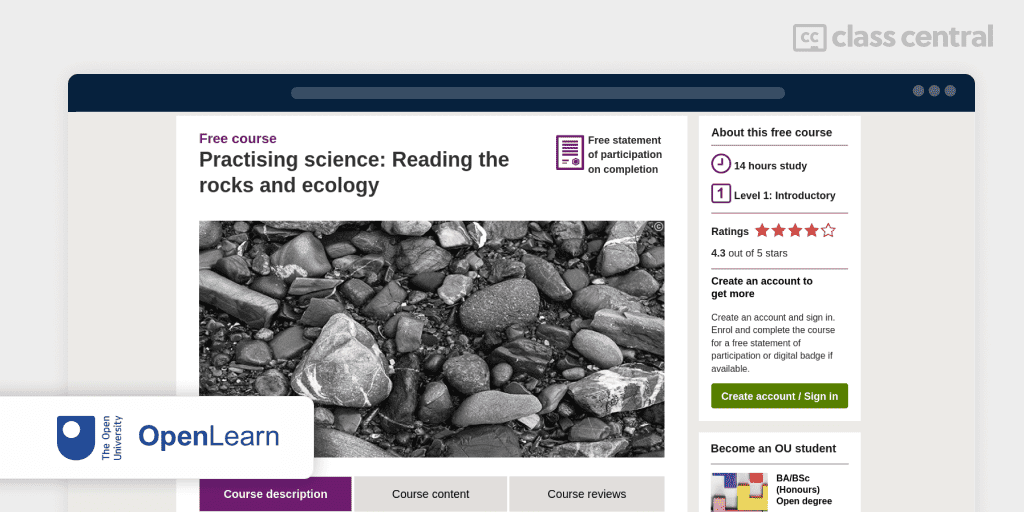
Practising science: Reading the rocks and ecology covers igneous, sedimentary, and metamorphic rocks: how to read them in the field, and how to classify igneous rocks by grain size and mineral composition. It also touches on ecology and fossils, including how to collect quantitative data in a field study. This is a text-based course: written content with embedded activities and resources, not video. You can start right away without signing up, but signing up lets you track your progress, complete quizzes and activities, and earn the free Statement of Participation.
It pairs with Minerals and the crystalline state, an Intermediate course on identifying minerals that assumes some chemistry knowledge, a step up from this Beginner course. This one runs 14 hours, a time estimate that’s on the generous side, but I easily completed both courses within a couple of days.
“This course is very informative, I learned so much.” Ed Bryan Malmis, OpenLearn Learner.
| Provider | OpenLearn |
| Institution | The Open University |
| Duration | 14 hours |
| Level | Beginner |
| Rating | 4.3/5.0 (22 ratings on OpenLearn) |
| Cost | Free |
| Certificate | Free Statement of Participation |
Best Free Certificate Geology Course on Minerals and Crystals (The Open University)
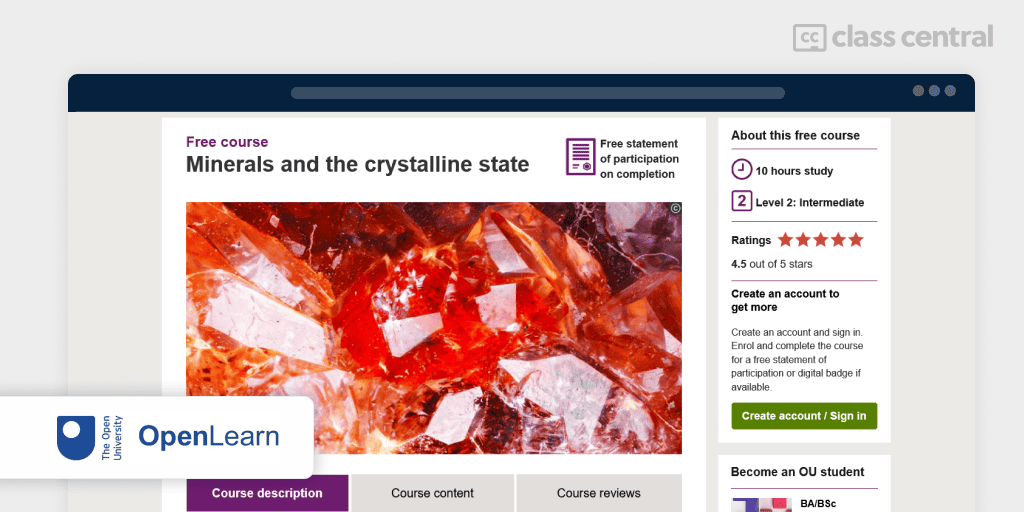
Minerals and the crystalline state covers how mineral crystals form and how their atomic structure shapes properties like cleavage, hardness and lustre. It also gives learners access to a marvelous tool called the Digital Geology Kit, which features images and properties of minerals, rocks and fossils. The course isn’t purely text: it also uses online text and interactive activities, including questions and answers, video clips, slidecasts and the Digital Kit.
Some parts may be tricky if you have zero knowledge of chemistry, but the concepts are explained well. If you’d rather start without any chemistry background, the companion course Practising science: Reading the rocks and ecology is a beginner-level course that assumes none.
“This is the best reference about mineralogy I have read by far.” Ed Bryan Malmis, OpenLearn Learner.
| Provider | OpenLearn |
| Institution | The Open University |
| Duration | 10 hours |
| Level | Intermediate |
| Rating | 4.6/5.0 (21 ratings on OpenLearn) |
| Cost | Free |
| Quizzes/Assessment Items | Practice exercises |
| Certificate | Free Statement of Participation |
Best Geology Course for Resources and Engineering (NPTEL)
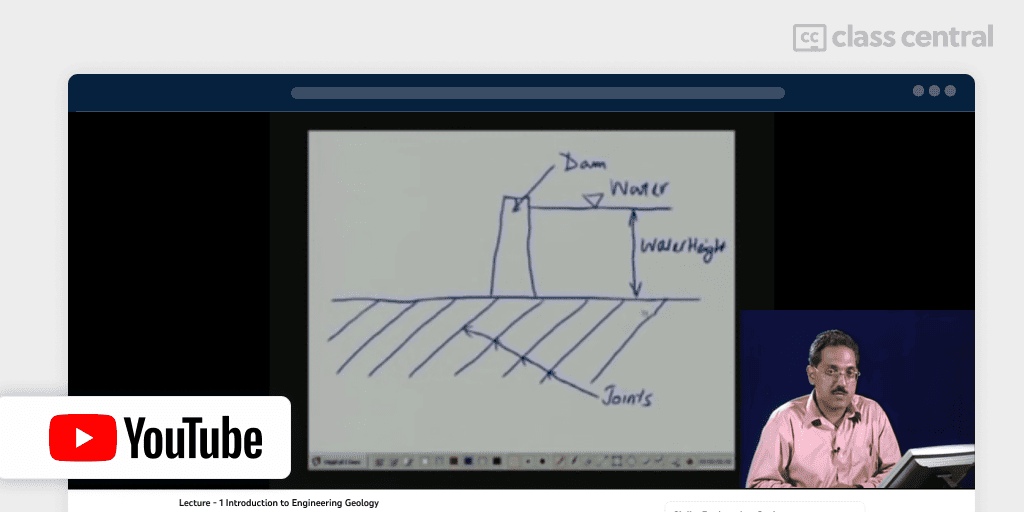
Mining and industry are big business in the 21st century, and Engineering Geology covers not only natural geological structures but also subsurface exploration, engineering properties of soil and rock, and groundwater issues. The final lecture teaches us how to identify various rocks and minerals.
Along the way it works through geologic considerations in tunnelling and dam construction, plate tectonics and earthquake hazard assessment, landslide hazard zoning, and index testing of soil and rock. It’s free, with no certificate or quizzes, with 40 lecture hours from Prof. Debasis Roy of IIT Kharagpur.
“This was a very immersive and interesting course…” Rayan Adi, Class Central learner.
| Provider | YouTube |
| Institution | NPTEL and Indian Institute of Technology, Kharagpur |
| Instructor | Prof. Debasis Roy |
| Duration | 40 hours |
| Level | Intermediate |
| Rating | 4.8/5.0 (30 ratings on Class Central) |
| Views (First Video) | 243K |
| Cost | Free |
| Quizzes/Assessment Items | No |
| Certificate | No |
Best Geology Course for the Energy Industry (Stanford)
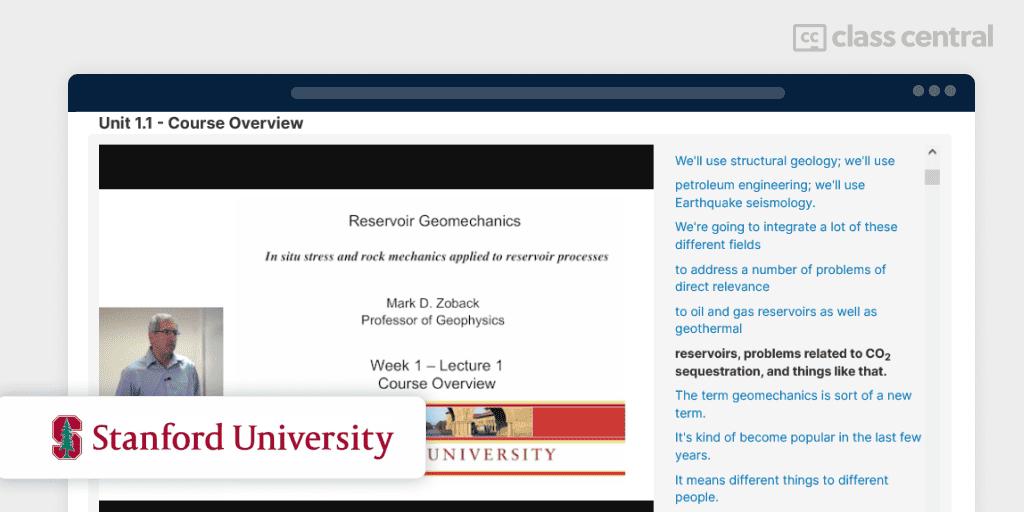
Taught by Stanford’s Mark Zoback, Reservoir Geomechanics pulls together rock mechanics, structural geology, earthquake seismology, and petroleum engineering to tackle real problems in oil and gas extraction: pore pressure prediction, fault seal potential, stable well trajectories, and the risk of production-induced earthquakes. It’s built for geoscientists and engineers in the petroleum and geothermal industries, as well as research scientists interested in stress measurements and their application to problems of faulting and fluid flow in the crust.
The course is classified as beginner-level, but you will need some basic geological understanding to get the most benefit. If you don’t have that grounding yet, Planet Earth…and You! offers a comprehensive beginner introduction.
“I definitely recommend this course to graduate students, post-docs, young faculty members, and professionals in geotechnical, geophysical, and petroleum engineering fields and to those from other disciplines who want to understand more about issues in fossil fuel extraction from design point of view.” Shahrzad Roshankhah, Class Central learner.
| Provider | edX |
| Institution | Stanford University |
| Instructor | Mark Zoback |
| Duration | 10 weeks, 3 to 6 hours a week |
| Level | Beginner |
| Rating | 4.9/5.0 (32 ratings on edX) |
| Enrollments | 21.2K |
| Cost | Free to audit |
| Certificate | Paid |
The post 10 Best Geology Courses for 2026: Real Rock, Real Data appeared first on The Report by Class Central.