

You might’ve heard kids talk about ChatGPT. Or work might’ve rolled out an “AI assistant” and you’re hoping nobody asks you to work with it. If you feel like everyone got the AI memo you missed, you’re not behind, and you’re in the right place.
Just relying on the internet for ‘how to learn AI?’ is too bold of a move today. Ask one question about AI and you’ll get ten answers back, half promising it will fix everything and the other half warning you to hide the children because the Roombas are coming (see this image we once made with AI).

We have a more clutter-less solution. We built a best AI courses list for complete beginners who just want to understand AI and use it day to day, and even programmers who want to build it, with room to grow into Deep Learning and Python when you’re ready.
If you’re short on time, here’s one pick that has you building an AI chatbot in about 30 minutes. Others run deep enough to prep you for a career.
From over 17,000 AI courses on Class Central, we picked 14 for this Best Courses Guide.
Which AI Course Is Right for You?





The hardest part of learning AI is finding the course meant for you, not others
Most AI course lists throw the same pile at every reader, whether they want to use AI or build it. A non-coder and a programmer need different starting points, and both need a course current enough to cover LLMs and generative AI, not just classical theory.
How We Chose These Courses
We looked for courses that name who they’re for, right on the course page.
- Each course states upfront whether you need to code
- Syllabi include LLMs or generative AI, not just classical algorithms
- Beginner tracks lead somewhere: a follow-up course or project to build next
- Instructors or providers have built or shipped real AI work, not just taught it
- Recent run dates or updates, so the content matches today’s tools
Our ranking leans on learner reviews on Class Central, ratings on the platforms hosting each course, and what learners say on Reddit.
Class Central has tracked online courses since 2011, and our small team has completed over 400 of them!
Best Beginner AI Course for Non-Coders (University of Helsinki)
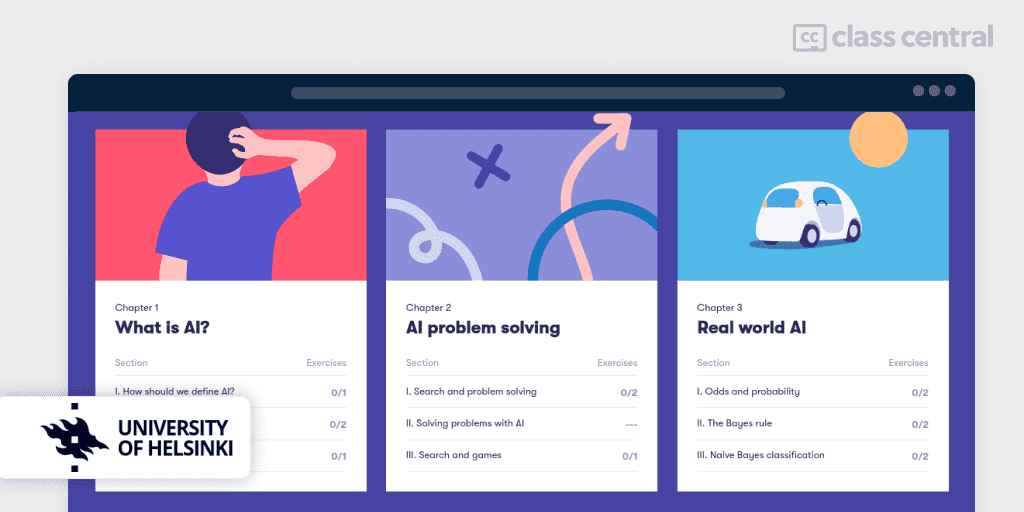
Elements of AI needs no programming and no advanced math. It’s built for people who need to understand AI to make decisions about it, not build it: managers, policy makers, teachers, healthcare workers.
The six-week syllabus moves from what AI is to machine learning and neural networks, then ends on implications like algorithmic bias, AI-generated content, and effects on work and privacy. By the end, you’ll be able to define what AI is, recognize where machine learning and neural networks fit, and judge AI claims in the news without getting lost in the hype.
Exercises mix multiple-choice quizzes, numerical problems, and peer-graded written answers. Complete about 90% of them and you get a free certificate from the University of Helsinki, though it’s not a formal academic credential.
Over a million people in 110+ countries have taken it, and it’s translated into 25+ languages. It holds a 4.8/5 rating from over a thousand reviewers. But it’s a first step, not a job-ready ML program. Anyone wanting to actually build something after finishing should look at the same team’s follow-up, Building AI.
| Provider | Independent |
| Institution | University of Helsinki, MinnaLearn |
| Duration | 6 weeks, 5-10 hours a week |
| Level | Beginner |
| Rating | 4.8/5.0 (1,052 ratings) |
| Cost | Free |
| Certificate | Free |
Best Workplace Productivity AI Course (Google)

Google AI Essentials is a five-course Specialization built for people who use AI at work, not people who build it. It skips coding and technical depth entirely, aiming instead at marketing, project management, business analysis, and operations roles.
The syllabus moves from an AI intro to productivity tools, prompting, responsible use, and keeping up with new developments. Activities are based on more than 20 real work scenarios: drafting emails, outlining ideas, researching and organizing information.
The prompting techniques taught aren’t tied to one product. Google says they carry over to whatever gen AI tool you end up using.
By the end, you’ll be able to write clearer prompts, apply AI to everyday work tasks like drafting and research, and judge which tool fits a given job.
At an hour a week over four weeks, it’s a light commitment, and the paid certificate comes from Google rather than a university, so treat it as a workplace credential rather than academic credit.
If you want a deeper, more academic grounding in how AI works before applying it, Elements of AI is a free alternative built for the same non-coder audience.
| Provider | Coursera |
| Institution | |
| Duration | 4 weeks, 1 hour a week |
| Level | Beginner |
| Rating | 4.8/5.0 (25,562 ratings on Coursera) |
| Cost | Paid |
| Certificate | Paid |
Best Quick Hands-On AI Course for Coders (Scrimba)

Learn OpenAI’s Assistants API is a 30-minute code-along that has you build a movie chatbot using retrieval to pull answers from a dataset.
Scrimba’s interactive format lets you edit the code inline as instructor Guil Hernandez builds the project, rather than just watching a screencast.
The course walks through the API’s four primitives: Assistants, Threads, Messages, and Runs. It requires existing JavaScript knowledge. After the course, you’ll be able to create and customize an assistant, set up threads and messages to simulate conversation, and implement retrieval so it draws on custom knowledge.
If you want a broader, Python-based grounding in AI concepts before narrowing in on one API, CS50’s Introduction to AI with Python is a fuller alternative.
Please note: The Assistants API was still in beta when this course was recorded, so some details may have shifted since.
| Provider | Scrimba |
| Instructors | Guil Hernandez |
| Duration | 30 minutes |
| Level | Intermediate |
| Rating | Not yet rated |
| Cost | Free to audit |
| Certificate | Paid |
Best Business Strategy AI Course (DeepLearning.AI)
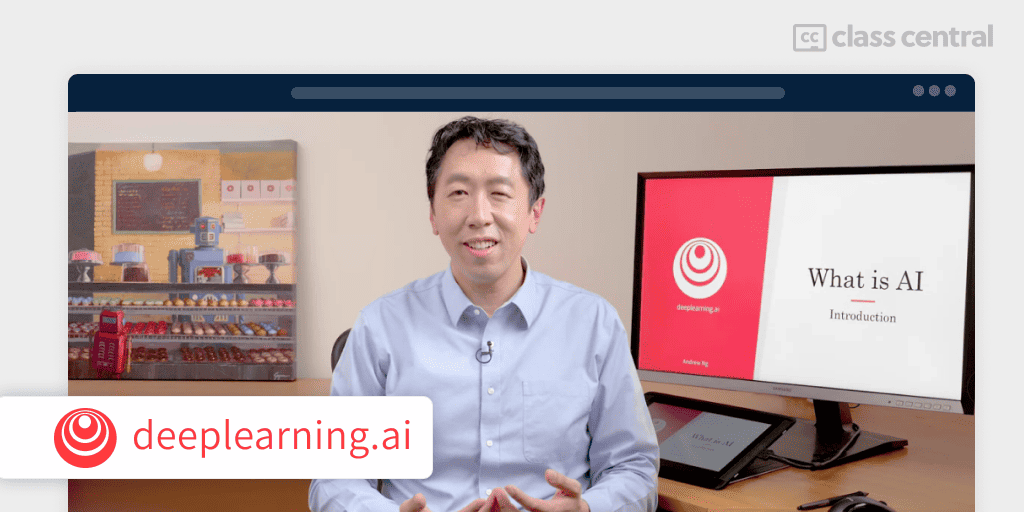
AI For Everyone is built for managers and executives, not coders. Andrew Ng, who led Google Brain and co-founded Coursera, teaches it over four weeks at about two hours a week.
There’s no programming. Instead, the course covers AI terminology, what machine learning and deep learning can and can’t realistically do, and how to spot where AI might fit in your own organization.
Case studies walk through what an AI project actually looks like, from working with a data science team to setting a broader AI strategy. The course also addresses the ethical and societal questions that come with adopting AI.
By the end, you’ll be able to talk through AI terminology, identify plausible AI opportunities at work, collaborate with an AI team, and think through strategy and ethics questions before a project starts.
All videos and readings are free to audit. Graded quizzes and the certificate require payment. Coursera rates it 4.8/5.0 across more than 53,000 ratings, with over 2.6 million learners enrolled!
If you want a slower, more detailed non-technical foundation before tackling strategy questions, Elements of AI is a good complement.
| Provider | Coursera |
| Institution | DeepLearning.AI |
| Instructors | Andrew Ng |
| Duration | 4 weeks, 2 hours a week |
| Level | Beginner |
| Rating | 4.8/5.0 (53,229 ratings) |
| Cost | Free to audit |
| Certificate | Paid |
Best Live, Mentored AI Course (Noble Desktop)

AI for Business with ChatGPT and Copilot is an 18-hour course taught by Dan Rodney, Mourad Kattan, and Garfield Stinvil.
You can take it in person at Noble Desktop’s NYC campus or live online, with a self-paced version also available. Classes are small, so you get real-time feedback from an instructor rather than working through recorded lectures alone.
The course covers prompt writing for ChatGPT, plus Copilot across Excel, Word, PowerPoint, Outlook, Teams, and OneDrive. It also touches custom GPTs, AI agents, deep research tools, and responsible AI use around privacy and copyright.
By the end, you’ll be able to write effective prompts, apply ChatGPT to real business tasks, and use Copilot to speed up work across Office 365 apps.
Enrollment includes a free retake within a year, plus class recordings and workbooks to review later.
There are no prerequisites, and Noble Desktop has run hands-on tech training for over three decades.
It costs more than self-paced alternatives like Google AI Essentials. But the higher price reflects live instruction and mentorship.
| Provider | Noble Desktop |
| Instructors | Dan Rodney, Mourad Kattan, Garfield Stinvil |
| Duration | 18 hours |
| Level | Beginner to Intermediate |
| Rating | 4.8/5.0 (150 ratings) |
| Cost | Paid ($799) |
| Certificate | Paid |
Best Hands-On, No-Code AI Course (IBM)

Introduction to Artificial Intelligence (AI) pairs its explanations with hands-on labs instead of leaving concepts abstract. Rav Ahuja teaches the four-week course for IBM, and it requires no programming background.
The course covers machine learning, deep learning, and neural networks, then moves into generative AI and large language models. It also looks at where AI shows up in practice: natural language processing, computer vision, robotics, and IoT.
A final project asks you to design an ethical generative-AI solution for a real organizational problem, backed by a graded quiz and a discussion of bias, hallucinations, and misuse.
Then, you’ll be able to explain core AI terminology, distinguish AI from augmented intelligence, spot where machine learning and generative AI fit, and weigh the ethical tradeoffs involved.
Over 956,000 people have enrolled, and it holds a 4.7/5.0 rating from 23,395 reviewers on Coursera.
Please note: the course is free to audit, but graded assignments and the certificate require payment.
If you want a more strategy-focused counterpart, AI For Everyone covers AI’s business implications without the labs.
| Provider | Coursera |
| Institution | IBM |
| Instructors | Rav Ahuja |
| Duration | 4 weeks, 3 hours a week |
| Level | Beginner |
| Rating | 4.7/5.0 (23,395 ratings on Coursera) |
| Cost | Free to audit |
| Certificate | Paid |
Best Hands-On AI Course for Building Practical Projects (University of Helsinki)
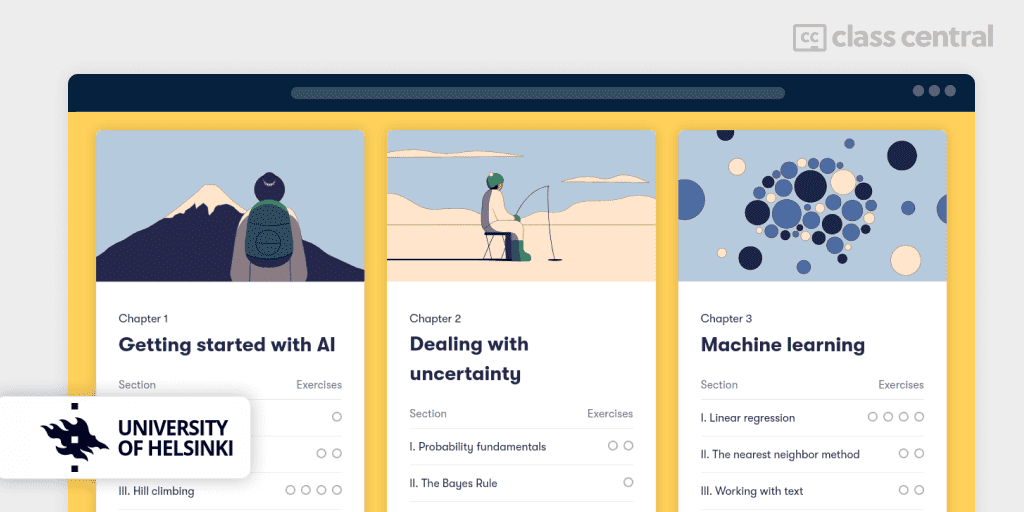
Building AI is the second part of the Elements of AI series from the University of Helsinki and MinnaLearn. It moves past concepts into implementation, using plain Python instead of frameworks like TensorFlow or PyTorch.
The course covers optimization, reasoning, and learning, then works through Bayes rule, linear regression, nearest neighbor, cross-validation, logistic regression, and simple neural networks. An optional final task asks you to propose your own AI idea.
Three difficulty tracks share the same material but split the exercises: beginner needs no coding, intermediate and advanced assume Python skills. Some prior Python is recommended if you want the coding exercises.
By the end, you’ll be able to describe the main types of AI approaches, pick a method for tasks like route planning or prediction, and implement algorithms such as linear regression and nearest neighbor in Python.
At 50 hours, self-paced and free, it’s a substantial step up from a survey course. It suits learners who finished an intro like Elements of AI and want to write the algorithms themselves.
| Institution | University of Helsinki, MinnaLearn |
| Duration | 50 hours |
| Level | All Levels |
| Rating | 4.4/5.0 |
| Cost | Free |
| Certificate | Paid |
Best Advanced AI Course for Building Models From Scratch (Andrej Karpathy)

Neural Networks: Zero to Hero is a free video series by Andrej Karpathy, former director of AI at Tesla and a founding member of OpenAI.
The course starts at the root: backpropagation, coded by hand through a small autograd engine called micrograd. From there it builds a character-level language model, makemore, expanding it step by step into an MLP with batch normalization and manual backprop, then a deeper WaveNet-style network.
The series ends with two advanced builds: a GPT from scratch based on the “Attention Is All You Need” paper, and a separate video on building a GPT tokenizer using byte-pair encoding. All coding is done in PyTorch.
This is not a course for beginners. It expects solid Python and comfort with derivatives and basic probability, and it moves fast through dense material.
By the end, you’ll be able to implement backpropagation manually, train neural networks from raw code, and build a working GPT-style transformer language model.
Coders who want a gentler, project-based route into AI first might start with Building AI.
| Provider | Independent |
| Institution | |
| Instructors | Andrej Karpathy |
| Duration | 14.5 hours |
| Level | Advanced |
| Rating | Not yet rated |
| Cost | Free |
| Certificate | No |
Best Beginner AI Math Course (KAIST)
Math for AI beginner part 1 Linear Algebra teaches the linear algebra that sits under most machine learning algorithms.
Yoon Yong Jin of KAIST builds up from vectors and scalars to row operations, linear independence, and inverse matrices.
Later modules cover determinants, the eigenvalue problem, and diagonalization, each tied back to machine learning, deep learning, and support vector machines.
The course doesnt need prior math background and spreads six modules over six weeks at roughly an hour a week. Five graded assignments reinforce the material along the way.
Learners come away able to read the linear algebra notation and operations that show up in AI papers and courses, rather than treating them as a black box.
This is part one of a KAIST series; part two moves into vector calculus for AI.
If you want the broader field context first can pair this with Elements of AI, a non-technical introduction to AI concepts.
| Provider | Coursera |
| Institution | KAIST |
| Instructors | Yoon Yong Jin |
| Duration | 6 weeks, 1 hour a week |
| Level | Beginner |
| Rating | 4.4/5.0 (33 ratings on Coursera) |
| Cost | Paid (free trial available) |
| Certificate | Paid |
Best AI Engineering Certificate (Microsoft)

The Microsoft AI Engineer Program is a six-month, live online career program built with Microsoft.
It moves through Python for AI, applied data science, machine learning, and a deep learning specialization before reaching Microsoft Azure AI Fundamentals (AI-900).
Later modules cover building AI agents, extending Microsoft 365 Copilot, generative AI, natural language processing, and agentic AI with Copilot Studio and AutoGen.
Live masterclasses run with Microsoft-certified trainers, backed by mentoring sessions and recordings for anyone who misses a class. A capstone project closes out the program, giving learners a project to show alongside preparation for the Azure AI-900 exam.
Learners finish having built machine learning, deep learning, and generative AI projects. You’ll also receive a certificate of completion from Microsoft and Simplilearn.
If you want a shorter, free way to test their interest before this commitment can start with IBM’s Introduction to AI.
| Provider | Simplilearn |
| Institution | Microsoft |
| Duration | 6 months |
| Level | Intermediate |
| Cost | Paid |
| Certificate | Paid |
Best Technical Intro AI Course for Python Coders (Harvard University)

CS50’s Introduction to Artificial Intelligence with Python walks through the ideas that power modern AI systems, then has you implement them yourself. It expects prior Python experience, unlike CS50’s intro-level offerings.
The syllabus covers search algorithms, knowledge representation, logical inference, probability, optimization, machine learning, neural networks, and natural language processing. Projects use scikit-learn and TensorFlow, so learners get practice with real libraries rather than toy code.
Seven quizzes and twelve programming projects make up the workload, which Harvard estimates at 10 to 30 hours a week over seven weeks. That range reflects how much the projects can demand once you move past the lecture material.
Learners finish able to build their own AI programs in Python, combining search, optimization, and machine learning techniques rather than just recognizing the concepts.
This course is free to audit, but tose who want to build neural networks from scratch, rather than mainly calling library functions, can follow up with Neural Networks: Zero to Hero.
| Provider | edX |
| Institution | Harvard University |
| Instructors | David J. Malan, Brian Yu |
| Duration | 7 weeks, 10-30 hours a week |
| Level | Beginner |
| Rating | 4.7/5.0 (38 ratings) |
| Cost | Free to audit |
| Certificate | Free (unverified via Harvard OCW) or Paid ($299 verified via edX) |
Best Text-Based AI Curriculum (Microsoft)

AI for Beginners is a free, open-source curriculum hosted on GitHub, built for coders who prefer reading and writing code over watching lectures.
The 12-week syllabus moves through AI history and symbolic reasoning, then into neural networks with PyTorch and TensorFlow, computer vision, NLP with transformers, and lighter topics like genetic algorithms and multi-agent systems. A section on AI ethics closes out the material.
Each lesson pairs text with Jupyter notebooks, so learners implement concepts in Python as they go rather than just reading about them. Pre- and post-lecture quizzes reinforce the material.
Working through the curriculum means writing and running code across the core areas of AI, from basic neural nets to computer vision and language models.
There’s no certificate and no rating system, since this is a community-maintained project rather than a platform course. Some prior Python exposure helps with the labs.
Coders who want video lectures, structured projects, and a certificate covering similar ground can look at CS50’s Introduction to AI with Python instead.
| Provider | Microsoft |
| Duration | 12 weeks |
| Level | Beginner |
| Cost | Free |
| Certificate | No |
Best Free Generative AI Course (Google)
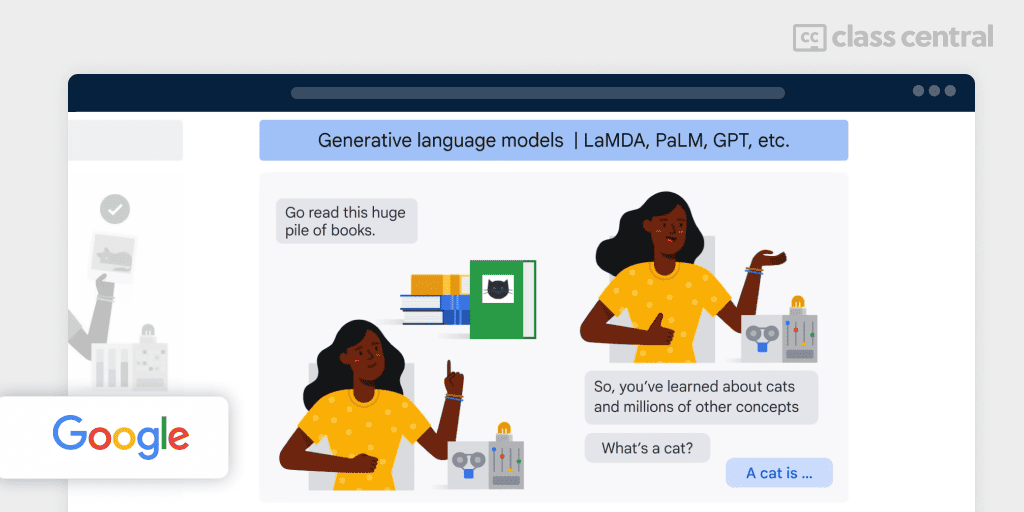
Introduction to Generative AI is a short learning path for people who have never studied AI. It takes about two hours, spread across several short videos.
The path covers what generative AI is, how it differs from other types of AI, and how large language models work at a basic level. It also touches on responsible AI principles.
Learners finish able to explain generative AI and large language models in plain terms, and describe basic responsible AI practices.
The course is free and self-paced, with no prerequisites. Completion earns a free Generative AI Fundamentals skill badge.
Please note: the platform was previously called Google Cloud Skills Boost and is now Google Skills.
Learners who want to apply generative AI to daily work tasks can follow up with Google AI Essentials.
| Provider | Google Skills |
| Institution | |
| Duration | ~5 hours |
| Level | Beginner |
| Rating | Not yet rated |
| Cost | Free |
| Certificate | Free badge |
Best Rigorous University Theory AI Course (MIT)
6.034 Artificial Intelligence is MIT’s full fall 2010 AI course, taught by the late Patrick Henry Winston and released through OpenCourseWare.
The course runs about 24 hours of lecture, recitation, and mega-recitation video. It requires calculus, linear algebra, and some programming background.
Coverage spans knowledge representation, search algorithms like A* and alpha-beta pruning, constraint satisfaction, and learning methods including neural nets, genetic algorithms, and support vector machines. Probabilistic inference rounds out the material.
Learners work through problem sets and exams that assemble these pieces into a working picture of how intelligent systems solve concrete problems, tying knowledge representation to search and learning.
Please note: this is a 2010 recording, so it predates the deep learning and large language model era. Its neural network material is foundational rather than current.
| Provider | MIT OpenCourseWare |
| Institution | MIT |
| Instructors | Patrick Henry Winston |
| Duration | 24 hours |
| Level | University level |
| Rating | 4.6/5.0 (239 ratings) |
| Cost | Free |
| Certificate | No |
The post 14 Best AI Courses for 2026: For Beginners & Coders appeared first on The Report by Class Central.