

15 Examples Of Earned Media That Build Strong Brand Authority And Trust
A company can explain its strengths through advertising, website content, and executive posts. But those messages come from the business itself. When a customer recommends the product or a journalist uses its research, another voice enters the conversation.
That outside perspective is what makes earned media worth pursuing. It gives potential buyers more to consider than the claims a company makes about itself. And it extends beyond press coverage to reviews, research citations, podcasts, professional recommendations, and industry recognition.
Earned media is third-party exposure or recognition a brand receives when external publishers, customers, experts, creators, or industry platforms independently choose to mention, cite, recommend, discuss, or recognize the brand or its expertise.
These 15 examples of earned media show what independent recognition looks like and how B2B businesses can give others a reason to discuss their work.
Key Takeaways
- Independent selection matters more than whether the wider campaign costs money.
- Research, expertise, and customer experiences create reasons for recognition.
- Reviews, recommendations, and editorial coverage provide different kinds of evidence.
- Relevance and credibility matter more than mention counts or guaranteed exposure.
Want to achieve data-driven growth and brand visibility?
Talk to our team about being featured in our AI-optimized editorial content or directories.
In This Article, We Explore…
What Counts As Earned Media?
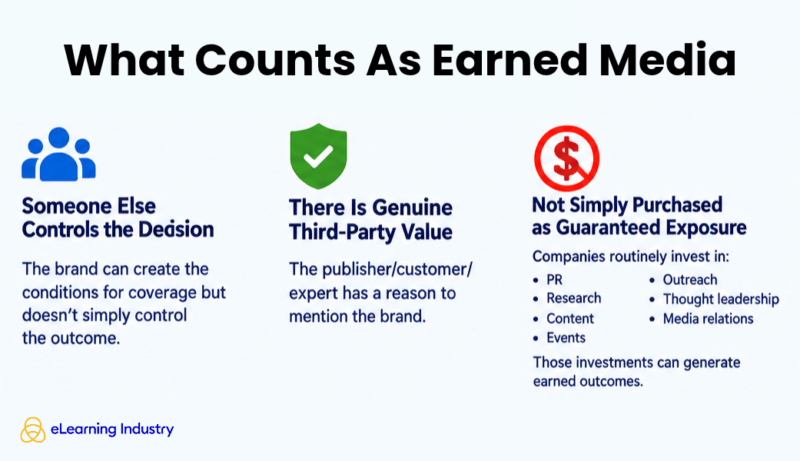
Three questions help establish whether exposure is genuinely earned: Who decided to publish it? Why did they consider it useful? And was the outcome guaranteed in exchange for payment?
A business can invest in research, PR, events, content, and outreach without purchasing the resulting coverage. Suppose a learning technology company commissions a buyer survey. If an editor independently uses its findings in an article, that citation is earned even though producing the research cost money.
By contrast, paying a publication to run a guaranteed article buys exposure. Editorial quality checks may improve the sponsored piece, but they do not turn a purchased placement into independent coverage.
The same distinction applies when commercial participation and recognition exist within one program. Examine what the payment secures, what the selection criteria assess, and whether those criteria can genuinely lead to rejection.
Also remember that earned coverage is not necessarily positive. An independent review can identify weaknesses, and a journalist may challenge your interpretation. What makes the exposure earned is the third party’s decision—not whether the result matches your preferred message.
What Counts As Earned Media
Earned Media Vs. Paid, Owned, And Shared Media
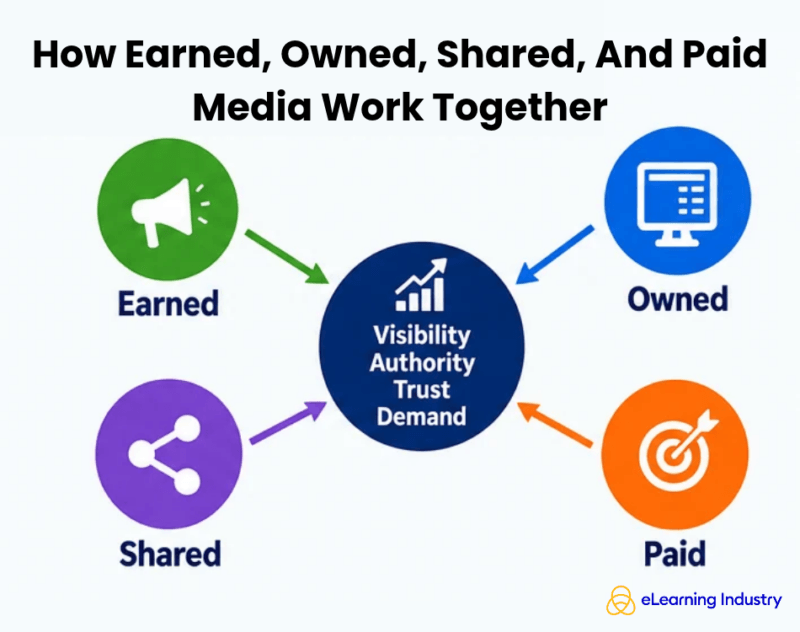
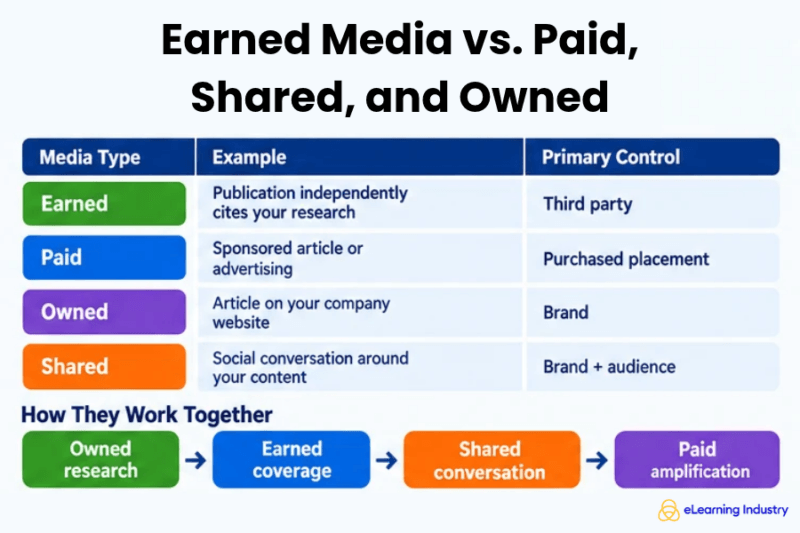
Owned media includes articles on your website and emails to your subscribers. Paid media covers purchased distribution, such as advertising and sponsored placements. Earned media comes from an outside decision to cover or reference your work, while shared media includes social conversations and distribution involving your audience.
These categories describe different parts of the same marketing effort. You might publish research on your website, earn coverage of a finding, see people discuss it socially, and pay to promote the resulting content.
The original report remains owned, the independent article is earned, the discussion is shared, and the advertisement is paid. Together, they help useful information reach people in different ways without changing who controls each outcome.
How Earned, Owned, Shared, And Paid Media Work Together
15 Examples Of Earned Media
The scenarios below illustrate how each format works rather than documenting specific company campaigns. Several can overlap: one research-based article might create editorial coverage, a brand mention, and a backlink.
1. Editorial Media Coverage
An industry publication investigates a market development and includes your company’s research, experience, or perspective. For example, a journalist examining enterprise training budgets might use a vendor’s buyer study to explain changing priorities.
The authority comes from editorial selection. Your contribution serves a broader story rather than appearing solely because your company purchased space.
To earn this coverage, identify what your information reveals beyond company activity. A launch announcement becomes more relevant when it addresses a documented customer problem or illustrates an industry change. Offer evidence, access to knowledgeable people, and a clear explanation of why the story matters.
2. Journalist Quotes And Expert Commentary
A journalist asks your chief marketing officer to explain changing buyer behavior or quotes a learning specialist about employee development. The company becomes visible through its expert’s contribution to the discussion.
A useful quotation connects an executive with a specific area of knowledge. It can also introduce the company through the expert’s professional background without turning the article into a business profile.
Build this opportunity by identifying what each spokesperson can explain from experience. Prepare examples, clarify availability, and respond directly to the journalist’s questions. Our Media Outreach guide explores how to develop those relationships. The aim is to become a reliable source, not to attach a product message to every answer.
3. Organic Brand Mentions In Industry Content
A writer discussing enterprise learning platforms names your company as an example of a particular approach. The reference may be brief, but it places the business within a conversation relevant to its category.
A reader researching customer education encounters the brand while learning about a problem they need to solve. The company becomes associated with a relevant use case rather than appearing in an unrelated promotional feature.
Help writers understand that connection by explaining your capabilities clearly and making supporting examples accessible. Avoid overstating what the product does. Accurate positioning gives others a sound basis for describing the business without simply repeating a slogan.
4. Editorial Backlinks
A publisher links to your website because a resource supports its article. The destination might be a benchmark report, an original dataset, a practical framework, or a detailed explanation.
The link directs readers to supporting information rather than serving the linked company’s SEO goals. A reference to relevant research is different from a product link inserted into an unrelated paragraph.
To encourage these citations, publish material people can verify and use. Explain definitions, show the evidence behind claims, and keep the source easy to find. During outreach, lead with what the resource contributes. Asking journalists to provide a particular anchor text puts your marketing requirement ahead of their readers.
5. Original Research Citations
A publication, newsletter, or speaker uses a finding from your company’s survey or benchmark report. A study examining implementation support, for example, could inform an article about vendor selection.
Research citations associate the business with original evidence. One study can support media coverage, backlinks, social discussion, and executive commentary, which may lead to further citations. That progression is possible, not automatic.
Start with a question your audience genuinely needs answered. Explain the sample, collection process, and limitations so others can judge the findings. Avoid presenting a narrow survey as a picture of the entire market.
eLearning Industry’s SurveyWorks helps vendors develop and distribute custom research to learning and HR professionals. Commissioning the study creates an asset for outreach; another publisher’s independent decision to cite it creates the earned outcome.
6. Podcast Guest Appearances
A podcast selects a founder to discuss scaling a business or invites a learning leader to explain an implementation challenge. The host chooses the guest because their experience fits the audience and promises a useful conversation.
This format gives listeners room to assess an executive’s reasoning. Stories about difficult decisions, mistakes, and lessons can demonstrate expertise more clearly than a short company biography.
Pitch a conversation supported by direct experience, and listen to previous episodes before approaching the host. Our Why Be a Podcast Guest? guide and eLearning Industry’s podcast hub provide starting points for exploring the format.
Check the arrangement carefully. An editorial invitation based on expertise is earned; a purchased appearance is paid, even when the host reviews the topic and the discussion is genuinely useful.
7. Customer Reviews
A customer independently explains why they selected your software, how implementation went, and what they would change. This is different from your website claiming that customers love the product.
Reviews add first-hand experience to the information available to prospective buyers. Details about support, usability, and limitations help readers assess relevance to their own situation. A balanced account can answer questions that a polished product description leaves open.
Invite honest feedback without supplying the verdict. Make participation straightforward, respond constructively, and use recurring criticism to identify improvements. eLearning Industry’s directories provide a place to explore vendor profiles and customer reviews. Keep the distinction clear: the profile a vendor creates is not itself independent customer validation.
8. Organic Customer Recommendations
A customer recommends your platform in a professional community, introduces a peer to your team, or mentions your product during a discussion about a shared problem. Unlike a formal review, the recommendation arises within an existing conversation.
Its value comes from context and first-hand experience. A colleague explaining why a tool worked for a similar team offers more useful information than a general endorsement without details.
Earn these recommendations through dependable service, helpful onboarding, and attention to customer problems. Give customers accurate resources to share, but leave the recommendation in their own words. Some conversations happen privately, so they may influence a buying decision without appearing in your analytics. Do not confuse limited tracking with a lack of value.
9. Organic Social Media Mentions
An industry professional shares your research, quotes an executive, or discusses your product without a paid arrangement. For example, a learning leader might post a survey finding and explain how it relates to their team’s experience.
The additional commentary introduces another perspective. It can connect your work with audiences outside your following and reveal which parts of the material people consider worth discussing.
Publish findings and explanations that stand on their own, then respond when others raise questions. Avoid scripting supposedly independent praise. A company post about itself is owned or shared activity; a customer’s independent post is earned recognition that also circulates through shared media. The categories overlap, but the source of the message still matters.
10. User-Generated Content
A customer records a product walkthrough, publishes a tutorial, or shares screenshots explaining how they built a workflow. This goes beyond a mention by showing the product in use.
For a prospective buyer, the value lies in seeing what someone actually did. A customer explaining their setup can reveal practical details, constraints, and adaptations that marketing materials leave out. However, one person’s experience does not establish what every customer will achieve.
Support this activity with useful documentation, accessible learning resources, and opportunities for customers to exchange ideas. Ask permission before republishing their work and preserve its meaning. A commissioned promotional video should not be presented as unsolicited customer content.
11. Industry Awards, Top Lists, And Editorial Recognition
An industry organization selects a company for an award or includes it in a Top List after evaluating relevant evidence. Recognition can help buyers understand how a vendor relates to a category, provided the basis for selection is meaningful.
Examine eligibility, methodology, reviewer expertise, customer evidence, and the relationship between payment and selection. A badge alone does not explain what was assessed. Credible recognition must be earned against criteria that can distinguish qualifying companies from those that do not qualify.
Commercial participation and recognition should therefore be described separately. An application fee or content program does not, by itself, establish independence. Equally, money spent around an opportunity does not explain every part of the selection process.
Learning Tech, HR Tech, and AI vendors can review relevant eLearning Industry Top Lists and apply for consideration. Its application guidance includes both evaluation criteria and co-branded content requirements. Consider those participation terms alongside the recognition rather than treating the application itself as an endorsement.
12. Conference And Event Invitations
An organizer invites an executive to speak, join a panel, present research, or moderate a discussion because their expertise fits the program. A learning specialist explaining a difficult rollout is one example.
The invitation recognizes the person’s ability to contribute beyond their company role. The session may also generate event coverage, attendee posts, quotations, or further interview opportunities. A purchased speaking slot, however, remains paid participation.
Develop a session around what the audience will learn, supported by examples and evidence. Offer a clear perspective rather than a product demonstration disguised as education. Executives interested in a related podcast guest discussion with eLearning Industry can contact [email protected] to explore the format and participation terms.
13. Unsolicited Creator Or Influencer Coverage
An industry creator independently reviews your software, discusses your research in a video, or mentions the brand in a professional newsletter. The coverage reflects the creator’s decision about what their audience would find useful.
Its value depends on that creator’s relevance and credibility with the audience. A specialist explaining how a tool fits an actual workflow may provide more useful context than a broad endorsement from someone unfamiliar with the category.
Make accurate information and appropriate product access available, while leaving the conclusion to the creator. Paid collaborations and affiliate arrangements should not be presented as wholly independent recommendations. Unsolicited coverage may include criticism, so respond to factual issues without trying to control the reviewer’s opinion.
14. Newsletter Mentions And Expert Roundups
A specialist newsletter links to your research, discusses your framework, or includes an executive’s contribution in a roundup. For a B2B brand, this can place useful expertise directly within a concentrated professional conversation.
Audience fit matters more than the subscriber count alone. A modest learning technology newsletter may reach a higher proportion of relevant buyers than a much larger general publication. The opportunity should be judged on that fit rather than assumed reach.
Read the newsletter before suggesting a contribution. Offer a concise finding, practical explanation, or evidence-backed perspective that suits its recurring topics. Keep purchased newsletter placements separate from editorial selections, and avoid sending a long company introduction when the editor needs a usable insight.
15. AI And Search Citations
An AI-generated answer cites your research, a search result surfaces your guide, or a relevant category response mentions the brand. These are examples of discovery in an environment your company does not directly control.
They are not identical to traditional earned media. A search system is not a journalist, and an AI mention is not independent confirmation that a product is suitable or a claim is true. Still, the visibility can introduce people to information they would not otherwise encounter.
Create useful resources with clear sourcing, accurate descriptions, and accessible explanations. Credible external references can add context around the brand, but they do not guarantee retrieval, citations, or recommendations. Treat AI and search visibility as an emerging discovery outcome, not proof of editorial endorsement.
Which Types Of Earned Media Build Brand Authority?
Different examples of earned media answer different buyer questions. Editorial coverage and expert quotes show that a source considered the contribution relevant. Research citations demonstrate the use of original evidence, while category mentions connect the brand with a particular problem or market.
Podcasts and event invitations give executives space to demonstrate their thinking. Reviews, recommendations, and user-generated content reveal customer experience. Awards and Top Lists offer recognition whose value depends on the criteria behind it.
Newsletter and creator coverage bring those contributions into specific communities, while backlinks and search citations provide routes to further information.
No format is universally best. A company seeking to establish technical expertise needs different evidence from one trying to reassure buyers about customer support. Build several forms of validation rather than expecting one mention to answer every question.
How To Generate More Earned Media
Start with something worth using: original data, an informative customer experience, or a practical framework. Then identify experts who can explain what it means and audiences who would benefit from that explanation.
A workable approach combines three activities:
- Develop evidence and perspectives that add something to the discussion.
- Build relationships and pitch ideas relevant to each recipient’s audience.
- Support genuine customer advocacy and participate in suitable industry conversations.
Our Media Outreach guide covers relationship-building, while Media Pitch Examples, Article Pitch Examples, and Email Pitch Examples explore different ways to present an opportunity.
Publications, podcasts, webinars, events, research projects, and communities can all help people encounter your work. Participation alone does not make the result earned. A company-hosted webinar is owned content; a journalist independently quoting it creates an earned outcome.
For the complete planning process, see Earned Media Strategy: A Practical Framework for Building Authority and Brand Visibility.
How Earned Media Supports SEO And AI Visibility
SEO
Earned coverage can create editorial links and routes for readers to discover your website. Relevant mentions can also prompt people to search for the company or explore a topic associated with its expertise.
However, referral visits, backlinks, and unlinked mentions are different outcomes. Do not treat every appearance as an equivalent ranking signal or assume that more coverage will automatically improve rankings. Focus on relevance and the usefulness of the linked material.
AI Discovery
External coverage adds information connecting a brand with categories, expertise, customers, and use cases. Reviews describe implementations, while research citations connect the company with specific findings.
This gives discovery systems potential sources beyond the company’s own claims. It does not establish that every system will find, trust, or cite them.
Keep descriptions accurate and evidence easy to verify. Also distinguish a citation to your resource from a recommendation of your product. Earned media can strengthen the external information available about a brand, but it does not guarantee AI visibility.
How To Measure Earned Media
Begin with the outcome you want to understand, then connect coverage to authority, audience response, and commercial activity. Counting mentions alone cannot show whether those mentions reached relevant people or helped them evaluate the company.
Visibility includes media and social mentions, branded searches, and Share of Voice. Define the competitors, topics, and channels used in the comparison, and separate original coverage from repeated distribution of the same story.
Authority concerns who referenced you and why. Assess publication relevance, expert quotations, research citations, backlinks, podcast invitations, and industry recognition. A critical mention and a recommendation should not be reported as equivalent endorsements.
Engagement includes referral visits, discussion, and consumption of the underlying content. Buyer trust requires closer attention to review detail, recommendation quality, and changes in customer feedback rather than assuming that a growing review count means improving sentiment.
For commercial impact, examine relevant leads, target-account activity, sales conversations, partnerships, and influenced pipeline. Ask prospects how they encountered the company, since private recommendations may leave no direct digital trail.
Compare results consistently, noting other activity that could affect them, including advertising, launches, and sales campaigns.
Avoid assigning an entire deal to one placement without evidence. A relevant mention can be useful even when its contribution cannot be isolated precisely.
Common Earned Media Mistakes
Sponsored coverage should not be described as editorial coverage, and an unpaid company post does not become earned simply because no advertising budget was involved.
Another mistake is pursuing attention without giving anyone something useful to discuss. Generic commentary, unsupported predictions, and product-first pitches leave journalists and readers doing the work of finding relevance. Demanding backlinks makes that imbalance even clearer.
Also avoid:
- Treating every award or badge as equally credible without examining its methodology.
- Chasing large audiences that have little connection to your buyers.
- Ignoring customer feedback and executive expertise while focusing only on press mentions.
Share relevant coverage with colleagues and customers, explain its usefulness, and respect the original context. Do not turn a limited research citation into a claim that the publication endorses your entire business.
Finally, allow different outcomes to serve different purposes. A podcast can demonstrate expertise without generating immediate enquiries, while a review may help an existing prospect rather than introduce a new one. Neither guarantees sales, search rankings, or AI recommendations, and reporting should not suggest otherwise.
Earned Media vs. Paid, Shared, and Owned
Conclusion
The strongest examples of earned media give people something beyond a company’s description of itself. They show an expert contributing to a wider discussion, research informing someone else’s work, or a customer explaining a genuine experience.
Support those outcomes through useful evidence, dependable service, and relevant relationships. Then assess each opportunity according to who makes the decision, what the audience gains, and whether the recognition can simply be purchased.
That approach keeps earned media focused on its real value: independent reasons for people to pay attention to your brand, consider its expertise, and decide whether it deserves their trust.
FAQ
Examples of earned media include editorial news coverage, journalist quotes, research citations, independent customer reviews, organic social mentions, podcast invitations, and editorial backlinks. For a B2B company, this might be an industry publication referencing its survey or a customer recommending its software in a professional community. The common feature is that someone outside the business independently decides the brand, its expertise, or its work is worth discussing.
Exposure counts as earned media when a third party independently chooses to mention, cite, review, or recognize a brand rather than providing guaranteed exposure in exchange for payment. That does not mean the company spent nothing to create the opportunity. Investing in research, content, or PR can lead to earned coverage. For example, commissioning a survey is a marketing investment, but a journalist’s independent decision to cite its findings is an earned outcome.
Earned media comes from third parties independently covering or referencing your business. Paid media includes exposure you purchase, such as advertisements and sponsored articles. Owned media covers channels your company controls, including its website, blog, and newsletter. These approaches can work together: a company might publish research on its website, earn editorial coverage of the findings, and then pay to promote that coverage. Each activity remains a different type of media.
Yes, independent customer reviews are earned media because they reflect a customer’s experience rather than a message written or controlled by the brand. A company can invite honest feedback while leaving customers free to decide what they say. Positive, mixed, and negative reviews can all qualify, since earned media is not necessarily favorable. However, a company-written testimonial or purchased positive review should not be presented as independent customer validation.
Backlinks count as earned media when another publisher independently links to your content because it provides useful information or supporting evidence. For example, an industry article might link to your original research, benchmark report, or practical guide. However, not every backlink is earned. A link included in an advertisement or guaranteed sponsored placement is part of paid exposure. The distinction is whether the publisher independently chose to reference your work rather than selling the placement.