
Learning Latin online is more accessible than it looks if you pick the right course. Some are fully self-contained; others require a textbook. Here’s what to know.
Most people who want to learn Latin don’t know where to start. The resources are scattered and it’s not always clear whether a course will actually teach you the language or just assume you already own the right book.
That distinction matters more than anything else when choosing a Latin course online. Some courses are fully self-contained: you show up, and they teach you everything. Others are companion guides built around a specific textbook like Wheelock’s Latin or the Cambridge Latin Course. Both approaches work, but only if you know which one you’re signing up for.
From over 60 Latin courses on Class Central, I picked 7 for this Best Courses Guide. The range covers free and paid options, self-contained foundations, textbook companions, spoken Latin, and one Italian-language course that traces how Latin was actually taught in the ancient world through papyrological evidence. Whether you want to read Cicero or just get started today, there’s a clear path here.
I’ve also highlighted some worthwhile textbooks if you prefer to learn with a book, or to supplement your online course.
Click on the shortcuts for more details:
- Which Latin Course is Right for You?
- Why Trust Us and This Guide
- What is Latin?
- How to Learn Latin
- Best Latin Textbooks
- Some Free Resources
Which Latin Course Is Right for You?
| Best Self-Contained Course for Getting Started An Introduction to Classical Latin Udemy |
~5 hours |
| Best Companion Course for the Wheelock’s Latin Textbook Wheelock’s Latin: Chapters 1–15 Udemy |
~17.5 hours |
| Best Latin Course for Reading Classical Texts Latin 101: Learning a Classical Language The Great Courses Plus |
~18.5 hours |
| Best Free Course for Absolute Beginners Getting started on classical Latin OpenLearn (The Open University) |
10 hours |
| Best Free Course to Pair with the Cambridge Latin Course Textbook Cambridge Latin Course Unit 1 (Stages 1-12) YouTube (latintutorial) |
~1.5 hours |
| Best Course for Italian Speakers Studying Latin Through Papyri Imparare il latino attraverso lo studio dei papiri edX (University of Naples Federico II) |
6 weeks (6-8 hrs/week) |
| Best Spoken Latin Course for Comprehensible Input Living Latin Independent (Paideia Institute) |
Self-paced (60 units) |
Why Trust Us and This Guide
I’m not a classicist, but I’m not starting from zero either. I’ve worked through Linney’s Getting Started with Latin and dipped into several online courses, which gives me enough grounding to evaluate whether a course is well-structured from a learner’s perspective. I’ve completed more than 200 online courses in a range of subjects and written over 50 Best Courses Guides for Class Central, which has cataloged online education since 2011 and lists over 250,000 courses.
With that background in mind, I filtered candidates by four criteria specific to Latin learning: whether the course discloses upfront if it requires a separate textbook; whether it includes exercises drilling declensions, conjugations, and vocabulary rather than passive video; whether it covers classical Latin prose rather than only ecclesiastical or medieval variants; and whether learner reviews confirm it works for true beginners. For that last check, I read reviews and ratings on host platforms, Class Central, and Reddit.




What is Latin?
Latin is a classical language that originated in the region of Latium in ancient Italy around 700 BC. It spread with the expansion of Roman power throughout Italy and eventually across much of western and southern Europe.
Latin is considered a “dead language” as it no longer has native speakers. However, it remains the official language of Vatican City and is still studied widely. It has greatly influenced many modern languages, especially English, contributing significantly to their vocabularies. Some estimates suggest up to 60% of English words have Latin or Greek roots, with a significant portion being Latin. The Latin alphabet, derived from the Etruscan alphabet, is now the most widely used alphabetic writing system in the world.
Latin’s legacy continues through its descendants (the Romance languages), its use in scientific and medical terminology, and its ongoing study in academic and religious contexts.
How to Learn Latin
Read progressively harder texts and practice daily to build your Latin skills. Here’s how to structure your learning:
- Practice daily in short sessions. Fifteen minutes a day beats two hours once a week. Spaced repetition improves retention.
- Make flashcards. Use physical cards or an app to drill vocabulary anywhere.
- Read from the start. Focus on understanding Latin texts early, not just memorizing grammar rules. Look for comprehensible input: texts slightly above your current level.
- Use English connections. Many English words derive directly or indirectly from Latin. Use those links to remember new words faster.
- Use mnemonic devices. Songs and chants help lock in noun declensions and verb conjugations.
- Learn Roman history and culture alongside the language. It provides context and helps maintain motivation.
- Practice actively. Read aloud, write in Latin, and translate texts regularly rather than just studying passively.
Best Self-Contained Course for Getting Started (Udemy)
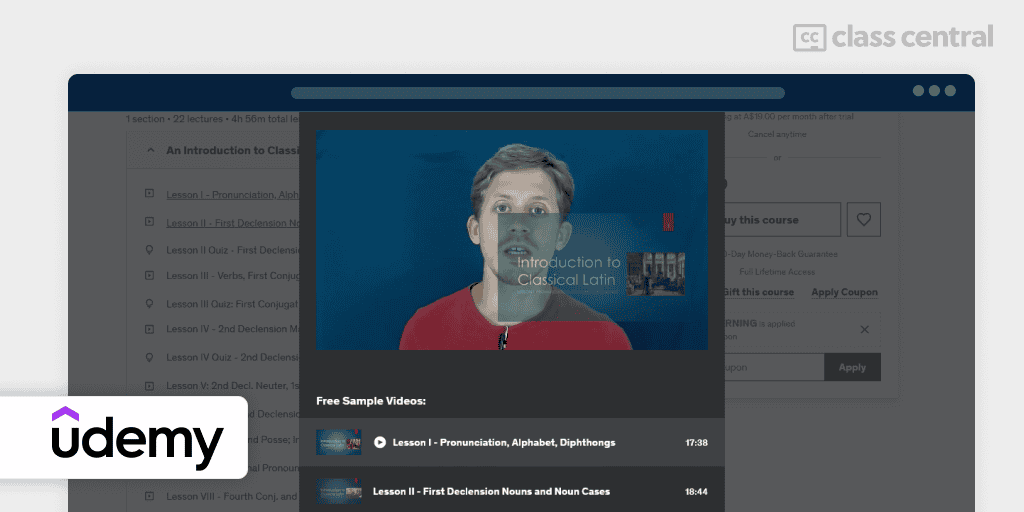
The beginner’s course, An Introduction to Classical Latin, covers the fundamentals of reading, writing, and understanding Latin. It serves as an excellent foundation for learning Romantic languages and enhances understanding of English etymology and grammar. The course has concise lectures, comprehensive materials including regularly updated vocabulary lists, and regular self-assessment opportunities with answer keys.
In this course, you will:
- Learn to read and write Latin
- Memorize a large vocabulary of Latin words
- Understand basic Latin grammar and syntax
- Explore the etymology of English words derived from Latin
- Gain insights into the grammar of your own language through Latin.
“Very well explained with perfect pace, review at the end of each lesson as well as examples of how to speak.” – Luis Antonio Gagliardi P., Udemy learner.
| Provider | Udemy |
| Instructor | Benedict Atchley |
| Workload | 4-5 hours |
| Enrollment | 7.3K |
| Rating | 4.6/5.0 (1K) |
| Cost | Paid |
| Quizzes/Assessment Items | Exercises and self-test exams |
| Certificate | Paid |
Best Companion Course for the Wheelock’s Latin Textbook (Udemy)
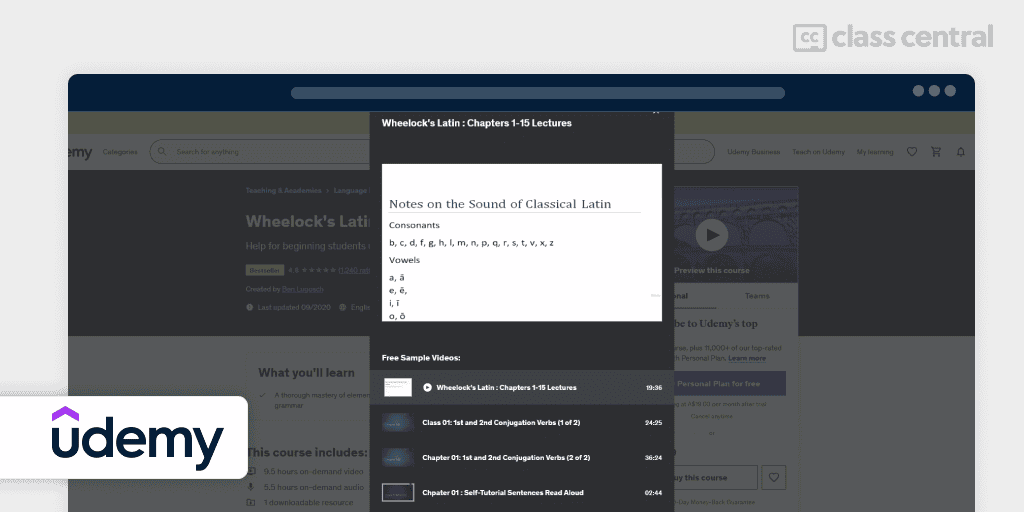
Wheelock’s Latin : Chapters 1-15 Lectures is designed to assist beginners using the renowned Wheelock’s Latin textbook. By complementing the textbook, the course provides clarity on complex grammar concepts in both English and Latin. While the lectures supplement the Wheelock text, they don’t replace it and do not provide answers to the exercises. This course is ideal for students seeking a structured approach to mastering the basics of Latin.
Syllabus:
- Introduction to basic concepts of Latin grammar
- Review and application of English grammar concepts as they relate to Latin
- Detailed walkthrough of Wheelock’s textbook chapters 1-15
- Guidance on self-tutorial exercises found in the Wheelock book
- Overview of classical Latin pronunciation as accepted by modern scholars
- Additional resources for progressing to intermediate Latin prose
- Information on further courses for advanced Latin studies, including AP Latin texts
Ben also has courses that cover the rest of Wheelock’s book:
- Wheelock’s Latin : Chapters 16-30 Lectures (11 hours)
- Wheelock’s Latin: Chapters 31-40 Lectures (5 hours)
“Excellent course. A dream come true. Something I can follow along at my own pace and with a very good instructor. I highly recommend this course.” – Gabriel R., Udemy learner.
| Provider | Udemy |
| Instructor | Ben Lugosch |
| Workload | 18 hours |
| Enrollment | 9.6K |
| Rating | 4.7/5.0 (1.3K) |
| Cost | Paid |
| Certificate | Paid |
Best Latin Course for Reading Classical Texts (The Great Courses Plus)

Latin 101: Learning a Classical Language is the pick that closes the gap between grammar study and actual reading. Most beginner courses stop at the rules. This one uses works by Cicero, Virgil, Caesar, and Roman legal texts as the destination, weaving real passages into the lessons rather than saving them for a separate course later.
The 36-lesson structure is methodical: declensions, conjugations, and moods build in sequence, but dedicated lessons on translating a Latin love poem, a passage from Caesar, and excerpts from Roman law keep the payoff visible throughout. At just over 18 hours, it covers substantial ground, including the subjunctive, participles, gerundives, and conditional sentences, without sprawling.
It’s professor-led and fully self-contained, which suits learners who want a single structured course rather than a textbook companion. It holds a 4.6 rating across 171 reviews.
| Provider | The Great Courses Plus |
| Instructor | Hans-Friedrich Mueller |
| Duration | 18 hours 20 minutes |
| Rating | 4.6/5.0 (171 provider ratings) |
| Cost | Paid (free trial available) |
| Certificate | No |
Best Free Course for Absolute Beginners (The Open University)
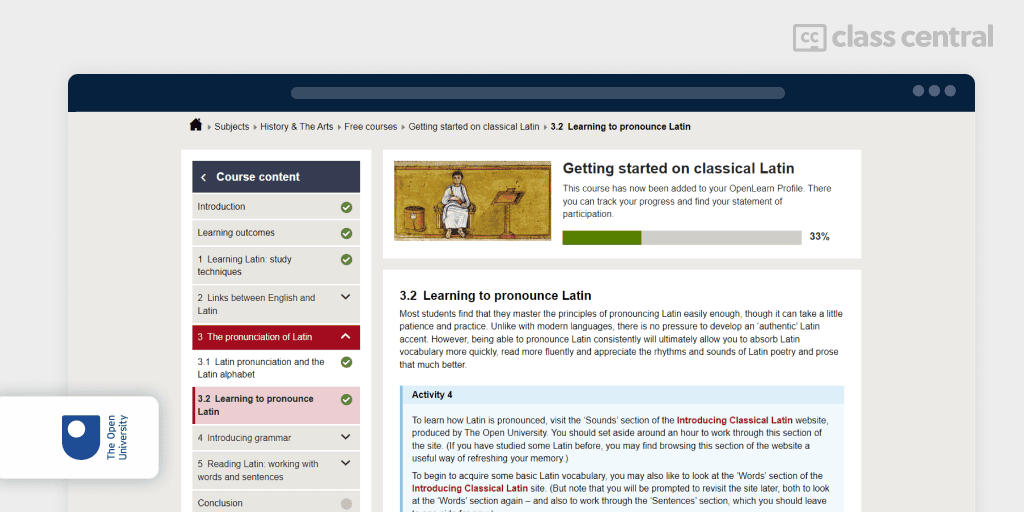
Getting started on classical Latin is a free, introductory 10-hour course designed for beginners with no prior experience in Latin, providing a foundation in the basics of the language and its historical influence on English. The course includes a glossary and aims to prepare learners for further study in classical languages.
Syllabus:
- Learning Latin: study techniques
- Links between English and Latin: the Roman empire, Norman French, the Renaissance, the modern era
- Latin vocabulary, pronunciation and the Latin alphabet
- Grammar: inflection, parts of speech, sentences
- Unravelling sentences (English prose and poetry: subjects and objects)
- Reading Latin: working with words and sentences
- Cases in Latin (Nominative, Accusative, Summary of cases).
Other Latin courses from The Open University:
- Continuing classical Latin (4 hours)
- Discovering Ancient Greek and Latin (12 hours)
“Really enjoyed this course from the way it is structures (sic) to the interactive style of learning. It really helped what I learnt stick more!
I recommend keeping a notebook with you while learning just to jot down what you learn and make notes especially with the whole subject-object-verb section! ” – Niamh Sharpe, OpenLearn learner.
| Provider | OpenLearn |
| University | The Open University |
| Workload | 10 hours |
| Rating | 4.5/5.0 (79) |
| Cost | Free |
| Quizzes/Assessment Items | Practice exercises |
| Certificate | Free |
Best Free Course to Pair with the Cambridge Latin Course Textbook (latintutorial)
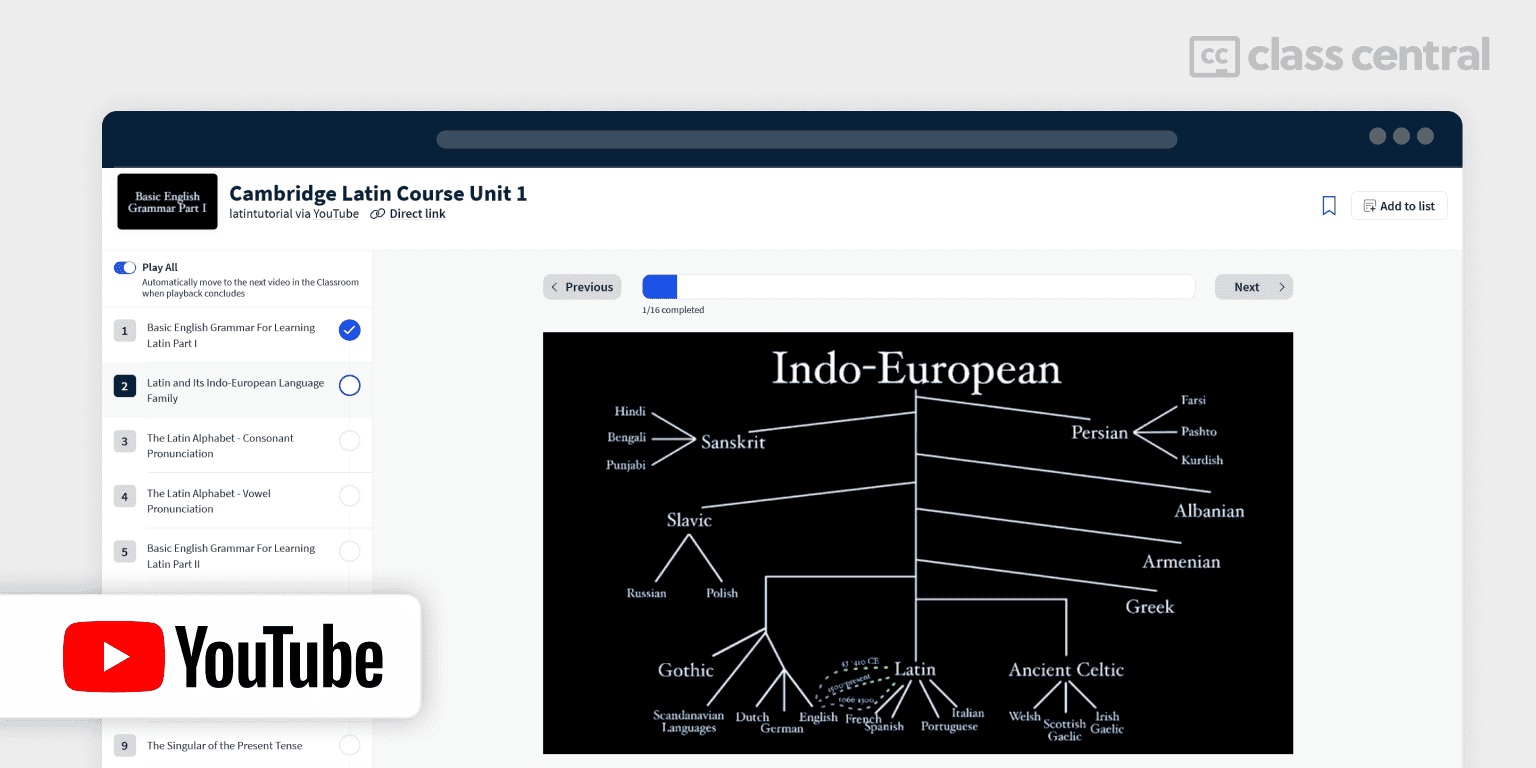
Cambridge Latin Course Unit 1 is designed to help students learning Latin focus on understanding grammar essentials. The course covers the basics of the Latin language, crucial for reading and understanding stories about characters including Caecilius, Quintus, and Grumio.
Syllabus:
- Basic English grammar for learning Latin
- Latin and its Indo-European language family
- The Latin alphabet – consonant and vowel pronunciation
- Nominative and accusative cases
- Basic Latin word order
- Basics of declension
- Subjectless and irregular verbs
- Tenses: singular and plural, present, perfect, imperfect
- Superlative adjectives
Other courses from latintutorial include:
- Basic Latin Essentials (2-3 hours)
- Latin Verbs (6 hours)
- Latin Nouns, Pronouns, and Adjectives (6 hours)
“Three and a half minutes and I’ve got my best class ever!…Thank you so much! GRATIAS TIBI AGO!” – keuzacosta1497, YouTube learner.
| Provider | YouTube |
| Channel | latintutorial |
| Workload | 1-2 hours |
| Views | 910K |
| Cost | Free |
| Quizzes/Assessment Items | Not available |
| Certificate | Not available |
Best Course for Italian Speakers Studying Latin Through Papyri (University of Naples Federico II)
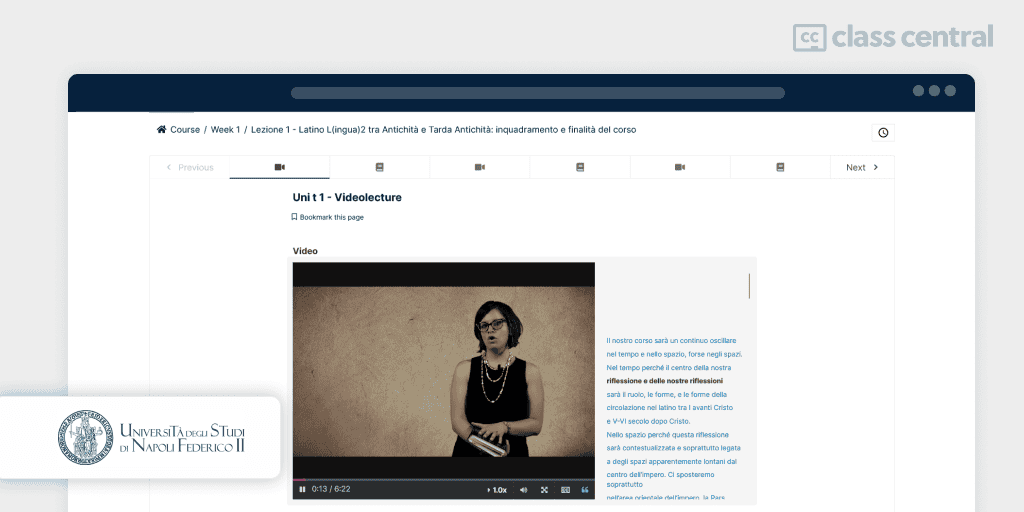
Imparare il latino attraverso lo studio dei papiri explores the teaching and spread of Latin in the Eastern Roman Empire from the 1st century BC to the 6th century AD, using direct evidence from papyri, parchment fragments, wooden tablets, and potsherds. The course delves into the phenomena of bilingualism (Latin-Greek) and diglossia, examining how Latin was perceived and taught as a second language in antiquity and late antiquity.
Course Syllabus:
- Introduction to the study of Latin through papyri
- Historical context of Latin in the Eastern Roman Empire
- Analysis of direct evidence from papyri and other materials
- Study of bilingualism and diglossia in the Eastern provinces
- Examination of Latin as a second language (L2) in antiquity
- Reflection on the teaching methods and perception of Latin during the period
- Conclusion and implications for understanding ancient linguistic practices
“Excellent course, with comprehensive coverage of the archeological and textological data on manuscripts related to transmission and distribution of the Latin language mostly in hellenophonic regions of the Roman Empire from antiquity to middle ages…” – George Belov, Class Central learner.
| Provider | edX |
| University | University of Naples Federico II |
| Instructor | Maria Chiara Scappaticcio |
| Language | Italian |
| Workload | 36-48 hours |
| Cost | Free audit |
| Quizzes/Assessment Items | Free practice questions |
| Certificate | Paid |
Best Spoken Latin Course for Comprehensible Input (The Paideia Institute)

Living Latin is the one pick here that breaks from the grammar-translation tradition. Every other course in this guide works through paradigm tables and drills. This one belongs to the “living Latin” movement, which treats the language as something to be read in context and absorbed, not decoded rule by rule.
The course follows a group of study-abroad students in modern Rome as they encounter ancient, medieval, and Renaissance texts tied to the sites around them. The story builds into a mystery across 60 units. That narrative frame isn’t decoration: it’s the delivery mechanism for a graded reader of more than 80,000 Latin words, rising steadily in difficulty as the plot develops.
Grammar is covered through 100 animated videos, and each chapter adds clickable vocabulary and morphology charts alongside quizzes and culture articles. The goal is reading fluency at the intermediate level, roughly equivalent to a full introductory college sequence.
It’s entirely self-paced with no live instruction, and the discussion forum is the only human contact. But as a standalone introduction to Latin that doesn’t feel like a grammar workbook, it stands apart from other self-paced options in this guide.
| Provider | Paideia Institute |
|---|---|
| Institution | The Paideia Institute |
| Duration | Self-paced, 60 units |
| Level | Beginner |
| Cost | Paid |
| Certificate | Not available |
Best Latin Textbooks
Wheelock’s Latin (7th ed., originally by Frederic M. Wheelock, now updated by Richard A. LaFleur)

Wheelock’s Latin has been the go-to introductory Latin textbook in American classrooms since 1956. Its 40 chapters work through grammar step by step, using real Roman writers instead of made-up practice sentences, which sets it apart from a lot of competitors. Each chapter comes with self-tutorial exercises and answer keys, so it works just as well for self-taught learners as it does in a classroom.
That grammar-first structure is also why some learners find it dry. But a whole ecosystem has grown up around it anyway: a sequel reader for intermediate students, a workbook, flashcard apps, and study guides from several publishers. The companion site, wheelockslatin.com, adds free audio pronunciation recordings and links to study groups. Seven decades on, it’s still the book most people turn to first, self-taught beginners and classroom students alike.
“I can confidently recommend Wheelock’s Latin for motivated learners, especially those with a lively curiosity about language and its history. It’s reliance on wordy, in depth (although very interesting) explanations make it less suitable for less committed students.” – James Milliken’s review on Aeterna Latina.
Best Latin Book and Site for Absolute Beginners (William E. Linney)
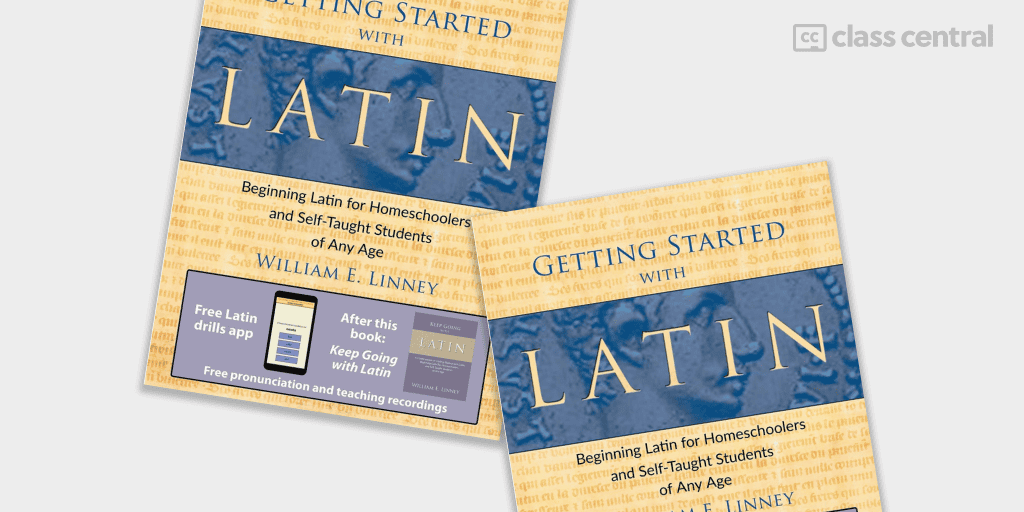
Ideal for self-taught and home-school Latin students, I can personally vouch for this book’s suitability for beginners. Paired with free audio recordings, free apps, and YouTube videos to help with pronunciation, Getting started with Latin is an excellent, easy-paced book.
It’s divided into simple lessons that explain the fundamentals of Latin grammar and compares them to English usage. New words and concepts are introduced gradually with plenty of spaced repetition. You can immediately apply what you’ve learned by translating the fun exercises in each lesson and check your work by turning to the included answer key. To hear the words pronounced, simply download the free recordings from www.GettingStartedWithLatin.com and check the extensive audio commentary recordings that cover every lesson and exercise in the book.
And when you’ve worked through Getting Started with Latin, move onto Keep Going with Latin for a strong foundation before tackling harder courses.
“…If you’re a complete beginner…start with this book! It will save you loads of frustration. Once you get through this book and the second, you’ll be well set up for moving on to the harder textbook….” – cmykarr, Amazon reviewer.
Also Great Latin Learning Book Series (Hans Ørberg)
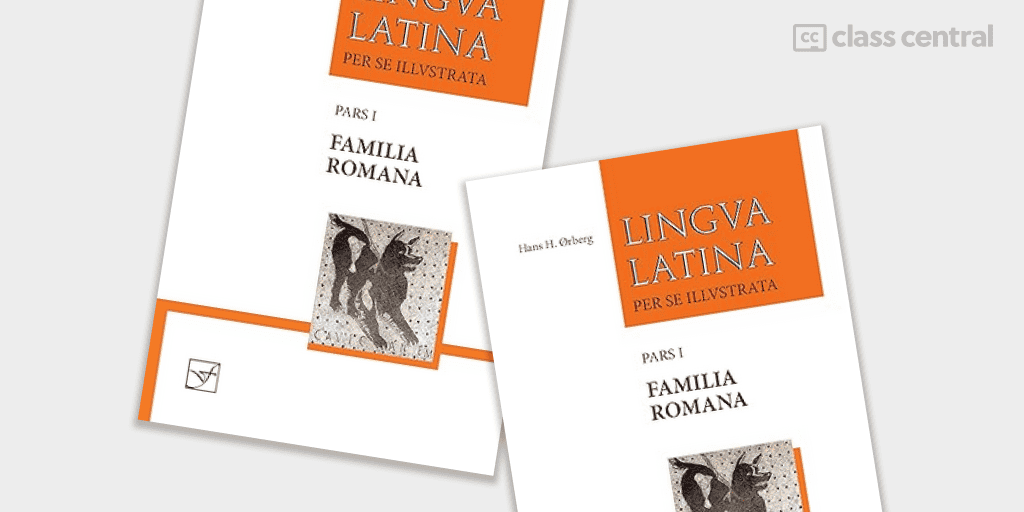
Receiving accolades from many learners, Lingua Latina Per Se Illustrata uses the natural method of language acquisition, immersing learners in Latin without any English translations. It tells the story of a Roman family, gradually introducing more complex grammar and vocabulary.
This approach encourages students to think in the language rather than translating it. By learning grammar and vocabulary inductively through extensive contextual reading, illustrations, and a unique system of marginal notes, students develop a deep understanding of Latin. This method is widely favored by teachers at both secondary and collegiate levels for cultivating Latin conversational skills in the classroom.
Complete beginners might find this book challenging without a tutor, but if you’re willing to put the time into reading and re-reading the text and examining the illustrations and sidebar notes, you will definitely learn Latin immersively. Combining this book with other resources in this Best Courses Guide would be the best approach.
“This may be the best way to learn Latin. It’s certainly the way that is working best for me…Way more fun than memorizing tables of declensions and conjugations. Although, I confess I don’t know if it would be quite so easy had I not memorized and reviewed much of that info in the past…” – Anonymous Amazon customer.
Some Free Resources
Improve your vocabulary with:
- Duolingo Latin (1.8M users) While Duolingo can help extend your vocabulary and pronunciation, you will benefit more from other resources to learn grammar rules
- Latin Word of the Day Another resource to learn vocabulary.
There are several YouTube channels with Latin videos, including:
- ScorpioMartianus: check out the playlist of Latin numbers
- polýMATHY: a range of topics, including Latin and ancient Greek
- Latinum Institute: several playlists, particularly The London Latin Course.
And if you have questions about Latin or translations, Reddit’s r/latin has an active community.
The post 7 Best Latin Courses Online in 2026 (Free & Paid) appeared first on The Report by Class Central.