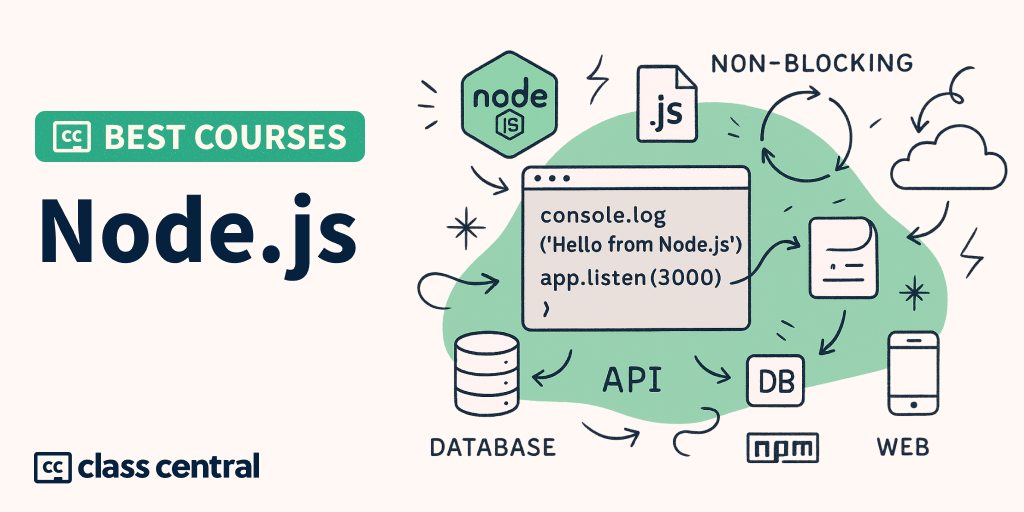

Node.js is one of the least known but most pervasive parts of JavaScript, powering modern web apps. From real-time platforms like Slack to streaming giants like Netflix, Node.js is the engine behind it all.
It’s one of the most practical skills you can add as a developer. Whether you’re aiming for backend roles or full-stack positions, it’s worth your time to learn it.
Learning Node.js can feel intimidating, especially for front-end developers. Unlike React, it doesn’t have a friendly UI or instant visual feedback. But learning to harness that power will take you to the next level as a web developer.
As someone who has spent years learning and teaching web development, I can confidently say that Node.js is one of the most essential technologies to master, especially if you want to stand out in the job market.
Of course, it’s not always easy to learn the right way, which is why many developers struggle with it. To make the process easier, I’ve done the research for you. At Class Central, we have plenty of Node.js courses, but I’ve narrowed them down to a handful of standout options, organized by your learning goals and experience.
- Why Learn Node.js?
- Why Trust Us?
- How I Made My Picks
- Which Node.js Course Is Right for You?
- Final Thoughts
Which Node.js Course Is Right for You?





Why Learn Node.js?
Node.js isn’t just another backend framework; it’s a way to unify your stack. With Node, you don’t have to juggle two or three languages to get an application off the ground. You can use JavaScript from front to back, powering everything from UI interactions to server-side logic.
As a developer who has been building both frontend and full-stack applications for years, there are two reasons Node.js is my backend runtime of choice:
- The extensive ecosystem that comes with it: NPM, or Node Package Manager, is like an app store for developers, and it’s the largest package registry in the world. So, as a developer, I don’t need to build new solutions from scratch.
Need a router for your application? There’s a package for that. Need a carousel to help you display beautiful images on your website? There’s one for that, too. Having access to NPM can save you hours on every project.
- The familiarity: I didn’t have to learn a completely new language just to build a backend. Instead, I could apply my JavaScript skills while focusing on how servers, APIs, and file systems worked. That lower barrier to entry helped me progress much faster in my projects.
Why Trust Us?
Class Central is a TripAdvisor for online education. We help you find courses quickly, eliminating the need to switch between multiple platforms. Our catalog of 250,000 courses has helped 100 million learners find their next course.
Now, why should you trust my recommendations?
I’ve been writing code professionally for over half a decade, with a focus on accessibility, mobile-first design, and test-driven development. In that time, I’ve built and scaled applications powered by Node.js and have shipped features and products used by millions of people around the world.
But I also know what it’s like to start from scratch. Like many, I didn’t always know how to code. I worked entirely in the arts. Wanting to expand my skill set, build websites, and eventually land a job as an engineer, I began my self-taught coding journey. That’s why I appreciate high-quality learning resources that don’t take up much time.

I’ve completed more than a dozen online courses across platforms like Coursera, edX, and freeCodeCamp. As both a former professor and a coding mentor, I’ve developed a critical eye for what makes a course effective.
How I Made My Picks
Class Central has 3,000+ Node.js courses. For this guide, I’ve narrowed the list to seven courses across six recommendations, designed for different learners.
My criteria were courses that:
- Cover fundamentals clearly: This includes modules, npm, REST APIs, and the event loop, among other skills
- Have hands-on projects: I’ve picked courses that focus on practice, not just theory
- Have been recently updated: The courses have been published or tangibly revised within the last 3 years.
Essentially, if I were learning Node.js today, these are the courses I’d take.
Best Overall: Introduction to Node.js, v2 (Frontend Masters)
- Duration: 4-5 hours
- Rating: 4.7
- Price: Paid (subscription)

Taught by Scott Moss, senior software engineer at Netflix, Introduction to Node.js, v2 is one of the most polished options on our list.
As an industry professional, Moss not only covers the foundations, but he also layers practical examples into his lessons to show you how to use Node.js in professional projects. This makes the material feel both accessible and practical.
You’ll learn:
- How Node.js works under the hood (event loop, modules, npm)
- Working with the file system
- Building a basic server
- Testing and debugging Node apps
Why I Like It:
It feels like the sweet spot between an academic class and a hands-on tutorial. The production value is high, and while the material dates to August 2023, the fundamentals it covers (the event loop, modules, the file system) have not moved much since.
Moss explains concepts clearly without rushing. Like me, he uses Node.js to power his daily work. It’s one thing to know and understand a language, but once you’re using it daily as part of your job, your familiarity with a piece of technology deepens exponentially. His depth of knowledge makes this course the best overall option on this list.
Who It’s for:
New learners or existing developers who want a structured, single course that covers Node.js fundamentals in depth. If you value learning from an experienced engineer, want a more structured experience, and don’t mind paying for quality, this is the one.
Best for Hands-on Training: JavaScript Development with Node, Express, & MongoDB (Noble Desktop)
- Duration: 120 hours
- Rating: 4.5
- Price: Paid
- Pre-requisite: Knowledge of JavaScript

This course teaches the server-side of JavaScript development with Node.js. Through projects, you’ll work with Node’s async architecture to handle requests, use its module system, and manage packages with npm.
The curriculum also covers Express for building APIs with routing and middleware, then integrates MongoDB for data persistence.
You’ll Learn:
- Synchronous and asynchronous JavaScript in Node.js
- Node Package Manager (npm) and configuring an Express.js server
- MongoDB integration and NoSQL database implementation
- Authentication protocols, server security measures, and API development
Why I Like It:
By the end of this course, you’ll have built multiple production-ready applications with full CRUD functionality, authentication, and database integration. The hands-on projects cover error handling, data validation, and API design patterns you’ll actually use on the job.
The course requires JavaScript knowledge, but if you’re new to it, the instructors will help you navigate it.
Noble Desktop also offers you the flexibility to choose in-person or live online classes. Plus, you can retake the course for a year after completion.
Who It’s for:
This course is for frontend developers looking to expand into backend development and build full-stack applications.
It’s also for beginner full-stack developers and software engineers who want to specialize in backend development.
Best for Project-Based Learners: Node.js Crash Course (Traversy Media)
- Duration: 2 hours
- Price: Free

Some people learn best by reading. Others listen. But if you learn best by building, Traversy Media’s Node.js Crash Course will be a good fit. This course will take you from zero Node knowledge to a working REST API in less than two hours of instruction.
By the end of the course, you’ll know how to cover installation, core modules, asynchronous programming, building servers and APIs, Express.js framework, database integration, authentication, real-time communication, and deployment techniques.
You’ll Learn:
- Node fundamentals: events, modules, npm basics
- Spinning up a server
- Building a REST API step-by-step
Why I Like It:
It’s concise, it’s completely free, and it has aged well. Traversy published it in April 2024, and the ground it covers (core modules, Express routing, environment variables) still works exactly the same way today.
The project-based approach keeps you engaged, and you walk away with something tangible you can build on. When I was learning how to code, as a self-taught developer, theory was great, but actually getting my hands dirty was what solidified my learning.
Once I had to put what I had read or watched into place, it forced me to contend with different issues that I hadn’t considered. Were there system-wide upgrades I needed to make on my machine? How would I install a package for a project that was different from the one in the tutorial? Putting my learning into practice is really what drove my learning exponentially.
Who It’s for:
Self-motivated learners who don’t need a lot of hand-holding. If you like learning by coding along and experimenting, this is a great starting point.
Best for Experienced Developers: Complete Node.js Developer (Zero to Mastery)
- Duration: 38 hours
- Rating: 4.9
- Price: Paid

If you’re already a developer looking for an in-depth, comprehensive understanding of Node.js, then the Complete Node.js Developer by Zero to Mastery is an excellent option.
At roughly 38 hours of instruction, this course is not for the faint of heart. But, if you’re truly looking to become a master of Node.js, then this course will get you there. It doesn’t hand-hold you into what development is, so having some background knowledge on working with IDEs, running your code, etc., will be essential.
You’ll Learn:
- Architecting a Node.js project
- Security best practices
- How to build 3 full-stack projects with Node.js
Why I Like It:
Taught by two industry professionals, Adam Odziemkowski & Andrei Neagoie, Zero to Mastery’s course is the ultimate exploration of Node.js.
It is a comprehensive option that is theory-focused and project-based, so you’ll leave with multiple portfolio projects.
The course will make you confident enough to apply to (and possibly secure) a full-stack position after successful completion.
Who It’s for:
I’d say this one is for frontend developers looking to expand their range of knowledge into the backend.
The ideal learner would be someone who thrives with a combination of lectures and project-based work, and who is self-motivated enough to complete the better part of 40 hours of video and additional work.
Also Great: Understanding Node.js Core Concepts (Udemy) & Learn Node.js (Codecademy)
If you’re not only learning for yourself but also want a certificate to add to your résumé or LinkedIn, these two options stand out.
- Udemy’s Understanding Node.js Core Concepts: Over 70 hours of in-depth content, covering everything from the event loop to file systems. It’s a commitment, but one of the most thorough resources available.
In this 4.6-rated course, you’ll learn node internals, the file system, the event loop, and deeper theory.
- Codecademy’s Learn Node.js: A shorter, interactive option (~5 hours) where you build directly in the browser with instant feedback.
The course itself is free to work through, though the certificate requires a Codecademy Pro subscription. You’ll learn core basics, modules, and build a small app.
Why I Like them:
Udemy’s course is actively updated, making it one of the most relevant deep dives into Node.js. If you really want to understand the inner workings of Node.js, and by proxy the internet as a whole, then Udemy’s course is the one for you.
The Codecademy course, by contrast, is approachable and structured with the added bonus of having an in-browser code editor to allow for a more interactive experience. If you’re the kind of learner who thrives by having instant feedback, this is a great option for you.
Who They’re for:
Choose Udemy if you want deep technical knowledge; Codecademy if you just need working skills and a credential.
Best Free Certificate: Server-side Web Development with Node.js and Express.js (CodeSignal)
- Duration: 4 hours
- Price: Free (certificate included)

Most free Node.js resources hand you a video and wish you luck. CodeSignal’s Server-side Web Development with Node.js and Express.js does something rarer: it’s free, you write code in the browser with instant feedback, and it ends with a certificate you don’t have to pay to unlock.
The six units build real server-side features rather than toy snippets. You’ll put together a product list that returns JSON, a blogging platform with working POST and DELETE routes, a data endpoint with custom middleware, and proper error handling on top of all of it.
You’ll Learn:
- Standing up your first server with Node.js and Express
- Routing, middleware, and RESTful API design
- Handling requests, responses, and JSON data flow
- Error handling for production-style applications
Why I Like It:
It closes the gap the rest of this list leaves open. Codecademy’s course is interactive but puts its certificate behind Pro, and every other paid pick here asks for money up front. This one asks for an afternoon and nothing else.
The exercises are also more fun than they need to be, framed around space missions and online stores instead of the usual foo and bar. That sounds like a small thing, but when you’re learning alone after work, wanting to finish the next exercise matters more than most people admit.
Who It’s for:
Anyone who wants a credential for their LinkedIn profile without paying a subscription, and anyone who learns better by typing than by watching. It’s also a solid refresher if you’ve written Node before and want to knock the rust off in a single sitting.
Final Thoughts
Node.js is one of the most practical skills you can add as a developer. Whether you’re aiming for backend roles or full-stack positions, it’s worth your time to learn it.
To recap:
- Want a structured, guided path? → Frontend Masters
- Prefer learning by building? → Traversy Media
- Want to learn advanced skills? → Zero to Mastery
- Need a paid deep dive with a certificate? → Udemy or Codecademy
- Want a free certificate in an afternoon? → CodeSignal
Whatever you choose, remember: don’t just watch, build. That’s the only way to turn knowledge into a real skill.
Did this guide help? We’ve got 300+ more for you. Check our Best Courses Guides to find your next course!

The post 7 Best Node.js Courses in 2026: Build APIs in JavaScript appeared first on The Report by Class Central.