Organic chemistry has a reputation as the course that decides who stays in medicine and who leaves. That reputation is mostly about pace, not difficulty. The subject is a small number of ideas, applied over and over to an enormous number of cases: where the electrons are, where they want to go, and what shape the molecule is in while they move.
The trouble is that most courses race through the ideas to get to the cases. So students end up memorizing hundreds of reactions instead of learning the handful of patterns that generate them, and then the exam asks for a mechanism they’ve never seen.
Everything in this guide teaches the patterns. I’ve ordered it by how much time you have and what you need it for: forty minutes of orientation at one end, a full two-semester lecture course at the other.
From over 430 organic chemistry courses on Class Central, I picked 8 for this Best Courses Guide. Most assume you’ve done a semester or two of general chemistry. If that’s shaky, start with our Chemistry BCG instead.
Which Organic Chemistry Course Is Right for You?
Every course here is free to take, and one offers an optional certificate
All eight picks can be worked through at no cost. Seven are free outright, being YouTube playlists and an open textbook, and the eighth is a university course you can audit for free.
Certificates are the gap. The University of York is the only pick that issues one at all, and it charges for it; the free audit gives you every video, article and experiment, but not the marked assessment. Nothing else here certifies anything, because the best organic chemistry teaching online has ended up on YouTube rather than on the platforms that award credentials.
So decide what you actually need. If it’s a transcript line, this is the wrong guide and you want a university course for credit. If it’s the chemistry, everything below is free and you can start today.
How We Chose These Courses
Organic chemistry is a big syllabus taught at wildly different depths, so I picked one strong resource per level and purpose rather than eight variations on Organic Chemistry I. I looked for:
- Mechanism taught as mechanism, meaning arrow pushing, intermediates, and why a reaction goes one way, rather than a list of products to memorise
- Coverage of structure determination, since IR, NMR and mass spec are where most courses thin out and most exams don’t
- A visible, ordered path through the material rather than a pile of loosely related videos
- Worked problems, because nobody has ever learned this subject by watching
- A distinct job: orientation, full course, reference text, general interest, university lectures, hands-on, applied, or exam prep
- Free access, with any certificate cost stated plainly
The ranking draws on learner reviews on Class Central, ratings on the host platforms, and time spent in the courses themselves. Class Central has tracked online courses since 2011, and our small team has completed 400+ of them.


Best Place to Start (The Organic Chemistry Tutor)

Organic Chemistry – Basic Introduction is 42 minutes long and it is the right first move for almost everyone, whether you’re about to start a course or trying to work out how far behind you are.
It covers the things every later topic silently assumes: bond types, bond strength and length, Lewis structures, hybridization, formal charge, lone pairs, and how to read a condensed formula as an actual molecule. If any of that is fuzzy, the mechanism chapters will not land, no matter how good the teaching is.
The delivery is a hand writing on a screen while a voice explains, which sounds unpromising but works extremely well. There’s no personality to get past and no production to sit through, just the structures being drawn at the speed you’d draw them yourself.
Use it as a diagnostic. Anything here that feels unfamiliar is a gap worth closing before you commit forty hours to Chad’s Prep.
| Provider | YouTube |
| Channel | The Organic Chemistry Tutor |
| Duration | 42 minutes |
| Level | Beginner |
| Rating | 4.4/5.0 (9 ratings on Class Central) |
| Cost | Free |
| Certificate | No |
Best Course to Actually Learn From (Chad’s Prep)

Organic Chemistry Complete Course is the best free replacement for a two-semester lecture course I’ve found, and it’s the pick I’d hand to anyone actually enrolled in one.
What sets it apart is the numbering. Every video is labelled by chapter and section, so 7.1 is SN2, 7.2 is SN1, 7.3 is SN1 vs SN2, 7.4 is elimination. The playlist maps onto a real syllabus instead of being a heap of topics, and when your lecturer says “we’re on chapter 15 next week,” you can find chapter 15.
Coverage runs the full arc: Lewis structures and hybridization, resonance, acid-base ranking, nomenclature, conformational analysis, stereochemistry and R/S, thermodynamics and kinetics, the whole substitution and elimination block, alkene and alkyne additions, radical reactions, retrosynthesis, alcohols, ethers and epoxides, aromatics and electrophilic aromatic substitution, carbonyl chemistry, and, unusually thoroughly, structure determination.
That spectroscopy section is the reason it beats the shorter video courses. IR, mass spectrometry with fragmentation patterns, carbon-13 and proton NMR, chemical shift, integration, multiplicity, then five worked structure-determination problems using all the spectra together. Most free courses gesture at this and move on.
The trade-off is time. At 40.5 hours it is the longest single commitment in this guide, and the style is exam-focused rather than curious. You learn what shows up on tests, not the history of how anyone figured it out. For that, take Yale’s course instead.
| Provider | YouTube |
| Channel | Chad’s Prep |
| Duration | 40.5 hours |
| Level | Intermediate |
| Views (First Video) | 585K |
| Cost | Free |
| Certificate | No |
Best Free Textbook (OpenStax)

Organic Chemistry: A Tenth Edition is John McMurry’s textbook, the one many of these courses are built on, released free through OpenStax. McMurry made it open access in memory of his son, and it is the same book that sells as a hardcover, not a cut-down version.
No video course can replace a reference text in this subject. You will want to look up a specific reaction at 11pm, check the exact conditions, and work the practice problems until the pattern sticks. That is what a book is for.
It covers bonding and structure, alkenes, alkynes, organohalides and alkyl halides, structure determination by mass spectrometry and IR, benzene and aromaticity, alcohols and phenols, ethers, aldehydes and ketones, carboxylic acids, amines, nitriles, the biomolecules (carbohydrates, amino acids, peptides, proteins, lipids and nucleic acids), metabolic pathways, and synthetic polymers.
Problems come with solutions, which makes it usable alone. Read it alongside a video course rather than instead of one: 1,250 pages is not a thing to work through cover to cover unless you’re teaching yourself the whole subject from scratch.
| Provider | OpenStax |
| Author | John McMurry |
| Length | 1,250 pages |
| Level | Intermediate to advanced |
| Assessment | Problems with solutions |
| Cost | Free online; hard copy sold separately |
| Certificate | No |
Best for General Interest (CrashCourse)

Organic Chemistry by CrashCourse compresses sophomore-level material into 50 episodes and about 6 hours, and it is the one I’d recommend to someone who wants to understand the subject without sitting an exam in it.
Deboki Chakravarti moves fast, and the animation does real work: electron flow is genuinely easier to follow when the arrows move. The series was built from nine reference texts including McMurry, Clayden, and Brown, so the content is standard even though the tone isn’t.
It covers nomenclature including heteroatom functional groups, 3D structure and bonding, stereochemistry, polarity and resonance, nucleophiles and electrophiles, reaction mechanisms, alkene and alkyne reactions, radical reactions, the SN1/SN2/E1/E2 block, alcohols and ethers and epoxides, IR and mass spec and proton NMR, aldehydes and ketones, organometallic reagents, and column chromatography.
Six hours for two semesters means things get skipped, and there is no assessment. Treat it as the tour, not the training, and pair it with McMurry if you want to hold onto any of it.
| Provider | YouTube |
| Institution | CrashCourse |
| Instructor | Deboki Chakravarti |
| Duration | 6 hours (50 episodes) |
| Level | Intermediate |
| Views | 3.3M |
| Cost | Free |
| Certificate | No |
Best University Lecture Course (Yale University)

Freshman Organic Chemistry is a real Yale lecture course, filmed in the hall, and it asks a question none of the other picks bother with: how does anyone know any of this is true?
McBride opens with “How Do You Know?” and means it. Before you get functional groups you get X-ray diffraction, electron difference density, and what it actually means to say you have seen a bond. Then quantum mechanical kinetic energy, wave functions, orbitals as an approximation rather than a fact, and only then hybridization and reactivity.
The second half is the part I’ve never seen anywhere else: the history. Oxygen and the chemical revolution, the rise of atomic theory, Berzelius to Liebig and Wöhler, radical and type theories, valence theory in 1858, structure determined by counting isomers in 1869, van’t Hoff’s tetrahedral carbon and the discovery of chirality. Watching structural theory get built from evidence is the single best cure for treating it as arbitrary rules.
Freshman Organic Chemistry II continues with 38 more lectures on mechanism, kinetics, substitution and elimination, addition, aromaticity, spectroscopy and carbonyl chemistry, ending on the synthesis of cortisone.
Two caveats. The lectures date from around 2008 to 2011, so the production is a camera at the back of a room; the chemistry has not moved, but the video quality has. And it is genuinely demanding, pitched at Yale freshmen with strong preparation rather than at beginners. Take the 42-minute primer first.
| Provider | YouTube |
| University | Yale University |
| Instructor | J. Michael McBride |
| Duration | 30 hours (37 lectures); a further 31 hours in Part II |
| Level | Advanced |
| Views (First Video) | 214K |
| Cost | Free |
| Certificate | No |
Best Hands-On Course (University of York)
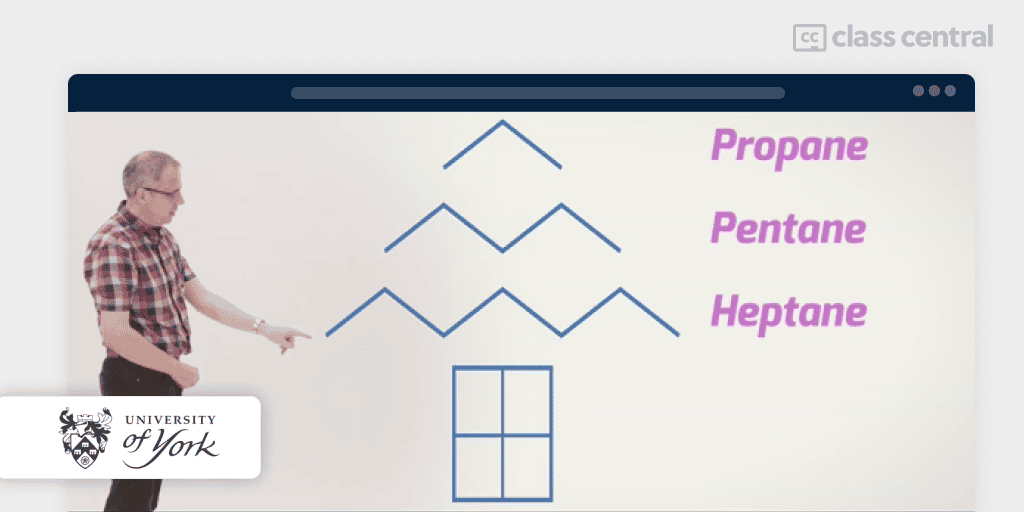
Exploring Everyday Chemistry is the only pick here where you make something. At 4.9 out of 5 it is also the highest-rated course in the guide.
Four weeks, four themes, each anchored in a real compound class. Week one is fragrance and pheromones: how molecular shape relates to smell, and the competing theories about why. Week two is antibiotics, covering how penicillin works, how resistance develops, and where new candidates are being looked for. Week three is brewing, with the flavor compounds in beer, tea and coffee, antioxidants, and reading spectroscopic data from real samples. Week four is sport: polymers, protective materials, and nutrition.
The experiments are the point. You extract a plant fragrance and test spices against microbes using kitchen equipment, which is as close to a lab as an online course gets.
It’s pitched at interested adults and at sixth formers heading to university, so the chemistry is real but the pace is unhurried. It won’t get you through Organic Chemistry II. Take it because you want to know why things smell and taste as they do. The audit is free; the certificate costs extra.
| Provider | FutureLearn |
| University | University of York |
| Instructor | Andy Parsons |
| Duration | 16 hours |
| Level | Beginner |
| Enrollments | 31.4K |
| Rating | 4.9/5.0 (18 ratings on Class Central) |
| Cost | Free to audit |
| Certificate | Paid |
Best on Drugs and Biology (NPTEL and IIT Kharagpur)

Organic Chemistry in Biology and Drug Development is where the subject stops being a syllabus and starts being a job. It’s the pick for anyone heading toward pharmacy, medicinal chemistry, or biochemistry.
Professor Amit Basak takes 63 lectures to get from amino acids to cancer chemotherapy. The first half is molecular: protein structure and purification, peptide synthesis and the protecting-group problem, enzyme kinetics and inhibition, nucleic acids, DNA sequencing and oligonucleotide synthesis, the central dogma, synthetic biology, cofactors and coenzymes.
The second half is drug discovery proper, covering combinatorial chemistry, neurotransmitters and the drugs that act on them, ACE inhibitor design, beta-lactam antibiotics and how resistance defeats them, antivirals, anticancer agents, cholesterol-lowering drugs, pharmacokinetics, and QSAR.
Two things to know. It assumes you already have organic chemistry, because this is an application course rather than an introduction, so it belongs after Chad’s Prep or a university course, not before. And it’s a recorded NPTEL run posted to YouTube: no assessment, no certificate, no interaction.
| Provider | YouTube |
| University | NPTEL and Indian Institute of Technology, Kharagpur |
| Instructor | Amit Basak |
| Duration | 42 hours (63 lectures) |
| Level | Advanced |
| Rating | 4.5/5.0 (39 ratings on Class Central) |
| Cost | Free |
| Certificate | No |
Best for Indian Competitive Exams (J Chemistry)

Organic Chemistry – CSIR-NET, GATE, IIT-JAM is taught in Hindi and pitched squarely at India’s postgraduate entrance exams. It is the most advanced course in this guide by some distance.
It follows Carruthers’ Modern Methods of Organic Synthesis, a graduate text, chapter by chapter. Enolate chemistry: alkylation, tautomerism, thermodynamic versus kinetic enolates, the Stork enamine reaction, Michael addition, aldol and Evans aldol with chiral auxiliaries. Organometallics: alkyl lithiums, Grignard and Kulinkovich, organozinc and Reformatsky, organocopper, organochromium, Pauson-Khand, and the full coupling set of Stille, Negishi, Sonogashira, Suzuki and Hiyama. Then eliminations including E1cB and Grob fragmentation, olefinations from Wittig through Horner-Wadsworth-Emmons, Peterson and Julia, and reduction and oxidation including Birch and hydroboration.
That is named-reaction territory, which is exactly what CSIR-NET and GATE test. If you are preparing for those exams and comfortable in Hindi, nothing else here comes close.
If you’re not sitting an Indian exam, skip it. The selection is driven by the syllabus, not by what a general learner needs. And as a YouTube playlist there’s no assessment, so you’ll need a question bank alongside it.
| Provider | YouTube |
| Channel | J Chemistry |
| Language | Hindi |
| Duration | 22 hours |
| Level | Advanced |
| Cost | Free |
| Certificate | No |
The post 8 Best Free Organic Chemistry Courses for 2026 appeared first on The Report by Class Central.