

What Is Culturally Responsive Teaching?
Culturally responsive teaching matters more than ever as classrooms and learning spaces become more diverse in culture, language, and location. No matter where learning happens, in person, online, or in global programs, learners bring their own backgrounds, experiences, and ways of understanding with them. Still, many learning experiences are designed with a single, assumed ‚default learner‘ in mind.
Culturally responsive education questions this idea. Rather than ignoring learners‘ backgrounds, it sees their experiences as valuable resources for learning. But what is it?
Culturally responsive teaching uses what learners already know, such as their culture, experiences, and perspectives, to make learning more meaningful and effective. Instead of seeing cultural differences as obstacles, this approach treats them as strengths.
Researcher Geneva Gay is well known for defining culturally responsive teaching. She describes it as linking learners‘ cultural knowledge, past experiences, perspectives, and learning styles to the teaching process.
But what does it actually look like to be culturally responsive? It means thinking about more than just the material itself. The examples you choose, the ways you encourage people to communicate, the activities you plan, how learners take part, and how you measure progress can all reflect cultural assumptions. So, being culturally responsive is not just a single teaching method. It is a mindset that guides your choices about teaching.
Culturally Responsive Teaching Vs. Culturally Relevant Pedagogy
Culturally responsive teaching is similar to culturally relevant pedagogy, but these terms are not exactly the same and should not be used interchangeably.
Gloria Ladson-Billings created the idea of culturally relevant pedagogy, which focuses on three main goals: academic success, cultural competence, and critical or sociopolitical awareness.
Geneva Gay’s approach to culturally responsive teaching focuses on teaching methods and draws on students‘ cultural backgrounds and experiences to make learning more meaningful and effective.
Another related idea, called culturally sustaining pedagogy, builds on these concepts by supporting the ongoing growth of cultural and language diversity, not just responding to differences.
Approach |
Core Emphasis |
| Culturally relevant pedagogy | Academic success, cultural competence, and critical consciousness |
| Culturally responsive teaching | Connecting instruction with learners‘ cultural knowledge and experiences |
| Culturally sustaining pedagogy | Supporting and sustaining cultural and linguistic pluralism |
Why Is Culturally Responsive Teaching Important?
Culturally responsive teaching matters because students make sense of new ideas based on what they already know, the situations they are familiar with, and their own experiences.
- First, it helps make learning more meaningful by linking new ideas to what students already understand. Rather than seeing past experiences as separate from school, responsive teaching uses them to connect and support learning.
- Second, culturally responsive practices help more students participate in class. Not everyone feels comfortable with the same kinds of discussions, group work, competition, stories, feedback, or tests.
- Third, this approach focuses on students‘ strengths. Instead of asking, „What is this learner missing?“ it also asks, „What knowledge, experience, language, and perspective does this learner already have?“
It is important to remember that culturally responsive teaching does not mean lowering expectations. Ladson-Billings‘ culturally relevant teaching places academic success at the center, alongside cultural understanding and critical thinking. The goal is not to make learning easier, but to find better ways to help students learn in meaningful ways.
What Are The Principles Of Culturally Responsive Teaching?
There is no single, universally agreed-upon list of principles for culturally responsive teaching. However, several frameworks break down the practice into sets of principles.
A well-known framework, adapted from Shade, Kelly, and Oberg, lists 7 principles for culturally responsive teaching. These include affirming learners‘ cultural connections, being personally inviting, creating culturally welcoming environments, supporting academic growth, adapting instruction for different learners, providing firm and caring management, and balancing group and individual interactions.
For L&D and EdTech teams, these principles can be grouped into 5 main design priorities:
1. Relationships: Get to know your learners and build trust.
2. Relevance: Make learning meaningful by connecting it to real-life situations.
3. High expectations: Challenge learners, but also give them the support they need.
4. Responsive design: Adjust your teaching methods to fit learners, instead of expecting everyone to learn the same way.
5. Inclusive participation: Offer various meaningful ways for learners to get involved and contribute.
In short, culturally responsive teaching works better as a way of thinking about learning decisions than as a simple checklist.
15 Culturally Responsive Teaching Strategies
Culturally responsive teaching works best when it shapes the entire learning experience, not just as separate diversity activities.
1. Get to know your learners. Instead of guessing their needs, use interviews, surveys, observations, needs analysis, and feedback.
2. Reflect on your own assumptions. Think about how your background shapes what you see as engagement, professionalism, participation, or good communication.
3. Focus on learners‘ strengths. Find out what they already know and what experiences they can share in the learning process.
4. Start new topics by linking them to what learners already know, using their experiences, examples, or familiar ideas.
5. Use diverse examples. Show cases from different workplaces, communities, roles, and situations, instead of relying on just one typical scenario.
6. Include a range of perspectives. Check which voices, research, expertise, case studies, and experiences are represented in your materials.
7. Don’t just add diverse names or stock photos. True responsiveness means rethinking the whole learning experience, not just its appearance.
8. Give learners different ways to participate. Allow live discussions, written reflections, small-group work, polls, teamwork, and options to contribute at their own pace.
9. Be mindful of language. Review your use of jargon, idioms, metaphors, humor, and any language that might be too complex.
10. Keep your expectations high. Offer support when needed, but don’t lower your learning goals.
11. Build strong relationships with your learners. When there is trust, people feel more comfortable sharing, asking questions, trying new things, and making mistakes.
12. Encourage learners to share their own examples, perspectives, backgrounds, and experiences.
13. Plan group work thoughtfully. Remember that not everyone feels the same about group participation or public disagreement.
14. Check your assessments to ensure they measure the knowledge or skills you want, not just familiarity with a certain cultural background.
15. Collect feedback and make changes as needed. Being culturally responsive is a continuous process, not just a one-time task during course design.
These methods help move from simply adding culture to lessons to designing learning that recognizes and values the cultures already present.
What Does Culturally Responsive Teaching Look Like?
Culturally responsive teaching examples become most useful when they demonstrate actual changes to instruction, participation, or assessment rather than superficial changes to imagery.
Learning Situation |
Culturally Responsive Practice |
| Leadership training | Use scenarios involving different communication and workplace contexts |
| Virtual workshop | Offer spoken, written, synchronous, and asynchronous participation |
| Global onboarding | Localize examples and workflows rather than only translating text |
| Compliance learning | Review scenarios for unnecessary regional or cultural assumptions |
| Group activity | Provide varied roles and ways to contribute |
| Assessment | Allow appropriate ways to demonstrate competence |
| Customer training | Include customers and situations from different contexts |
| Discussion activity | Invite learners to connect the concept with their own experiences |
A culturally responsive classroom is more than just a space with diverse materials. It is a place where relationships, curriculum, teaching methods, expectations, communication, and participation are all shaped by a focus on cultural responsiveness. This idea also applies to online learning spaces.
How Does Culturally Responsive Teaching Apply To Digital Learning And EdTech?
Culturally responsive teaching matters even more in digital learning, since technology can quickly spread both strong design choices and mistakes.
Recent research shows that cultural responsiveness needs to be intentionally included in course design, assessment, and building digital communities. It does not automatically carry over from in-person teaching.
Content And Representation
When creating digital content, teams should consider which perspectives, voices, examples, and experiences are included. For example, a global sales course should avoid treating one country’s sales process, customer expectations, or workplace culture as if they apply everywhere.
Language And Localization
Culturally responsive teaching involves more than just translating content when learners come from different languages and regions. Elements such as idioms, humor, metaphors, case studies, examples, measurements, workplace habits, and references may need to be adapted. Using clear language also helps multilingual learners understand the content without making the ideas too simple.
Interaction Design
Culturally responsive teaching should shape how digital learning invites people to participate. Some learners do well in live discussions, while others prefer to share their thoughts in writing, in small groups, or through activities they can do on their own time. Offering different ways to participate makes the learning environment more flexible.
Technology And Access
Culturally responsive teaching in EdTech should also consider how and where people access learning. Access to devices, internet connection, bandwidth, accessibility, digital skills, and local technology can be very different for each learner. If a learning experience only works well with perfect technology, some people may be left out.
Assessment
Culturally responsive teaching also means that assessment designers should check if a task really measures the skill or knowledge they want to assess. If doing well on an assessment depends on knowing certain idioms, cultural references, or ways of communicating that are not part of the learning goal, the test might be measuring something extra.
Finally, personalization should avoid turning into stereotyping. AI systems and adaptive platforms should not infer someone’s learning preferences solely from their nationality, ethnicity, language, or other demographic details.
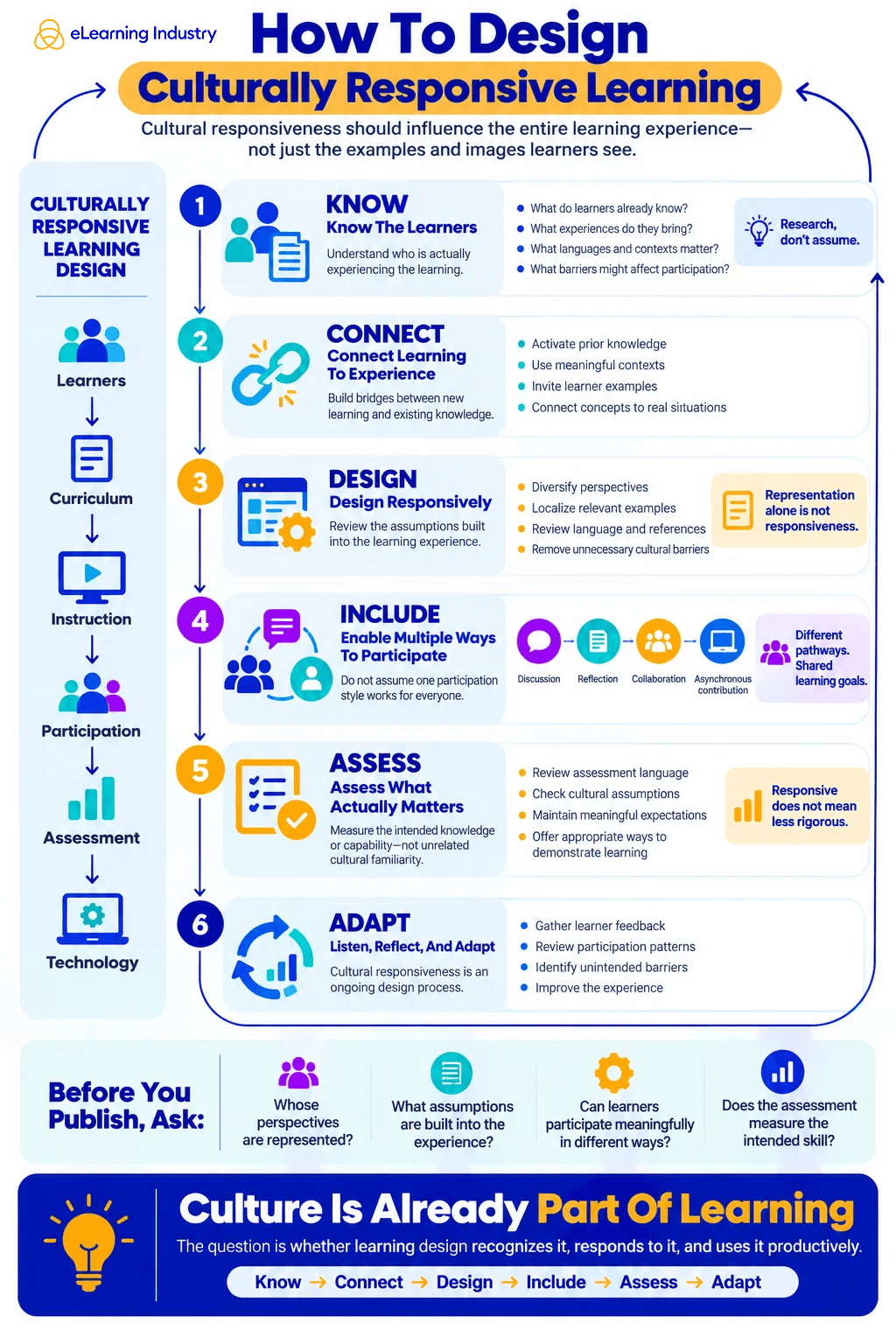
Culturally Responsive Curriculum: What Should Instructional Designers Review?
Instructional Designers can make culturally responsive teaching a practical quality-assurance process by reviewing curriculum from several consistent perspectives.
- Content: Whose knowledge and experiences are represented?
- Context: Do the examples assume only one type of workplace, family, community, or way of communicating?
- Language: Are there idioms, jokes, jargon, or cultural references that might make learning harder for some people?
- Interaction: Can learners take part in ways that are meaningful to them?
- Media: Does the content avoid stereotypes, tokenism, and the assignment of people to expected roles?
- Assessment: Does the task actually measure what learners are supposed to learn?
- Feedback: Can learners point out material that seems wrong, confusing, irrelevant, or makes them feel left out?
This matters even more when a culturally responsive curriculum is shared widely through an LMS or content library. Once a design choice is built into reusable content, its assumptions can affect thousands of learners.
How Can L&D Build Culturally Responsive Teaching Capability?
Professional development for culturally responsive teaching needs to be more than just a single awareness course or a checklist handed out to trainers.
A more effective way to build these skills involves:
1. Foundational learning about culturally responsive and culturally relevant pedagogy.
2. Self-reflection on assumptions about learners, communication, participation, and success.
3. Course review to identify cultural assumptions embedded in existing content.
4. Practice redesigning scenarios, examples, assessments, and interactions.
5. Peer feedback on instructional decisions.
6. Learner feedback from people experiencing the learning.
7. Continuous improvement as audiences, contexts, and needs change.
This difference matters for L&D leaders. Cultural responsiveness is not just something you learn once. It is a design and facilitation skill that improves with practice, feedback, and reflection.
Conclusion
Culturally responsive teaching involves more than just adding diverse examples to your content. It asks you to think about how culture shapes the curriculum, relationships, communication, participation, instruction, technology, and assessment. For L&D teams and Instructional Designers, this is especially important as learning is now more global, digital, and scalable. Courses can reach people from different languages, regions, and professional backgrounds, even those whom the original designers may never meet.