

Quick Access:
- Best Beginner Astronomy Courses: University of Arizona, CrashCourse, Astronomy for Kids
- Best Courses on the Solar System: The Solar System by Caltech, Moons by The Open University
- Best Specific Aspects of Astronomy: Astronomical Imaging, Cosmology, Black Holes, Extraterrestrial Life
So, you’d like to learn about astronomy without enrolling in a university degree? There are thousands of free and paid online courses and video tutorials available, ranging from simply observing the sky to in-depth university-level courses delving deep into mathematics and physics. How to choose and where to start?
We’ve done the work of choosing a course for you. Class Central is a search engine for online courses, with more than 3,700 courses and videos in our astronomy subject. I relied on ratings and reviews on Class Central and provider sites to find the best open online astronomy courses.
Our top courses cover a range of sub-fields: Are you interested in star formation and the different types of stars? The planets? The possibility of extraterrestrial life? The age of the universe? We’ve got you covered!
Click on the shortcuts for more details:
- Top Picks
- Why Trust Us and This Guide
- How We Made Our Picks and Tested Them
- Courses Overview
- Honorable Mentions and Communities
- Stellarium
Here are our top picks
Why Trust Us and This Guide
Class Central, a Tripadvisor for online education, has helped 100 million learners find their next course. We’ve been combing through online education for almost a decade to aggregate a catalog of 250,000 online courses and 250,000 reviews written by our users. And we’re online learners ourselves: combined, the Class Central team has completed over 400 online courses, including online degrees.
I’ve personally completed over 200 online courses. I’ve had a lifelong love affair with looking into the sky and trying to understand what’s out there. In 2012, the very first online course I enrolled in was in this subject and I have completed several online astronomy courses since then.
How We Made Our Picks and Tested Them
Trying to find “the best” can be daunting, even for those of us who live and breathe online courses. Here’s how I approached this task.
I combed through Class Central’s Catalog and the internet to find a variety of free and paid open courses, some with certificates. You don’t need to enroll in a university to learn about astronomy.
I extracted information from course syllabi and reviews, and compiled their ratings, leveraging the Class Central database with its thousands of course ratings and reviews written by our users as well as course provider ratings. I watched some course videos to sample courses I hadn’t already taken.
Then I defined the scope for these recommendations. An astronomy course can cover various topics, from basics through to Black Holes and extraterrestrial life. Ultimately, I used a combination of data and my own judgment to make these picks.





Courses Overview
- 5 of the courses are free or free to audit
- Six courses offer a certificate of completion, one of these is free
- The Astronomy subject is followed by 100K learners on Class Central
- The most featured provider is Coursera with 5 courses.
Best Comprehensive Astronomy Course For Beginners (University of Arizona)
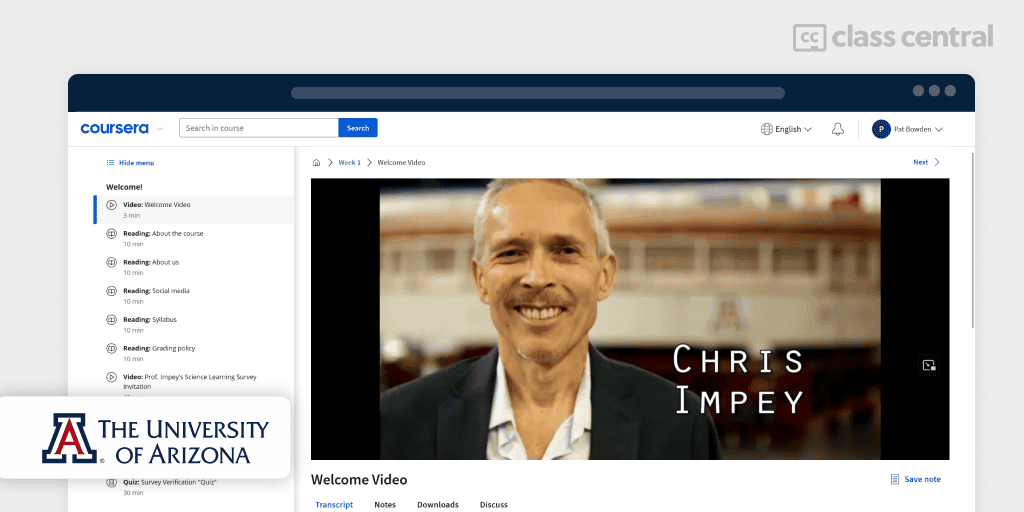
Astronomy: Exploring Time and Space, listed in Class Central’s Best Online Courses of All Time, is an introductory-level course designed for anyone interested in learning more about modern astronomy and recent astronomical discoveries, even if you don’t have a science background.
Syllabus:
- Science and history, the night sky and tools of astronomy
- Matter and Radiation: use the electromagnetic spectrum to analyze the composition and physical conditions of distant objects
- The Solar System
- Exoplanets
- Star Birth and Death
- Galaxies
- Cosmology
- Life in the Universe.
“Honestly, I cannot express my thanks enough for this course…I would say take your time with this course. It’s worth it.” – Hnin Oo Lwin, Class Central learner.
| Provider | Coursera |
| Level | Beginner |
| University | University of Arizona |
| Instructors | Chris Impey and Matthew Wenger |
| Time Commitment | 43 hours |
| Enrollments | 266.6K |
| Rating | 4.8/5.0 (3.9K) |
| Cost | Paid |
| Quizzes/Assessment Items | Yes |
| Certificate | Paid |
Best Shorter Beginner Astronomy Course (CrashCourse)
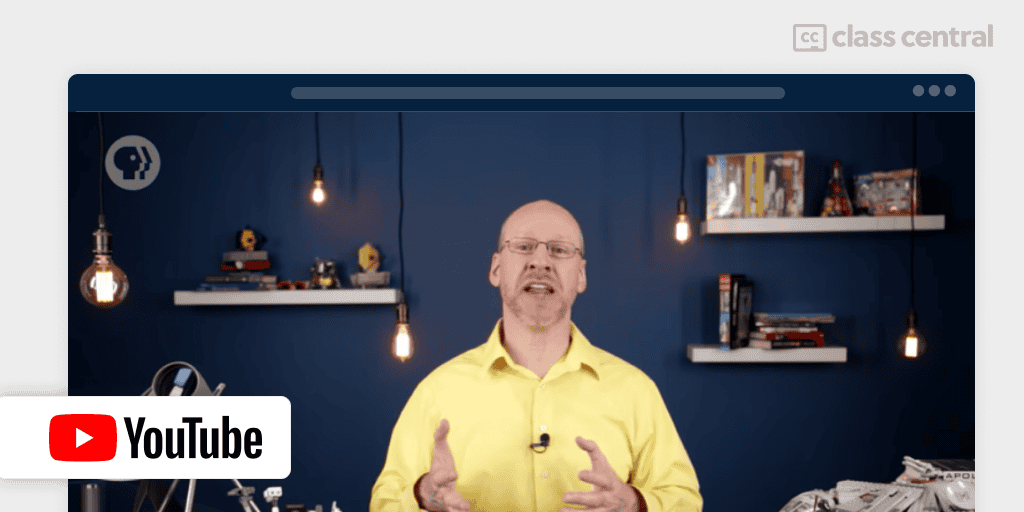
Maybe you have never studied the sciences before but are curious about what you can see in the sky at night. Enter Astronomy by CrashCourse! These 46 free videos have been viewed millions of times with good reason – the tone is upbeat, with plenty of animations and actual images of space objects interspersed with views of the narrator. It would also be a useful course for older children and teenagers.
In this course:
- Dr. Phil Plait introduces astronomy and its connections to other sciences, using Mars studies as an example
- The course covers naked-eye observations, solar system, stars, galaxies, and universe
- It’s loosely based on an introductory university-level curriculum
- Learning objectives include understanding universe composition, astronomy study methods, and differences between asteroids, comets, and meteors
- Relate observations to scientific theories about space and its history
- The course concludes with a 360-degree interactive solar system tour.
Here’s an in-depth review.
“This course is really good, starting with a solid foundation in the basics before delving into more advanced topics.” – Neeraj Pallikonda, Class Central learner.
| Provider | YouTube |
| Institution | CrashCourse |
| Level | Beginner |
| Instructor | Phil Plait |
| Time Commitment | 9 Hours |
| Views | 23.2M |
| Rating | 5.0/5.0 (13) |
| Cost | Free |
| Quizzes/Assessment Items | No |
| Certificate | No |
Best Course on Imaging with Free Certificate (The Open University)
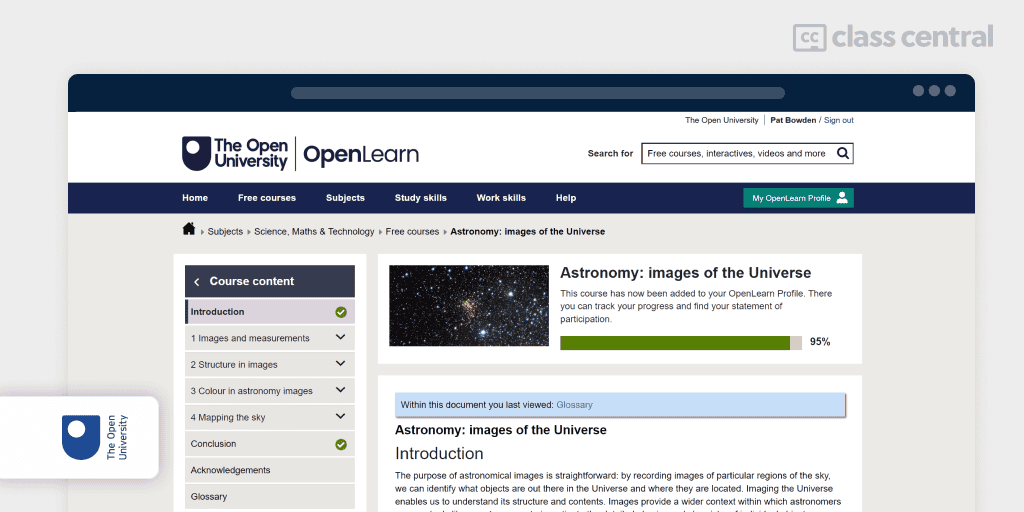
Astronomy: images of the Universe is a text-based course with interactive features, released in February 2024. We are no longer limited to seeing astronomical objects only in visible light, we can detect wavelengths across the entire spectrum from radio waves through to ultra-short gamma rays. This free course enables you to explore multiwavelength images of the Universe and make your own measurements of stars, nebulae and galaxies using online tools and databases, and use a web tool called Chromoscope to survey the Milky Way in different wavebands.
You will learn about:
- Images and measurements, brightness, sizes, shapes, and structure of point-like stars to diverse nebulae and galaxies
- The Messier catalogue
- Types of extended objects
- Color in astronomy images including broadband, multiwavelength, and narrow-band images
- Mapping the sky, the Milky Way and the galactic plane
- Surveying the variable universe.
This free course is an adapted extract from the Open University course S284 Astronomy.
“…As the name implies, the course focuses on imaging nebulae, star clusters, and galaxies in many different wavelengths, from radio waves, through visible light, to gamma rays…” – Pat Bowden (yes, me!), Class Central learner.
| Provider | OpenLearn |
| University | The Open University |
| Level | Intermediate |
| Instructors | Judith Croston and Andrew Norton |
| Time Commitment | 6 Hours |
| Rating | 5.0/5.0 (10) |
| Cost | Free |
| Quizzes/Assessment Items | Informal |
| Certificate | Free |
Best Course for Kids (FreeSchool)
Free School’s Astronomy and Space for Children has plenty of images of real astronomical objects as well as animations. As a child, I would have simply loved this course.
Learn about:
- The planets
- The Moon’s phases, the Sun, and auroras
- Constellations such as Orion, Cassiopeia, Scorpius, Taurus, and Leo
- Mythology and locating constellations in the night sky
- Eclipses, black holes, and the Hubble Space Telescope
- Explore cosmic clouds and nebulae with telescope images.
The narration is in child-friendly language, but doesn’t talk down to the audience. It’s also interesting for adults with no prior knowledge of astronomy.
“I came onto the course with high expectations. They have been thoroughly met…” – Ghadi Byiringiro, Class Central learner.
| Provider | YouTube |
| Institution | FreeSchool |
| Level | Beginner |
| Time Commitment | 3-4 Hours |
| Views | 655.0K |
| Likes (First Video) | 78K |
| Cost | Free |
| Quizzes/Assessment Items | No |
| Certificate | No |
Best Course About the Solar System (Caltech)
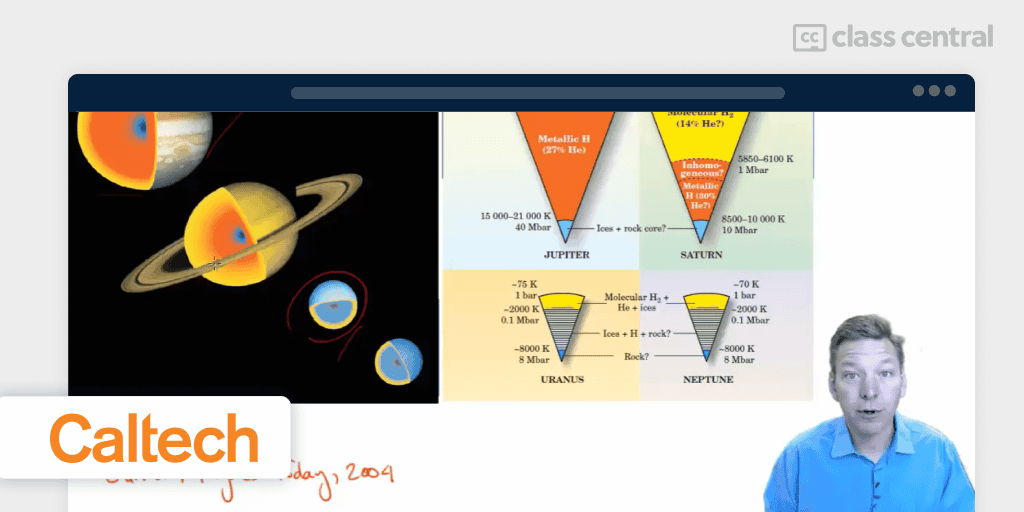
The Science of the Solar System: I couldn’t leave this excellent, highly-rated course out of the list! Although some scientific and mathematical knowledge is helpful for this university-level Caltech course, you can get plenty out of it even if you gloss over tricky details.
In this course:
- Examine Mars in detail as an introduction to course concepts
- Focus on giant planets, followed by smaller solar system bodies
- Explore extraterrestrial life and life-sustaining conditions
- Integrate chemistry, geology, and biology with physics and mathematics.
The quizzes and final exam aren’t just about memorizing facts, you need to really think about what you’ve learned. It might be a challenge, but it’ll be worth it. It’s featured in several editions of Class Central’s Best Online Courses of All Time list. Check out my detailed review of this course.
“This class has to be the BEST class I have ever taken- MOOC or otherwise! Instructor was engaging and really presented a great deal of difficult information in a manner that was easy to follow and learn…” – Anonymous Class Central learner.
| Provider | Coursera |
| University | California Institute of Technology |
| Instructor | Mike Brown |
| Time Commitment | 30 hours |
| Enrollments | 75.0K |
| Rating | 4.8/5.0 (814) |
| Cost | Paid |
| Quizzes/Assessment Items | Yes |
| Certificate | Paid |
Also Great Course About the Solar System (The Open University)
No prior knowledge of astronomy is required to explore the vast diversity of Moons in our Solar System, with their range in size, composition, and potential for hosting life.
You will learn:
- What are moons?
- Orbits, formation and composition, surface features and activity, craters, volcanism on moons
- Our Moon: historical missions; going to the Moon, what we learned, analyzing Moon rocks, water on the Moon
- Exploring other moons
- Future prospects.
You can also find this course in a different format through OpenLearn, titled Moons of our Solar System.
“Very interesting course. There is a good mix of articles, videos, discussions and quizzes – and so the course was quite interactive…” – Jaimee Van Der Westhuizen, Class Central learner.
| Provider | FutureLearn |
| University | The Open University |
| Instructor | David Rothery |
| Time Commitment | 24 hours |
| Enrollments | 61.1K |
| Rating | 4.7/5.0 (233) |
| Cost | Free audit |
| Quizzes/Assessment Items | Yes |
| Certificate | Paid |
Best Cosmology Course (University of Tokyo

Described as a beginner course, some learners have mentioned that knowledge of high school calculus and physics is expected.
The course covers:
- Evolution of the Universe since the Big Bang (13.8 billion years)
- Dark Matter and its role in star/galaxy formation
- The Higgs-boson and its significance
- Matter vs. Anti-Matter survival
- Dark Energy and accelerating universe expansion.
“This was a wonderful course! The professor does a great job in turning difficult concepts more clear and easier to understand!” – Juliana Cavalcanti Correa, Class Central learner.
| Provider | Coursera |
| University | University of Tokyo |
| Level | Beginner/Intermediate |
| Instructors | Hitoshi Murayama |
| Time Commitment | 31 hours |
| Enrollments | 109.6K |
| Rating | 4.8/5.0 (3.6K) |
| Cost | Paid |
| Quizzes/Assessment Items | Yes |
| Certificate | Paid |
Best Course About Black Holes (University of Alberta)
Who remembers the images (in May 2022) of the black hole at the center of our own Milky Way galaxy? Astro 101: Black Holes delves into the mysteries of black holes.
You will:
- Understand black holes: their formation and relation to stars
- Explore consequences of falling into a black hole and methods of detection
- Investigate whether particle accelerators could create black holes
- Consider the potential of black holes as wormholes or time machines
- Learn about astronomy, relativity, and quantum physics concepts
- Master black hole research, types, formation, detection methods, and ongoing puzzles.
“I didn’t know the real science behind black holes and getting deeper into the research that’s been done in this field is just amazing. The course provides all the theory and basic formulas to understand these massive astronomical objects without being too complicated…” – Fabio Dantas, Class Central learner.
| Provider | Coursera |
| University | University of Alberta |
| Level | Beginner |
| Instructor | Sharon Morsink |
| Time Commitment | 10 weeks |
| Enrollments | 53.6K |
| Rating | 4.8/5.0 (1.2K) |
| Cost | Free |
| Quizzes/Assessment Items | Yes |
| Certificate | Not available |
Best Course About Extraterrestrial Life (University of Edinburgh)
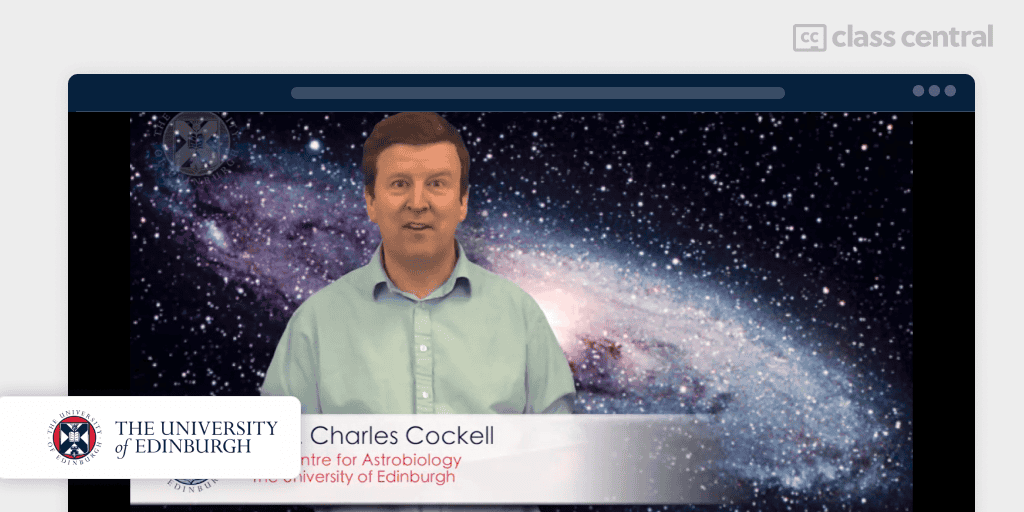
Astrobiology and the Search for Extraterrestrial Life is another course on Class Central’s Best Online Courses of All Time list. It’s an interdisciplinary course covering astronomy, biology, geology, and other scientific fields.
In this course:
- Focus on the origins and evolution of life on Earth
- Explore life’s adaptation to extreme environments
- Investigate the possibility of life on other celestial bodies
- Learn about methods for detecting extraterrestrial life
- Contemplate the implications of contact with intelligent extraterrestrial life.
If you’re curious about the mysteries of life in the universe, this course is for you.
“Wonderful course from University of Edinburgh. Professor Cockell’s lectures are simply brilliant – educational, entertaining, and easy to follow…” – Anonymous Class Central learner.
| Provider | Coursera |
| University | University of Edinburgh |
| Instructor | Charles Cockell |
| Time Commitment | 5 weeks |
| Enrollments | 92.7K |
| Rating | 4.8/5.0 (2.6K) |
| Cost | Paid |
| Quizzes/Assessment Items | Yes |
| Certificate | Paid |
Honorable Mentions and Communities
Archeoastronomy from Politecnico di Milano will teach you an interdisciplinary science that explores the links between ancient monuments and the sky, with a focus on solstices and equinoxes at famous places like Stonehenge, Giza, and Machu Picchu. Plus, you’ll get an introduction to how naked-eye astronomy was used in ancient religions and power structures.
AstroTech: The Science and Technology behind Astronomical Discovery from the University of Edinburgh: astronomy would be impossible without technology, and every advance in astronomy is due to advances in technology. Each week you will learn about a different aspect of astronomical technology, how it works, how astronomical data is collected, the results, and a discussion of what the future may hold.
Reddit has several Astronomy subreddits including:
- r/Astronomy for general astronomy discussion and posting your own high-quality images
- r/Astronomy_Help if you have astronomy-related questions
- r/AstronomyMemes A spot for memes about space, astrophotography, telescopes, spaceflight, and related topics.
Stellarium
And if you just want to know the names of things you can see in the sky or where to find a particular object, a free download of Stellarium may be all that you need. This amazing software lets you choose your position on the earth and move through time to see what’s in the sky now, in the past, and the future.
The post Best Astronomy Courses Online: Free & Paid Picks for 2026 appeared first on The Report by Class Central.