

What Is Constructivism? A Clear Definition For Learning Professionals
Constructivism learning theory explains that people learn best by building knowledge through experience, reflection, and interaction rather than simply receiving information. Simply put, the constructivism definition centers on the idea that learners create meaning based on what they already know and what they experience. Constructivism is a way of learning where people build understanding by solving problems, working with others, and applying ideas to real situations. It is more than memorizing facts. Learners are encouraged to ask questions, think critically, and connect ideas instead of just taking in information.
Constructivism assumes that knowledge is not simply passed from teacher to learner. Instead, people build understanding through their own experiences, social interactions, and the situations they are in. This idea has shaped how many modern training and learning programs are designed. In simple terms, constructivism means people learn best when they take an active role in learning. This is different from behaviorism, which looks at repeated actions, and cognitivism, which focuses on how we process and store information. Constructivism values engagement, discovery, and making meaning, which is especially important for today’s L&D programs that focus on critical thinking and real-world skills.
Constructivism Learning Theory Core Principles
The constructivism learning theory definition describes learning as a process of constructing understanding through real-world engagement. Rather than viewing learners as empty containers waiting to be filled with information, the constructivism theory positions learners as active participants in the learning process. Several core principles shape the theory:
- Knowledge is constructed, not transmitted.
Learners create understanding by interpreting information through prior experiences and perspectives. - Learning is contextual and experiential.
People tend to learn better when training is based on real-life situations and practical problems. - Social interaction shapes meaning.
Discussions, collaboration, and peer feedback help learners improve their understanding and see things from new perspectives. - Reflection drives understanding.
Learners understand more deeply when they look at their experiences, think about what happened, and connect those lessons to what they might face in the future.
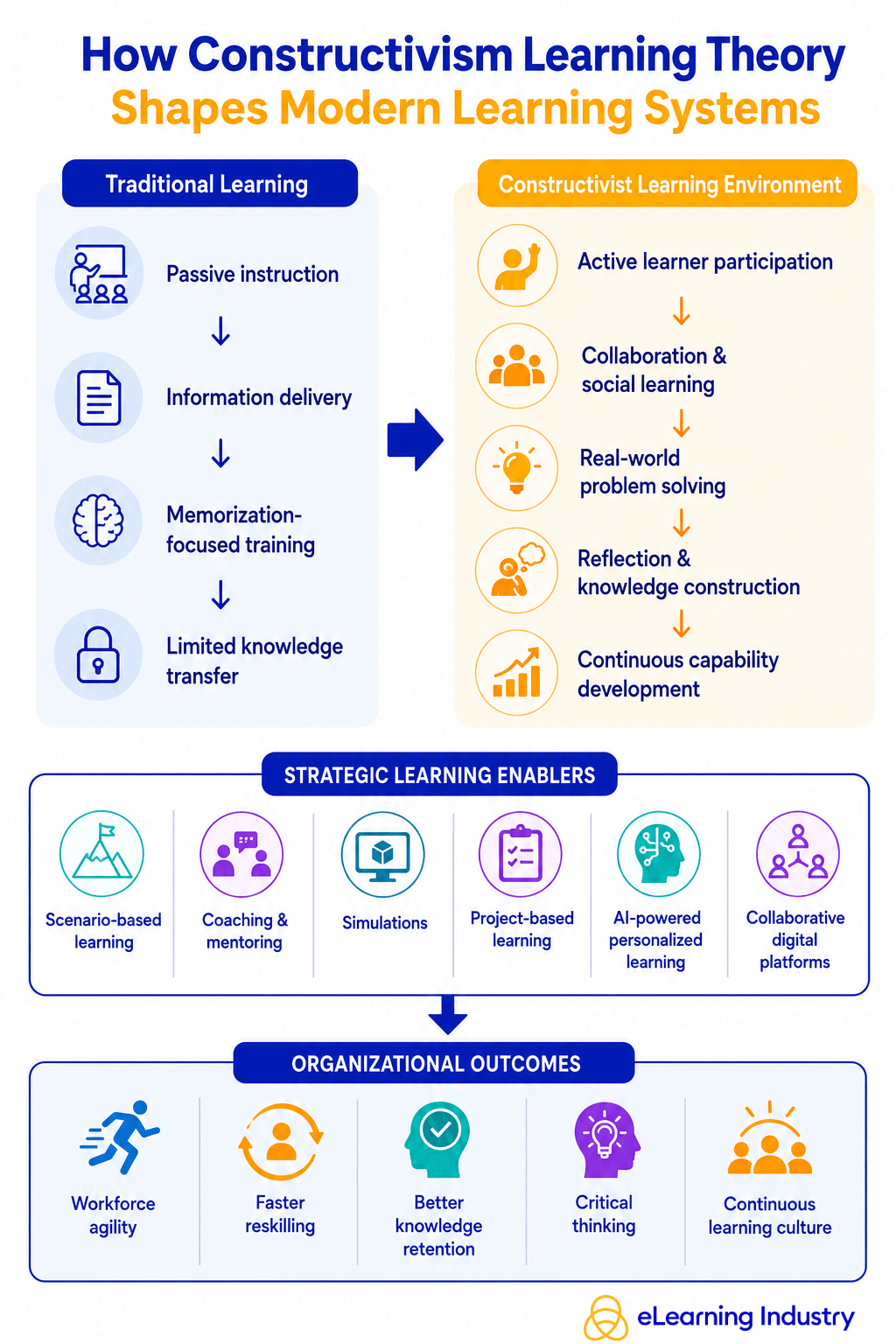
These principles show why constructivism in learning remains highly relevant for corporate training and L&D strategy. Modern organizations increasingly need employees who can solve problems, adapt quickly, and use their knowledge in new situations. Thankfully, constructivism promotes critical thinking, teamwork, and ongoing improvement. Many organizations now use this approach through simulations, group workshops, scenario-based learning, mentoring, and project-based training.
What Is Constructivism In Education And Instructional Design?
Constructivism learning theory is important in today’s education and workplace learning because it emphasizes that people build knowledge by doing, reflecting, and interacting. In simple terms, constructivism in education means learners understand more when they take part in the process, not just listen to a teacher.
Back in the day, education was mostly led by teachers, and students were expected to take in information without much involvement. In contrast, constructivism education takes a different approach by encouraging students to work together, solve problems, discuss ideas, and use what they learn in real situations. This change has shaped both schools and workplace training programs.
Today, constructivism theory in education is widely reflected in Instructional Design practices. Models like ADDIE and SAM now include activities that let learners explore, get feedback, and learn by doing instead of just reading or listening. Additionally, designers often use simulations, real-life scenarios, and group projects to help people use what they learn in real situations.
This approach aligns closely with the needs of modern organizations, too. Businesses want employees who can think critically, adapt quickly, and solve complex problems. Because of this, modern L&D strategies increasingly rely on these principles to create more engaging, practical, and learner-driven training experiences.
Key Theorists Behind Constructivism Learning Theory
Several influential thinkers shaped constructivism learning theory, changing how educators and L&D professionals view learning, knowledge, and human development. These theorists showed that learners build understanding through experience, reflection, and interaction, not just by receiving information.
John Dewey
John Dewey is one of the most important figures in constructivism. He believed people learn best through experience and active participation. His „learning by doing“ approach became a major foundation of constructivism in education. Instead of memorizing information passively, learners solve problems, ask questions, and connect what they learn to real-life situations. Many workplace training programs still use Dewey’s ideas today through simulations, projects, and hands-on activities.
Jean Piaget
Another major constructivism theorist is Jean Piaget. Piaget focused on cognitive development and explained that learners build knowledge in stages as they grow and interact with their environment. Piaget introduced cognitive constructivism, which highlights the importance of internal thinking and developing mental models. His research still shapes Instructional Design, especially in learner-centered and adaptive learning settings.
Lev Vygotsky
Lev Vygotsky further developed the theory by focusing on the role of social interaction in learning. His work on social constructivism showed that collaboration, communication, and support from others help learners understand more effectively. Vygotsky also introduced scaffolding, in which teachers or peers support learners until they can perform tasks independently.
Constructivism Learning Examples In Workplace And L&D
Constructivism learning theory is popular in today’s workplace training because it encourages employees to learn by doing, reflecting, and getting involved, not just by listening. Instead of just taking in information, people learn by solving problems, working with others, and using ideas in real situations. This makes constructivism especially useful for organizations that want to build lasting skills and improve performance over time.
Scenario-Based Learning
One of the most common constructivism learning theory examples in corporate L&D is scenario-based learning. Employees face realistic situations that reflect actual workplace challenges, like handling customer complaints, managing conflict, or making leadership decisions. Instead of just memorizing steps, learners practice critical thinking and decision-making in real-world contexts. This leads to better engagement and helps people remember what they learn because it connects directly to their daily work.
Simulations And Role-Playing
Simulation and role-play training are also central to constructivism learning. For example, sales teams may participate in virtual client negotiations, and healthcare professionals use simulations to practice patient care decisions. These hands-on experiences let learners try out ideas, learn from mistakes in a safe setting, and think about what works. This helps employees build real confidence as well as a solid understanding of the concepts.
Project-Based Learning
In many companies, employees learn by working on real business projects instead of just finishing separate training modules. They collaborate across teams, do research, and experiment as part of learning. This approach matches the main idea of constructivism: people build knowledge through meaningful activities and working with others.
Collaborative Problem-Solving
Teams join forces to tackle tough challenges, share their views, and learn together. This method fits well with social constructivism, which says people learn best through discussion and teamwork. Coaching and mentoring also support this approach by encouraging reflection, guided practice, and regular feedback from experienced colleagues.
Modern LMSs
Instructional Designers are also using constructivism in digital learning platforms. Today’s LMSs often have interactive simulations, discussion forums, branching scenarios, and group workspaces that get people involved. Rather than just showing information, these systems let learners explore, try things out, and use what they learn on their own.
When Should Instructional Designers And L&D Leaders Use The Constructivism Learning Theory?
Constructivism works well when organizations want learners to build decision-making, leadership, communication, or problem-solving skills. Methods like scenario-based learning, group workshops, simulations, and peer learning fit this theory because they help people learn by doing and through experience.
However, constructivism should be balanced with more efficient training methods. Not every goal needs a hands-on or group approach. For example, compliance training, onboarding, and standard knowledge sharing often work better with clear instruction and some targeted constructivist activities.
A useful way to decide is to ask: Does the learner need to memorize facts or use them in complex situations? If applying knowledge, making judgments, and adapting are important, constructivism can lead to better results. Today, Instructional Design often blends constructivism, guided learning, and digital tools to build flexible learning systems that support both business goals and learners.
Conclusion
As organizations invest in reskilling, upskilling, and digital transformation, constructivism learning theory becomes increasingly relevant in workplace learning. Modern L&D teams are using cognitive constructivism and social constructivism learning theory to support critical thinking, problem-solving, and continuous capability building. In today’s evolving business landscape, constructivism learning helps organizations create more agile, future-ready workforces.