
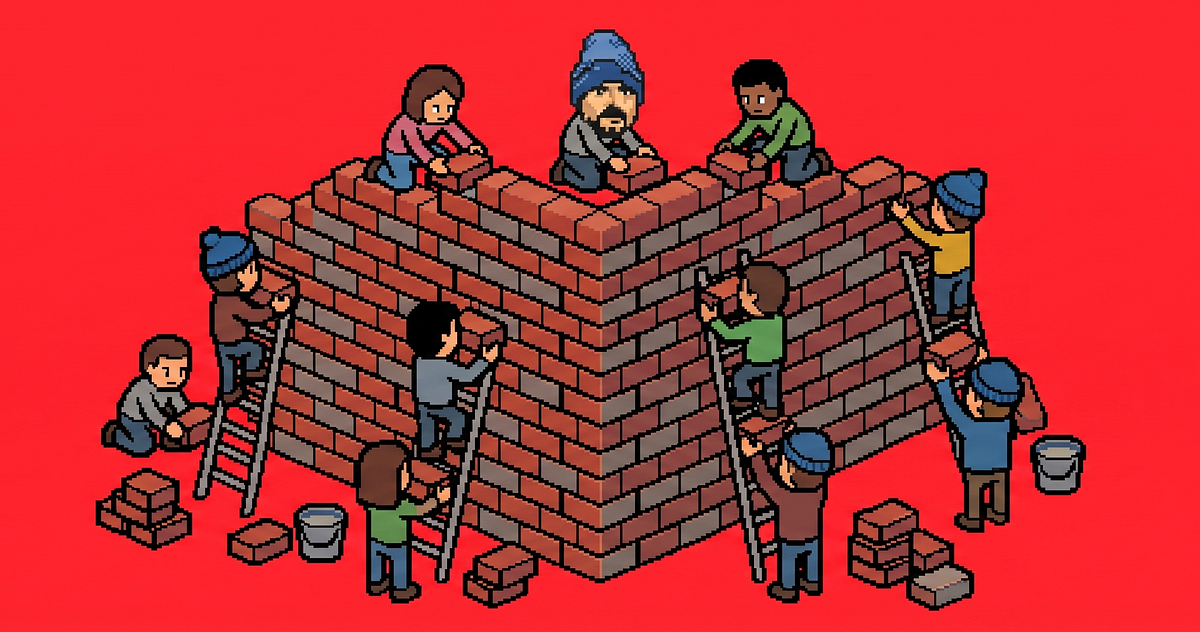
What It Should Look Like: Building Shared Standards for AI Interfaces
None of this happens by waiting. Here is where the work is.
Name the patterns before the vendors lock them in.
The web got semantic markup because designers agreed on what a heading, a list, and a link meant before the tools decided for them.
Do the same for AI interfaces now: agree on what “show your work,” “cite your source,” and “I am not sure” should look and behave like, as reusable components rather than one-off features.
The same discipline belongs a layer down, in how a skill is described, discovered, and combined, so capabilities compose instead of colliding. If you keep a component library, this is where shared AI patterns belong.
My own ux-components.com is one attempt at that; build your own and build it in the open.
Make traceability and confidence first-class parts of the interface.
The most dangerous thing an AI interface can do is present a guess with the same visual authority as a fact. Standards-era design stripped false neutrality out of markup by making structure explicit.
The equivalent move today is to make sourcing, traceability, and calibrated confidence visible by default, so a person can see where an answer came from and how far to trust it. Treat that as a convention, not a competitive differentiator.
The most dangerous thing an AI interface can do is present a guess with the same visual authority as a fact.
Build the coalition, not the mandate.
You do not have the authority to set an industry standard, and neither did the Web Standards Project. What you have is your own work, done in public, and the willingness to keep making the case.
- Publish your patterns.
- Argue for them at conferences and in writing.
- Adopt other people’s good conventions instead of reinventing them for credit.
Start this week: take one convention you have already settled — how your product signals confidence, say — write it down, and publish it where another team can find and copy it.
Standards spread when agreeing becomes easier than diverging, especially when cost is involved.
The New Markup Is Markdown
There is a quieter version of this already taking shape in the projects agents work in — Markdown as a baseline, which also has a long history back to 2004 as invented by John Gruber and the late Aaron Swartz. It is cheap and good, thus has become a standard.
Agents increasingly take their instructions from plain text files that sit beside the work — AGENTS.md for how an agent should behave in a project, SKILL.md for what a capability can do, README.md for the context around both.
This is the new semantic layer. It is markup again, written in Markdown and read by a model instead of a browser.
That layer inherits two disciplines the web spent twenty years learning, and it is being built as if neither exists. The first is accessibility, and right now it is missing from what informs the agent.
A model generating an interface has no accessibility standard in front of it, so it ships whatever it ships. Those requirements — contrast, focus order, alternative text, keyboard paths — belong in the file that guides the agent, feeding it up front rather than getting bolted on after the interface is generated. The second is content strategy. Voice, terminology, reading level, and the shape of what a model produces are decisions, and right now they are made by default, one prompt at a time, with no shared model to anchor them.
So write the files down, and standardize what goes in them.
A design.md that carries your design system’s patterns, tokens, and rules into every agent that touches the product. An accessibility.md that states the non-negotiables in language a model can follow. A content.md that fixes voice, terminology, and the content model.
The set is not fixed — a research.md for what you know about users, a brand.md for identity, whatever your practice depends on.
Name them, share them, and treat them the way the web learned to treat structure, presentation, and accessibility: as a contract, not a preference.
The W3C Already Built the Machinery and We should Use it
Here is the part that should make this feel less daunting. You are not starting from nothing.
The World Wide Web Consortium — the W3C — has run an open, consensus-based standards process since 1994. It produced the specifications that Zeldman’s coalition spent years pushing browser makers to honor.
The division of labor back then is worth remembering. The W3C wrote the standards, and the Web Standards Project made adoption non-optional. One body defined the shared language; a movement made it stick.
That machinery did not disappear. It still runs the accessibility, privacy, and security work that any responsible AI interface will need, and it has already turned toward this moment. In 2025 the W3C launched a Web and AI Interest Group to work through how AI technologies intersect with the web, and community groups there are drafting early protocols for how agents identify themselves and cooperate.
You are not waiting for this to begin. It has begun. A partial map of the standards taking shape right now:
- Model Context Protocol — a shared way for a model to reach tools, data, and context, already adopted across rival platforms and now stewarded by a neutral foundation.
- A2UI — a declarative protocol for agents to describe interfaces that render natively across web, mobile, and desktop, keeping what the interface is separate from how each client draws it.
- Agent2Agent — an open protocol for agents to discover one another and collaborate across frameworks and vendors, launched by Google and handed to the Linux Foundation.
- The W3C AI Agent Protocol Community Group — a grassroots group drafting open rules for a trustworthy web of agents.
- Agent identity work — cross-body efforts, at the W3C and beyond, to verify who an agent is and what it is allowed to do before it acts.
None of these is finished, and that is the opening. The conventions are still soft enough to shape, which is exactly where Zeldman’s coalition made its difference.
So leverage the past instead of relighting the fire. Extend the accessibility standards that already exist rather than inventing parallel ones, and bring your patterns to the groups already forming instead of publishing them into a silo. The lesson of the browser wars is not only that standards win. It is that the institutions to make them are already here, and the work is joining them, not founding a rival.
Conclusion
The standards moment is not a prediction. It is a choice, and it is being made right now, mostly by default.
Every AI product that ships a novel interface without asking whether it should be novel is casting a vote for chaos — for a world where each assistant works its own way, users relearn the rules with every tool, and the people who get stranded are the ones with the least patience for our cleverness. That world is not inevitable. It only feels that way because no one with a title is going to stop it.
Zeldman’s lesson is that no one ever does. Standards did not arrive because an authority demanded them. They arrived because a stubborn coalition of practitioners decided the web should work the same way for everyone, and then made that true one argument at a time.
We are the practitioners now. The models are astonishing and the interfaces around them are a mess, which is exactly the condition Zeldman walked into and refused to accept.
So look back, take what worked, and get to work. The window is open, the same one Zeldman climbed through. It closes the moment we agree the chaos is normal.