


The next decade of user experience work is not about prompting better, it’s about owning the systems, the white space, and trade-offs nobody has mapped yet.
Most designers I talk to already use AI every day. It makes them so much faster.
Sketching faster.
Doing research faster.
Writing copy faster.
Generating variants faster.
That is real and it matters, but it is the smallest version of what’s coming next. And this is it — The shift from AI Designer to AI Experience Architect is not about working faster, it is a change in how you do your work and what you are accountable for.
One of the earliest signals is that Figma is still in job postings, but lower on the priority list. Design (not production) still matters a lot, it’s just part of other roles.
A faster pencil makes you more productive inside an existing workflow. An architect designs the workflow itself, including the parts nobody wrote down which means it’s contained in no LLM, ever.
Goldman Sachs splits AI-exposed work into substitution and augmentation, and design sits on the augmentation side. That is why the architect seat is opening up and it’s ours to take.
Here’s why — Jevons paradox.
When a resource becomes cheaper to use, total consumption usually rises rather than falls, because new uses become economically viable. William Stanley Jevons watched this happen with coal in 1865 — more efficient steam engines did not reduce coal demand, they exploded it.
The version playing out in design right now is that as AI makes design work cheaper per unit, more things become worth designing at all.
The leaders planning to replace designers with AI are making a Jevons mistake, treating design as a fixed cost rather than an elastic one.
The paradox does not guarantee the work grows — that depends on whether the value is captured by designers or extracted from them — but it does explain why the seat exists.
We’re all learning together. This is what it could look like for you.

Stage One: The Faster Pencil
This is where most designers sit right now, and it is a perfectly reasonable place to be working in 2026.
You open Figma, you open Claude or ChatGPT in another tab, and you move through your existing process about thirty percent faster than you did last year.
The deliverables look the same, the review cycles look the same, and yet the seat you hold on the team has not moved. That is risk.
The honest version of this stage is that it is mostly a productivity story rather than a design story, and that distinction matters more than it sounds.
You are generating more output per hour, but the questions you are answering and the leverage you have in the org chart have not changed. That is fine, and it is a real gain, and roughly 85% of developers are doing the equivalent thing in their own discipline right now.
The Figma State of the Designer 2026 survey reports that 91% of designers using AI say it improves the quality of their work, a remarkable number for a tool barely three years old.
It’s the equivalent of moving from paste up to Adobe InDesign in three weeks. However, it’s not enough.
How long you should stay here: three to six months. Tool fluency used to take a year because every model had its own quirks, but the major tools have converged enough that what you learn in one transfers cleanly to the next. Stay much past six months and you are not deepening your craft, you are just getting comfortable, and the market reprices comfortable work faster than it used to.
To get to the next stage, you have to stop measuring AI by how much faster it makes you and start measuring it by how much of your judgment you can encode into a repeatable system. That means writing down the heuristics you’ve been carrying in your head for ten years, adding them as a Claude or Lovable skill, and being willing to watch a tool apply them imperfectly while you correct it.

Stage Two: The Workflow Designer
This is where the work starts to look genuinely different from what came before it. You stop using AI as a tool inside your process and you start designing processes that have AI inside them as a participant.
The deliverable is no longer a screen, it is a flow: who hands what to whom, where the model gets called, where a human reviews, and where the loop finally closes.
There’s a name for it: Service Design. That’s what we were supposed to do. Designing for situations that need guardrails.
Your toolbox shifts with it. Workshops and Figma start taking up less of your week, not because the craft does not matter, but because the work is happening upstream of where mockups live.
However, the trap at this stage is mistaking automation for architecture, and it is a trap that almost everyone falls into at least once. Automating your existing research synthesis or your existing design review is useful, but it quietly bakes in whatever was already broken about those rituals. The harder and more valuable move is to look at what the team actually does, not what the process diagram claims it does, and to design honestly from there.
This is the white space problem showing up in your own backyard, in the Slack threads and the hallway corrections and the quiet vetoes that never made it into the Confluence page.
A lot of designer AI adoption is still happening in the shadows, with people experimenting on personal laptops after standup ends, which tells you the official workflow is not actually the workflow.
How long you should stay here: three to six months. Workflow cycles used to take a year apiece, but agentic tooling means you can ship a flow, watch it break, and rebuild it in weeks rather than quarters. Two or three honest cycles is enough, and you can learn the rest of the traps secondhand from the public post-mortems other teams have already published on Medium.
To get to the next stage, you need to start owning outcomes rather than flows. A workflow can be elegant and still produce the wrong result, and when it does, you answer for it by changing the prompt. If you cannot say what your AI-enabled process is supposed to make better in business terms, you are still a workflow decorator, not an architect.
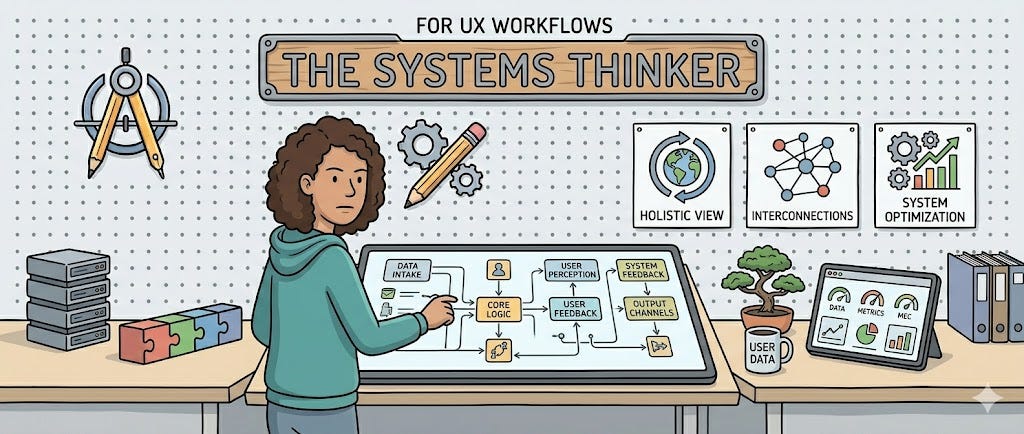
Stage Three: The Systems Thinker
At this stage you are designing the relationships between systems, not the screens that happen to sit on top of them. You are asking questions like where the source of truth lives, how agents authenticate, what the audit trail looks like, and what a user is supposed to do when the model is confidently wrong about something important.
The design surface expands to include data contracts, permissions, latency, fallback behavior, and the internal politics of who is allowed to change what. This is the layer where the EU AI Act and GDPR Article 22 stop being compliance trivia and start being real constraints on the structure of your product.
The uncomfortable part of this stage is that a lot of your craft skill stops being legible to the people sitting around you in meetings. Your stakeholders see fewer pixels and more diagrams, and some of them will read that as you having stopped designing entirely.
You have not stopped designing, you have started designing the thing that makes the pixels possible in the first place.
I am about three and a half years into this work myself, and my workflow has changed completely. I rarely produce a mockup anymore, because by the time a screen would be useful, the rules of the system have already shifted underneath it. The risk is real, and it is why most designers stall out here, because the org chart often does not have a clean box for what you are now doing.
How long you should stay here: one to two years. Systems thinking used to need multiple full regulatory cycles to develop, but the EU AI Act already brought the calendar to you, and the org chart finally has boxes for this work that did not exist eighteen months ago. Stay past two years without moving up and you become the person who knows how everything works but does not get to decide what gets built.
To get to the next stage, you have to be able to defend trade-offs in front of people who do not share your vocabulary or your instincts. Engineering wants determinism, legal wants auditability, product wants velocity, and the people doing the actual daily work want to not be surveilled by their own tools.
An architect holds that room together. A senior designer with good Figma files does not.

Stage Four: The AI Experience Architect
This is the role that most companies do not yet have, and that they will spend the next ten years gradually figuring out they actually need. You sit at the level where the question stops being what this product should do and starts being what this organization should be capable of doing.
You work with operations, legal, IT, and the executive team to decide which decisions a model gets to make, which ones a human keeps, and what the social contract is with the people whose daily work just changed underneath them.
The 97% of executives reporting AI benefits but only 29% seeing meaningful organizational ROI is the exact gap you are paid to close.
The work at this level is mostly not glamorous, and anyone who tells you otherwise is selling you something. It is incentive design, change management, vendor selection, and a long series of slow conversations with people who are scared or skeptical or both at once.
The leverage is enormous, but it shows up in metrics that take quarters or years to actually move, not in a polished demo at the all-hands. You are much closer to Henry Ford figuring out the five-dollar workday than to a designer shipping a screen.
How long you should stay here: three to seven years, and probably the last seat with that kind of runway. The earlier stages compressed because tooling and org structure caught up, but the political work at this level does not compress, you cannot speedrun trust with a legal team or an exec staff. The role itself is also temporary, because once organizations finish absorbing AI into their operating model, the seat either becomes ordinary executive leadership or it splits into specialties we cannot name yet.
The thing to conquer at this stage is not another skill, it is the temptation to retreat back into craft work the moment the architectural job gets political or uncomfortable. Every architect I have watched succeed at this level has had to make peace with not being the person who made the pretty thing, and instead being the person who made the pretty thing possible in the first place.
A Note On Bringing Designers Along
The ladder above is a personal one, but the architect’s job is not. If you are starting to climb, the people you leave behind are not abstractions, they are the designers on your team whose jobs are changing underneath them in real time.
Bringing them along is not a kindness, it is the work.
The numbers here are uncomfortable. Only about 31% of designers are using AI for core design work today, compared to roughly 59% of developers, and the gap is not closing on its own.
Meanwhile the Washington Post’s analysis ranks web designers as more exposed to AI than many roles that feel more obviously at risk.
The designers most at risk are not the ones refusing to engage, they are the ones engaging alone, in the shadows, without the cover or context of a team conversation. If your organization is climbing the ladder and your team is not, that is an architectural and leadership failure, not a talent problem.
Building the social contract, the training time, the air cover for experimentation, and the clear permission to fail in public is part of the architect’s job. Skip it and you will arrive at the top of the ladder by yourself, which is not actually the top.
Conclusion
None of these stages is wrong on its own terms, and not everyone has to climb the whole ladder to do meaningful work.
The question is whether you are choosing your stage or quietly defaulting into it. Faster pencils are getting cheaper every quarter, and roughly 37% of business leaders expect to replace human workers with AI by year-end. That is the wrong way to read the moment, but it is the prevailing way.
The enterprises stuck in pilot purgatory are not stuck because they need more screens, they are stuck because no one is designing the system underneath.
From faster pencil to AI Experience Architect: a designer’s path was originally published in UX Collective on Medium, where people are continuing the conversation by highlighting and responding to this story.