
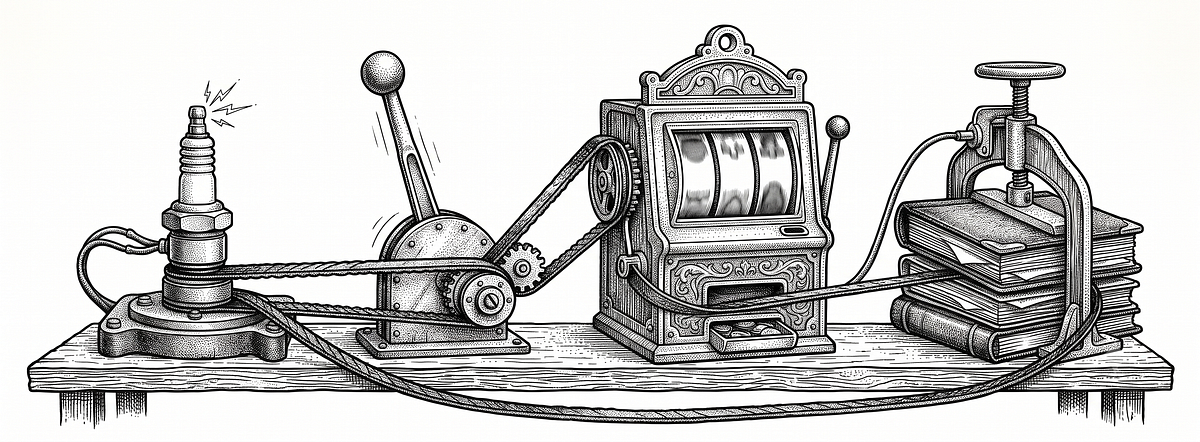
The habit loop that built social media is now wired into every chatbot — here are ways to use it without becoming the dealer.

14 hours ago
Nir Eyal published Hooked in 2014, and product teams have been running its playbook ever since. It was a topic I taught in General Assembly, and have been fascinated with ever since because it’s at the base of many interactions, digital or not.

’s Hook Model builds directly on ’s work at the Stanford Behavior Design Lab, where Eyal studied. Fogg’s Behavior Model (B=MAP) holds that behavior happens when motivation, ability, and a prompt converge at the same moment.
Eyal absorbed this foundation — particularly Fogg’s emphasis on triggers and making actions as frictionless as possible — and extended it into a four-phase loop, adding variable rewards and investment to explain how products build habits over repeated cycles.

Building on B.J. Fogg’s behavior model, Hooked describes a four-step loop that turns a product into a habit:
- A trigger prompts you to act — You hit a wall drafting a tricky email to your boss (internal trigger: the discomfort of not knowing how to phrase it), or the assistant pushes a notification: “Your weekly digest is ready to review.” Either way, something nudges you.
- An action delivers a quick win — You type one line — “make this sound more confident but not pushy” — and get a polished draft back in two seconds. Minimal effort, immediate payoff.
- A variable reward keeps the outcome slightly unpredictable — Each response is a little different. Sometimes it just fixes the tone; sometimes it surfaces an angle you hadn’t considered or catches an error you missed. You can’t fully predict the quality or the surprise, so you keep pulling the lever.
- An investment loads the next trigger — You correct the draft, save a preference, upload your style guide, or let it remember that you always sign off a certain way by creating instructions. That effort makes the next session better and quietly plants the reason to come back —a trigger—so your customized assistant is now more useful than a blank one.

This fits AI assistants and chat almost too well. For consumer, it pushes you into a higher subscription tier; for enterprise, it costs money per token.
Those tools already provide value, so the loop has real utility to wrap around. Value gets someone to try you once; the Hooked loop is the layer above it, turning a useful answer into a daily habit.
Triggers come in two kinds.
- External: The notification, the email, the app icon.
- Internal: Feelings that send you back unprompted — boredom, the nagging itch of an unfinished thought, a glass of whiskey.
Variable rewards are the engine: an uncertain outcome keeps you pulling the lever, which is why the model borrows from the slot machine. Investment is the quiet closer — every preference, file, and correction raises the switching cost.
And that investment? It’s helping the assistants build their models.
Understand the loop, and you see it running underneath nearly every AI product you touch.

Triggers: Move Users From the Notification to the Itch
Most teams reach for external triggers first, because they are the easy ones to ship.
Send a digest email.
Add a red badge.
Fire a push notification when the model finishes a task.
These work for a while, and then they stop working, because people learn to ignore anything that arrives on someone else’s schedule. The durable trigger is internal. It is the reflex that sends you to a chatbot the moment you feel stuck, bored, or unsure — before any notification arrives.
That reflex has already formed at scale from habits of the past.
When Sam Altman said in October 2025 that ChatGPT had reached 800 million weekly active users, he was describing a lot of people who now open a text box the way an earlier generation opened a search box, or a phone book. Previous habits for a new world.
The design work is not adding another alert. It is finding the specific emotion or routine your product should attach to, then removing everything between that feeling and the first useful response so you don’t overwhelm the user.
If your only lever is the notification, you are renting attention. If you own the internal trigger, you stop paying rent.
Trigger Examples
- Duolingo — the streak counter and its notifications are relentless external triggers; the real design work is the emotion underneath (fear of losing the streak) that keeps users returning once the pings are muted.
- Slack — the unread badge starts as an external cue and hardens into the internal “am I missing something” reflex; attach to an anxiety users already have rather than inventing one.
- ChatGPT — people now open it unprompted the moment they hit a blank page; identify the specific stuck-moment your product should own. Some are using it more than Google.
Action items
- Map the internal trigger before the external one. Name the exact feeling — the blank page, the stalled decision, the half-formed question — that your product should answer. Design backward from it.
- Retire the notification that hasn’t earned its place. Every alert that gets dismissed teaches the user to dismiss the next one. Cut the ones that fire on your schedule rather than their need.
- Attach to a routine that already exists. New habits are cheaper to borrow than to build. Slot your product into the moment a user already reaches for something else.

Action: The Chat Box Is the Lowest-Friction Action Ever Shipped
Eyal borrowed the action stage from B.J. Fogg, whose model says a behavior happens when motivation, ability, and a prompt line up at the same moment. The action is the simplest thing a user can do in anticipation of a reward.
Lower the effort, and the behavior fires more often.
By that measure the empty chat box is close to the theoretical minimum. There is nothing to learn, no menu to parse, no feature to find. You type a sentence, the way you would text a colleague, and something happens.
That is why it spread faster than any interface in the history of software.
There is nothing to learn, no menu to parse, no feature to find. You type a sentence, the way you would text a colleague, and something happens.
It is also why the friction did not disappear so much as move. made the case early, in Why Chatbots Are Not the Future: the blank box looks identical to a search field, a login form, and a credit-card input, so the burden of knowing what to type falls entirely on the user. The old friction was learning the interface. The new friction is knowing what to ask, trusting what comes back, and switching between telling the model what to do and judging whether it did it.
That is the reason the chat box won: it was the fastest thing to ship on the day the capability arrived, not the best interface anyone could design. Think of it as VHS vs. Betamax for the AI age.
The durable AI habits will belong to the teams that keep the low effort and quietly repair the friction that moved.
Action Examples
- ChatGPT — a single text box: near-zero effort, but no hint of what to type; lower the cost of the first good prompt with examples and sensible defaults.
- GitHub Copilot — the suggestion appears inline as you type and accepts with one keystroke; push the action below the box wherever the context is already known.
- Perplexity — suggested follow-up questions and visible sources are affordances built into the interface; carry context in the UI instead of making users retype it.
Action items
- Reduce the cost of the first good prompt by setting expectations. Show examples, defaults, and starting points so the user is not staring at a blank oracle wondering what it knows.
- Add the affordances the blank box hides. Sliders, toggles, and structured inputs can carry context the user would otherwise have to type — and remember to type — every time.
- Design for the evaluate step, not just the ask. The action is not finished when the user hits enter. It is finished when they can tell whether the answer is any good.

Rewards: A Language Model Is a Slot Machine by Default
Here is the part of the loop AI did not have to engineer, because it comes free with the technology. A language model is nondeterministic. Ask the same question twice and you get two different answers.

Eyal split rewards into three kinds, and AI hits all three.
- Rewards of the hunt are the information you were chasing — the answer, the summary, the fix.
- Rewards of the self are the sense of progress and mastery — a finished draft, a solved bug, a box checked.
- Rewards of the tribe are social — the clever output or report you screenshot and share.
Every generation is a fresh pull, and you never know in advance whether this one is brilliant, useful, or nonsense, hallucinations included.
The trap is that the same variability that hooks people is also the reliability problem.
A slot machine is supposed to be unpredictable. A tool is not, which presents some ethical challenges for AI.
When the unpredictability lands, users chase the next great answer; when it misses, they lose trust in all the answers. You cannot turn the variability all the way up without eventually turning credibility down.
So the discipline is to be deliberate about which reward you are really paying out, and to make the good outcome reliably reachable rather than occasionally miraculous.
Reward Examples
- Midjourney — four images per prompt and a reroll button turn nondeterminism into a ritual; make the reward of the hunt clear and the good outcome reachable.
- ChatGPT “Regenerate” — each press is a fresh pull of the lever; use variability to help the user, not to string them along.
- Spotify Discover Weekly — an unpredictable, personalized set you open because you never know what you’ll find; pair the surprise with genuine relevance.
Action items
- Name the reward you are really offering. Hunt, self, or tribe — pick one on purpose. A product that pretends to offer all three usually delivers none of them well.
- Make the good outcome reachable, not just possible. Users forgive a model that is consistently helpful faster than they forgive one that is occasionally dazzling.
- Do not manufacture variability you cannot stand behind. Randomness that serves engagement but not the user is the first step from facilitator to dealer.

Investment: Every Iteration You Make Loads the Next Trigger
The fourth stage is the one that compounds. Investment is any effort the user puts in — time, data, preferences, content — that makes the next session better than the last because it adds context. Unlike a sales funnel, it has no endpoint.
It is stored value that improves the product without the company lifting a finger.
AI products are unusually good at this, because correcting the model is itself an investment. Every custom instruction, uploaded file, saved project, and thumbs-up quietly tunes the thing toward you. The model gets more yours, and the cost of starting over somewhere else climbs with each pass through the loop.
Get Patrick Neeman’s stories in your inbox
Join Medium for free to get updates from this writer.
This is the endowment effect and the IKEA effect doing exactly what they always do: we overvalue what we have shaped and what we have helped build.
You can watch investment deepen in the enterprise numbers. OpenAI reported that usage of structured workflows such as Projects and Custom GPTs rose roughly 19-fold across 2025 — the shift from casual questions to configured, repeatable setups people do not want to rebuild elsewhere.
The catch is that investment cuts both ways. Lock-in that the user chose feels like ownership. Lock-in they did not choose feels like a hostage situation, and the moment a competitor is meaningfully better, resentment does the switching for them.
Investment Examples
- ChatGPT memory and custom instructions — every correction tunes the assistant toward you; make that accumulated value visible so users feel the return.
- OpenAI Projects and Custom GPTs — configured, repeatable setups people will not rebuild elsewhere; let power users see and export what they have built.
- Notion — the workspace you have filled with your own documents and structure is the switching cost; earn the data with a real win before asking for more.
Action items
- Make the investment visible so users feel the return. People keep investing when they can see the memory, the customization, and the saved work paying off in front of them.
- Let users port what they have built. Confidence that they could leave is often what convinces them to stay. Export is a retention feature, not a leak.
- Earn the data before you ask for it. Request the investment after the first real win, not before it. Value first, effort second.

The Manipulation Matrix: Run Eyal’s Own Ethics Test Before You Ship
Eyal knew the loop could be pointed at harm, so he built a gate for it. The Manipulation Matrix asks two questions:
- Does the product materially improve the user’s life?
- And would you use it yourself?

Here’s the quadrant:
- Answer yes to both and you are a facilitator. You are building something you would use and believe in, which is the only quadrant where you get to run the techniques at full strength.
- Yes to improving lives but no to using it, and you are a peddler. You usually headed for failure because you lack the empathy to build something people want.
- Yes to using it but no to improving lives, and you are an entertainer. This is fine but it is art, not value.
- No to both is the dealer, and Eyal has a plainer word for it: exploitation.
No to both is the dealer, and Eyal has a plainer word for it: exploitation.
There is a second test, sharper than the first. Eyal calls it the regret test: if users knew everything you know about what is about to happen, would they still do this?
An assistant that saves someone an hour passes easily; an engagement-maximized companion tuned to keep a lonely user talking past midnight does not, and no amount of retention lift changes the answer.
Run these before the roadmap review, not after the lawsuit.
Manipulation Examples
- Slack and WhatsApp — Eyal’s facilitators: the founders used what they built and believed it helped; the honest quadrant is the one you can occupy without a preamble.
- Gamified fitness and charity apps — Eyal’s classic peddler: badges bolted onto tasks the makers themselves would not do daily; if you would not use it, research hard before shipping it.
- Engagement-maximized AI companions — the dealer risk: tuned to keep a user talking with unproven benefit; run the regret test on the retention feature before it ships.
Action items
- Put your product in a quadrant, out loud. Say the words facilitator, peddler, entertainer, or dealer in the room. Ambiguity is where exploitation hides.
- Apply the regret test to the retention feature. Not to the product in the abstract — to the specific mechanic you are shipping to make the number go up.
- If you are writing an “if I were the user” preamble, stop. Eyal’s rule is direct: if you have to imagine yourself into the user’s shoes to justify it, you already failed the test.
Where the Loop Breaks: Habit Is Not the Same as Value
The model has one blind spot, and AI walks straight into it. The loop measures engagement, not benefit. It counts whether people came back, not whether they should have. With social media, the worst common case was wasted time. With AI systems built to simulate a relationship, the stakes are higher, because the product is designed to feel like a friend, a confidant, or a partner.
Start with what the loop counts. Every number it produces — return visits, sessions, messages sent, minutes on the platform, tokens burned — measures consumption. And consumption is not an outcome. It is an activity, the input a user spends in the hope of getting something, not proof that they got it. A person can pour an hour into your product and walk away with nothing solved, and every dashboard you own will record that hour as success.
In an AI product the problem runs deeper, because a rising consumption number is often the tool failing louder: the re-asks, the re-prompts, the three mediocre answers a user wades through to reach one usable one all register as engagement. Every consumption metric leaves the only question that matters — did this help? — wide open.
You can watch both signals sit in the same report.
OpenAI’s enterprise data shows consumption climbing fast — weekly messages up roughly eightfold and reasoning-token use per organization up hundreds of times across a year. That tells you how much the tool gets used. The figure that carries value is a different one in the same document: workers reporting 40 to 60 minutes saved per day. Time saved is an outcome. Messages sent is consumption. Only one of them answers the question you were asking.
A person can pour an hour into your product and walk away with nothing solved, and every dashboard you own will record that hour as success. That’s consumption over valuable outcome.
That is not a hypothetical.
In late 2025, Character.AI removed open-ended chat for users under 18, effective November 25, after lawsuits and regulatory pressure over teen harm, including wrongful-death claims. A company built entirely on the loop conceded, in public, that for some users the loop had grown too strong to leave running.
The direct version: if your retention depends on a variable-reward loop that users would switch off the moment they understood it, you did not build a habit, you built a trap.
This is the same lesson behind the old “worse is better” pattern — products win on utility, not novelty, and the AI habits that last will be the ones that make a real job faster, not the ones that keep a user pulling the lever. Compulsion retains people until it doesn’t; utility retains them because it works.
There is even a self-interested reason to care: the variability that rewards a user is the same variability that erodes trust, and a hooked user who stops believing the output leaves anyway. Build the honest version. It is the one that survives.
Examples
- Character.AI — removed open-ended chat for under-18 users after harm and lawsuits; a loop strong enough to require shutting off is a design failure, not a metric win.
- Infinite social feeds — Instagram and TikTok optimized engagement while the value question stayed open; more time on the platform is not more benefit to the person.
- AI usage dashboards — message and token counts measure consumption, not outcomes; instrument time saved and tasks finished instead.
Action items
- Count outcomes, not consumption. Messages, minutes, and tokens measure how much your product got used, never whether it helped. The same problem we’ve had with search, for years. Instrument the result — the task finished, the time saved — or you are guessing about value.
- Build the graceful exit before you need it. Limits, summaries, and natural stopping points signal a facilitator and are more valuable. Their absence signals a dealer.
- Separate “they came back” from “it helped.” Treat them as two different numbers, because the whole failure mode lives in the gap between them.
Conclusion
The Hooked Model is not a trick, and it is not a villain. It is a description of how habits form, and it works the same whether you point it at a fitness app, a feed, or a language model.
The four stages have not changed since 2014 — what changed is that AI arrived with two of them pre-installed: the variable reward comes almost free with a nondeterministic model, and the action collapsed to a single text box anyone can use, even if the expectations aren’t set.
That is why the loop runs faster and stickier in AI than in almost anything before it, and why the ethics stopped being optional. When the reward is automatic and the action is frictionless, the only real brake left is the one you choose to build.
So use the model, all four stages of it, without apology. Attach to a genuine internal trigger. Keep the action simple. Be deliberate about the reward. Let users invest in something they can carry with them. Then run Eyal’s own two questions and the regret test, and be honest about the answers.
Build the facilitator. The dealer’s numbers look better for exactly one quarter, then the trust runs out and takes retention with it.