
Do you want to learn how to make money with a direct mail side hustle?
Have you ever thought about helping local businesses advertise, but without starting a full marketing agency or spending a lot of money upfront?
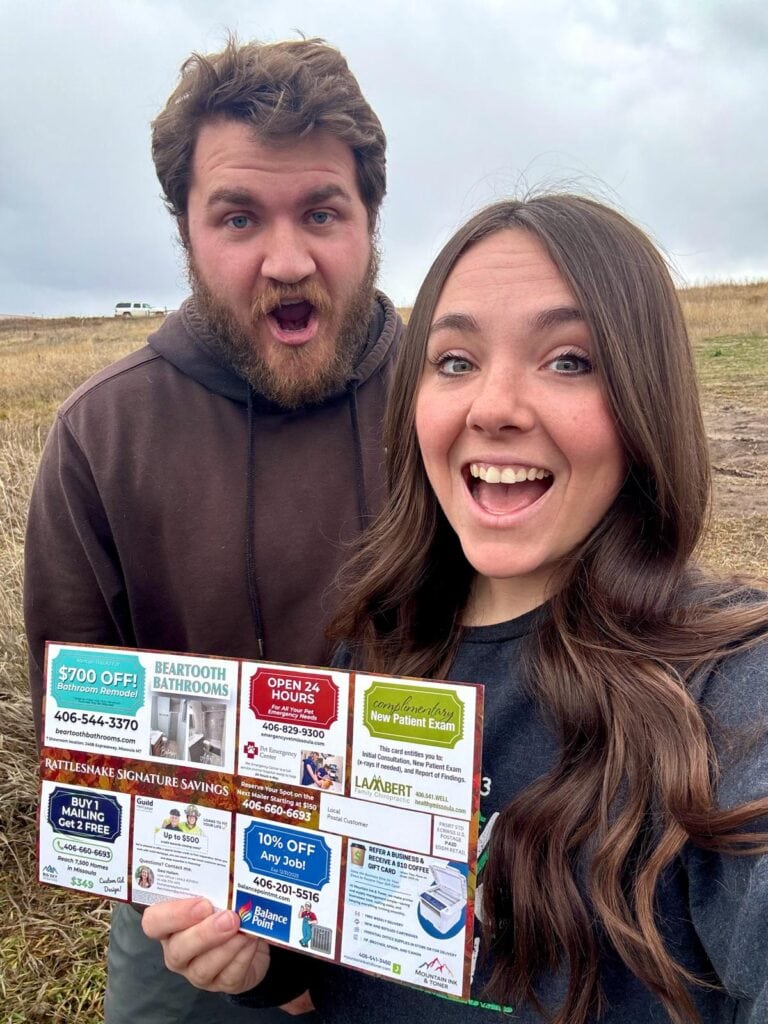
Today, I’m excited to share an interview with Rachel and Dalton, who run a local direct mail card business. They started out trying different side hustles, eventually quit their jobs, and built a business that now includes direct mail cards for local businesses.
So far, they’ve made over $100,000 in revenue from these cards and have sent more than 40 mailings.
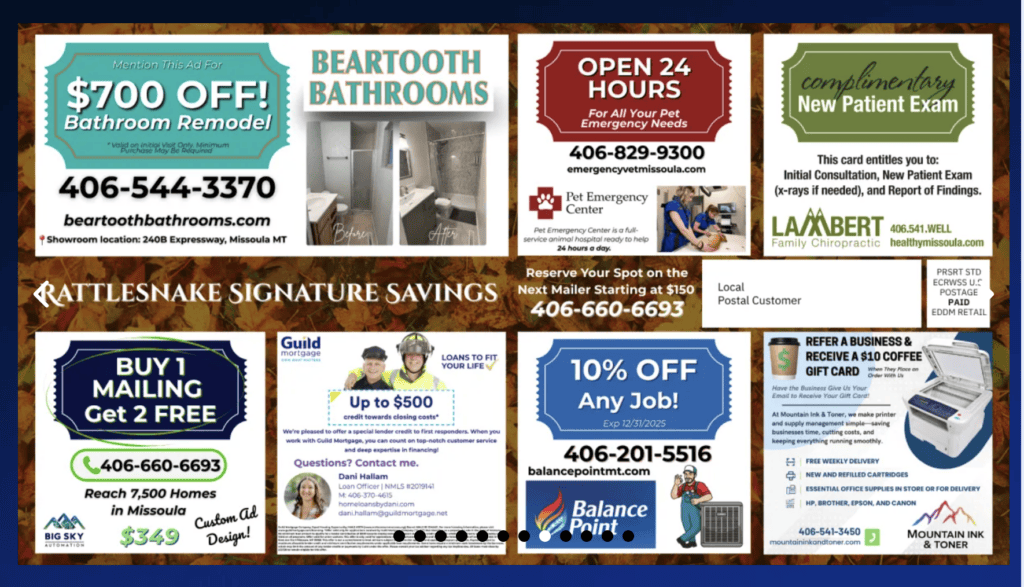
A community direct mail card is a large postcard that features multiple local businesses. Each business pays for an ad spot, the card is mailed to thousands of homes in a local neighborhood, and the person running the card keeps the difference after printing and postage costs.
Rachel and Dalton say one card can bring in around $1,100 to $3,500 in profit, depending on what you charge.
In this interview, you’ll learn:
- How a community direct mail card works
- How much money you can make
- How much it costs to get started
- How to find local businesses that want to advertise
- How to choose neighborhoods to mail to
- How USPS Every Door Direct Mail works
- Whether you need graphic design or printing experience
- How long it takes to put a card together
I also recommend checking out the Community Card Playbook if this side hustle sounds interesting to you. What I like about this business idea is that you don’t need a storefront, inventory, or a huge amount of money to get started. Rachel and Dalton created Community Card Playbook to walk you through the process they use themselves, including how to find advertisers, choose mailing routes, create your card, price your spots, and get everything printed and mailed. They also give you their scripts, templates, and printer recommendations, so you’re not figuring everything out on your own. You can learn more about Community Card Playbook here.
How To Make $1,000+ With a Direct Mail Side Hustle
This interview is for you if you want to learn how to make money with a direct mail side hustle.
1. Tell us your story! Who are you, and how did you get started with a direct mail side hustle? What do you like about running this business?
I’m Rachel, and my husband is Dalton. We met at work, and from almost the first conversation we had, we were talking about owning our own business and getting out of our jobs. That was always the dream. We had only been together about three months when we did our very first side hustle together: we bought a pallet of returned speakers and sold them one by one on Facebook Marketplace. We made about $600 on it and thought it was the coolest thing in the world. Looking back, that was such a small win, but it told us something about ourselves. Hustle was built into us.
Over the next few years we explored a lot of side hustles and business ideas. Some made a little money, some made none, but nothing really stuck. What did stick was the plan. We saved for five years knowing that at some point we were going to go all in. When we finally did, we quit our jobs about a month apart. We had roughly three years of living expenses in the bank, and we made a deal with each other: “If we can’t make something work in three years, we’re better off going back to a 9 to 5.” That deadline was real, and it kept us moving.
We started as a marketing agency doing digital services. Websites, Google Business Profile setups, all the things that so many other people are already trying to sell. We learned fast that local business owners are absolutely bombarded with “I can build your website” messages. They’ve heard it a hundred times, and most of them have been burned at least once. What they were not being bombarded with was a really affordable direct mail offer.
That’s where the light bulb went off. Business owners already know, like, and trust direct mail. They’ve seen it work. The problem is that most of them can’t afford to send their own mailer, because sending a few thousand postcards on your own costs real money. So we asked a simple question: what if we put multiple businesses on one big postcard, so each of them only pays a fraction of the cost? That became our community card, and it became our best selling service almost overnight. It moved to the front of our business and it’s still there today.
What I love most about this business is the freedom it has given us. We work from anywhere, we set our own hours, and we’ve built something that pays the bills without either of us having to answer to a boss. It also means we get to work together, which I know is not for everyone, but for us it’s been the best part. Every card we send is a little reminder that the deal we made with each other paid off.
2. What is a community direct mail card, and how does this business work? Can you explain it in simple terms for someone who has never heard of this before?
A community card is a huge postcard, typically 6.5 by 12 inches, that features multiple local businesses on it. Instead of one business paying to mail their own card, we put 16 businesses on one card and mail it to a few thousand homes in a specific neighborhood. Think of it like the coupon cards or coupon magazines you’ve probably gotten in your mailbox, except it’s one oversized card, it’s all local businesses, and there’s only one business per industry on it.
The way the business works is simple. You pick a neighborhood, you sell the ad spaces on the card to local businesses, you collect their money up front, and then you send the design to a printer who prints it and gets it into the mail through the post office. Each business pays a small fee to be on the card. You pay the printer for the printing and postage. Whatever is left over is your profit.
The reason it works is that you’re solving a real problem for both sides. The business owner gets in front of thousands of homes for a couple hundred dollars, which they could never do on their own. The homeowner gets a card full of local businesses and deals in one place instead of a pile of junk. And you get paid for putting it together. Nobody is losing in that deal.
3. How do you make money with a direct mail card? How many businesses typically advertise on one card, what do you charge them, and what does the profit look like?
Our card has 16 ad spaces, 8 on the front and 8 on the back. Each space goes to a different business, and we only allow one business per industry, so there’s one plumber, one landscaper, one salon, one realtor, and so on. That exclusivity matters a lot to business owners, and it’s one of the first things we mention when we reach out.
We charge anywhere from $150 to $300 per business per mailing. Where you land in that range depends on the area. The nicer the neighborhood you’re mailing to, the more you can charge, and larger metros generally warrant higher prices than small towns.
Here’s what the math looks like. If you charge $150 for all 16 spaces, that’s $2,400 collected. After printing, postage, and fulfillment for a mailing to about 2,500 homes, you’re looking at roughly $1,128 in profit. If you charge $300 for all 16 spaces, that’s $4,800 collected and about $3,528 in profit. Those numbers are based on the printer we use for printing and fulfillment, but other printers should come in around the same. So one card is somewhere between $1,100 and $3,500 in your pocket.
The part people don’t always realize is that the same businesses tend to come back. Once a business has been on a card and gotten a few calls from it, they want to be on the next one. So after your first card, you’re not starting from zero. You’re calling people who already said yes and asking if they want to stay on. That’s where this starts to feel less like a hustle and more like a business.
4. How much money have you personally made with this business? What can a beginner realistically expect to make from their first card or first few months?
We have brought in over $100,000 in revenue from the cards so far, and we’ve sent more than 40 mailings.
For a beginner, I think a realistic expectation is around $1,000 in profit on your first card. Your first one is the slowest because you’re building your list from scratch, figuring out your message, and getting your first few yeses. Once you have that first card out, things speed up. If you stay consistent, you can typically get a card out every 4 to 6 weeks.
For us, after our second month of doing these cards we started sending two cards per month in two different neighborhoods, and our profit was a little over $2,000 a month at that point. That’s when it went from “this is a fun side thing” to “this is actually paying our bills.” I always tell people not to judge the business on card number one. Judge it on card number three. By then you have advertisers who renew, a list of businesses who told you “maybe next time,” and a system you actually understand.
5. How much money does someone need to get started?
This is my favorite part. It really is a $0 to get started kind of side hustle.
The only thing you actually need is a way to design the ads. We use Canva, and the free version will get you surprisingly far. If you want the paid version for the extra templates, it’s a small monthly subscription. AI tools like ChatGPT and nano banana are also really good at designing ads now, so you have options.
Here’s why there’s no money at risk: you don’t buy any printing until you’ve sold all the spots. You reach out to businesses, they say yes, they pay you, and only after all the money is collected do you send the design to the printer and pay for printing and postage. You’re paying the printer out of money the advertisers already gave you, and you keep the difference. And if you’re really strapped for cash and don’t want to pay for a design subscription, wait until you’ve sold your first spot and then sign up. At that point your first advertiser has literally paid for your tools. That makes it a true $0 out of pocket business.
6. How do you find local businesses that are willing to advertise on the card? What types of businesses tend to be the easiest to work with?
We reach out to businesses mostly through Facebook Messenger and email. For Facebook, we search for local businesses in our area and message their business page directly. For email, we search Google for businesses by category, like “plumber Colorado Springs,” pull their email from their website or Google listing, and send them a note. Between those two, you can build a list of a hundred businesses in an afternoon.
The message we send is really simple. It goes something like: “Hey, we’re putting together a postcard featuring local businesses that goes to 2,500 homes in [neighborhood]. We only allow one business per industry. Would you be interested?” That’s it. We don’t send a pitch deck or a long explanation. Short and friendly gets way more replies than long and salesy.
You can also call businesses, or even stop by in person and have the conversation face to face. Whatever fits your personality best. Some people in our community love walking into a shop and shaking hands. I’d rather send a hundred messages. For us it’s email, Facebook DMs, and then a phone call to anyone who replies that they’re interested. The phone call is where it closes.
The easiest businesses to work with are the ones that already understand advertising and sell higher-ticket services. Think HVAC, plumbing, roofing, landscaping, painting, realtors, med spas, dentists, that kind of thing. When you tell a plumber it’s $150 or $300 to be on a postcard going to 2,500 homes and their average job is $1,500 or $5,000 or more, it’s a no brainer. One customer pays for the ad many times over. Businesses that sell a $10 product have a much harder time seeing the math, so I don’t spend a lot of energy chasing them.
One more tip: businesses that are already advertising somewhere, whether that’s Facebook ads, a billboard, or a wrapped truck, are usually the fastest yes. They’ve already decided that advertising is worth paying for. You’re just offering them a cheaper way to do it.
7. Why would a local business pay to be on one of these cards instead of buying Facebook ads, Google ads, or sending their own mailer?
Let’s start with sending their own mailer. To mail 2,500 postcards on their own, a business is looking at somewhere north of $2,000 or more once you add up design, printing, and postage. To be on our shared card, it’s a couple hundred. They reach the exact same mailboxes for a fraction of the price. That alone is usually enough.
Google ads and Facebook ads absolutely work, but they’re crowded, they’re expensive, and they’re getting more expensive every year. Every business in town is bidding on the same clicks. Meanwhile, there’s a huge lull in the direct mail world right now because everyone decided it was dead. That’s exactly why it’s working so well. The average household only receives about two pieces of mail a day now. When a big, colorful, oversized card shows up in the mailbox, people actually look at it. It sits on the counter. It goes on the fridge. Compare that to a Facebook ad that gets scrolled past in half a second and replaced by a hundred more within the hour.
When we’re talking about attention, direct mail is winning right now, and most business owners already know it in their gut. They’ve just been priced out of it. We’re not trying to convince them that direct mail works. We’re removing the reason they stopped doing it.
There’s also the community angle. Being on a card with 15 other local businesses feels different than a random ad. It feels like they’re part of something local, and the people receiving it treat it that way too.
8. How do you choose where the card gets mailed? How does USPS Every Door Direct Mail work, and do you need to understand postal rules before starting?
We choose well-known neighborhoods that business owners will immediately recognize. When we started these cards we were living in Missoula, Montana, and two of the well known neighborhoods there were Miller Creek and Rattlesnake. When a business owner heard those names, they knew exactly what that meant: the folks living there have disposable income, because those were the nicer neighborhoods in town. Half of your sales pitch is done for you just by naming the neighborhood.
I’m not talking about the richest neighborhoods, though. That’s a mistake I see people make. The wealthiest households don’t care about a discount, and they’re more likely to look at a postcard full of local businesses and think it’s junk mail. The sweet spot is middle to upper middle class, roughly the $70,000 to $120,000 household income range. Those people have disposable income, they own their homes, they hire plumbers and landscapers, and they still care about getting a good deal.
This is where Every Door Direct Mail, or EDDM, comes in. EDDM is a program from the post office that lets you mail to every single address on a mail carrier’s route without needing anyone’s name or address. You’re not buying a mailing list. You’re simply saying “deliver one of these to every house on these routes,” and the mail carrier drops one in every mailbox on their normal rounds. Because the post office doesn’t have to sort by name and address, the postage is the cheapest they offer, well under the cost of a regular stamp per piece.
The best part is the free mapping tool on the USPS website. You type in a ZIP code or an address, and it shows you a map of every carrier route in that area. You click on the routes you want, and it tells you how many homes are on each one along with the average household income, average age, and household size for that route. That’s how we know we’re hitting the $70,000 to $120,000 range. You can also choose to send to residential addresses only and skip businesses. We keep picking routes until we’re at around 2,500 homes, which is our standard card size.
Do you need to understand the postal rules before you start? Honestly, no, as long as you use the right printer. There are rules about the size of the card, the postage marking that gets printed on it instead of a stamp, how the cards have to be bundled, and the paperwork that goes to the post office. That sounds like a lot, but any printer that offers full EDDM fulfillment does all of that every single day. They’ll tell you the exact size to design to, they’ll tell you the specs for the correct postage marking on your design, they’ll bundle everything the way the post office requires, and they’ll deliver it to the right post office for you. All you need to know is which routes you want and what the card should look like. Let the printer handle the rest.
9. Do you need to know graphic design or printing to do this? How do you create the card, find a printer, and get everything ready to mail?
You do not need to be a designer. I’m not one. Canva is so easy to use these days that anyone can put together a clean ad in a few minutes. It has tons of templates, so for most ads you’re just swapping out the business name, logo, phone number, offer, and maybe a photo, and you have a ready to go ad. Some businesses will already have an ad or a flyer they’ve used before and will just send it to you, which makes it even easier.
AI has made this even simpler. We use ChatGPT for some of our ads now, and a simple prompt describing the business and the offer will give you a completed ad in a minute or two. So the workflow is: collect the business info, make each ad, place all 16 ads into the card template, and export the file.
For printing, the key phrase to search for is “full fulfillment EDDM” or “EDDM full service.” That means the printer doesn’t just print the cards and ship them to you. They print them, bundle them the way the post office requires, fill out the paperwork, and deliver them to your local post office. You send them your design file and the list of carrier routes you picked, and you’re done. You never even have to touch a postcard. Before you ever sell a spot, get a quote from a printer for your card size and your number of homes. That’s how you know your cost, which tells you what you need to charge.
10. How long does it take to put together one community card from start to finish? What does a typical week look like while you’re working on one?
When you’re first getting started, expect about 4 to 6 weeks from the day you send your first message to the day the cards hit mailboxes. Most of that time is selling the spots. Once you have some traction in your town, it gets a lot faster. We typically fill a card in one to two weeks now, because we have advertisers who renew and a list of businesses who already know who we are.
In the beginning, our rule was 5 Facebook messages and 10 emails every single day, no matter what. We were doing it all manually. We’d spend about an hour or two a day figuring out who to reach out to and then actually reaching out. Then throughout the day we’d reply to anyone who responded and get on a quick call with the ones who were interested. That was really the whole job. Consistency mattered way more than volume. Five messages a day for 30 days is 150 conversations started, and you only need 16 yeses.
Now we have it automated. We feed our system a list of businesses, and it sends out over 100 emails a day for us across the multiple areas we mail to. So my job is mostly replying to the people who say they’re interested and getting them on the card. It’s far less time than it used to be, and it’s the reason we can run multiple cards at once.
A typical week while a card is filling looks like this: Monday through Friday, outreach goes out in the morning. During the day I’m replying to interested businesses, sending payment links, and collecting their logo and offer. Once someone pays, their ad gets made in Canva that week. When the sixteenth spot is sold, I send the file and the routes to the printer. The printer takes it from there, and the cards typically land in mailboxes about two to three weeks after that. Then I’m already starting outreach for the next one.
11. Can someone do this in a small town, or does it work better in a larger city?
Small towns work just as well, just for different reasons. Small town businesses have smaller budgets, and with a community card they can reach a huge portion of the entire town in a single mailing for a couple hundred dollars. Small towns are also very community focused. People want to support local businesses, and the brand recognition these cards provide, with customers seeing the same business over and over again, works quickly. In a small town, you also become known fast. After a card or two, business owners will start reaching out to you.
Larger cities are great too, for a few reasons. First, it’s so competitive that the low cost really stands out. A business can spend a fraction of what they’d spend elsewhere to reach thousands of their potential customers, while their competitors are paying thousands to reach the same people on Google or Facebook. Second, there are simply more businesses in every category, so filling a card is faster, and if the plumber you wanted says no, there are 100 more plumbers to ask. Third, a big city has dozens of distinct neighborhoods, so you can run separate cards in different parts of town and even put the same advertiser on more than one of them. That’s how you go from one card a month to several. Fourth, household incomes tend to be higher in larger metros, so you can charge more per spot. And finally, business owners in bigger cities are already used to paying real money for advertising, so $300 for 2,500 homes sounds like a bargain rather than an expense.
So the honest answer is that it works in both. In a small town you’ll fill cards on relationships and reputation. In a city you’ll fill them on volume and price.
12. If someone wanted to start this side hustle this month, can you list the steps you would recommend taking?
Here’s exactly what I’d do if I were starting from scratch this month.
- Pick your neighborhood. Go to the USPS EDDM mapping tool, type in your ZIP code, and choose carrier routes that add up to around 2,500 homes with an average household income in the $70,000 to $120,000 range. Pick a neighborhood that local business owners will recognize by name.
- Get a printer quote. Search for a printer that offers full fulfillment EDDM and get a quote for a 6.5 by 12 inch postcard mailed to your 2,500 homes. Now you know your cost.
- Set your price. Divide your cost by 16 and add the profit you want per spot. In most areas that lands you between $150 and $300 per space. Write it down and don’t second guess it.
- Build your card template in Canva. Set up a 6.5 by 12 inch card with 8 ad spaces on the front and 8 on the back. Even a plain template with 16 boxes works for now.
- Build your list. Make a list of 100 local businesses across different industries, one industry per line. Higher ticket services first: HVAC, plumbing, roofing, landscaping, realtors, dentists, med spas, auto repair, and so on. Grab their Facebook page and email address.
- Start outreach and don’t stop. Send your simple message to 10 to 15 businesses a day. “We’re putting together a postcard featuring local businesses that goes to 2,500 homes in [neighborhood]. We only allow one business per industry. Would you be interested?” Reply to everyone who responds, and get the interested ones on a quick phone call.
- Collect payment up front. When a business says yes, send a payment link right away. A spot isn’t sold until it’s paid for. Then ask for their logo, phone number, and the offer they want on their ad.
- Make the ads. Drop each business’s info into a Canva template or use ChatGPT to generate the ad, then place it into your card layout. Send each business a quick proof of their ad to approve.
- Send it to print. Once all 16 spots are paid and the ads are approved, send your design file and your list of carrier routes to the printer. They handle printing, bundling, and delivery to the post office.
- Follow up and go again. Once the cards land, check in with each advertiser and ask if they want to be on the next one. Then start outreach for the next neighborhood. The second card is always faster than the first.
If you do nothing but those ten things for 30 days, you will have a card in the mail. It’s not complicated. It just requires you to actually send the messages.
13. Can you tell us more about Community Card Playbook and your membership? Who is it for, what does it teach, and how does it help someone launch their first card?
Community Card Playbook is the membership Dalton and I built to teach exactly what we’ve been talking about in this interview. It came out of people asking us how we were doing these cards, and us realizing that the best way to help was to just hand over the whole system.
It’s for a few different kinds of people. First, anyone looking to make some extra money on the side, whether that’s for a vacation, bills, a new car, savings, or just breathing room. Second, anyone who wants to dip their toe into the entrepreneur world. If you’ve ever thought about starting a business but didn’t know where to begin, this is a really low-risk way to find out if you like it. There’s no inventory, no storefront, and no money out of pocket, and you’ll learn to sell, which is the skill that every business runs on.
It also works really well for two other groups. If you’ve considered starting a marketing agency like we did, the cards are the best foot in the door I know of. You build relationships with dozens of local businesses, you get them a result, and that opens the door to selling them your other services. That’s exactly how our agency grew. And if you already own a local business, whether that’s landscaping, HVAC, plumbing, a salon, a restaurant, real estate, or anything else, you can run a card and put your own business on it. The other 15 advertisers pay for the mailing, and you advertise to 2,500 homes for free.
Inside the membership we have the entire process laid out end to end. That includes our printer recommendation, the exact scripts we use for outreach and follow up, our card templates, tons of video walkthroughs, and step by step trainings on everything from choosing routes in EDDM to setting up automated email outreach so you’re not sending every message by hand. We also do live weekly calls with Dalton and myself where we hop on, answer questions, share what’s working and what’s not, help people get unstuck, and go over real cards that members are putting together. Those calls are where a lot of the magic happens, because you’re hearing from other people who are a card or two ahead of you.
The goal of the membership is simple: get your first card in the mail. Once you’ve done one, you understand the whole business, and everything after that is repetition. We’ve watched people go from never having sold anything in their life to having a full card in a few weeks, and there is nothing more fun for us than seeing someone send us a photo of their first card sitting in a mailbox.
You can click here to learn more about the course, Community Card Playbook.
Do you think a community card like this would work where you live?
Recommended reading:
- 19 Best Side Hustles for Couples To Make Extra Money Together
- How I Made $6,161 in Just 4 Months With a New Etsy Printables Shop
- 31 Best Stay At Home Jobs (#1 Is My Full Time Job!)
- 22 Ways To Make Money Online Without Paying Anything
- How I Got Paid $39,177 Directly From Facebook in One Month Just To Post Content
The post How To Make $1,000+ With a Direct Mail Side Hustle appeared first on Making Sense Of Cents.