
Media Monitoring: A Practical Framework for Tracking Visibility and Reputation
A brand mention is not automatically good news. Your company might appear in a major publication, get mentioned alongside a competitor, or have an executive quoted by an industry journalist. But that same visibility could come from negative coverage, a customer complaint gaining attention, or a story that puts your reputation at risk.
Knowing that somebody mentioned your brand is useful. Understanding why they mentioned it, how the story is developing, and what it means for your business is much more valuable.
This is where media monitoring comes in.
Modern media monitoring goes beyond collecting newspaper clippings or setting up alerts for your company name. It helps businesses understand how they are represented across news websites, social media, podcasts, blogs, forums, broadcast media, reviews, and other sources.
However, collecting thousands of mentions does not automatically provide useful information. The real value comes from identifying meaningful patterns, understanding changes in the conversation, and knowing when those changes require action.
This guide explains how media monitoring works, what your company should track, which metrics matter, and how to build a practical framework that connects media visibility with reputation management and business decisions.
Key Takeaways
- Media monitoring helps businesses track and analyze coverage across news, social media, podcasts, broadcast, blogs, forums, and other relevant sources.
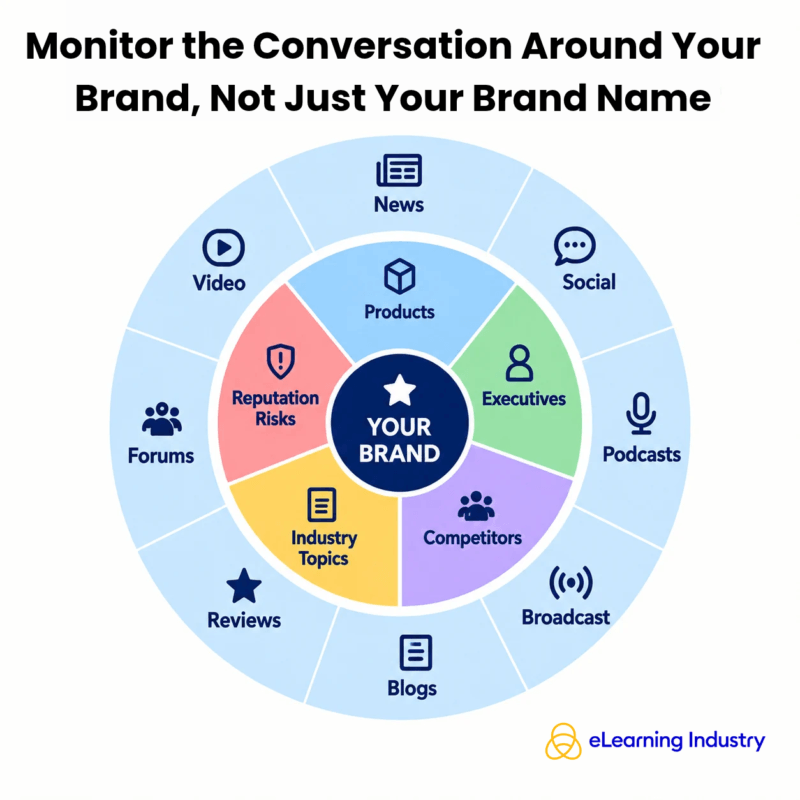
- Effective monitoring extends beyond company names to include products, executives, competitors, industry topics, and potential reputation risks.
- Mention volume alone does not measure successful media visibility. Source quality, sentiment, prominence, and Share of Voice provide important context.
- Media monitoring, social listening, and reputation monitoring overlap, but they answer different business questions.
- The most useful monitoring programs establish a baseline, identify meaningful changes, and connect findings to clear actions.
- AI can help analyze coverage and detect emerging patterns, but human judgment remains essential when interpreting reputation risks.
Want to achieve data-driven growth and brand visibility?
Talk to our team about being featured in our AI-optimized editorial content or directories.
In This Article, We Explore…
What Is Media Monitoring?
Media monitoring is the systematic process of tracking, collecting, and analyzing mentions of a brand, organization, executive, competitor, product, or topic across relevant media channels to understand visibility, reputation, trends, and emerging issues.
Traditionally, media monitoring was closely associated with public relations. Communications teams collected newspaper articles, tracked broadcast mentions, and prepared reports showing where their company appeared in the news.
Today, the process covers a much broader information environment. Businesses can monitor online news, industry publications, print media, television, radio, social platforms, podcasts, blogs, forums, customer reviews, and video content.
The information collected can help answer several questions. Which publications are mentioning our company? Are executives becoming more visible? Is negative coverage increasing? Which competitors are receiving more attention? And what topics are journalists connecting with our brand?
This broader approach introduces an important distinction between media monitoring and media intelligence.
Media monitoring tells you what appeared. Media intelligence helps explain what it means and what you should do about it.
For example, discovering that your company received 30 mentions last month is a monitoring result. Learning that most of those mentions came from irrelevant websites, while competitors were featured in publications your buyers trust, is the beginning of useful intelligence.
Why Media Monitoring Matters for B2B Brands
For B2B companies, media visibility can influence how potential customers understand a brand before they speak with a sales representative. Buyers may encounter research, expert commentary, industry articles, reviews, or podcast discussions while evaluating their options.
Media monitoring helps businesses understand where those conversations are happening and whether their message is reaching the right people.
Understanding Brand Visibility
Monitoring reveals how frequently your company appears, which publications mention it, and what topics those mentions cover.
A learning technology vendor, for example, may discover that it receives considerable attention for product announcements but rarely appears in discussions about AI adoption or employee development. That difference can reveal a gap between the company’s intended positioning and its actual media presence.
Protecting Brand Reputation
Negative stories, misinformation, executive controversies, and customer complaints can affect how people perceive a business.
By tracking changes in coverage, communications teams can identify potential problems and investigate them before they become more difficult to manage. The objective is not to respond to every critical comment, but to recognize which developments deserve attention.
Measuring PR Performance
Media monitoring also helps evaluate whether PR activities generate meaningful coverage.
A company might publish original research, announce a partnership, participate in an event, or offer expert commentary. Monitoring shows which activities attracted editorial attention and whether the resulting coverage communicated the intended message.
Identifying Competitive Opportunities
Competitor coverage can reveal which topics are attracting attention, which executives are being quoted, and where your brand has limited visibility.
Meanwhile, journalists covering those subjects may become relevant contacts for future research, interviews, or expert contributions.
Therefore, media monitoring becomes particularly valuable when it identifies these changes early enough for the business to do something useful with them.
Media Monitoring vs. Social Listening vs. Reputation Monitoring
Overall, media monitoring, social listening, and reputation monitoring are closely related, but they serve different purposes.
Media monitoring focuses on where and how a company, executive, competitor, or topic appears across the wider media environment. It typically includes news, broadcast, industry publications, podcasts, blogs, and relevant social sources. PR and communications teams use it to evaluate coverage, visibility, and media narratives.
Social listening focuses more closely on conversations happening across social platforms and online communities. It helps marketers understand audience concerns, emerging trends, customer opinions, and the language people use when discussing industry problems. Our guide to Social Listening for B2B Marketers explores that process in greater detail.
Reputation monitoring, meanwhile, examines what those conversations and external signals reveal about trust and public perception. It brings together reviews, sentiment, media coverage, and other information to identify potential reputation risks.
These activities often use overlapping technology and data. The main difference is the question each one answers.
Media monitoring asks where your brand appears and how it is covered. Social listening asks what people are discussing. Reputation monitoring asks what those signals mean for how your business is perceived.
For a broader approach to managing those perceptions, see our guide to Online Reputation Management Strategies.
What Should You Monitor?
Many companies begin by setting up alerts for their brand name. That is a useful starting point, but it provides only a limited view of the conversations affecting the business.
A practical media monitoring strategy should cover six areas.
Brand Mentions
Track your company name, common variations and misspellings, domain name, and relevant branded hashtags. Include terminology that helps distinguish your business from unrelated organizations with similar names.
Products and Services
Monitor product names, platforms, important features, and campaigns. For software companies, product-level monitoring can reveal customer concerns or media attention that does not mention the parent company.
Executives and Subject-Matter Experts
Include founders, CEOs, CMOs, public-facing executives, and specialists who represent your company in industry discussions.
This is particularly important for businesses investing in executive thought leadership. A leader may appear in a podcast or industry article without the company being mentioned prominently.
Competitors
Follow relevant competitors, products, executives, announcements, and media appearances.
The objective is not to monitor everything they do, but to understand where they are earning attention and how their market positioning compares with yours.
Industry Topics
Track the subjects you want your company to be associated with.
For a learning technology vendor, these might include learning management systems, AI in learning, skills intelligence, customer education, and learning analytics. These conversations can reveal emerging opportunities even when your company is not mentioned.
Reputation and Risk Terms
Combine relevant brand or product terms with words such as complaint, breach, outage, lawsuit, security, or cancellation.
Choose terms based on realistic risks. Broad searches without context can generate unnecessary alerts and make genuine issues harder to identify.
Together, these six categories create a monitoring universe that covers both your current visibility and the conversations you may need to join or respond to.
The Media Monitoring Framework: From Mentions to Intelligence
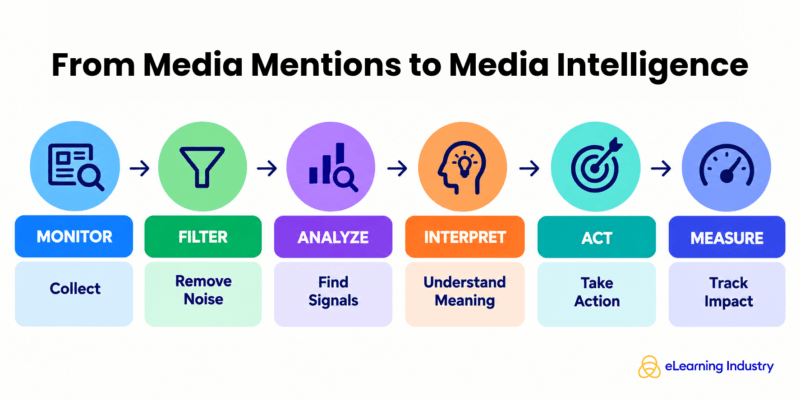
An effective media monitoring process needs more than data collection. Teams should understand how information moves from a monitoring platform into an actual business decision.
The following six-step framework provides a practical way to organize that process.
Monitor – Filter – Analyze – Interpret – Act – Measure
Step 1: Monitor Relevant Sources
Start by collecting mentions across the channels most relevant to your business. These may include industry news, mainstream publications, social platforms, podcasts, blogs, forums, reviews, and broadcast media.
The objective is not to track every available source. It is to capture the conversations that influence your customers, reputation, competitors, and industry position.
For example, a B2B SaaS company may place greater emphasis on specialist publications and professional communities than on general consumer media.
Step 2: Filter Out Irrelevant Information
Not every collected mention deserves attention.
Monitoring results frequently contain duplicate articles, syndicated press releases, unrelated keyword matches, spam, and low-value references. If these are treated as separate meaningful mentions, reporting can exaggerate the amount of genuine coverage.
Filtering helps teams distinguish original stories from repeated distribution and separate relevant conversations from noise.
This is especially important when tracking broad industry topics that generate considerable activity.
Step 3: Analyze the Coverage
Once irrelevant results have been removed, examine the remaining coverage.
Look at mention volume, publication relevance, potential reach, sentiment, topic, competitors, and the prominence of your company within each story.
A mention in the headline is different from a passing reference near the end of an article. Similarly, a detailed executive interview provides different value from a short company mention.
Analysis should capture those differences rather than treating every result equally.
Step 4: Interpret What the Data Means
This is where monitoring becomes intelligence.
Compare the findings with historical performance and ask what changed. Is the increase in mentions normal? Did a particular announcement create interest? Has negative sentiment increased? Is a new competitor shaping the discussion?
Also consider who is driving the conversation and whether the change affects an audience that matters to your business.
A sudden increase in coverage may be positive, negative, or simply unrelated to your priorities. Interpretation provides the context needed to make that distinction.
Step 5: Take the Appropriate Action
Once the team understands the signal, decide what should happen next.
Possible actions include contacting a journalist, amplifying relevant coverage, correcting inaccurate information, briefing executives, investigating customer concerns, or developing content around an emerging topic.
Not every finding requires a public response. Sometimes the correct action is continued observation. In other cases, an issue may need immediate escalation to PR, legal, customer success, or leadership.
Define responsibilities in advance so important signals do not remain unanswered.
Step 6: Measure the Impact
Finally, evaluate what happened after the action.
Did coverage improve? Was inaccurate information corrected? Did the company receive more relevant mentions? Did a new expert contribution reach the intended audience?
Review both the original signal and the outcome. Then use those findings to improve monitoring queries, alert thresholds, reporting, and future decisions.
The value of media monitoring comes from the entire process, not simply the number of mentions collected.
What Media Monitoring Metrics Should You Track?
Media monitoring reports often contain a large number of metrics. However, relying on one overall media score can hide important differences in coverage quality and business relevance.
Mention Volume and Share of Voice
Mention volume shows how frequently your brand appears within the monitored sources. It is useful for identifying changes over time, but an increase does not automatically mean your reputation or authority is improving.
Share of Voice adds a competitive perspective by comparing your visibility with that of other brands across a defined set of sources and topics.
For media monitoring, keep the comparison focused on media coverage rather than mixing it with unrelated search or advertising metrics.
Source Quality and Coverage Prominence
Consider whether coverage appears in publications your buyers actually trust. Also assess whether the brand is the main subject, an expert source, a headline mention, or a passing reference.
Potential reach can provide context, but it should not be treated as the number of people who actually saw the coverage.
Sentiment and Message Pull-Through
Sentiment helps classify coverage as positive, neutral, or negative. However, those categories need interpretation, particularly when an article contains mixed opinions.
Our guide to Brand Sentiment explores how these signals relate to wider brand perception.
Message pull-through examines whether the coverage accurately communicated the ideas your campaign intended to convey. For example, a research campaign about implementation challenges may generate mentions, but the real question is whether publications discussed those challenges or focused on something unrelated.
Executive Visibility and Topic Associations
Track which company experts are quoted and the subjects they discuss. Over time, this can reveal whether executives are becoming recognizable voices within their areas of expertise.
Narrative tracking adds another layer by showing which concepts appear alongside the company, such as enterprise learning, AI adoption, customer education, or innovation.
Finally, review editorial backlinks, referral traffic, and engagement where they can be measured. These indicate whether coverage encouraged people to explore your company or supporting resources.
How to Analyze Media Coverage Instead of Just Counting Mentions
Suppose your company receives 50 media mentions in one month, while a competitor receives only 12.
At first, your company appears to have considerably stronger media visibility. But after reviewing the results, you discover that 45 of your mentions are syndicated copies of one press release. The competitor’s 12 mentions, meanwhile, come from specialist publications regularly read by your target customers.
The original numbers tell only part of the story.
A more useful assessment examines the quantity, quality, context, prominence, sentiment, competitive position, and business relevance of the coverage.
For each meaningful placement, consider what was said, whether the publication is relevant, how central your brand was to the story, and whether the coverage supports your positioning.
It is also worth distinguishing independent editorial coverage from paid placements and automated syndication. They may all increase visibility, but they do not represent the same level of editorial interest.
Rather than reporting only how many mentions the business received, explain which stories mattered, why they mattered, and what changed as a result.
Media coverage should be evaluated by influence and relevance, not simply volume.
How Media Monitoring Supports Reputation Management
Reputation problems often develop gradually. A customer complains about a product, others report similar experiences, and the conversation gains attention in a professional community. Eventually, a journalist notices the discussion and begins asking questions.
Media monitoring can help organizations recognize that progression.
By tracking sentiment changes, emerging criticisms, misinformation, executive mentions, and negative coverage, communications teams gain a broader understanding of potential reputation risks.
However, identifying a negative story is only useful when the information reaches someone who can assess it and respond appropriately.
For example, repeated complaints about a learning platform’s reliability may require investigation by customer success and product teams before PR can communicate an accurate explanation.
This is why media monitoring should connect with wider reputation and crisis processes. Our guide to Online Reputation Monitoring explores ongoing reputation tracking, while Crisis Management Tools examines the technology used when issues require a coordinated response.
Media Monitoring for Competitive Intelligence
Competitor monitoring helps B2B businesses understand who is shaping conversations across their industry.
For example, a SaaS company may notice that one competitor is frequently quoted in articles about AI implementation, while another receives regular podcast invitations to discuss customer experience.
Those patterns can reveal how competitors are positioning themselves and which subjects are attracting editorial attention.
Look at the publications covering competitors, the research being referenced, the executives appearing in interviews, and the messages journalists repeat. Compare those findings with your own visibility.
It is also useful to distinguish between media presence and actual market performance. A company receiving frequent coverage is not necessarily winning more customers or delivering a stronger product.
The objective is not to copy a competitor’s messaging. Instead, identify where the conversation is already crowded, which questions remain unanswered, and where your company can contribute a different perspective.
This analysis can inform future research, thought leadership, content planning, and SEO Share of Voice discussions, while keeping media and search visibility measurements separate.
Media Monitoring and AI Search: The GEO Connection
As companies invest more in generative engine optimization, or GEO, media monitoring has another useful role: helping businesses understand the external information available about their brand.
Traditional monitoring asks where the company appears in media coverage. An AI-era approach adds a related question: What information about our company exists across the sources that buyers and AI systems may encounter?
This includes industry articles, expert citations, research references, reviews, directory profiles, customer experiences, and other third-party discussions.
For example, a learning technology vendor may describe itself as a specialist in AI-powered employee development. Media monitoring can help determine whether credible external sources also connect that company with the same category and expertise.
If those associations rarely appear outside the company’s website, that may indicate an opportunity to contribute better research, expert commentary, or practical industry resources.
Consistency matters too. Conflicting product descriptions, outdated information, and inaccurate claims can create confusion for people researching the business. Monitoring helps identify where corrections or clearer explanations may be needed.
However, third-party media mentions do not automatically influence ChatGPT, Google AI Overviews, or other AI-generated responses. Different systems retrieve and use information differently, and even credible content is not guaranteed to appear.
Media monitoring can reveal the information footprint surrounding your brand, but it cannot establish that a particular mention caused an AI recommendation.
The practical GEO connection is about understanding whether the wider web contains relevant, credible, and consistent information about who your company is, what it does, and the subjects it has genuine expertise in.
How AI Is Changing Media Monitoring
AI is also changing the technology used to monitor media coverage.
Modern platforms can use automated analysis to classify mentions, remove duplicates, identify conversation spikes, summarize articles, detect sentiment changes, and group coverage around common themes.
For teams handling large volumes of information, these capabilities can reduce the time spent reviewing irrelevant material and help important patterns become visible.
For example, automated clustering may reveal that apparently unrelated articles are discussing the same customer concern. Anomaly detection may also identify a sudden increase in negative mentions before it becomes obvious in a weekly report.
However, automated interpretation has limitations.
Sentiment analysis may struggle with sarcasm, technical language, or nuanced criticism. Summaries can omit important context, especially when a story contains qualifications or conflicting accounts.
AI also cannot reliably determine the business importance of every mention. A single question from a major industry journalist may deserve more attention than hundreds of unrelated social posts.
For high-risk coverage, teams should review original sources and confirm important findings before making decisions.
Use AI to reduce monitoring noise, not to outsource reputation judgment.
How to Choose Media Monitoring Tools
The right media monitoring software depends on what your organization needs to understand and how the information will be used.
Start with source coverage. A company concerned with industry news and journalist activity needs different capabilities from one monitoring social discussions, customer reviews, or international broadcast coverage.
Next, assess how quickly the platform detects new mentions and whether it can identify unusual changes. Historical data is also valuable because it helps teams establish baselines and compare performance across time.
Other useful capabilities include:
- Advanced keyword and Boolean searches, competitor tracking, and Share of Voice analysis.
- Sentiment analysis, AI summaries, topic classification, and customizable alerts.
- Reporting dashboards, data exports, team collaboration, and integrations with existing communication tools.
Platforms such as Meltwater, CisionOne, Brandwatch, Talkwalker, Sprinklr, Brand24, and Mention address different parts of the media monitoring market.
Rather than selecting software based on its feature list alone, test whether it captures the sources that matter to your organization and produces information your team can act on.
Also consider who will own the process. A platform that requires constant manual work may not suit a small communications team, while a large enterprise may need more detailed workflows and reporting.
Common Media Monitoring Mistakes
One of the most common mistakes is monitoring only the company name. This misses industry conversations, competitor activity, executive mentions, and emerging issues that may affect the brand indirectly.
Another problem is collecting too much information without deciding what matters. Teams can become overwhelmed by alerts, duplicate articles, irrelevant references, and dashboards that nobody has time to review.
Other mistakes include:
- Treating syndicated press releases as separate independent coverage.
- Measuring mention volume without reviewing source quality or context.
- Relying entirely on automated sentiment without human verification.
- Ignoring podcasts, video, specialist publications, and sources buyers actually trust.
- Failing to establish baselines, escalation thresholds, or clear responsibilities.
Some companies also keep media monitoring separate from customer experience, PR, leadership, and marketing decisions. That limits its usefulness because teams may recognize an important signal without knowing who should respond.
Review your monitoring process regularly. Remove unnecessary alerts, update search queries, examine missed stories, and make sure every important finding has a clear owner.
If nobody knows what action should follow a signal, you are collecting data rather than building useful intelligence.
Conclusion
Media monitoring has moved well beyond collecting press clippings and counting brand mentions. For modern B2B companies, it provides a way to understand how their brand, executives, products, competitors, and industry are represented across an increasingly fragmented media environment.
However, monitoring more sources does not automatically produce better decisions. Businesses need to identify which conversations matter, separate meaningful signals from noise, and connect findings with practical action.
The six-step framework provides a way to make that happen:
Monitor → Filter → Analyze → Interpret → Act → Measure
When these activities work together, media monitoring becomes more than a reporting exercise. It helps organizations understand their visibility, protect their reputation, recognize competitive opportunities, and make informed communication decisions.
Build Your Brand’s Industry Visibility
Media monitoring shows you where your brand appears in industry conversations. The next challenge is earning more of the right visibility.
eLearning Industry helps Learning Tech, HR Tech, EdTech, AI, and workplace-learning companies strengthen their industry presence through thought leadership, original research, podcasts, webinars, customer stories, directory visibility, reviews, Top Lists, and targeted content campaigns.
Explore eLearning Industry’s marketing and advertising solutions to find opportunities that match your audience and business goals.
FAQs
Media monitoring is the process of tracking and analyzing mentions of a brand, company, executive, competitor, product, or industry topic across different media channels. These can include online news, social media, blogs, podcasts, broadcast media, forums, and industry publications. The goal is to understand where a brand appears, how it is being discussed, and what those conversations reveal about its visibility, reputation, and position in the market.
Media monitoring works by collecting mentions and coverage from relevant sources, filtering out irrelevant information, and analyzing the results to identify meaningful patterns. Businesses typically track metrics such as mention volume, sentiment, source quality, and Share of Voice. They then compare the findings with previous performance to identify changes, potential risks, or opportunities. An effective process follows six steps: monitor, filter, analyze, interpret, act, and measure. This helps teams turn media coverage into information they can use to make decisions.
Brands should monitor more than their company name. A comprehensive media monitoring strategy should include product and service names, executives, competitors, industry topics, and potential reputation risks. Businesses should also track relevant news coverage, customer complaints, expert mentions, and conversations taking place across the channels their audiences use. Monitoring these areas helps companies understand how they are represented, identify emerging industry discussions, and recognize issues that may require attention.
Media monitoring focuses on tracking brand mentions and coverage across a broad range of sources, including news websites, broadcast media, podcasts, blogs, industry publications, and social platforms. Social listening focuses more specifically on conversations happening across social media and online communities. While media monitoring helps businesses understand their visibility and how they are covered, social listening provides deeper insights into audience opinions, concerns, and emerging conversations. The two approaches often overlap and work best when used together.
Media monitoring helps businesses understand how their brand is being portrayed and identify potential reputation problems before they become more serious. By tracking negative coverage, sentiment changes, misinformation, customer complaints, and emerging media narratives, companies can recognize when a situation needs attention. It also helps communications teams evaluate whether their responses are effective and whether public perception is changing. This makes media monitoring an important part of a broader reputation management strategy.
Important media monitoring metrics include mention volume, Share of Voice, sentiment, source quality, coverage prominence, and message pull-through. Businesses should also track executive mentions, editorial backlinks, referral traffic, and the topics increasingly associated with their brand. However, these metrics should not be evaluated in isolation. A mention in a trusted industry publication may be more valuable than dozens of mentions on irrelevant websites. The focus should be on the quality, context, and business relevance of the coverage rather than its volume alone.