

How To Train New Hires As Fast As You Hire Them
Recently, we met the L&D leader of a home care provider going through a period of rapid growth. The goal was to roll out eLearning faster, and the leader was looking at options beyond expanding the in-house team.
The organization was hiring caregivers every week, and a new caregiver could be visiting clients within days of joining. Each one needed training in safe lifting, infection control, and working with families before that first visit. The L&D team was building courses as fast as it could, but hiring kept moving faster.
Many growing organizations reach this point. The usual response is to push the team harder or add one more person. It often helps more to change how courses get built, so the process itself is faster and the team is not relying on extra hours. For this L&D team, that started with looking at what was slowing each course down.
What Makes Speed So Hard In Frontline Training?
Three things slowed the team down, a pattern common in most growing organizations.
The first was breadth. Caregivers needed training on safe lifting, infection control, dementia care, professionalism, and managing family dynamics. Corporate staff needed leadership, burnout prevention, and IT security. Each topic calls for a different design approach.
The second was scattered development. Some field staff were building their own courses, which helps in the short term but makes quality and consistency hard to control.
The third was delivery. The organization ran two separate LMSs, one for corporate staff and one for caregivers. Learners mostly used laptops and sometimes phones. Every course had to publish cleanly to both platforms and work on a smaller screen, which adds testing time to each release.
When every course is built from scratch, each of these adds weeks. Cutting that time meant changing how each course gets built.
What Does Rapid Development Change?
Rapid eLearning speeds up development by removing repeated work. In practice, that means:
- Templates and design standards: Every course starts from an approved structure, look, and interaction set. Designers spend their time on content, and courses built by different hands still feel consistent.
- Authoring tools built for speed: More of our clients are moving from Storyline to Rise for much of their content. Rise is faster to develop, easier to update, and works well on phones. Storyline is still the better choice for complex interactions.
- AI video: AI video tools turn a script into a presenter-led video without a shoot. For procedures and policy updates, that saves days per course and makes revisions simple.
- Short modules: One skill per module. A caregiver can finish one between visits, and the L&D team can update one without reworking a full course.
These methods save the most time when they are matched to the right courses, which makes sorting the catalog the next step.
Which Courses Should Be Built Rapidly?
Not every course needs the same treatment. Most catalogs fall into three groups.
Procedures and compliance, such as lifting, infection control, and IT security, suit rapid formats. Clarity and accuracy matter most, and these topics change often. Rise with short AI-generated videos works well.
Behavioral skills, such as dementia care, family dynamics, and professionalism, need scenarios where learners make decisions and see the results. In a dementia care module, for example, a learner might decide how to respond when a client becomes confused or agitated, then see how the client and family react. Extra design time pays off here.
Corporate training, such as leadership and burnout prevention, usually sits in between. A rapid format with a few reflective scenarios is often enough.
Can Rapid Courses Still Engage Learners?
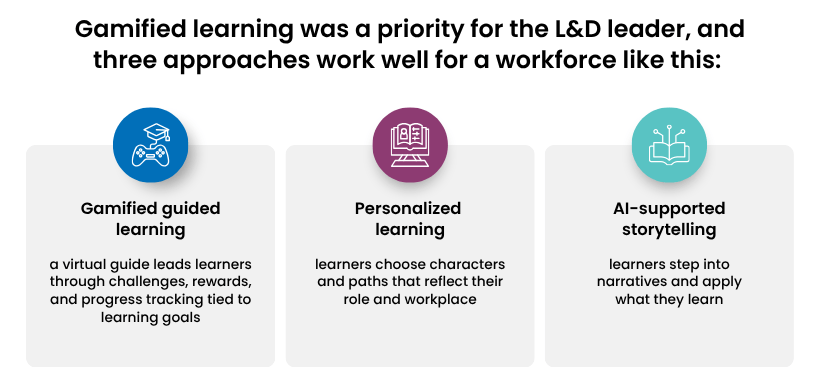
These fit caregivers well. A caregiver who chooses how to respond to a frustrated family member, and sees what follows, practices a judgment call that a checklist cannot cover.
When gamified elements such as points, levels, and progress markers are built into the templates, every new course inherits them, so engagement does not slow production. Learners who study between shifts are also more likely to finish short modules with clear progress.
With the approach clear, the next question was how it would work in practice.
How Does A Rapid Project Run?
The leader asked what a project would look like from day one.
Every project starts with a kickoff where stakeholders from both sides clarify questions, timelines, and priorities. A project plan and a detailed outline follow, the presentation strategy is agreed, and the course moves through alpha, beta, and gold reviews. Alpha is the first full build for content review, beta reflects those changes for a final check, and gold is the version that goes live.
Most of the speed comes from deciding early. When reviewers sign off on the outline and strategy, changes happen while they are still cheap to make, and the timeline holds.
A dedicated team can be in place within one week, which helps when new hires are arriving every month. That leaves one decision for the L&D team: which courses come first.
Where Should A Growing L&D Team Start?
The best place to begin is the courses every new caregiver needs in the first two weeks, before the first client visit. That is usually a short list of five to eight courses, and it covers what a caregiver relies on in those first visits.
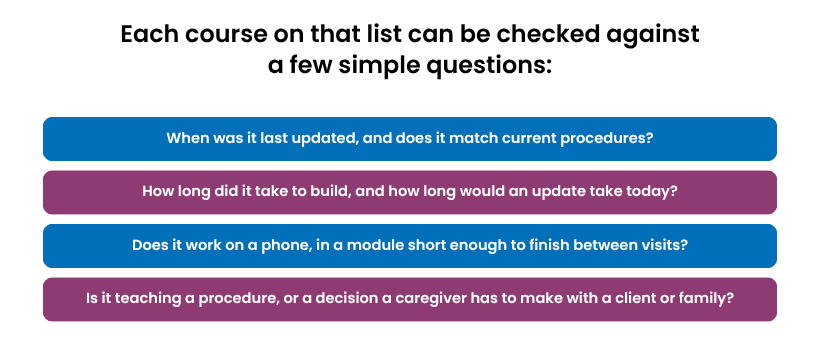
The answers usually sort the list quickly, into the same groups as the wider catalog. Courses that are out of date or slow to update are the first candidates for rapid development in Rise. Courses that teach judgment, such as dementia care or difficult family conversations, need scenario design and are worth the extra time. Courses built by field staff deserve a close look too. Field staff often know the work best, so these courses are a useful starting point even when they need rebuilding. They can be reviewed, merged, and rebuilt on common templates so the organization has one approved version of each.
From there, the same approach extends to the rest of the catalog, including corporate courses on leadership and IT security. The aim is for a new course or an update to take days instead of weeks, so training keeps up as the organization grows.
With development moving faster, an L&D leader can decide what to keep in-house and what to hand to a partner. Some teams keep strategy and SME coordination internal and outsource development. Others bring in a dedicated learning architect for six months to a year, and some combine the two.
CommLab India works with growing L&D teams in all three ways, and the right mix usually becomes clear once the first set of courses is underway.