
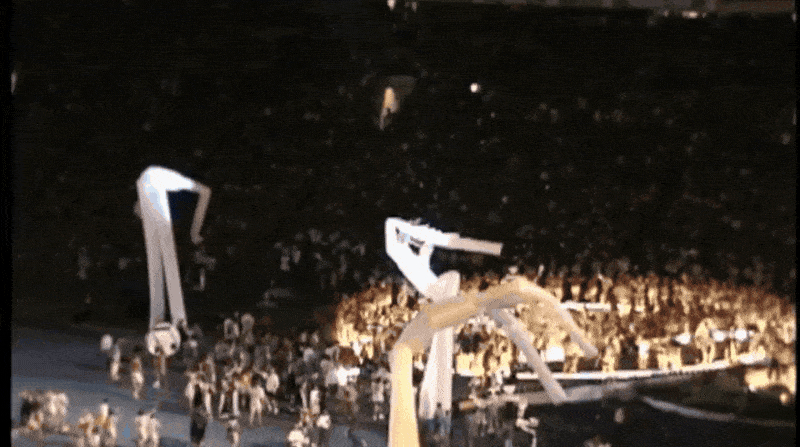
Animacy isn’t something you design. It’s something you trigger.

In 1973, a Swedish psychologist named Gunnar Johansson ran an experiment that should have changed how we think about design. He placed twelve reflective dots on a person’s joints — ankles, knees, hips, elbows, wrists, shoulders — and filmed them walking in a dark room. The body was invisible. The face was invisible. What the camera captured was only the movement paths of those dozen points of light.
Viewers watching the footage instantly perceived a walking human being. Later experiments using the same method found people could even determine the walker’s gender, and in further variations their emotional state. Twelve dots, no body, no face. The animacy was already there.
The animacy detector in the human brain doesn’t work the way design has been assuming it does. It doesn’t start with the face. It starts — and often ends — with how something moves.

I’ve been thinking about this since two weeks ago at Automate 2026, one of the largest industrial automation shows in the world. The floor is full of robots: humanoid assistants with expressive LED faces, companion robots designed to feel approachable, arms with carefully engineered proportions meant to suggest a body rather than a machine. The face budget in that…