
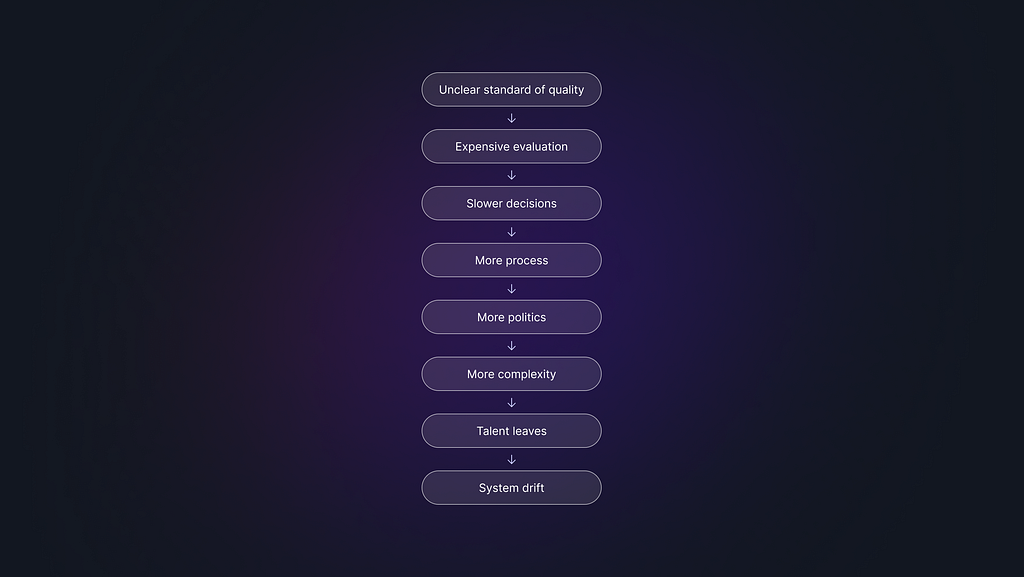
When taste is weak, organizations don’t fail in strategy. They fail in decisions.
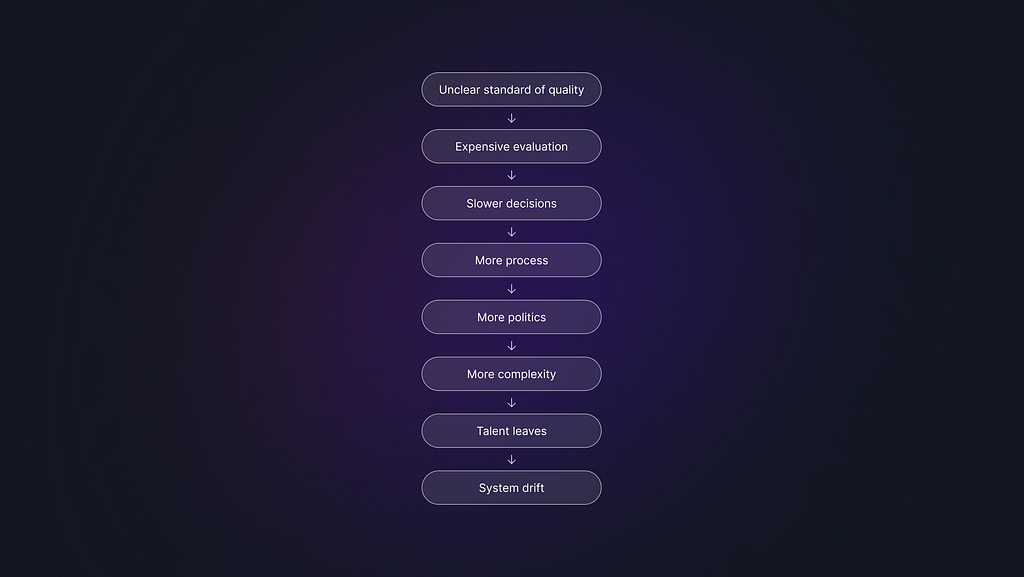
From scaling problem to judgment problem
In a previous article, I argued that AI has made everyone a creator, but not a designer. Creation is becoming abundant while judgment remains scarce. Images, interfaces, code, content, and even entire products can now be generated at near zero cost. What has not scaled is the ability to recognize what is actually worth keeping.
At the time, I was mostly thinking about individuals.
Since then, I’ve started noticing what happens when the same dynamic plays out inside organizations. For a long time, organizational dysfunction looked like a scaling problem. As companies grow, communication gets harder, stakeholders multiply, dependencies stack up, and decisions slow down. Complexity rises, and friction follows.
That explanation works until you see it fail in places where scale does not explain it.
Startups with fifty people show the same decision paralysis as organizations fifty times their size. Small product teams become buried under layers of alignment. Roadmaps expand quarter after quarter while the product itself becomes harder to describe.
The contexts differ, but the pattern does not. Decisions slow down. Meetings multiply. Complexity accumulates. The people most sensitive to quality become the most frustrated by the system meant to produce it.
Eventually, they leave.
The missing variable
At first, I treated these as separate failures. That is also how organizations usually describe them internally.
Velocity. Alignment. Process. Retention.
Over time, a different explanation became harder to ignore. These are not separate inefficiencies. They are different symptoms of the same underlying issue. The organization no longer has a stable way to recognize quality. Not in an aesthetic sense, but in an operational one. What deserves to exist, and what does not.
This distinction matters.
Taste is the standard. Judgment is the act of applying it.
Organizations struggle when the standard becomes unclear and the act of judgment becomes expensive.
What strong taste does
Taste is often mistaken for preference. In practice, it behaves more like an operating system for decision making. Designers have understood this for decades, even when they did not frame it in organizational terms. The work of Dieter Rams at Braun is usually remembered for restraint and minimalism. That framing misses the point. The real achievement was not visual consistency, but shared judgment across the organization.
Designers, engineers, and leadership did not negotiate quality on a case by case basis. They already agreed on what good looked like. That agreement changed where effort went. Teams were not spending energy defending decisions in meetings. They were spending it avoiding weak decisions before they ever surfaced. Most options never reached discussion, not because they were debated away, but because they were silently filtered out by a shared standard.
Rams’ principles worked less as guidelines than as compression. They reduced the number of viable directions before evaluation began. Good design was not the product of considering everything carefully. It was the product of eliminating most things early enough that careful consideration became rare.
That is what strong taste does. It collapses the space of acceptable choices so judgment is only exercised where it matters.
Herbert A. Simon captured this formally with the idea of bounded rationality. Decision quality does not improve by expanding evaluation capacity. It improves by reducing the number of options that ever need to be evaluated in the first place.
It starts with decisions
Most organizational decline does not begin with failure. It begins in meetings where nothing feels obviously wrong. A decision enters the room that should be straightforward. The proposal is sound. The direction is reasonable. Under normal conditions, it would move quickly.
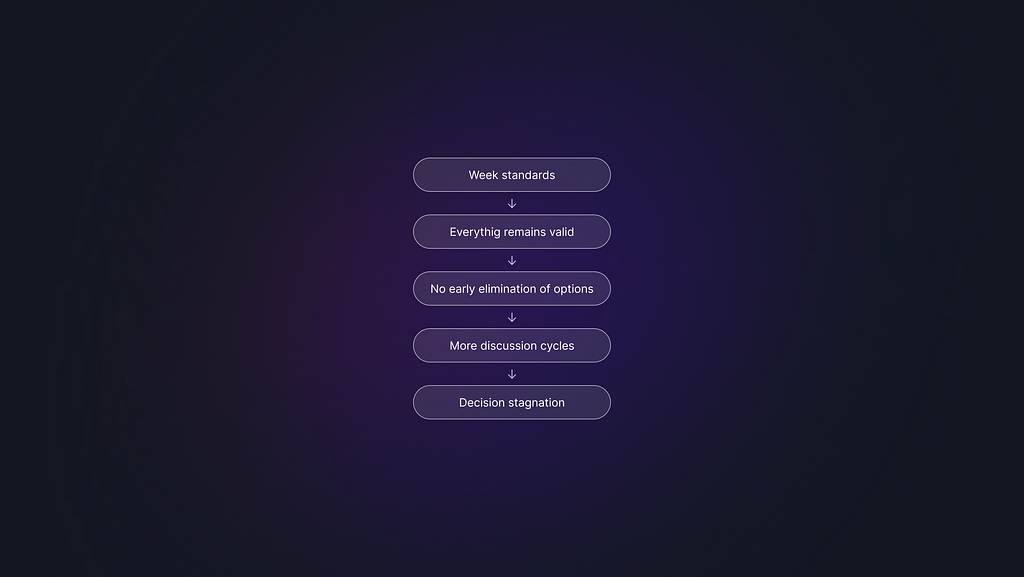
Instead, the conversation expands. An edge case appears. Then another. A stakeholder raises a concern. A dependency surfaces. Another team needs to be consulted. Each concern is reasonable in isolation, and that is what makes the discussion so persistent. The problem is not that concerns exist. It is that they never converge into a decision. The meeting shifts from choosing a direction to validating whether any direction is safe enough to proceed.
Eventually, it ends without resolution.
The usual explanation is complexity. Sometimes that is true. More often, complexity is where uncertainty hides. When a strong standard exists, options collapse early. Teams may disagree on tradeoffs, but they agree on what “good” looks like. The discussion narrows and decisions converge.
When that standard is weak, the opposite happens. More options remain open longer, more stakeholders become involved, and more escalation is required.
The bottleneck stops being execution. It becomes selection.
Once judgment becomes expensive, organizations compensate by introducing process.
Politics enters the system
When quality becomes difficult to recognize, agreement becomes the next best signal.
The question quietly shifts from what is good to what can be supported. From there, influence matters more than clarity. Stakeholder management expands. Pre alignment conversations multiply. Consensus becomes a prerequisite for action. This is why politics is rarely the root cause of dysfunction. It is an adaptation. It emerges when shared judgment is no longer strong enough to resolve disagreement directly.
Complexity accumulates
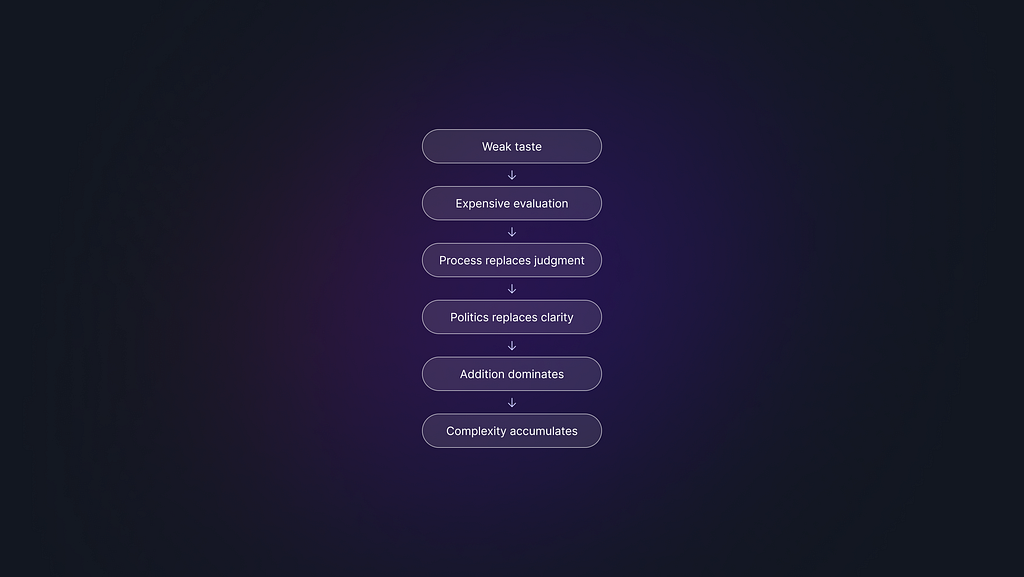
Most products do not become complicated because someone decides they should. They become complicated because removal is harder than addition. Every feature has a rationale. Every exception solves a real problem. Every request is defensible in isolation.
That is what makes complexity so persistent. Very little enters a system because it is obviously bad. It enters because it is justifiable. But products are not experienced as isolated decisions. They are experienced as a whole.
Christopher Alexander captured this clearly in his work on architecture and cities. The challenge is not whether individual elements are justified, but whether they preserve coherence at the system level. A building or a city can become less intelligible even as each change appears reasonable on its own.
Organizations face the same constraint. Without a strong shared standard, there is no reliable way to distinguish improvement from expansion. The question slowly shifts from “Should this exist?” to “Can we justify it?” Once that happens, addition always wins.
The same dynamic appears in tooling and internal systems. Each new layer improves something locally while increasing cognitive load globally. Interfaces multiply, dependencies accumulate, and coherence degrades.
By the time complexity becomes visible, no single decision appears responsible for it. It is the result of accumulation, not intent. Complexity is rarely ambition. It is weak filtering over time.
The best people eventually leave
People who care deeply about quality are rarely motivated by stability. They are motivated by standards. Defending those standards occasionally is manageable. Defending them continuously is not. Over time, a selection effect emerges. Those most sensitive to quality leave first. Those most tolerant of its absence remain. The organization does not collapse. It adapts. Not through design, but through attrition.
Why this matters more in the age of AI
For most of modern product history, production was the constraint. Building software or products required time, effort, and coordination. That friction acted as a natural filter. Many ideas never became real.
AI removes much of that constraint.
John Maeda, in The Laws of Simplicity, describes simplicity as the removal of the unnecessary so that what matters can surface more clearly. The important part is not aesthetic minimalism, but the mechanism: reducing what must be evaluated.
When filtering is strong, most possibilities never reach discussion. The system feels decisive not because it evaluates faster, but because it rejects earlier.
When filtering is weak, everything stays alive longer than it should. More options remain valid at the same time, and every decision expands into debate. AI increases the supply of options. Without strong standards, that abundance does not create clarity. It creates overload.
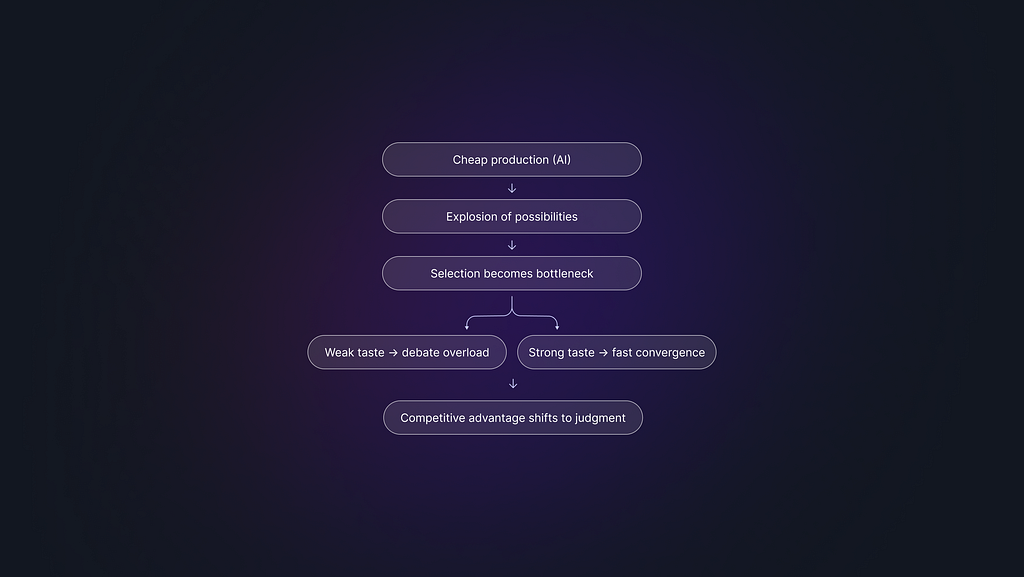
The new organizational bottleneck
The constraint inside organizations is no longer the ability to produce work. It is the ability to decide what work should exist in the first place. When taste is strong, most decisions never become decisions. They are filtered out before they require effort. When taste is weak, everything survives long enough to demand justification, and the organization slowly confuses activity with progress.
AI accelerates both sides of this dynamic. It multiplies what can be created, but it does not improve what can be selected. That gap becomes the defining organizational constraint. Execution is no longer rare. Judgment is.
And judgment is what organizations quietly rise or fall on.
References:
- Rams, Dieter. “Ten Principles for Good Design.” Braun / Vitsœ design philosophy.
- Simon, Herbert A. “Designing Organizations for an Information-Rich World.” In Computers, Communications, and the Public Interest, edited by Martin Greenberger. Baltimore: Johns Hopkins Press, 1971.
- Alexander, Christopher. The Timeless Way of Building. Oxford University Press, 1979.
- Maeda, John. The Laws of Simplicity. MIT Press, 2006.
The organizational cost of low taste was originally published in UX Collective on Medium, where people are continuing the conversation by highlighting and responding to this story.