
Profound and Semrush have both staked out positions in the answer engine optimization space, but they’re built for different teams with different goals. This post breaks down what each tool actually does, where they differ on engine coverage, prompt research, dashboards, and pricing, and how to decide which one fits your workflow.

We’ll also cover HubSpot AEO, a third option worth considering if you want AI visibility connected to your CRM and marketing stack from day one.
Table of Contents
What is AEO and how is it different from SEO?
SEO focuses on visibility in traditional search results. AEO focuses on visibility in AI-generated answers. That’s the clean version. The messier reality is that the two share plenty of tactics but differ in measurement, tooling, and what “winning” actually means.
When someone Googles a question, they get a list of blue links. When they ask ChatGPT, Gemini, or Perplexity the same question, they get a synthesized, semantic search result that may or may not include your brand. Answer engine optimization is the practice of making sure your brand shows up in those answers, accurately and favorably.
This matters now because buyer behavior is shifting faster than most teams realize. Rather than clicking through ten results, people increasingly ask AI for recommendations and act on the first response they get. If you’re not in that answer, you’re not in the consideration set.
Quick checklist: Do you need to care about AEO now?
You probably do if:
- Your buyers research solutions by asking AI tools before visiting vendor sites
- You’re in a category where competitors are already showing up in AI answers
- You track branded search and want to understand AI mentions alongside it
- Your content team is creating thought-leadership and wants to know if it’s landing in AI channels
You can likely hold off if:
- Your sales cycle is almost entirely outbound or referral-based
- You’re in a heavily regulated category where AI rarely surfaces specific vendors
- You don’t have anyone to act on the insights (data without action isn’t worth much)
Not sure where you stand? The AEO Grader gives you a free baseline on your current AI visibility before you invest in any platform.
Profound vs. Semrush AEO At a Glance
Here’s the honest summary: Profound and Semrush are solving different problems. Profound is a purpose-built AEO tool. Semrush is a full-stack digital marketing platform that added AI visibility features to an already large product suite. That distinction shapes everything from the depth of data to the workflow it fits into.
|
Profound |
Semrush |
HubSpot AEO |
|
|---|---|---|---|
|
Core focus |
Pure-play AEO |
SEO + AI visibility combined |
AEO integrated with CRM and marketing ops |
|
Data capture |
Browser-based (mimics real user experience) |
Historical database (239M tracked LLM prompts) |
Live answer engine queries with CRM context |
|
AI engines tracked |
Up to 10 (Starter: ChatGPT only) |
ChatGPT, Gemini, Perplexity, Google AI Overviews |
ChatGPT, Gemini, Perplexity |
|
Custom prompt volume |
50–100+ prompts |
50–200 prompts |
CRM-suggested; 25 on free trial |
|
AI bot analytics |
Server log tracking (no JS required) |
Traditional site crawler |
Not included |
|
Content tools |
No-code Agents workflow builder |
Content Toolkit + social/email repurposing |
Connects directly to Content Hub and Marketing Hub |
|
AEO entry price |
$99/mo |
$199/mo |
$50/mo |
|
Best for |
Teams focused entirely on AI visibility |
Teams managing SEO, local, social, and AI together |
Teams wanting AEO connected to CRM and pipeline |
Want to see AEO in action before committing to a platform?
Get a demo of HubSpot AEO — See how HubSpot connects AI visibility to your CRM data and turns insights into action without switching platforms.
Profound vs. Semrush AEO Engine Coverage
Engine coverage affects AEO tool usefulness more than most buyers realize when they’re first evaluating options. A tool that only tracks ChatGPT leaves you unaware of how you show up in Gemini, Perplexity, and Google AI Overviews, which together represent a massive share of AI-driven queries.
Profound:
Profound’s engine access is tiered by plan:
- Starter ($99/mo): ChatGPT only, 1 region/language
- Growth ($399/mo): ChatGPT, Perplexity, Google AI Overviews (3 engines)
- Enterprise (custom): Up to 10 engines including Claude, Gemini, Meta AI, Grok, and others
The jump from Starter to Growth is significant. If ChatGPT-only is your starting point, you won’t see how your brand performs on Perplexity, where many technical and research-oriented buyers spend time, or on Google AI Overviews, where traditional search and AI search are already merging. For a real AEO program, Growth is effectively the entry point.
Semrush:
Semrush’s AI visibility features track across ChatGPT, Gemini, Perplexity, and Google AI Overviews at its paid AEO tiers. The key caveat: the base SEO plan at $139.95/mo doesn’t include custom AI prompt tracking. You need to step up to the Starter plan at $199/mo to unlock 50 custom AI prompts across a single domain.
Why engine coverage matters:
If your brand operates across multiple segments or regions, the engine your buyers use may vary. B2B buyers tend to use Perplexity heavily. Consumer categories see more ChatGPT and Gemini activity. A multi-engine view gives you much more reliable signal than a single-engine dashboard — and it’s what separates a real AEO program from a vanity metric.
Pro tip: Before picking a plan, map which engines your buyers actually use. Check with your sales team, look at referral traffic from AI sources, and see where competitors are being mentioned. That tells you which engine tier you actually need — and saves you from starting on a plan you’ll outgrow in a month.
How Prompt Research Works In Each Tool
Prompt research supports content planning and experiment design in AEO the same way keyword research does in traditional SEO. The quality of your prompt list determines the quality of your visibility data.
How Profound handles it:
Profound’s approach centers on a curated set of prompts you define and track over time. You identify prompts that reflect real buyer questions in your category, then track how your brand appears in answers to those prompts across your monitored engines. The strength is depth: for each tracked prompt, you can see the exact browser-captured answer, which gets closer to what your buyer actually sees than API-sampled data would. Profound’s Growth plan tracks 100 prompts; Enterprise scales higher with API access.
For content workflows, Profound’s Agents feature is a no-code drag-and-drop builder that lets you automate AI-search-informed content creation. You define the workflow, humans approve before anything goes live, and Profound handles the connective tissue between prompt insights and content output.
How Semrush handles it:
Semrush’s scale advantage shows up clearly in prompt discovery. Its database includes 239 million tracked LLM prompts, so you can identify prompts that are already driving AI answers in your category before you even build your tracking list. That’s useful for teams starting from zero who aren’t sure which questions to track. Custom prompt tracking then caps at 50 to 200 prompts depending on your plan.
Semrush’s Content Toolkit generates and optimizes content for both Google and AI search, and connects directly to tools for repurposing content to social media and email. For teams already managing content operations in Semrush, that’s a real workflow advantage.
My take: Profound’s browser-based capture gives you higher-fidelity data per prompt. Semrush’s database helps you discover prompts to track faster. If you’re starting from zero, Semrush’s existing data is a solid head start. If you already know your target prompts and want to see exactly what your buyers are seeing, Profound’s capture method is harder to beat.
Visibility Dashboards and Answer Views Compared
AI visibility dashboards show visibility metrics across tracked prompts and engines, but the way each platform presents that data differs meaningfully.
Profound’s dashboard:
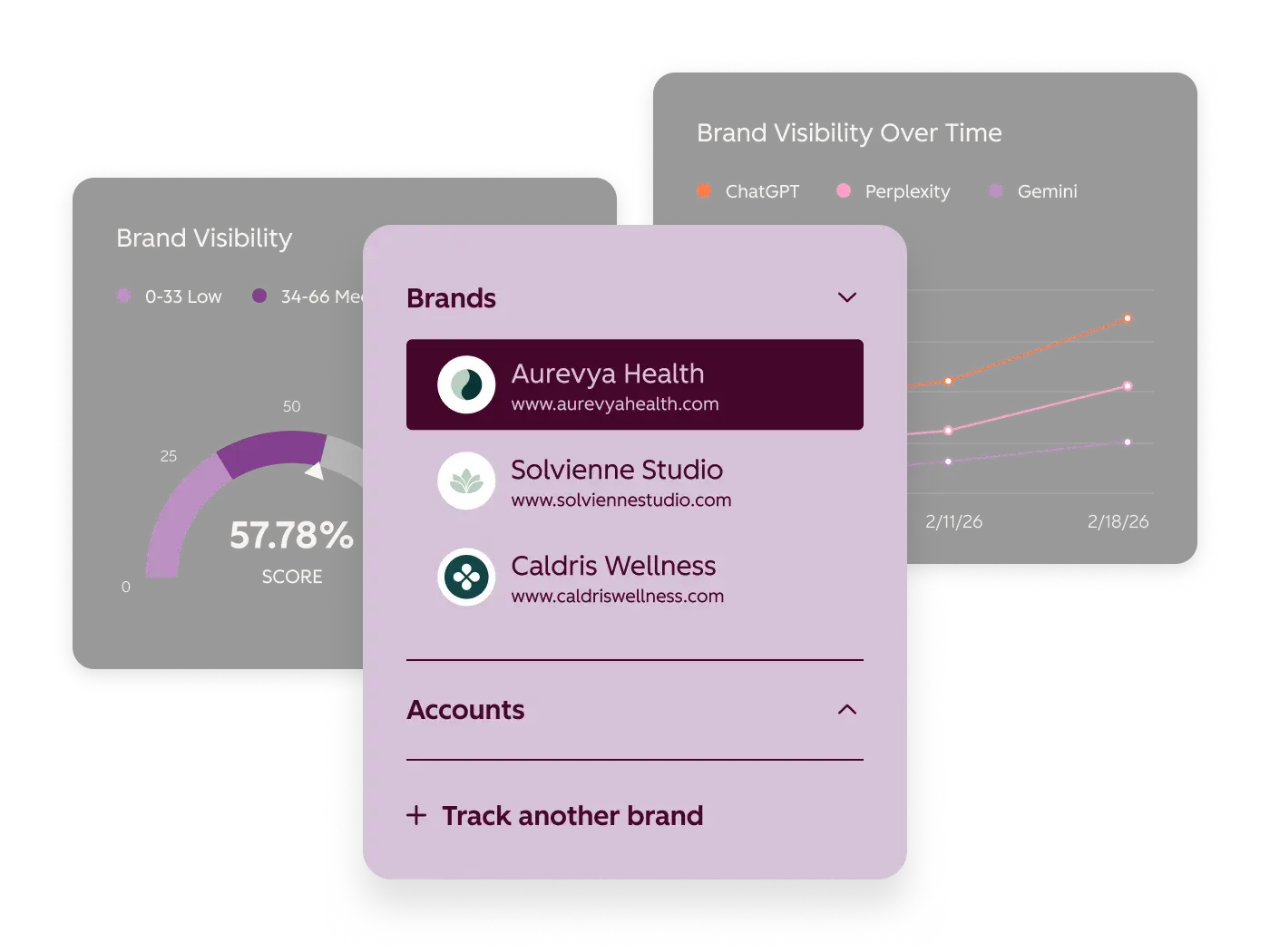
Profound is built around AI search from the ground up, and it shows. You get visibility scores per prompt and per engine, competitive share of voice, sentiment analysis, and answer views. Answer views show how your brand appears inside specific AI answers: you can pull up the exact response a buyer would have seen, including citations, phrasing, and sentiment framing. This is particularly useful for understanding how AI is narrating your brand, not just whether you showed up.
Semrush’s dashboard:
Semrush surfaces AI visibility data within its broader SEO dashboard. You see brand mentions across tracked AI prompts, competitive comparisons, and sentiment signals, but all in context with your traditional search rankings, backlink profile, and content performance. For teams that need to report on their full digital presence to leadership, this unified view has real value. The tradeoff is that AI-specific views aren’t as granular as Profound’s.
Where HubSpot AEO fits:
HubSpot AEO takes a different approach that’s worth understanding: it starts from your CRM. Because HubSpot knows your customers, competitors, and product positioning, its prompt suggestions and visibility data are grounded in your actual business context from day one, not a generic template.
- Best for score-centric dashboards: Semrush, if you want AI visibility in context with your full SEO program.
- Best for answer-level views: Profound, if you need to see exactly what buyers are seeing.
- Best for connecting visibility to pipeline: HubSpot AEO, where CRM integration makes every insight more actionable.
Profound vs. Semrush AEO Site Health And AI Crawler Analytics
AI crawler analytics help verify bot access and content readiness, and this is one area where Profound and Semrush take different approaches.
Profound — Agent Analytics:
Profound reads server logs directly, without needing JavaScript trackers. That means you can see which AI bots (GPTBot, ClaudeBot, PerplexityBot, and others) are crawling your site, which pages they’re accessing, and at what frequency — regardless of whether your site runs JavaScript well or whether a bot is executing scripts. For teams with complex CMS setups or paywalled content, this is a meaningful technical advantage. Profound’s server log analysis reveals actual crawler behavior instead of inferred behavior from a simulated audit.
Semrush — AI Search Site Health:
Semrush’s AI Search Site Health audit checks crawlability from an AI bot perspective, but it operates more like a traditional site crawler. You get actionable flags around structured data, indexability, and page accessibility. Semrush’s AI Search Site Health audit doesn’t provide the server log depth that Profound’s Agent Analytics delivers.
Pre-flight checklist for AI content readiness (applicable regardless of which tool you use):
- Is GPTBot, ClaudeBot, and PerplexityBot allowed in your robots.txt?
- Are your most important pages accessible without JavaScript execution?
- Do you have structured data (Schema.org) on key product and FAQ pages?
- Is your internal linking structured to pass context between related content?
- Are there any bot-blocking rules in your CDN or WAF that might be filtering AI crawlers?
Pro tip: Even if you’re not investing in an AEO platform yet, check your server logs for AI bot traffic. If you’re already getting crawled heavily by GPTBot or PerplexityBot, you’re sitting on useful data about which pages AI considers authoritative for your domain — and you can start optimizing before you spend anything.
Pricing and Value by Use Case
Pricing evaluation should include limits, usage gates, and use-case fit, not just the headline number. Both platforms gate meaningful features behind higher tiers, and the jump from entry-level to where you actually want to operate can be significant.
Profound pricing:
|
Plan |
Monthly |
Annual |
Prompts |
Engines |
|---|---|---|---|---|
|
Starter |
$99/mo |
$82.50/mo |
50 |
ChatGPT only (1 region) |
|
Growth |
$399/mo |
$332.50/mo |
100 |
3 (ChatGPT, Perplexity, Google AI Overviews) |
|
Enterprise |
Custom |
Custom |
Custom |
Up to 10 engines |
The Starter plan’s single-engine limitation is worth flagging. For a serious AEO program, Profound’s Growth plan ($399/mo) is the realistic minimum because the Starter plan’s single-engine limitation leaves visibility gaps on Perplexity and Google AI Overviews. Enterprise unlocks the full engine set including Claude, Gemini, Meta AI, and Grok, plus ChatGPT Shopping tracking at the SKU level and API access.
Semrush pricing (AEO-capable plans):
|
Plan |
Monthly |
Annual |
Keywords |
AI Prompts |
|---|---|---|---|---|
|
Starter |
$199/mo |
$165.17/mo |
500 |
50 (1 domain) |
|
Pro+ |
$299/mo |
$248.17/mo |
1,500 |
100 |
|
Advanced |
$549/mo |
$455.67/mo |
5,000 |
200 + API |
The Starter plan’s single-engine limitation is worth flagging. For a serious AEO program, Profound’s Growth plan ($399/mo) is the realistic minimum because the Starter plan’s single-engine limitation leaves visibility gaps on Perplexity and Google AI Overviews. Enterprise unlocks the full engine set including Claude, Gemini, Meta AI, and Grok, plus ChatGPT Shopping tracking at the SKU level and API access.
One important note: the $139.95/mo base SEO plan doesn’t include custom AI prompt tracking. AI visibility features start at $199/mo, and that’s before any modular add-ons for Content, Social, Local, or Traffic toolkits. Those run an additional $20 to $289/month per module, depending on the suite.
HubSpot AEO pricing:
HubSpot AEO is $50/month standalone (or $45/mo annually), with multi-engine coverage across ChatGPT, Gemini, and Perplexity included. There’s a free 28-day trial with 25 prompts and no credit card required. HubSpot for Marketers bundles Marketing Hub, Content Hub, and AEO, starting at $900/month for teams that want AI visibility integrated with a full marketing and content stack.
Budget mapping by use case:
- Pure AEO, small team starting out: Profound Starter gets you in at $99/mo, but the single-engine constraint is real. HubSpot AEO at $50/mo gives you multi-engine coverage for less.
- AEO + full SEO management: Semrush Pro+ at $299/mo makes sense if you’re already a Semrush shop and want to fold AI visibility into an existing workflow.
- AEO integrated with CRM and content operations: HubSpot AEO or HubSpot for Marketers, where visibility data connects directly to your pipeline and content tools.
- Enterprise AEO with ChatGPT Shopping or multi-region needs: Profound Enterprise (custom pricing) or HubSpot for Marketers at scale.
When to Choose Profound vs. When Semrush Is Enough
Choose Profound if:
- AEO is your team’s primary focus and you want the deepest, most specialized toolset available
- You need server log AI bot analytics rather than a traditional crawler-based audit
- You’re in e-commerce and need ChatGPT Shopping tracking at the SKU level
- You want browser-captured answer data rather than API-sampled responses
- You’re running a dedicated AEO program and don’t need it bundled with traditional SEO reporting
Choose Semrush if:
- You’re already using Semrush for SEO and want to add AI visibility without switching tools
- You need to manage Google SEO, local listings, social media, and PPC alongside AI visibility
- Your team needs one platform for everything and can’t afford to manage multiple subscriptions
- You’re not running a dedicated AEO program yet and want AI insights as a supplement to existing SEO reporting
- You want access to Semrush’s large prompt database for initial discovery
Consider HubSpot AEO if:
- You want AI visibility connected to your CRM and marketing workflows
- You’re already on HubSpot and don’t want to add another vendor
- You want the best dollar-for-dollar entry into multi-engine AEO coverage ($50/mo)
- You want to go from a visibility gap to published content without leaving your existing stack
Agency versus in-house: Agencies running AEO programs for multiple clients often find Profound’s depth and browser-based capture more defensible when presenting data. Semrush’s all-in-one model works well for agencies already using it for SEO reporting who want to fold AI metrics into existing dashboards. HubSpot AEO is particularly strong for in-house teams where CRM integration creates direct connections between AI visibility and revenue attribution.
Enterprise considerations: Both Profound Enterprise and Semrush Advanced offer API access for teams that need to build custom reporting or feed data into their own BI tools. For enterprise teams already on HubSpot, AEO data connects natively to dashboards, deal attribution, and contact-level reporting through Smart CRM, so there’s no custom integration layer to build.
How to Operationalize AEO in Your Stack
Phase 1: Evaluate readiness.
Before you start tracking prompts, you need to know where you stand. Use the free AEO Grader to get a baseline visibility score across the major answer engines before investing in a full program. This also gives you a benchmark to measure improvement against.
Alongside that, audit your technical readiness:
- Confirm AI crawlers aren’t blocked in robots.txt
- Verify structured data is in place on key pages
- Review server logs for existing AI bot activity
- Check that your most important content is accessible without JavaScript execution
If you’re using Profound, run Agent Analytics against your server logs. If you’re on Semrush, run the AI Search Site Health audit. Fix crawl access issues before optimizing content — AI bots cannot benefit from AEO-optimized content they can’t read.
Phase 2: Plan and produce content.
Once your baseline is set and content is crawlable, the work shifts to prompt research and content production. Prompt research supports content planning the same way keyword research does: you need to know which questions buyers are actually asking before you can optimize for them.
In Profound, you define target prompts manually and track browser-captured answers. In Semrush, you can use the existing prompt database to identify high-opportunity prompts before you build your tracking list. Either way, what you’re looking for is: which prompts matter to your buyers, and where are you absent?
Content Hub helps turn prompt insights into structured briefs. When you identify a prompt your brand doesn’t appear in, Content Hub connects that gap to your content calendar, collaboration workflow, and publishing tools, so the insight doesn’t just sit in a dashboard.
Pro tip: Don’t try to track 200 prompts from day one. Start with 20 to 30 prompts that map tightly to your product’s core use cases. Get good data on those, act on the gaps, then expand your tracking list once you have a repeatable process. More prompts doesn’t mean better data if you can’t act on what you’re seeing.
Phase 3: Monitor and attribute.
AEO ROI should connect visibility changes to engagement and pipeline, not just report on visibility scores in isolation. That’s where most AEO programs break down: teams track their scores but don’t build the attribution layer that connects AI mentions to actual revenue.
The core attribution chain looks like this:
prompt tracking → visibility score improvement → increased AI referral traffic → form fills or demo requests → pipeline attribution
The challenge is that AI referral traffic often appears as direct traffic in GA4 because most AI tools don’t pass UTM parameters. Set up dedicated views in your analytics for AI referral sources (ChatGPT.com, perplexity.ai, gemini.google.com) to capture what you can, and use your CRM to track AI-sourced contact creation.
In HubSpot, AEO data and campaign metrics live in the same platform, so when a visibility score improves, you can check whether it’s actually driving traffic, form fills, or pipeline without jumping between tools. Smart CRM connects AEO activity to contacts, deals, and dashboards. When a lead comes in from an AI referral, HubSpot tracks it through the funnel so you can report AI-sourced pipeline to leadership without a custom integration.
What to measure week over week:
- Brand visibility score trend by engine
- Share of voice versus top 3 competitors across tracked prompts
- Citation rate by content type (owned blog versus third-party versus social)
- Traffic from AI referral sources
- Pipeline attributed to AI-sourced leads
Pro tip: Learn more about HubSpot AEO in Marketing Hub — AEO insights, content tools, and CRM reporting in one place.
Frequently Asked Questions About Profound vs. Semrush AEO
Can I use Profound and Semrush together?
Yes, and some teams do since their tooling doesn’t overlap much. The practical question is budget: Profound Growth ($399/mo) plus Semrush Starter ($199/mo) adds up fast. Most teams pick one based on their primary workflow.
How do I measure ROI from AEO work?
Track the chain: visibility score → AI referral traffic → conversions → pipeline. The main challenge is that AI traffic often shows up as direct in GA4. Set up a dedicated segment for known AI referral sources (ChatGPT.com, perplexity.ai, gemini.google.com) and use your CRM to track AI-sourced contacts through to revenue.
What skills or roles do I need to run AEO well?
A content strategist or SEO specialist can handle most of it. The core skills are prompt research, content creation, and analytics. Server log analysis is more technical — one reason Profound’s Agent Analytics exists. HubSpot’s AEO tool is built so any marketer can get started without technical expertise.
How do I validate prompt data before I build content?
Manually run your target prompts in ChatGPT, Gemini, and Perplexity before creating content. Look at which brands are cited and what sources are referenced. If your tool shows you as absent but you’re appearing manually, there’s likely a data lag or tracking issue worth investigating before spending content budget.
What if I’m not ready to adopt an AEO platform?
Start with the free AEO Grader for a baseline, then manually check 10 to 15 relevant prompts across ChatGPT and Perplexity. Document where you appear and where competitors do. Manually checking 10 to 15 relevant prompts across ChatGPT and Perplexity usually uncovers quick wins you can act on without a paid tool.