
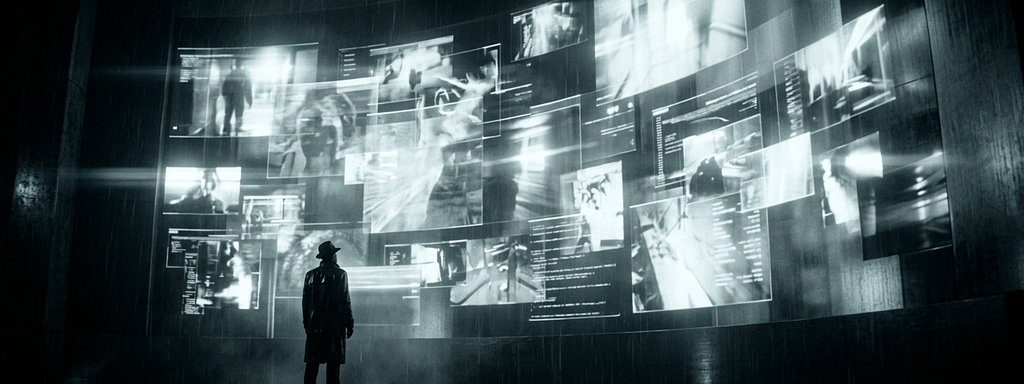

Steven Spielberg’s Precogs Are The Sharpest Portrait Of Generative AI Anyone Drew Before It Arrived — Fluent, Confident, Acting On Their Own, Hallucinations Included.
Watch Minority Report again and count what people quote from it and the answer is always the same: Tom Cruise in a black glove, waving his hands at a floating screen, conducting video like an orchestra. That image launched a thousand concept demos and a generation of gesture-controlled ambition.
It is also the least accurate thing the film predicted.
The 2002 movie, directed by Steven Spielberg and lifted from Philip K. Dick’s 1956 story The Minority Report, is remembered as a design showpiece. Look past the interface everyone copied and you find something more exact: a sketch of generative artificial intelligence.
The precogs do not look the future up in a database, they generate it by producing a fluent, confident account of what will happen, which the system treats as fact.
Swap the psychics for a language model and the machinery is identical, down to the failure the plot is built on.
That is not set dressing, it is the product specification for the tool in hundreds of millions of pockets, warning label included. The precogs were never the villains.
Read as design fiction rather than spectacle, they are the most accurate portrait of generative AI anyone drew before it arrived.

The Gesture Interface Was the Decoy
Of all the futures the film put on screen, the gesture interface is the one designers took home.
Christopher Noessel and Nathan Shedroff, who cataloged science-fiction interfaces in Make It So, describe the precog scrubber in What Sci-Fi Tells Interaction Designers About Gestural Interfaces as one of the most referenced interfaces in cinematic history. Every product person who has mimed pinch-and-swipe in a pitch owes it a royalty.
Then it aged into a gimmick.
https://medium.com/media/612c2079426ff989b7e667c5dba16011/href
Waving your arms at a vertical screen is exhausting inside a minute, and the industry had named the problem “gorilla arm” before Cruise put on the glove.
In 2010, Don Norman and Jakob Nielsen warned in Gestural Interfaces: A Step Backwards in Usability that the rush toward “natural” gestures was throwing out decades of hard-won standards — visibility, feedback, a reliable way to undo. The interfaces that won instead shrank to a slab of glass, then a voice, then a text box that answers back.
The most copied idea in the film was the one that mattered least.
Designers copy what photographs well, and a gloved hand sweeping through light is a poster while a model quietly generating a confident answer is not. So the poster got mimicked in keynote after keynote while the generative engine got built off camera.
A science-fiction interface is made to be read in two seconds, not operated for two hours — Cruise sweeps his arms because the camera needs to see him think. Believable and usable are different problems, and cinema only has to solve the first.
The same misdirection is happening again, except today the copied thing is the chat box. Change the input device all you like — glove, mouse, voice, prompt — and the hard question underneath does not move. It is what you do with an answer a machine invented and delivered without a flicker of doubt.

The Precogs Were a Generative Model
Strip the film to its plumbing and the precogs are a generative model with a homicide division. They do not retrieve a fact about the future; they synthesize one that did not exist until they generated it. Ask a language model a question and it does not look up the answer either — it generates the most plausible continuation, token by token, and hands it over with the calm authority the precogs give their visions.
For most of the film’s life that looked like fantasy. ChatGPT crossed 800 million weekly users within three years of launch, and generative models are now wired into search, email, coding tools, and the support box on half the sites you visit.
A decade ago the answer to a question was a list of links you weighed yourself; now it is one generated paragraph that has done the weighing and shows you none of it.
The precogs do not retrieve the future; they generate it, the same move that makes a language model useful and needs human in the loop.
The distinction matters more than it sounds.
- A search engine retrieves, and when it has nothing it returns nothing — the blank is honest.
- A generative model never returns a blank; it still produces a plausible, well-formed answer, because that is the only thing it does.
Confidence is not a signal that the system is right, it is the house style. The model gets treated as a component that returns answers, the way a database returns rows, and the difference between looking something up and making it up never comes up.
That difference is the product risk.
Josh Clark has a name for the version of this we now live inside. In Say Hello to Sentient Design, he and Veronika Kindred argue that generative interfaces are already here rather than on the way, and that we meet machine-made output dozens of times a day without registering it.
A machine producing confident answers about matters it cannot verify is now the ordinary condition.

The Precogs Were the Training Data
Now the part people find hardest to sit with. The precogs are not machines — they are three people, drugged, floating in a tank, their minds strip-mined for visions they never volunteered. Precrime’s marketing calls them a system, the state keeps them in a room the public never sees, and the apparatus rests on human beings whose contribution is compulsory and uncredited.
That is the origin question generative AI keeps trying not to answer, and the interface is exactly where the answer gets hidden.
A model’s fluency is not conjured; it is distilled from an enormous quantity of human work gathered without asking, and the bill is arriving in court. A federal judge gave final approval in 2026 to Anthropic’s $1.5 billion settlement with authors over pirated books, roughly $3,000 per work across some 500,000 works — the largest copyright recovery on record. The New York Times’ case against OpenAI heads toward trial on the same question.
The tank is not a metaphor, and every fluent answer is somebody’s labor, rendered anonymous under fair use.
It is not only the writing that got absorbed, either. TIME reported that OpenAI’s contractors in Kenya were paid between $1.32 and $2 an hour to read the worst material on the internet so ChatGPT would not repeat it.
People took the toxicity directly so the output could feel clean. The film has a precise image for that arrangement, and it is not flattering.
For designers the point is not guilt, it is disclosure. Interfaces are built to make generated output feel like it came from nowhere, and that seamlessness is a choice. Linking what the model drew on, marking which parts are retrieved and which invented — these are design decisions, and defaulting to silence about where an answer came from is the instinct that kept the tank out of sight.

The System Acts and Nobody Checks
The precogs’ visions do not sit in a report. They trigger an arrest — a team acts on the generated output before the predicted event has happened, generation and action welded together.
That weld is what the industry is racing to build, and it has a name: agents. PwC found that 79 percent of companies already have AI agents in use, tools that generate a plan and then execute it without waiting to be asked.
The dazzle is real, and so is the quiet transfer of authority, because each capability added is a decision handed to a system that generates its confidence as fluently as its answers. Every agent demo I have watched ends at the moment of success, never at someone unpicking what it did on a bad day.
The prompt box kept a person between the generated answer and the world. The agent’s whole selling point is removing them.
The prompt box kept a person between the generated answer and the world. The agent’s whole selling point is removing them.
Watch what the precrime cops do with all that automation. They do not investigate; they receive a name, confirm it on a screen, and make the arrest, with the detective work handed off to the oracle entirely. That is automation bias, the tendency to over-trust a machine and stop checking it.
A 2023 study in Scientific Reports found people defer to an AI recommendation even when it is visibly wrong, then keep making its mistakes after the system is switched off. Generative AI sharpens this, because fluency reads as competence.
Ben Shneiderman argues this is a false choice. In Human-Centered Artificial Intelligence: Reliable, Safe & Trustworthy, he replaces the usual dial — more automation, less human control — with two axes and puts the goal where both run high.
Precrime sits in the opposite corner, and the rule it breaks is worth stating plainly: match the reversibility of the action to your confidence in the generation. A draft left for you to send is cheap to be wrong about, a sent email is not, a payment is less so, and an arrest is catastrophic.
The fix is not less capability but deliberate friction: show the two answers the model was torn between, and make someone type a consequential decision rather than click accept.

The Minority Report Was the Hallucination
Here is the part with the film’s name on it. A “minority report” is what happens when the precogs disagree — one generates a different outcome, and the system buries the dissent to present a single clean verdict. That suppression is the plot, and it is also a design decision. Anderton gets flagged as a future murderer, and the vision that would clear him is filed away, because the system is built to output certainty rather than doubt.
That is hallucination, described twenty years early. A generative model also discards the cloud of things it could have said and hands you one answer with the uncertainty stripped off. When that answer is wrong but fluent, it is a minority report the system declined to show you.
And it is not rare. Stanford researchers tested the legal AI tools sold specifically as grounded and hallucination-free, reporting in Hallucination-Free? Assessing the Reliability of Leading AI Legal Research Tools that Lexis+ AI and Westlaw’s tool still fabricate or misstate the law between 17 and 33 percent of the time, and those are the careful, retrieval-grounded systems.
Generated prose compounds it, flattening the difference between what the model knew and what it invented, so the retrieved citation and the fabricated one sit in the same sentence.
A model confident enough to answer is confident enough to be wrong about a person.
A model confident enough to answer is confident enough to be wrong about a person. So build the minority report back in on purpose. This is not new advice — Guidelines for Human-AI Interaction, published by Saleema Amershi and colleagues at Microsoft in 2019, tells you to make plain what a system can and cannot do and to support correction when it is wrong.
In practice: surface the uncertainty, show the sources beside the answer, and give the person a path to contest it before the system acts. It rarely happens because certainty ships faster than doubt, so teams round the confidence up and let the prose imply a sureness the model never earned.
Two questions cut through this on any generative feature.
- What does it show when the model is unsure, and who absorbs the cost when it is fluently wrong?
- If the answers are nothing and someone outside the room, you have shipped precrime with better typography.
The Real Forecast Was Never on the Screen
The film got the spectacle wrong and the substance right, which is the usual ratio for design fiction. We copied the gloves and missed the machine.
For two decades, “it’s like Minority Report” meant waving at a screen, when the truer read was the opposite — a system generating confident answers about a world it could not see, and people acting on them before anyone checked.
That future arrived, and it did not stay in the lab — It writes hundreds of millions of answers a week, drafts the email, runs the query, and increasingly acts without asking.
The edge case the film built its plot around is no longer hypothetical; it is a measured rate, aimed at people, not playlists.
The work now is not to build the generative engine; that part is done. The work is to build the minority report back into it — to treat the model’s suppressed uncertainty as a feature, not a bug, and to keep a human between the generated answer and the consequence. Watch the film again. Skip the hands. Study what the machine was so sure about, and who paid when it turned out wrong.
What Minority Report got right about AI was originally published in UX Collective on Medium, where people are continuing the conversation by highlighting and responding to this story.