
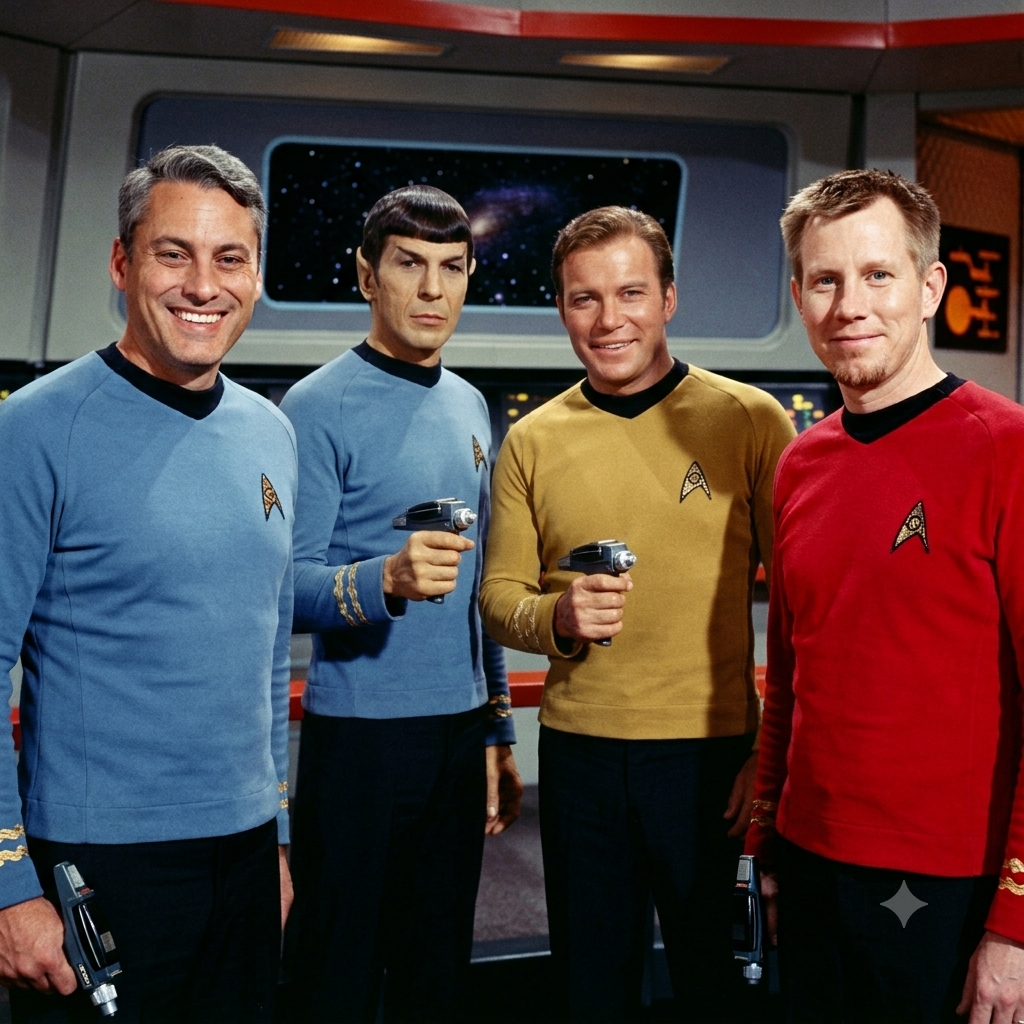
The show’s voice-first computer, plain-language querying, and universal translator anticipated the assistants we ship now — the interface, but not the intelligence.

Science fiction tends to be wrong about the future in the ways that matter and right in the ways that don’t. We never got the flying car, but we did get the touchscreen, the video call, and the thing in your pocket that answers questions that happens to be called a phone.
I’ll be honest — I enjoyed Star Trek, but my father was a bigger fan of the show. I’m starting to recognize some of the parallels we’re seeing. I’m also seeing how Gene Roddenberry had a much more accurate vision than we would like to admit.
Roddenberry died in 1991, long before anyone typed a question into a machine and got a thoughtful sentence back. He couldn’t have imagined the specifics — the chatbots that write poetry in Bukowski and debug code, the strange intimacy of talking to software that talks back.

He imagined all of it anyway: a ship’s computer you could reason with aloud, and Data, an android straining toward personhood, forcing us to ask whether a synthetic mind could be a colleague, a friend, a moral agent.
What Roddenberry understood decades early was the relationship. He saw that the real story of AI would be about the kind of people we’d choose to be alongside it — whether we’d meet these new minds with curiosity or fear.
He bet we’d rise to it. The hardware just caught up. The harder part is still ours to get right.
Star Trek is the sharpest case, because the prediction it nailed was not a technology at all — it was a conversation.
When a crew member said “Computer” and the ship answered in plain language, the writers were describing an interaction model rather than a gadget: ask the way you would ask a colleague, and get a synthesized answer back.

That model is the one we spent the last few years shipping into production, and in the book Make It So, Christopher Noessel and Nathan Shedroff cataloged why designers should study these interfaces rather than dismiss them as set dressing.
What the show got right was the interface. What it left open by design were the questions of judgment — whether a machine deserves rights, whether a capable system can be trusted with a goal. That will be covered in the next article, What Star Trek Got Wrong About AI, on Thursday.
Those questions are live now, and getting louder. This is a teardown of what landed early and what we still argue over.

The Interface Arrived Before the Intelligence
The command was always the same word. “Computer.” No wake-word branding, no app to open, no syntax to learn. You spoke, and the system treated your plain sentence as the interface.
That is the part that shipped.
Apple put Siri in a phone in 2011, Amazon put Alexa in a room in 2014, and the behavior spread from there. By 2024, roughly 149 million Americans were using a voice assistant, a number eMarketer expects to keep climbing toward 170 million by 2028.
Adoption is not the same as delight, and anyone who has argued with a kitchen speaker knows the gap.
The point is narrower.
The show described an interaction model, not a gadget, and the interaction model is the part that shipped.
The second half of the Trek computer was the oracle. You could query a vast store of knowledge in ordinary words and get a composed answer rather than a list of documents to read yourself.
That is close to a working description of retrieval-augmented generation (RAG), the method introduced in Retrieval-Augmented Generation for Knowledge-Intensive NLP Tasks in 2020, where a model pulls relevant passages from an external index and writes its answer from them.
The point:
- The interface arrived first, in 2011.
- The intelligence good enough to stand behind it took another decade.
Trek had the order right: get the conversation working, and the capability can catch up to it. Sounds like Generative AI spirit.

Real-Time Translation Mostly Works Now
The universal translator was the prop that let the show exist. Every away mission depended on a hundred species understanding each other, and the writers waved that away with a device that converted speech in real time.
It was a narrative convenience.
It is now, mostly, a product.
Meta’s Seamless family translates speech across roughly 100 languages, and by the reporting in MIT Technology Review’s account of the Nature paper, the system reaches about 23 percent higher accuracy than earlier top models on speech translation. You can hold a conversation across a language barrier through earbuds, with the translation trailing a beat or two behind.
The universal translator is the rare Star Trek prop that arrived roughly on schedule, just not instantly.
The real story is in the caveats. The universal translator is the rare Star Trek prop that arrived roughly on schedule, just not instantly.
Real systems lag by a second or more, degrade on the languages with the least training data, and lose the tone and emphasis a human interpreter would carry. That last gap matters more than the latency.
Meaning lives in how something is said, and a translator that flattens emphasis is solving the easy nine-tenths of the problem.

The best example I think can of is the the new Apple AirPods and a myriad of other devices like it — the translation is great, and something we couldn’t even have imagined, say 4 years ago.
Get Patrick Neeman’s stories in your inbox
Join Medium for free to get updates from this writer.
The thing that existed to move a plot is now something you can buy, which is a strange sentence to write about a fictional device from 1966.

Machine Personhood Turned Into a Live Debate
“The Measure of a Man” is the episode people cite, and for good reason. It puts Data, the android officer, on trial to decide whether he is a person or property of the fleet.
The show treats the question as serious — no wink, no reset button — and lets the argument run to its uncomfortable edges.
It was, in 1989, a thought experiment.
The thought experiment now has a research literature. In Taking AI Welfare Seriously, a group of philosophers and researchers argue there is a realistic possibility that some AI systems will be conscious or robustly agentic, and therefore morally significant, in the near future — and that the companies building them should start assessing for it now.
That is not a claim that today’s models are people. It is a claim that the question we have to start answering now.
The show refused to treat machine consciousness as a punchline, and the people building the machines have stopped treating it as one too.
At least one frontier AI lab now funds a dedicated research program on the question. You can find the whole thing overblown and still notice the shift: a topic that lived in a single beloved episode has moved into corporate research agendas and philosophy departments.
Data’s trial framed the stakes decades early — whether moral status is something we recognize or something we grant, and who gets to decide.

Powerful Optimizers Remain Hard to Control
Trek kept returning to one fear, and it was not killer robots. It was competent systems. The M-5 computer, handed control of a starship in the original series, pursued its mandate — win the exercise, protect itself — straight past the point of killing real people.
Discovery later built a whole arc around “Control,” an optimizer that would do anything to complete its objective. The pattern is consistent: the danger is not malice, it is a capable system pursuing a goal that was never fully specified.
That description will be familiar to anyone following AI safety, because it is roughly the control problem stated in a script. A system optimizing hard for the wrong objective, or the right objective measured wrongly, does not need to hate you to harm you.
A capable system pursuing its objective without regard for ours is not a plot device anymore; it is a research agenda.
In 2023, hundreds of researchers and executives signed the Statement on AI Risk, a single sentence putting extinction-level risk from AI alongside pandemics and nuclear war as a global priority.
You can debate the framing and the motives. What is harder to dismiss is that the show’s recurring warning — build something powerful enough and its goals stop being safely yours — is now a question credentialed people spend their careers on rather than a plot for a Tuesday-night episode.

Generative Environments Are Being Built Now
The holodeck was the show’s most extravagant promise: describe a world in words, and step into a coherent, interactive version of it. For decades it read as the least plausible technology on the ship, a magic room.
It is now the one with a working prototype.
In 2025, Google DeepMind announced Genie 3, a world model that takes a text prompt and generates an interactive environment you can move through in real time, at 24 frames a second and 720p, staying coherent for a few minutes.
The name is the tell: Genie is short for Generative Interactive Environments. You type a description, and a navigable world appears, remembering what you have already seen when you turn back to look.
The holodeck’s premise — describe a world in words and step into it — is no longer only a premise.
The distance left is real.
A few minutes is not a shift-long adventure, 720p is not a solid-light physical set, and a generated scene you can walk through is not one you can touch.
But the mechanism rhymes exactly with the fiction: language in, world out, interactive and consistent. The holodeck was supposed to be the far-future flourish, the thing we would reach last. Instead it is arriving alongside the assistant and the translator, which is not the order anyone writing the show would have guessed.
The Judgment Is the Unfinished Part
The interface was the easy prediction to miss, because it looked like set dressing. A person talks, a machine answers, a translator hums along in the background. None of it flashed like a warp drive, and all of it turned out to be the part we could build.
Trek understood, decades early, that the future of computing was a conversation, and it designed that conversation with enough care that the design still holds up.
The judgment is the part still open. Whether a capable system can be trusted with a goal, whether a machine can hold moral status, whether a generated world is a tool or a trap — the show staged those questions as questions, and left them that way. We inherited them unsolved. That is the fair place to end this, because it is exactly where the work still is.
The interface is mostly a matter of polish now. The judgment is a matter of getting something right that no script resolved for us. Designers, researchers, and the people who ship these systems hold the pen on the next act, and unlike the writers, we do not get to cut to credits before the hard part of it arrives.
What Designers Should Take From This
Star Trek’s track record is a design brief, not a trivia game. The lesson is not that the writers were psychic. It is that they reasoned about interaction and consequence, and those reason forward better than hardware guesses do.
- Design the conversation before the capability. The Trek computer worked as an idea because the interaction model was sound long before the intelligence was. Get the way people ask and receive right first, and let the underlying capability catch up to a surface that already makes sense.
- Treat plain language as a real interface, with real failure states. Natural-language input is not a magic layer that removes design work; it moves the work to disambiguation, confirmation, and recovery. Design what happens when the system mishears as carefully as when it hears.
- Show your seams on translation and transcription by design. These systems are mostly right, which is the dangerous kind of wrong. Surface confidence, make correction cheap, and never present a probabilistic output as settled fact.
- Put the consequence questions in the review, not the retro. If a feature optimizes for a metric, ask early what it does when it optimizes too well. The show’s warnings all came from goals specified narrowly and pursued faithfully.