

Are Halloween Activities For Work Useful?
Halloween activities for work can be more than costume contests, pumpkin decorating, or candy in the break room. With some planning, these seasonal activities can give employees easy ways to talk, solve problems, share ideas, and work together while supporting Learning and Development goals.
This doesn’t mean every Halloween event should turn into a formal training session. Making every social gathering a required learning activity can take away the fun. Instead, L&D and HR teams can use good learning design in activities employees already enjoy.
The trick is finding the right balance. Halloween workplace activities should still feel enjoyable, voluntary, and inclusive. At the same time, they can give employees opportunities to practice collaboration, creative thinking, decision-making, and even knowledge recall. With the right approach, a bit of seasonal fun can be more valuable than just another office party.
Why Use Halloween Activities As Part Of Workplace Learning?
Halloween activities for work can offer hands-on learning without making employees feel like they are in another formal training. Adding novelty, storytelling, competition, and teamwork helps break up routines and gives employees fresh ways to connect with information and each other.
Experiential learning at work means learning by doing, reflecting, and applying new skills instead of just listening to instructions. A Halloween-themed challenge can help create this kind of active learning environment.
For example, when employees work together to solve a mystery, they have to share information, question their assumptions, and make decisions quickly. The story might include ghosts or zombies, but the skills they practice, like communication, reasoning, prioritizing, and teamwork, are real.
Halloween games at work can also use gamification. Adding points, challenges, progress updates, feedback, and friendly competition can motivate people to join in when used well.
However, Halloween office games should not take the place of formal corporate training. They work best as extra activities that support what employees have already learned, encourage sharing knowledge, or let people practice useful skills in a more relaxed setting.
How To Match The Halloween Activity To The Learning Goal
Halloween activities for work are more effective when L&D professionals focus on the goal first, rather than picking something just because it seems fun. Think about what you want employees to learn or experience, then pick the Halloween activity that fits best.
Learning Or Team Goal |
Recommended Halloween Activity |
| Problem-solving | Escape room or mystery challenge |
| Communication | Information-gap game |
| Collaboration | Team scavenger hunt |
| Knowledge retention | Halloween trivia |
| Creativity | Storytelling challenge |
| Decision-making | Survival simulation |
| Leadership | Strategy challenge |
| Cross-team connection | Peer-learning activity |
Here’s a helpful order to follow:
Outcome → Audience → Format → Activity
For instance, if you want to encourage better collaboration between teams, a group scavenger hunt might be more effective than individual trivia. If your main goal is to reinforce knowledge, a short quiz that asks people to recall information could be more effective.
Always let your objective guide the choice of activity, not the other way around.
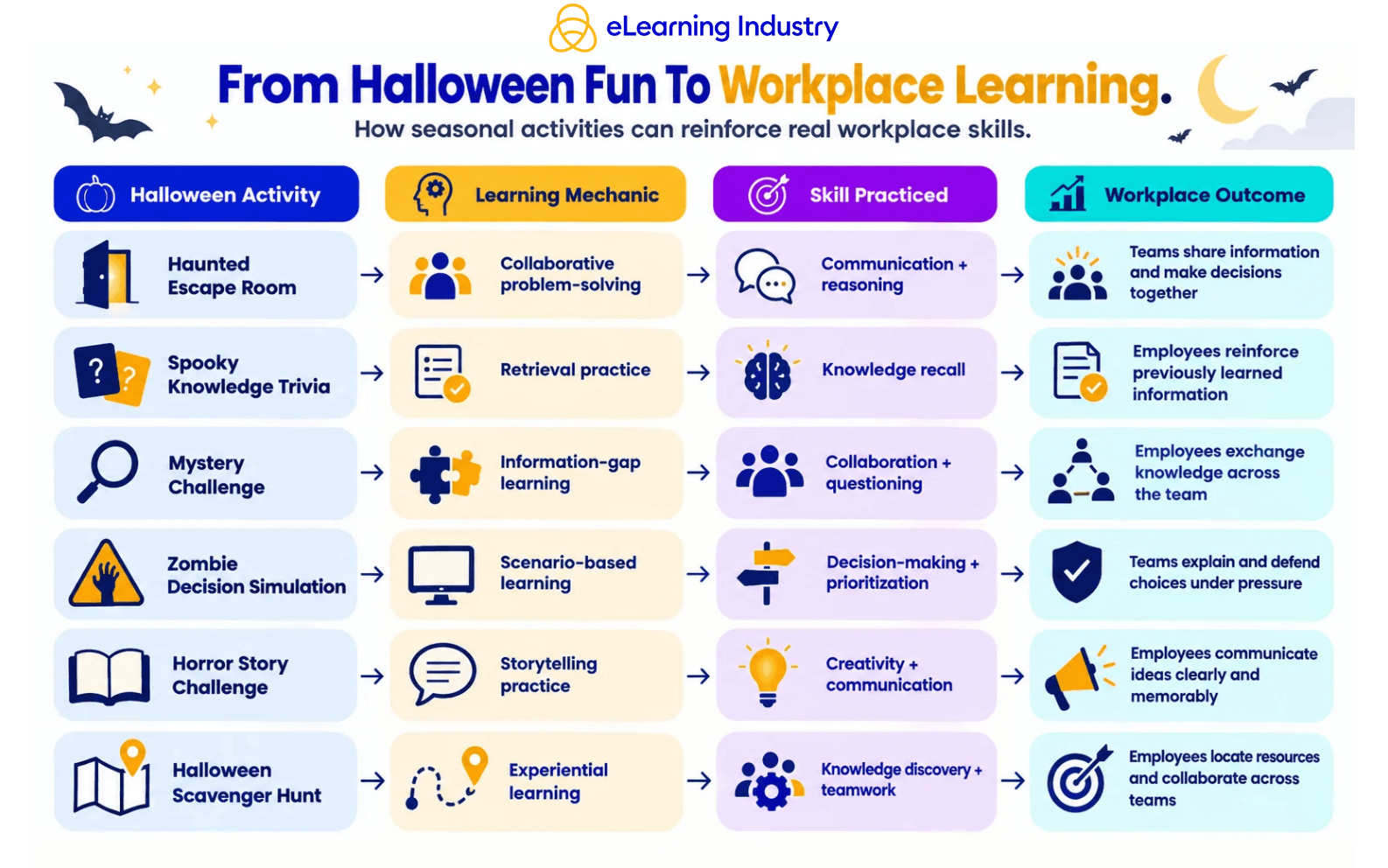
15 Halloween Activities For Work With An L&D Twist
Halloween activities for work don’t need to involve fancy decorations or complicated event planning to create meaningful experiences. These Halloween office ideas add an L&D element while keeping the spooky spirit intact.
1. Haunted Escape Room Challenge
Try using an escape-room format for a fast-paced team activity that builds collaboration and problem-solving. For example, give each team a set of clues to solve before time is up.
To add a learning element, include company knowledge, customer scenarios, business terms, or work-related puzzles in the clues.
This activity helps employees practice communication, decision-making, and teamwork, all while keeping things fun with a Halloween theme.
2. Halloween Learning Scavenger Hunt
Make a scavenger hunt more meaningful by having employees search for information rather than just objects. Clues can lead to company resources, learning materials, knowledgeable colleagues, or answers hidden in your LMS or intranet.
If your team is remote, set up a digital version using shared docs, collaboration tools, or online clues.
This approach is great for helping people discover new information and learn across teams.
3. Spooky Knowledge Trivia
Turn regular quizzes into fun Halloween games by mixing in trivia with questions about recent training, company info, compliance, products, or industry trends.
Make sure to keep the mood relaxed, though. The goal isn’t to test or catch mistakes, but to make learning enjoyable.
Use this activity to help people remember what they’ve learned and spot areas that might need a little more practice.
4. Zombie Apocalypse Decision-Making Simulation
A pretend zombie apocalypse can make prioritizing and decision-making more engaging. Give teams limited resources, mixed information, and a few possible actions to choose from. Then, ask employees to agree on a strategy.
The real learning happens after the game. Talk about what information teams focused on, the assumptions they made, who influenced the choices, and how they worked through disagreements.
The zombies may be made up, but the decision-making skills are real.
5. Mystery-Solving Team Challenge
Boost information sharing by giving each employee a piece of a made-up mystery. No one should have enough clues to solve it alone.
To solve the mystery, team members need to ask questions, share clues, connect the dots, and challenge their own assumptions.
This activity is especially helpful when you want to build collaboration and communication skills.
6. „Escape The Deadline“ Project Management Game
You don’t need haunted houses or monsters for a Halloween vibe. In this challenge, the scary part is the looming deadline, which most professionals know well.
Give teams a pretend project with limited resources. Add changing requirements, stakeholder requests, surprise risks, and competing priorities. Teams need to decide what to focus on and how to keep the project on track.
It’s a fun way to practice adaptability, planning, and project management skills.
7. Halloween Scenario Cards
Use short „What would you do?“ cards to make scenario-based learning easy. Each card describes a work situation with a Halloween theme. Scenarios might cover:
- Leadership
- Customer service
- Compliance
- Cybersecurity
- Communication
- Management
- Workplace ethics
Then, teams talk through their answers and share why they chose them.
This simple format can be used for almost any learning topic.
8. Two-Minute Horror Story Challenge
Storytelling in Halloween activities can help build creativity and clear communication. Give employees a few required words, concepts, or prompts, and ask them to create a two-minute horror story that uses all of them.
This activity works especially well for trainers, facilitators, sales teams, and Instructional Designers, since storytelling is a valuable skill all year round.
In the end, teams can vote for the story they find most creative, persuasive, or memorable.
9. The Haunted Customer Journey
You can turn a deliberately bad customer or learner experience into a problem-solving activity. Give teams a fictional journey full of confusing instructions, extra steps, poor communication, and frustrating moments. Ask employees to identify what went wrong and develop a better version.
This approach works especially well for teams focused on Customer Experience, onboarding, service design, product education, or learner experience. Sometimes, the scariest thing is just poor design.
10. „Spot The Learning Design Horror“ Challenge
These activities are especially helpful for L&D teams when employees are asked to spot really bad learning design. Make a poor example with issues like too much text, unclear goals, pointless interactions, hard-to-access content, or tests that don’t match the skill being taught.
Teams compete to find as many problems as they can. Afterward, talk about how to fix each issue.
For Instructional Designers and corporate trainers, this Halloween activity makes professional critique more engaging.
11. Halloween Peer-Teaching Sessions
Halloween activities can make peer learning feel more relaxed by giving employees short chances to teach colleagues something useful. The topic doesn’t have to be about Halloween. An employee could show a shortcut, explain a process, share a helpful tool, or give a quick five-minute intro to something they know well.
These microlearning sessions can encourage Subject Matter Experts to share knowledge that might otherwise remain within their own teams.
12. Virtual Halloween Escape Challenge
Don’t forget to actually involve remote employees, not just treat them as spectators at on-site events. A virtual escape challenge can use breakout rooms, shared documents, polls, whiteboards, and digital clues.
Make sure everyone has a meaningful role, though. Don’t design an in-person game and then just add remote employees to a video call. Virtual Halloween team building works best when it’s planned with digital participation in mind from the beginning.
13. AI-Powered Halloween Scenario Challenge
Halloween activities can also help build AI skills when employees use approved generative AI tools to solve, create, or review Halloween-themed scenarios. For instance, participants might:
- Improve a poorly written AI prompt.
- Identify inaccuracies in an AI-generated answer.
- Compare human and AI recommendations.
- Create a scenario using AI and evaluate the result.
- Rewrite an AI response for a particular audience.
The Halloween theme adds a creative touch, but the main goal is to build critical thinking about AI-assisted work.
14. Halloween Skills Bingo
Halloween activities can turn bingo into a way to recognize helpful workplace behaviors. Instead of numbers, fill each square with actions employees can see or do. Examples include:
- Asked a useful question.
- Helped another team.
- Shared a helpful resource.
- Challenged an assumption respectfully.
- Suggested an alternative solution.
- Introduced two colleagues who could help each other.
This approach makes engagement activities more focused on behavior without making them too formal.
15. Build Your Own Halloween Learning Game
Halloween activities can challenge L&D teams to design a five-minute learning game based on a workplace concept. Each group must define:
- The learning objective
- The audience
- The rules
- The challenge
- The feedback mechanism
- The success criteria
Then, teams try out each other’s ideas.
For trainers, facilitators, and Instructional Designers, this exercise is a good reminder that even the most fun activity needs a clear purpose.
How To Keep Halloween Activities Inclusive
When planning Halloween activities for work, make sure everyone feels welcome to join or sit out. Some people do not celebrate Halloween, enjoy dressing up, or feel comfortable joining in seasonal events.
1. Participation doesn’t mean engagement. So, avoid treating it as proof of engagement or team spirit. Employees may opt out for cultural, religious, personal, or accessibility reasons.
2. Offer different ways for people to get involved. Some may want to help run the event, judge, design clues, keep score, or just watch instead of joining in directly.
3. Steer clear of themes that use cultural stereotypes, realistic violence, trauma, or jokes that might make others uncomfortable.
4. Accessibility is important as well. Consider mobility, sensory needs, visual and auditory access, and neurodiversity when planning your event.
5. Hybrid teams need special attention. Make sure remote employees can join in just as much as those on-site. If people in the office are solving clues while remote coworkers only watch, the activity is not truly inclusive.
How L&D Teams Can Turn A Halloween Activity Into A Learning Experience
Halloween activities for work are more effective when L&D teams add a bit of thoughtful planning instead of just making more rules or adding complexity. One helpful method is the BOO Framework: Behavior, Opportunity, Observation.
Behavior
Decide which behavior you want employees to practice.
These could be things like clear communication, sharing information, setting priorities, questioning assumptions, solving problems, or making decisions.
Opportunity
Pick an activity that really lets employees show that behavior in action.
For example, if you want to encourage information sharing, try a mystery game where each person has different clues. This sets up the right situation.
Observation
Wrap up by asking employees what they noticed during the activity.
Questions might include:
- What helped the team succeed?
- Where did communication break down?
- What assumptions did you make?
- What would you do differently?
- How did the team reach its decision?
Spending just five minutes reflecting can lead to more learning than adding another half hour of game rules. The goal isn’t to hide training inside Halloween fun. It’s to make a fun activity a bit more purposeful.
Conclusion
When L&D and HR teams plan Halloween activities with purpose, they can offer more than just a few hours of fun. These games can reinforce knowledge, show how people communicate, let employees practice decision-making, or help teams connect. However, you don’t have to turn these activities into formal training programs. Let people join in if they want; make sure everyone can take part; pick activities that fit your group; and link them to real goals when it makes sense.
What sets a regular Halloween game apart from a valuable learning experience at work usually isn’t the activity itself. It’s the thought that goes into planning it.