
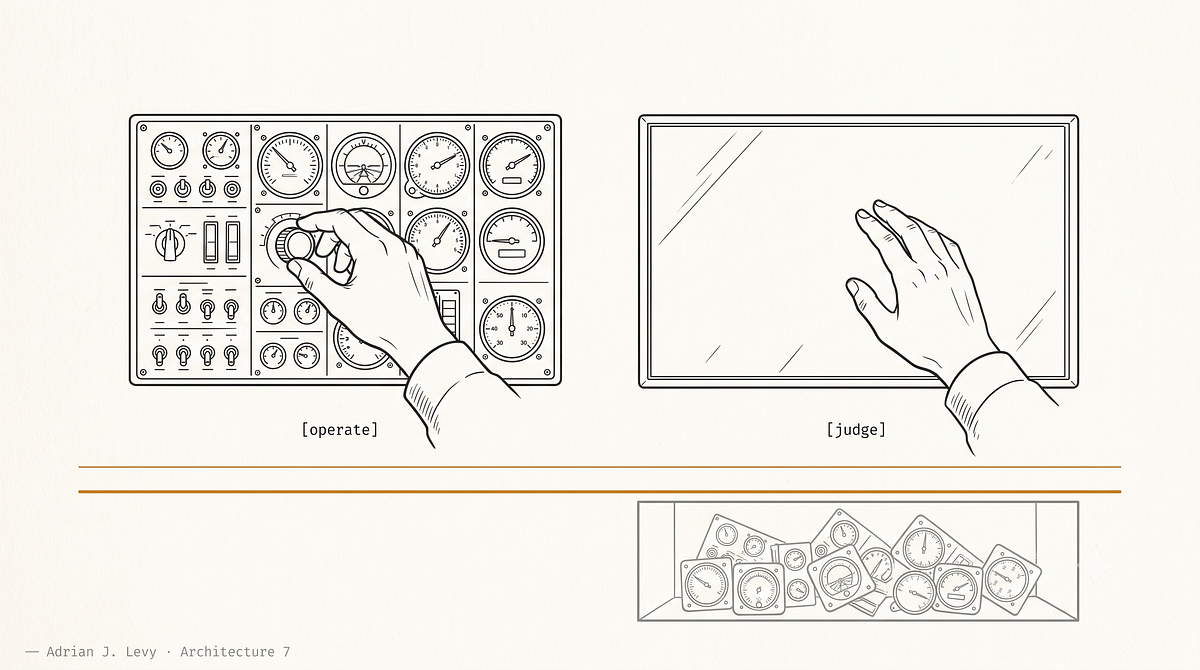
The work didn’t vanish with the screen. It fell one layer down.


I read John Maeda’s Design in Tech Report late, on my phone, the way you read something you already agree with — half-attention, thumb moving. He gave the shift a name, and the name was good. UX to AX. User experience to agentic experience. The machine stops waiting to be operated and starts acting on what you meant. I kept scrolling, nodding, filing it under yes, obviously.
Then I hit one word, and my thumb stopped.
He describes the new work as “moving from crafting interfaces to orchestrating outcomes.” Not designing. Not arranging. Not flowing. Orchestrating. I sat with the phone for a second longer than the sentence needed, because I had a folder for that word already, and it wasn’t labeled “trend.” It was labeled “layer.” Maeda was using the word to name a movement — where design is going. I’d been using it to name a place — a region of the system with a position and edges. Same word, pointing at two different things.
That gap — a word for a movement versus a name for a place — is what this essay is about. Not because one of them is wrong. Because the movement is easy to see; your feed is full of it. The place is not. And the place is where the actual design work now lives: it’s where someone…