
Can you build a real business around one very specific animal?
Deborah Niemann has spent nearly two decades doing exactly that. She runs ThriftyHomesteader.com(opens in new tab), a goat-focused media company with a podcast, a YouTube channel, six online courses, and a paid membership with 150 members.
She’s also taking her first overseas goat tour to Portugal this October, where some of her most loyal followers are paying to visit goat farms with her.
Deborah didn’t plan any of it. She moved to the country in 2002 to raise her own food, made a lot of beginner mistakes, and started teaching classes on her farm so other people wouldn’t repeat them.
Tune in to Episode 757 of the Side Hustle Show to learn:
- how Deborah stacks six different income streams in one small niche
- why her course sales fell and her membership kept growing
- how a simple ad network switch took her from $1 a month to $100 a month on video

- Gusto(opens in new tab) — Get 3 months free of the leading payroll, benefits, and HR provider for modern small businesses!


How Deborah’s Goat Business Got Started
It began on the farm. Deborah raised and sold goats, and she offered buyers a free class so they’d know what they were doing.
Then something shifted. More people wanted the class than wanted the goats. So she started running paid on-farm goat classes.
She also kept an online journal at antiquityoaks.blogspot.com(opens in new tab) from 2006 to 2016, writing about everything she and her family were doing:
- sheep
- goats
- cows
- pigs
- chickens
- turkeys
- ducks
- geese
- even llamas
That blog is how a publisher found her. They spotted a link to it on the Mother Earth News Fair website, watched her speak at the fair in 2010, and asked if she wanted to write books.
Why Writing Books Wasn’t the Payday She Expected
Deborah said yes to the offer to write books. Then her publisher asked if she could write an 80,000-word book in three months.
She said yes to that too, working seven days a week, 12 to 14 hours a day.
Homegrown and Handmade(opens in new tab) was her best seller. The first print run of 5,000 copies sold out in about 9 months, and her publisher was thrilled.
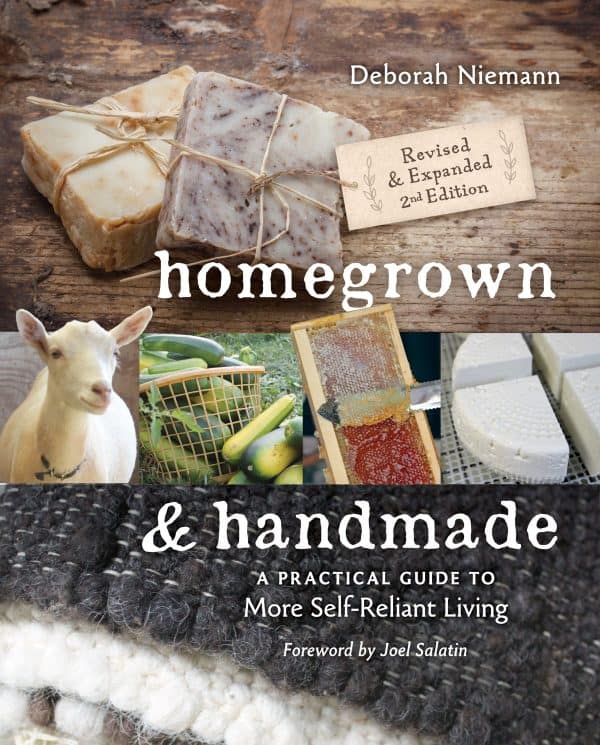
Then she did the math. The book sold for $20, and her royalty was 10% of wholesale, or about $1 per book. Her advance was $3,000.
“I could have made more money if I was working at a fast food restaurant,” she said.
Her other books:
Across all her books, she’s sold around 25,000 copies. The books opened doors, including speaking gigs from Washington State to Virginia. They just didn’t pay well on an hourly basis.
Turning a Book into an Online Course
After three books in three years, Deborah went looking for a better way to earn from work she loved.
In 2013 she started teaching online for the University of Massachusetts. Students paid $1,500 for the class, but her cut was still small.
Around 2015 she noticed people creating their own online courses(opens in new tab). Her plan was to use her goat book as the outline. Then she realized she had far more to say than would fit in one course.
Books have a hard limit, and it’s paper. Her editor’s questions pushed the manuscript past 80,000 words to 90,000, and the publisher said no more. Online, there was no ceiling.
“The nutrition chapter in this book is probably maybe 15 pages, but my goat nutrition course online is like seven or eight hours. I mean I talk for two hours about copper.”
Her First Course
Her first course, Goats 101(opens in new tab), launched in early 2017 to a 2,000-person email list. A few hundred people bought it, roughly a 10% conversion rate.
She credits Jeff Walker’s book for the approach: keep your audience updated on your progress. She emailed her list for about six months about a course that kept getting delayed. About 75% of buyers purchased the moment the cart opened.
How People Find Her Content
Deborah says to “be everywhere.” She has over 700 articles(opens in new tab), over 800 YouTube videos(opens in new tab), and roughly 180 podcast episodes(opens in new tab).
Her YouTube channel and podcast are both called For the Love of Goats.

Her articles target the questions goat owners actually type into search:
- how much a goat eats per day
- what to do about a fat goat
- when a goat needs a C-section
The Google AI Summary Hit
About two years ago, Google added AI summaries(opens in new tab) to the top of search results. People got their answer without clicking.
Deborah’s traffic fell from 110,000 visits per month to 40,000 almost overnight. It has since rebounded to about 60,000.
Lead Magnets and Email Follow-Up
Those website visits are where subscribers come from. Deborah’s free offers target whatever hurts most right now.
In summer, that’s worms. She also offers a goat mineral comparison chart and a “what do goats eat” cheat sheet.
Once someone opts in, they get Goat News every Monday, tied to the season. In summer that means parasites, drought, and heat stress. In December it’s cold weather.
The rotation is simple: week one is articles, week two is YouTube videos, week three is podcast episodes. Everything is pulled from her own archives.
For more ways to turn traffic into subscribers, Episode 747 with Chenell Basilio of Growth in Reverse(opens in new tab) digs into the list-building tactics working right now.
Why the Membership Beat the Courses
Deborah launched her membership, Goats 365(opens in new tab), in 2019. Her mentor asked how many members she could handle. She said 20. Exactly 20 joined.
She was terrified of being overwhelmed. In the early days, two or three people showed up to the Zoom calls.
The membership has grown every single year since, and now sits at 150 members. Some of the original 2019 members are still there.
Meanwhile, her one-off course sales fell year after year. She’s not alone; everyone in her mastermind has seen the same slide.
She’s asked her list the same question every January: do you prefer one-time course purchases or a monthly membership? For years the split was even. A couple of years ago, it moved toward the membership.
She’s since stopped running the monthly 20%-off course promotions. “I am not gonna bug everybody with emails for a week just so that ten people can buy this at a twenty percent discount.”
What Members Actually Get in the Membership
Deborah’s goal isn’t to teach everything. It’s to make each member “the expert on your goats on your farm,” because with goats, the answer is almost always “it depends.”
That’s why the community matters. Two years ago she moved her courses onto the same platform as her community, and engagement jumped.
Members now get three Q&A calls a month, each running an hour and a half to two hours. Deborah stays until every question is answered.
“We are dealing with live animals and you can’t tell the goats, ‘Hey, could you just hold off on dying?’”
About two-thirds of members join at the premium level for those calls.
In-Person Events
She hosted her first member event on her farm in Illinois. Out of 150 members, 12 signed up, traveling from Virginia, Texas, California, and around the Midwest.
Attendees immediately volunteered their own farms. The next event is in Texas in September, with Virginia and California in discussion.
Deborah’s Revenue Stack
Here’s how the income actually breaks down:
Switching from Mediavine to Raptive
Display ads have been about a quarter of Deborah’s income since 2019. Revenue peaked around $3,000/month, dropped to roughly $1,000 when traffic fell, and is now back to a couple thousand.
On July 6 she switched from Mediavine(opens in new tab) to Raptive(opens in new tab), mostly for one feature: she can host her own videos on her site and get paid for views.
The difference was immediate. On Mediavine she’d uploaded about 20 videos and made barely $1 a month on them. In the first month on Raptive, those same videos brought in over $100.
She’s now having her VA replace embedded YouTube videos with directly uploaded ones. The tradeoff is that those views don’t count toward her YouTube algorithm, but as she said, “I don’t get that many YouTube views.”
Tools/Tech
Mighty Networks and Kit are the two she calls essential: “I couldn’t really run the business without those two things.”
A Day in the Life
Deborah is at her desk 40 to 50 hours a week.
RescueTime(opens in new tab) is what changed her workload. Around 2019 she installed it and discovered she was spending 15 hours a week on Facebook, answering questions and building posts in Canva.
So she hired a VA, Amy, who’s still with her and “probably knows my content better than I do now.” She’s since added Abby, plus a team member who was one of the first Goats 365 members back in 2019.
Because there are 700-plus articles to point to, many questions get answered with a link, which is a more thorough response anyway.
Her members come first. She checks the Goats 365 group each morning, then splits her day between creating content and answering questions.
Mistakes or Surprises?
The first big surprise was the royalty check. “I started a blog in 2006 thinking you blog and then you get discovered by a publisher and then you write books and you get rich. And it worked that way right up until that last sentence.”
Her most recent surprise was noticing she hadn’t written anything for the public since her last book came out in 2020. Writing is what she loves most, so she’s started posting on Substack(opens in new tab), going back to the personal, journal-style writing she did from 2006 to 2016.
What’s Next for Deborah?
Portugal. She’s leading her first international goat tour in October, something she’d wanted to do for at least 10 years but kept putting off because it felt “like jumping over the Grand Canyon.”
The unlock was a friend, Janelle, who moved to Portugal three years ago. Deborah asked if she could put together a goat tour. Janelle said yes.
They promoted it in July for an end-of-October trip, and hotels wanted wire deposits up front. People paid.
Nearly everyone who signed up is a Goats 365 member, most bringing family or friends. The draw isn’t the country, it’s the goats. The group is visiting working dairies that don’t normally do agritourism, plus lunch on a friend’s farm.
Four people asked about different dates, so a second trip is set for the first week of April.
Deborah’s #1 Tip for Side Hustle Nation
“Start your email list ASAP.”
She finally started hers in 2016 after hearing Michael Hyatt talk about it and reading Nathan Barry’s book.
“Your email list is the one thing that cannot be taken away from you. You can get kicked off of Facebook. Google can change their algorithm again and stop sending people to your website. But once somebody is on your list, then there’s a lot you can do with that list.”
Episode Links
Looking for More Side Hustle Help?