
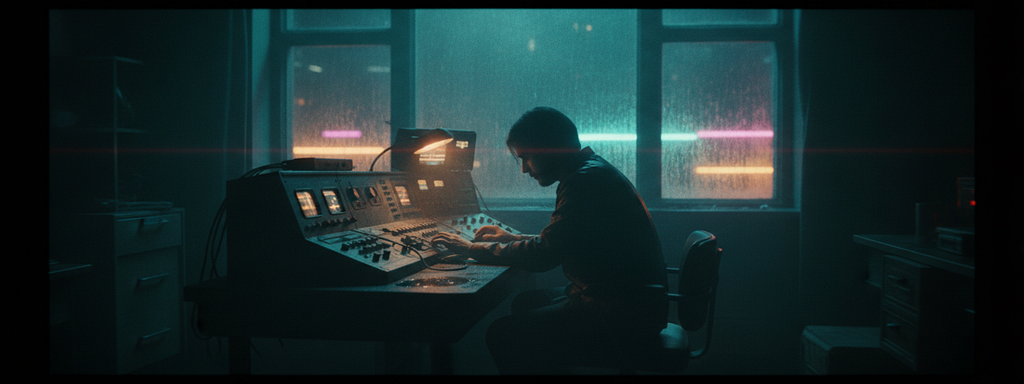

A 1982 film and its 2017 sequel predicted the design problems we are still failing to solve, from synthetic memory to the interfaces we now argue about daily.
Ridley Scott’s Blade Runner turned out to be a design document. Most people remember it for the rain, the neon, and whether Deckard is a replicant.
The reality: the film kept getting the texture of artificial intelligence right while everyone around it argued about flying cars and Pan Am.
It imagined machines that remember, machines that judge, and the people who have to tell them apart, all lifted from Philip K. Dick’s 1968 novel Do Androids Dream of Electric Sheep? Watch it now, after two years building on large language models, and the uncanny part is not the world.
It is the workflow.
The tools in that film raise the problems your roadmap is dreaming to solve. Synthetic memory. A test that cannot separate human from machine. An interface bolted onto a case it was never meant to hold. A company that owns intelligence and sells it back to you as a feeling.
None of that was prophecy in the mystical sense, it was a set of deliberate design decisions, and its 2017 sequel, Blade Runner 2049, only doubled down on them.
Here are five things the films got right, and what each one asks of you today.

Implanted Memories and Systems That Now Remember You
Rachael does not know she is a replicant. Her certainty rests on memories that were written into her — a childhood, a mother, a spider outside the window — none of it lived, all of it load-bearing.
https://medium.com/media/d2608e0a73ed1b955b70cdd9c1ca02d0/href
Tyrell calls it a cushion for the emotions. The film treats memory not as storage but as what makes a mind feel continuous, and so real — the insight, decades before it became a product decision.
Denis Villeneuve’s 2017 sequel turned the idea into a job. Dr. Ana Stelline designs implanted memories for a living, building other beings’ childhoods to order, since a convincing past makes a replicant behave. Memory became a product with a designer attached.
Now the systems remember you instead. In April 2025, OpenAI updated ChatGPT to reference all your past conversations by default, building a running model of your preferences, projects, and phrasing — see its note on memory and new controls for ChatGPT.
The pitch is continuity; the effect is a relationship you did not mean to start.
Rachael’s memories made her feel human to herself; the assistant’s memory makes it feel present to you — the same trick, reversed.
Blade Runner’s warning was never that the memories were fake, but that a convincing past changes how you treat the thing that holds it.
When a tool remembers your daughter’s name, you stop auditing it. Design for that erosion of scrutiny; it is coming, plan for it or not.

The Voight-Kampff Test and the Challenges of AI Detection
Authenticity, in Blade Runner, is something you measure, and the measuring is where it breaks. The Voight-Kampff machine answers one question — person or manufactured copy — by reading empathy: pupil dilation, response time, the flinch at a cruel prompt.
It is slow, invasive, and unreliable.
Deckard needs more than a hundred questions to read Rachael, and even then Tyrell confirms it.
The test does not reveal the truth; it renders a verdict.
We built the same machine. When AI-written text filled classrooms and inboxes, the answer was a detector. OpenAI shipped one, then pulled it: by its own account on the new AI classifier for indicating AI-written text, the tool flagged just 26 percent of AI text and was retired in July 2023 for low accuracy. Paragram is being used on Substack, and is showing similar results.
Every commercial detector since carries the same issues, landing hardest on non-native writers: a Stanford study, GPT detectors are biased against non-native English writers, found more than half of non-native English essays incorrectly flagged as machine-generated, while native writing passed almost untouched.

The sequel adds the other half of the problem. Niander Wallace, whose corporation bought out the bankrupt Tyrell, tempts Deckard with a recreated Rachael — Sean Young’s face rebuilt with CGI over another performer, a copy so close it should work.
Deckard refuses it on one detail: the eyes are wrong.
That is a hallucination made flesh, a near-perfect fabrication with a flaw only someone who knew the original can catch — the failure mode of every generative model, dressed as a person.
Blade Runner understood that a test for authenticity is a design artifact, with its own failure modes and victims.
If your product’s answer to “is this real” is a confidence score, you have built a Voight-Kampff machine. Decide now how to manage it.

The Esper Machine and the Interfaces We Keep Retrofitting
Deckard sits in his apartment and talks a photograph into giving up its secrets. Enhance, pan, pull back, print. The Esper is voice-driven, screen-based, visibly retrofitted — a well-worn piece of furniture doing extraordinary work through clumsy conversation.
In his teardown of Deckard’s photo inspector, interaction designer Christopher Noessel sorts it into three modes: a tool he drives, an assistant that helps, or an agent that acts on his behalf while his attention is elsewhere. That taxonomy is the current argument about agents, written in 2020 about a 1982 film.
When you can only add capability by narrating commands into a blank rectangle, you have stopped designing and started apologizing.
I have sat in the meetings where the text box wins because it is easy to ship, not because it serves anyone. The Esper at least knew it was a specialized instrument.
The retrofit shows.
When you can only add capability by narrating commands into a blank rectangle, you have stopped designing and started apologizing. The affordances have to go back in.

The Tyrell Corporation and the Concentration of Machine Intelligence
Tyrell Corporation does not sell products so much as sell life, made to order and licensed with an expiration date. Its motto — more human than human — is a marketing line, and the film knows it.
Power sits in a pyramid visible across the city, run by a man most will never reach, his methods proprietary, his creations built to feel more alive than their buyers.
Look closer and the city is one long advertisement.
Its 2019 skyline glows with the corporate titans of 1982 — Atari, Pan Am, Bell, RCA, Cuisinart — sold as permanent fixtures of the future.
Almost none survived contact with real life:
- Atari cratered in the 1983 crash
- Bell broke up in 1984
- RCA was absorbed by General Electric in 1986
- Cuisinart went bankrupt
- Pan Am folded in 1991
Fans named it the Blade Runner curse. The film got the concentration right and the winners exactly wrong, and every lab that looks permanent today makes the same bet its advertisers did.
That concentration is now measurable: in 2025, more than 90 percent of notable AI models came from industry, not universities or governments, per Stanford’s AI Index for 2026. Stanford’s Foundation Model Transparency Index puts that industry at 40 out of 100, most opaque about training data and compute.
This is the Tyrell arrangement: a few firms hold the recipe, and the rest of us get the finished product.
Ben Shneiderman, in his case for human-centered artificial intelligence, has argued we stop calling these systems teammates and call them what they are — powerful tools — not more human than human. Tyrell chose the slogan; you do not have to.

The Hardware Was Wrong and the Humans Were Right
Everything Blade Runner got wrong is hardware. There are no smartphones; Deckard feeds coins into a videophone. The screens glow like tube televisions because they are tube televisions. The flying cars never came.
It passes on the only axis that matters: what people feel toward the machines.
https://medium.com/media/ab1c62f24566b016c5c1ad5516f4346a/href
Roy Batty, hunting more life, spends his last minutes saving the man sent to kill him, then sits in the rain and lets a white dove go as his body shuts down — a manufactured being mourning its own memories as they go dark.
“I’ve seen things you people wouldn’t believe. Attack ships on fire off the shoulder of Orion. I watched c-beams glitter in the dark near the Tannhäuser Gate. All those moments will be lost in time, like tears in rain. Time to die.”
— Roy Batty
The film bet that the hard problem would be emotional, not technical, and it collected.
The score makes the point before anyone speaks. Vangelis sets the whole film on a synthesizer, a Yamaha CS-80 bent into rain, neon, and mourning.
The instrument is artificial; the feeling it produces is not.
The sequel gave that feeling a price tag. Joi is a holographic companion sold by Wallace, tuned to say what her owner wants to hear, and the film won’t settle whether her love is real or engineered — the question the companion apps raise now.
That bet is now data. In a 2025 study by MIT Media Lab and OpenAI across nearly a thousand participants and forty million messages, the heaviest users were the most likely to call the chatbot a friend and grant it human feelings, with higher daily use tracking more loneliness and dependence.
The film’s ask, 40 years early: design for the feeling, because the feeling is where the challenge and the value both live.
The Backlog Was Written in 1982
Science fiction is not in the prediction business, whatever the marketing says. It is in the design business — it takes a set of assumptions about people and technology, pushes them a few decades forward, and shows you the shape of the trouble.
Blade Runner did this so well that its trouble is now your backlog. The memory that builds a relationship you did not consent to. The detector that fails and the fabrication too clean to catch. The interface that gave up and became a text box. The corporate names that looked permanent and were not. The feeling engineered, sold, and now measured.
None of these are exotic. They are Tuesday. What the film offers you is not a warning to heed but a brief to work from, drawn with clarity about where the pressure would land.
The pressure landed on exactly those five places, right on the very schedule the film implied. You can treat that as spooky, or you can treat it as a head start. The people who built that world were guessing; you have the data they lacked and the products in hand. Read the film as a set of open tickets, and go close them.
Resources
- Make It So: Interaction Design Lessons from Science Fiction — Nathan Shedroff and Christopher Noessel
- Blade Runner (1982) — the full interface teardown at Sci-fi Interfaces
- Human-Centered AI — Ben Shneiderman
- The 2026 AI Index Report — Stanford Institute for Human-Centered AI
What Blade Runner got right about AI was originally published in UX Collective on Medium, where people are continuing the conversation by highlighting and responding to this story.